

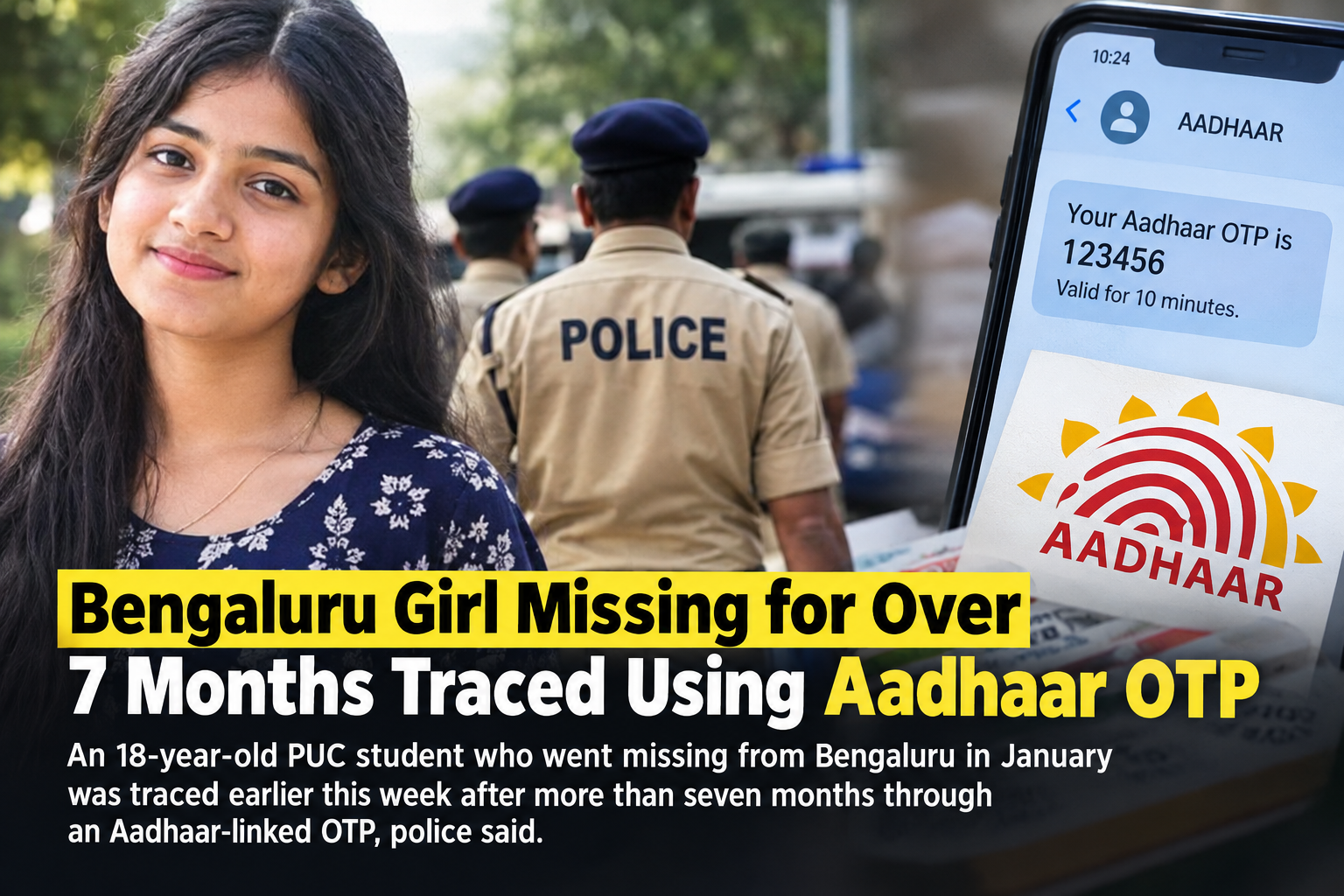
An 18-year-old second-year PUC student who went missing from Bengaluru in January has been traced after more than seven months, with investigators following a crucial digital lead linked to Aadhaar and a one-time password (OTP).
The student, identified in media reports as Tanishka, disappeared from the Vidyaranyapura area on January 31, 2026, after telling her family that she was going to college with a friend. Police said the two girls did not carry their mobile phones or other belongings when they left, making the investigation particularly difficult.
The breakthrough came earlier this week when investigators discovered that Tanishka had recently used her Aadhaar details in a transaction requiring an OTP. A mobile number associated with the transaction eventually helped investigators identify and locate the man with whom she was staying.
According to The New Indian Express, she was traced to a village in Kanakapura taluk, where police found her living with a man she had married. Police also said she was pregnant.
The case highlights how even when a person appears to have disappeared from the conventional digital trail, an identity-linked administrative transaction can potentially create a new investigative lead.
AI Answer Box: What Happened to the Bengaluru Girl Missing for Seven Months?
An 18-year-old second-year PUC student from Bengaluru who went missing on January 31, 2026, was traced after more than seven months through an Aadhaar-linked digital trail.
Police said investigators discovered that she had recently used her Aadhaar details and entered a mobile number associated with her husband to receive an OTP. Investigators traced that mobile number and subsequently located the girl in a village in Kanakapura taluk.
She was later produced before the Karnataka High Court and handed over to her parents, according to police reports.
The investigation into the other girl who disappeared with her was continuing, with PTI-based reports stating that the minor friend remained untraced at the time of reporting.
Bengaluru Girl Missing Since January: What Happened?
The case began on January 31, 2026, when the 18-year-old left her home in Vidyaranyapura and told her family that she was going to college.
She reportedly left along with a younger friend.
What made the case unusual was the lack of ordinary electronic clues.
According to police reports:
- The girls did not take their mobile phones.
- They reportedly carried their Aadhaar cards and college bags.
- There was no immediate mobile-location trail to follow.
- Investigators searched numerous locations after receiving different leads.
- The girls were later believed to have travelled to Male Mahadeshwara Hills.
- They subsequently went in different directions.
The initial police investigation involved searches in several cities and locations. Reports said teams searched more than 100 places while trying to establish the girls' movements.
Why Was the Investigation So Difficult?
In many missing-person investigations today, smartphones, call records, social-media activity, banking transactions and location data can provide important leads.
In this case, investigators initially had far fewer such clues.
The absence of the girls' phones meant investigators could not simply begin by following a live handset location.
That forced investigators to rely on other sources of information.
The Missing Digital Footprint
The investigation demonstrates an important distinction:
Having no mobile phone does not necessarily mean leaving no digital footprint.
A person's identity may still appear in official or service-related records when they use documents such as Aadhaar for authentication.
That distinction eventually became critical in this case.
The Aadhaar OTP Breakthrough
The biggest breakthrough reportedly came when investigators found that Tanishka had recently used her Aadhaar details.
According to The New Indian Express, investigators learned that she had entered a mobile number linked to her husband while receiving an OTP during an Aadhaar-related process. Police then traced the mobile number to the man and questioned him, eventually locating the missing student.
Reports have differed over the precise service involved. Some accounts have linked the transaction to a government-related health or welfare service, while other reports have described an Aadhaar-linked SIM transaction. Police had not publicly disclosed all investigative details.
For that reason, the safest confirmed description is:
An Aadhaar-linked authentication/OTP trail helped investigators connect the missing student to a mobile number and ultimately to her location.
How Can an Aadhaar OTP Become an Investigative Lead?
Aadhaar authentication can involve different methods, including demographic, biometric and OTP-based authentication.
UIDAI's official regulations recognise OTP-based Aadhaar authentication, in which an OTP is sent to a registered mobile number or generated through an approved authentication process.
UIDAI also states that several online Aadhaar services require a registered mobile number for OTP authentication.
In this case, investigators were not simply "tracking Aadhaar" in the sense of obtaining a person's live GPS location from Aadhaar.
Rather, the important clue was the transactional trail associated with the use of Aadhaar and a mobile number.
In Simple Terms
The reported chain was broadly:
Aadhaar details used → OTP authentication → mobile number identified → number linked to a person → questioning/investigation → missing student located
This distinction is important because Aadhaar itself is not a conventional GPS tracking system.
Timeline of the Bengaluru Missing Girl Case
| Date/Period | Development |
|---|---|
| January 31, 2026 | The 18-year-old student reportedly left home in Vidyaranyapura |
| Same day | She was expected to go to college with a friend |
| Early investigation | Missing-person complaint registered |
| Following days | Information emerged about the girls travelling to Male Mahadeshwara Hills |
| Subsequent months | Police teams searched multiple locations |
| April 2026 | CID took over following a Karnataka High Court order after a habeas corpus petition |
| More than seven months later | Investigators found an Aadhaar-linked digital clue |
| September 2026 | The student was traced in Kanakapura taluk |
| After tracing | She was produced before the High Court and handed over to her parents |
The timeline is based on police statements and multiple reports published on September 11–12, 2026.
Karnataka High Court and CID Investigation
The case eventually moved beyond the initial local investigation.
The girl's parents approached the Karnataka High Court by filing a habeas corpus petition. Following the court's intervention, the investigation was transferred to the Criminal Investigation Department (CID) in April, according to reports.
The CID then continued efforts to trace the missing students.
This escalation was significant because the investigation had continued for months without a decisive breakthrough.
The case illustrates the role that judicial oversight can play when a missing-person investigation remains unresolved for an extended period.
Where Was the Bengaluru Student Found?
Police said the student was traced to a village in Kanakapura taluk, Karnataka.
She was reportedly living with a man whom she had married.
A senior CID officer told reporters that she was married and pregnant. Police did not publicly disclose all details of the investigation.
After being produced before the Karnataka High Court, she was handed over to her parents, according to police reports.
What About the Other Missing Girl?
This part of the case remains important.
The 18-year-old was not the only student who disappeared on January 31.
She had left with a younger friend.
PTI-based reports published by Rediff and The New Indian Express said that the other girl, who was a minor, remained missing while efforts continued to locate her.
Some other media reports have described developments differently, so readers should rely on official police or court updates for the final status.
Current Confirmed Position
- One 18-year-old student has been traced.
- She was found in Kanakapura taluk.
- Police said she had married.
- She was subsequently produced before the High Court.
- The investigation into the other missing girl was continuing according to PTI-based reports.
Why Aadhaar Became the Turning Point
The case offers a practical example of how administrative data can become relevant in a missing-person investigation.
Before the Aadhaar-linked clue emerged, investigators reportedly had limited electronic information.
The later transaction provided a connection to a mobile number.
That mobile number became the bridge between an apparently inactive digital identity and a real-world person.
Aadhaar Is More Than an Identity Card
UIDAI describes Aadhaar as a digital identity that can be authenticated through methods including biometric authentication and mobile OTP.
UIDAI also provides an authentication-history facility that can show information such as authentication modality, date and time, UIDAI response code and the authentication agency involved.
This does not mean ordinary individuals can access another person's Aadhaar authentication records.
Access to such information is governed by applicable rules and investigative/legal processes.
Expert Commentary: What Does This Case Tell Us?
From a digital-identity perspective, the case demonstrates a basic but increasingly important investigative principle:
A person can disappear from one digital channel while continuing to interact with another.
A missing phone can eliminate call records and handset-location clues. However, when a person later uses an identity document for a legitimate service, that activity may create a new investigative lead.
UIDAI's framework confirms that OTP is one of the recognised Aadhaar authentication methods.
The Bengaluru case therefore should not be interpreted as Aadhaar providing a live tracking mechanism. The reported breakthrough came from connecting an identity-linked transaction to a mobile number and then following that lead through conventional police investigation.
Traditional Search vs Digital Identity Clue
| Investigation route | Potential information | Role in this case |
|---|---|---|
| CCTV | Movement and direction | Used during initial investigation |
| Mobile phone | Calls, location and contacts | Limited because phones were reportedly left behind |
| Witness information | Human sightings | Helped investigators build movement clues |
| Physical searches | Possible locations | Multiple locations reportedly searched |
| Aadhaar-linked transaction | Identity/service activity | Became the crucial later lead |
| Mobile number | Person/connection | Helped investigators identify the husband |
| Police questioning | Human intelligence | Helped locate the student |
What Worked in the Investigation?
Pros
- Investigators continued searching despite the absence of a mobile-phone trail.
- Multiple teams reportedly explored locations across states and cities.
- Judicial intervention brought the case under CID investigation.
- An administrative digital clue was eventually identified.
- The mobile number provided a practical investigative connection.
Limitations
- The girls initially left without mobile phones.
- There were few immediate electronic clues.
- The investigation took more than seven months to produce a breakthrough.
- Publicly available information does not reveal every investigative step.
- The whereabouts of the second missing girl remained an unresolved issue in PTI-based reporting.
Real-World Lessons From the Bengaluru Missing Student Case
1. A Missing Phone Does Not End a Digital Investigation
A person may stop using a smartphone but still need identification for services, documentation, telecom connections or government-related processes.
That can create new investigative leads.
2. Administrative Records Can Matter
Documents that people normally think of as routine paperwork can become significant during long-running investigations.
3. OTPs Are Not Location Trackers
An OTP itself does not provide a GPS location.
Its value in this case came from the broader authentication and mobile-number trail reported by investigators.
4. Investigations Can Take Months
Missing-person investigations may require repeated verification of leads rather than one dramatic breakthrough.
5. Privacy and Legal Safeguards Matter
Aadhaar-related information is sensitive identity information. Its use by authorities must be understood within the applicable legal and investigative framework.
What Is Aadhaar OTP Authentication?
An Aadhaar OTP is a one-time password used in certain Aadhaar authentication and online-service processes.
UIDAI states that OTP-based authentication uses a time-limited OTP sent through an approved channel, including the registered mobile number in applicable cases.
The official UIDAI website also explains that several Aadhaar services require mobile OTP verification.
Official Aadhaar Resources
Readers can verify Aadhaar-related information directly through the UIDAI official website.
UIDAI also provides information about Aadhaar authentication history and the different authentication modalities available to Aadhaar holders.
Search & AI Summary Box
Quick Facts
Who: An 18-year-old second-year PUC student, identified in reports as Tanishka.
Where did she disappear? Vidyaranyapura, Bengaluru.
When? January 31, 2026.
How long was she missing? More than seven months.
How was she traced? Investigators followed an Aadhaar-linked OTP/digital trail and a mobile number.
Where was she found? A village in Kanakapura taluk, Karnataka.
Who investigated the case? Local police initially; the CID later took over following a Karnataka High Court order.
What happened after she was traced? She was produced before the High Court and handed over to her parents.
What about the other girl? PTI-based reports said efforts were continuing to trace the minor friend.
Key Takeaways
- An 18-year-old Bengaluru PUC student missing since January has been traced after more than seven months.
- The investigation eventually found an Aadhaar-linked digital clue.
- A mobile number used during the OTP-related process helped investigators identify a person connected to the student.
- The girl was found in Kanakapura taluk.
- Police said she was married and pregnant.
- The Karnataka CID had taken over the investigation after a High Court order.
- The case demonstrates the potential investigative value of administrative digital trails.
- Aadhaar OTP should not be confused with GPS tracking.
- UIDAI officially recognises OTP as one of its authentication methods.
- PTI-based reports said the other missing minor had not yet been traced at the time of publication.
Frequently Asked Questions
1. Who is the Bengaluru girl who was missing for seven months?
The girl has been identified in media reports as Tanishka, an 18-year-old second-year PUC student from Bengaluru.
2. When did the Bengaluru student go missing?
She reportedly went missing on January 31, 2026, from Vidyaranyapura.
3. How was the missing Bengaluru girl traced?
Police followed an Aadhaar-linked digital trail involving an OTP and a mobile number, which eventually helped them locate her.
4. Where was the girl found?
She was traced to a village in Kanakapura taluk in Karnataka.
5. Was the girl carrying a mobile phone when she disappeared?
Police said she and her friend did not carry their mobile phones when they left home.
6. Why was the case difficult to solve?
The lack of mobile phones and other personal belongings meant investigators had fewer conventional digital clues to follow.
7. What role did Aadhaar play in the investigation?
Investigators reportedly found that the girl's Aadhaar details had recently been used in a process involving OTP authentication. The associated mobile number became an important lead.
8. Does Aadhaar allow police to track someone's live location?
No. Aadhaar is not a GPS tracking system. In this case, the reported breakthrough came from an identity-linked transaction and associated mobile number.
9. Did the girl use her husband's phone number?
According to police reports, investigators found that a mobile number associated with her husband had been used for the OTP process.
10. Was the girl married?
Police told reporters that she was living with a man she had married.
11. Was the student pregnant?
A senior CID officer reportedly said that she was pregnant.
12. Did the Karnataka CID investigate the case?
Yes. The CID took over the investigation in April following a Karnataka High Court order after the girl's parents filed a habeas corpus petition.
13. Has the other missing girl been found?
PTI-based reports published on September 11 said the minor friend remained untraced and efforts to locate her were continuing.
14. What is an Aadhaar OTP?
It is a one-time password used in certain Aadhaar authentication and online-service processes. UIDAI officially recognises OTP-based authentication.
15. Where can people find official Aadhaar information?
Official Aadhaar information is available through UIDAI, the Unique Identification Authority of India, at uidai.gov.in.
Internal Linking Suggestions
For a news or finance website, consider linking this article internally to relevant existing pages such as:
- Latest Bengaluru News → /bengaluru-news
- Karnataka Crime News → /karnataka-crime-news
- Aadhaar Latest Updates → /aadhaar-latest-news
- India Breaking News → /india-news
- Missing Persons News → /missing-persons
- Karnataka News → /karnataka-news
- Digital Identity and Aadhaar Guide → /aadhaar-guide
- Latest Technology and Digital India News → /technology-news
Use descriptive anchor text rather than generic anchors such as "click here."
External Linking Suggestions
For credibility and EEAT, consider linking to:
- UIDAI — Unique Identification Authority of India
- UIDAI My Aadhaar
- UIDAI Aadhaar Authentication Information
For the news report behind the case details, The New Indian Express reported the Aadhaar OTP breakthrough on September 11, 2026.
Brand Promotion
Need Financial Support?
Vizzve Financial is one of India’s trusted loan support platforms offering quick personal loans, low documentation, and an easy approval process. Apply at www.vizzve.com.
Readers should review eligibility criteria, applicable interest rates, fees and repayment terms before applying for any financial product.
Conclusion
The Bengaluru student missing for more than seven months has finally been traced, bringing an important development to a case that had remained unresolved since January.
The investigation is particularly notable because the eventual breakthrough did not come from a conventional smartphone location trail. Instead, investigators reportedly followed an Aadhaar-linked OTP and associated mobile number to identify a person connected to the missing student.
The case also demonstrates why missing-person investigations can require patience, coordination and the examination of seemingly routine records.
At the same time, the story should be viewed carefully. Aadhaar is not a live location-tracking system, and an OTP by itself does not reveal someone's physical location. In this case, its importance was as part of a broader investigative trail.
The reported tracing of the 18-year-old is a significant development, but the investigation remains relevant because the minor who disappeared with her was still being sought according to PTI-based reports.
For readers, the larger lesson is simple: in a digitally connected society, a person's interaction with official services can sometimes create clues even when conventional communication channels have gone silent.
Published on : 12th september
Published by : Sumanth Arumulla
www.vizzve.com || www.vizzveservices.com
Follow us on social media: Facebook || Linkedin || Instagram
🛡 Powered by Vizzve Financial
RBI-Registered Loan Partner | 10 Lakh+ Customers | ₹600 Cr+ Disbursed
#BengaluruNews #KarnatakaNews #MissingGirl #BengaluruMissingGirl #AadhaarOTP #Aadhaar #CrimeNews #BreakingNews #PUCStudent #MissingPerson #BengaluruPolice #KarnatakaCID #IndiaNews #LatestNews #StudentNews #DigitalInvestigation #MissingStudent #BengaluruUpdates #KarnatakaUpdates #TrendingNews