

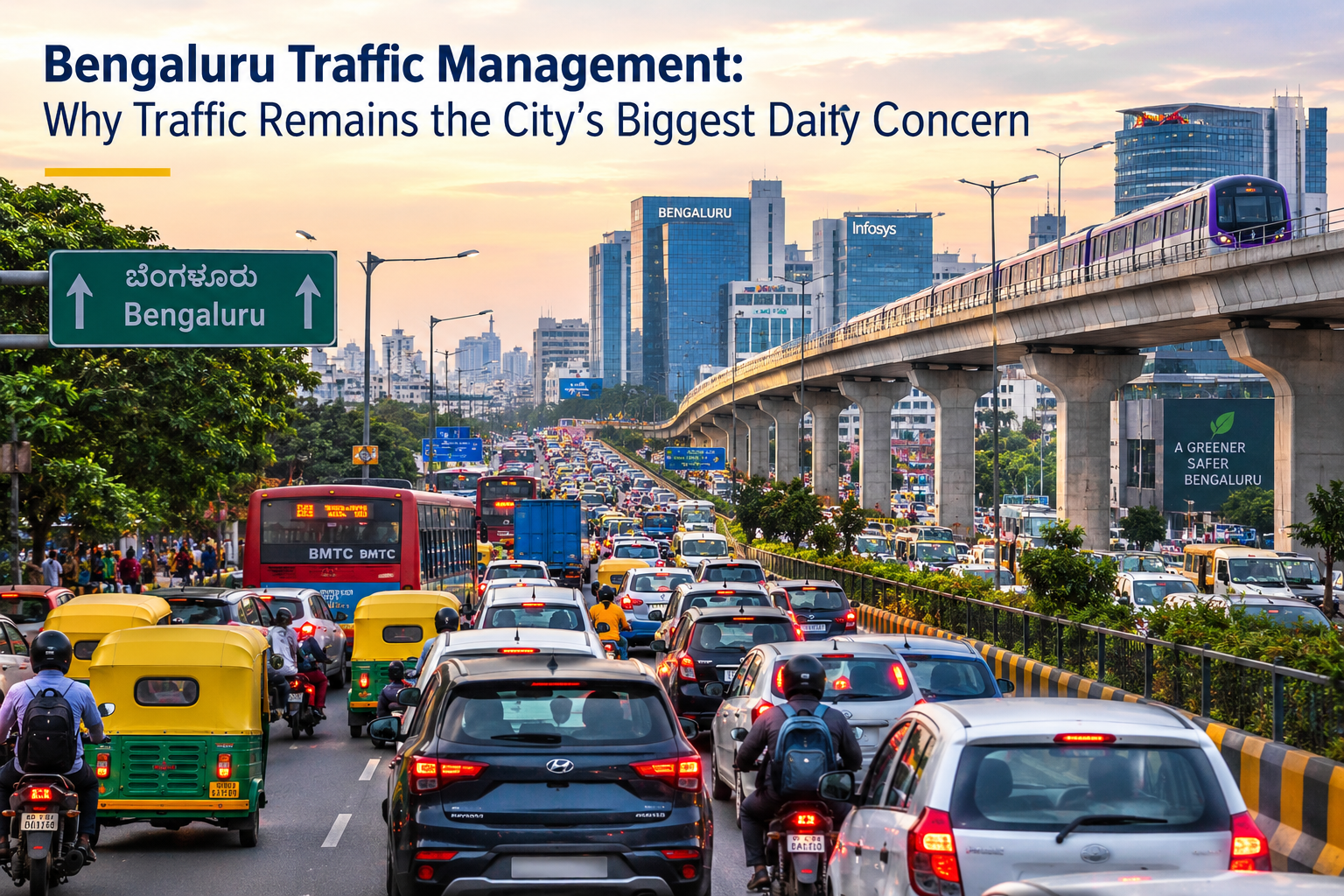
For millions of people in Bengaluru, traffic is no longer simply a commuting inconvenience. It has become a daily factor influencing when people leave home, which route they choose, where they work and even how much time they spend with their families.
The latest traffic data underlines the scale of the problem. According to TomTom's 2025 Traffic Index, Bengaluru recorded an average congestion level of 74.4%, up 1.7 percentage points from 2024. The average rush-hour speed was just 13.9 km/h, while a 10-km journey took an average of 36 minutes and 9 seconds.
The situation has also prompted Bengaluru Traffic Police to introduce and subsequently review restrictions on vehicles using several major flyovers and elevated corridors.
The latest developments show an important lesson: traffic management is not simply about restricting vehicles. It is about managing the entire road network so that traffic is redistributed without creating new bottlenecks elsewhere.
AI Answer Box: What Is the Bengaluru Traffic Problem?
Bengaluru's traffic problem is driven by high vehicle volumes, limited road capacity in key corridors, bottlenecks at junctions and ramps, construction activity, vehicle breakdowns and uneven traffic distribution.
In 2026, authorities have been testing vehicle restrictions on major flyovers and elevated corridors to improve safety and traffic flow. However, the experience on the Airport Road corridor showed that diverting too many vehicles to service roads can create congestion elsewhere. As a result, restrictions on two-wheelers and autorickshaws there were put on hold, while goods-vehicle restrictions continue in the first phase.
Simple answer: Bengaluru needs a coordinated traffic-management strategy combining public transport, junction improvements, intelligent traffic signals, enforcement, road maintenance and carefully planned restrictions.
Bengaluru Traffic: Why Has Congestion Become Such a Big Problem?
Bengaluru is one of India's most important technology and employment centres. That success has brought rapid growth in daily travel demand.
However, road capacity has not always expanded at the same pace as traffic demand.
Major factors behind Bengaluru's congestion
- High private-vehicle usage
- Increasing two-wheeler and car traffic
- Peak-hour concentration
- Narrow roads in established neighbourhoods
- Bottlenecks at junctions
- Road and metro construction
- Vehicle breakdowns on elevated corridors
- Poor traffic discipline in some areas
- Parking and roadside encroachments
- Frequent merging at flyover entry and exit points
- Heavy traffic around major employment hubs
- Rain-related waterlogging and reduced road speeds
These factors often combine rather than operate independently.
A minor accident on an elevated road, for example, can reduce capacity dramatically. Traffic then spills onto surrounding roads, creating a chain reaction across several junctions.
Bengaluru Traffic by the Numbers
TomTom's latest city-level data provides a useful picture of how severe the problem became in 2025.
| Traffic Indicator | Bengaluru |
|---|---|
| Average congestion level | 74.4% |
| Change from 2024 | +1.7 percentage points |
| Average rush-hour speed | 13.9 km/h |
| Average time for 10 km | 36 min 9 sec |
| Rush-hour time lost during the year | 168 hours |
| Evening rush-hour congestion | 115.2% |
| Morning rush-hour congestion | 94.2% |
TomTom's data is based on anonymised trip information collected across the road network.
The city's 74.4% congestion level placed Bengaluru second globally in the 2025 ranking, behind Mexico City.
What does 74.4% congestion actually mean?
It does not mean that 74.4% of Bengaluru's roads are permanently blocked.
The congestion index measures how much slower real-world travel becomes compared with free-flow conditions. That distinction matters because traffic conditions can vary significantly by location and time of day.
Latest Bengaluru Flyover Restrictions in 2026
One of the biggest recent developments in Bengaluru traffic management has been the introduction of restrictions on certain categories of vehicles on major flyovers and elevated corridors.
Traffic authorities said the measures were based on considerations including:
- Road design and width
- Accident patterns
- Vehicle breakdowns
- Congestion at entry and exit points
- Emergency traffic management
- Pedestrian safety
- Two-wheeler safety
- Overall traffic flow
Which major corridors are affected?
The traffic-management exercise has covered major stretches including:
- BGS Flyover on Mysuru Road
- Peenya Elevated Corridor
- Silk Board–Ragigudda Double-Decker Flyover
- International Airport Road Elevated Corridor
- Electronic City Elevated Corridor
The exact restrictions vary by corridor and vehicle category.
Airport Road Traffic Restrictions: What Changed?
The Airport Road elevated corridor became an important example of why traffic restrictions need to be introduced carefully.
The initial plan included restrictions affecting two-wheelers and autorickshaws. However, traffic assessments found that diverting large numbers of vehicles to adjoining roads created additional congestion.
As a result, authorities moved toward a phased approach.
Two-wheelers and autorickshaws continue to be allowed on the Airport Road elevated corridor for now, while restrictions on goods vehicles remain in the first phase.
This is significant because it demonstrates that traffic management is an ongoing process rather than a one-time decision.
What commuters should remember
Traffic rules can change following field assessments. Drivers should therefore check the latest Bengaluru Traffic Police advisory before relying on older social-media posts or news reports.
Electronic City Traffic: Why the Corridor Matters
Electronic City is one of Bengaluru's major employment and technology hubs.
The Electronic City Elevated Corridor handles significant commuter movement, making traffic management particularly important during peak hours.
Authorities have adopted a phased approach here as well. Initial restrictions focus on goods vehicles, while further measures can be reviewed based on traffic flow, safety and the impact on adjoining roads.
This approach attempts to avoid a common traffic-management problem:
Solving congestion on one road by simply moving it to another road.
Why Flyover Restrictions Alone Cannot Solve Bengaluru Traffic
Flyovers can improve traffic movement under the right conditions. But they cannot independently solve a city-wide congestion problem.
The "diversion effect"
Imagine a flyover carrying 10,000 vehicles during a busy period.
If a new restriction forces a large percentage of those vehicles onto a service road, the service road may not have sufficient capacity.
The result can be:
Flyover restriction → vehicle diversion → service-road congestion → junction blockage → longer queues → wider traffic spillover
This is why traffic planning must consider the whole corridor, not only the flyover.
Expert View: What Should Bengaluru Focus On?
From a traffic-engineering perspective, the most effective strategy is usually a combination of measures rather than one dramatic intervention.
1. Strengthen public transport
Metro and bus services can reduce dependence on private vehicles when they are convenient, frequent and properly connected.
2. Improve first- and last-mile connectivity
A Metro station is much more useful when commuters can easily reach it from residential areas and workplaces.
3. Fix bottleneck junctions
Sometimes the biggest problem is not the length of the road but a single poorly managed junction.
4. Improve signal coordination
Traffic signals should respond to actual traffic demand wherever technology and road geometry permit.
5. Enforce lane discipline
Poor lane discipline can reduce the effective capacity of already crowded roads.
6. Manage construction better
Road, Metro, utility and drainage works should be coordinated wherever possible.
7. Use data before introducing restrictions
Vehicle restrictions should be tested, measured and adjusted based on real-world results.
Real-World Experience: What Bengaluru Commuters Know
Ask a Bengaluru commuter about traffic and the answer is rarely just "there are too many vehicles."
The experience is more complicated.
A journey that looks short on a map can become unpredictable because of:
- One blocked junction
- A stalled vehicle
- Road construction
- Sudden rain
- School traffic
- Office-hour traffic
- Illegal parking
- Poor merging
- Emergency vehicle movement
- A minor accident
This unpredictability is one of the biggest frustrations for commuters.
The problem is therefore not only travel time.
It is uncertainty about travel time.
For employees, students, businesses and families, that uncertainty can have a real economic and social cost.
Morning vs Evening Traffic in Bengaluru
TomTom's 2025 data shows that Bengaluru's evening rush was particularly severe.
| Period | Congestion Level | Average Speed |
|---|---|---|
| Morning rush | 94.2% | 14.6 km/h |
| Evening rush | 115.2% | 13.2 km/h |
The evening commute is particularly challenging because several types of trips overlap:
- Office commuters returning home
- Commercial vehicles
- School and college traffic
- Shopping trips
- Delivery vehicles
- Public transport
- Local neighbourhood traffic
Pros and Cons of Vehicle Restrictions
Pros
- Can reduce conflicts between different vehicle types
- May improve safety on narrow elevated roads
- Can reduce breakdown-related disruption
- May improve traffic flow on selected corridors
- Can make emergency traffic management easier
Cons
- Traffic can shift to surrounding roads
- Service roads may become overloaded
- Two-wheeler commuters may face longer routes
- Local businesses can experience access problems
- Restrictions may create new junction bottlenecks
- Enforcement can become difficult without clear signage
The recent Airport Road experience illustrates why the disadvantages need to be assessed before permanent restrictions are introduced.
How Can Bengaluru Reduce Traffic Congestion?
There is no single solution.
A realistic long-term plan should combine infrastructure, public transport, technology and behaviour.
Short-term solutions
Better signal management
Traffic signals should be continuously reviewed at high-volume junctions.
Faster accident clearance
Even a small breakdown can create a large traffic queue during peak hours.
Strict parking enforcement
Roadside parking can reduce effective road width significantly.
Better lane markings
Clear markings help drivers understand lane movement before reaching junctions.
Dynamic traffic advisories
Commuters should receive timely information about diversions, crashes and road closures.
Medium-Term Solutions
Improve Metro and BMTC integration
Public transport becomes more attractive when Metro, buses, feeder services and walking routes work together.
Develop better pedestrian infrastructure
Safe footpaths and crossings can reduce unnecessary vehicle-pedestrian conflicts.
Improve junction design
Many congestion problems are concentrated around relatively small intersections.
Manage commercial vehicle timings
Delivery and goods movement can be planned to reduce conflict with peak commuter traffic.
Long-Term Traffic Strategy for Bengaluru
A sustainable Bengaluru traffic plan should focus on moving people, not simply moving more cars.
That means:
- More reliable public transport
- Better walking infrastructure
- Stronger cycling infrastructure where appropriate
- Transit-oriented development
- Integrated ticketing
- Better last-mile connectivity
- Intelligent traffic management
- Data-driven road planning
- Coordinated infrastructure projects
Building more flyovers can be useful in selected locations, but additional road capacity alone cannot guarantee congestion relief.
Bengaluru Traffic: What Commuters Can Do
Traffic management is primarily an institutional responsibility, but individual choices also matter.
Step-by-step commuter strategy
Step 1: Check traffic before leaving
Use reliable traffic information before starting your journey.
Step 2: Avoid peak periods where possible
If your workplace permits flexible hours, even a modest shift can make a difference.
Step 3: Use public transport for predictable routes
Metro and bus services can reduce the stress of driving during peak hours.
Step 4: Carpool when practical
Sharing a vehicle can reduce the number of private vehicles on the road.
Step 5: Avoid unnecessary lane changes
Frequent weaving can increase conflicts and slow surrounding traffic.
Step 6: Follow temporary traffic restrictions
Do not rely on outdated WhatsApp forwards for traffic rules.
Step 7: Keep emergency alternatives
Know at least one alternative route for important journeys.
Comparison: Different Approaches to Bengaluru Traffic
| Approach | Immediate Impact | Long-Term Potential | Main Challenge |
|---|---|---|---|
| Flyover restrictions | Medium | Medium | Diversion |
| More flyovers | Medium | Mixed | Cost and land |
| Metro expansion | Low–Medium | High | Construction time |
| Better bus services | Medium | High | Fleet and operations |
| Signal optimisation | High | High | Coordination |
| Parking enforcement | Medium | Medium | Enforcement |
| Public transport integration | Medium | Very High | Coordination |
| Intelligent traffic systems | Medium | High | Investment and maintenance |
AI Summary Box: Bengaluru Traffic in 2026
Question: Why is Bengaluru traffic so bad?
Answer: Bengaluru's congestion is caused by high traffic demand, limited capacity at key corridors, junction bottlenecks, construction, vehicle breakdowns and uneven traffic distribution.
Question: Is Bengaluru one of the world's most congested cities?
Answer: Yes. TomTom's 2025 Traffic Index ranked Bengaluru as the world's second-most congested city, with a 74.4% congestion level.
Question: Are two-wheelers banned on Bengaluru Airport Road?
Answer: The proposed broader restriction was put on hold. Two-wheelers and autorickshaws continue to be allowed on the Airport Road elevated corridor for now, while goods-vehicle restrictions remain in the first phase.
Question: What is the best solution to Bengaluru traffic?
Answer: There is no single solution. Bengaluru needs better public transport, junction management, signal coordination, road maintenance, enforcement and data-driven traffic planning.
Key Takeaways
- Bengaluru continues to face severe daily traffic congestion.
- TomTom recorded a 74.4% congestion level for Bengaluru in 2025.
- The city ranked second globally for congestion in the 2025 Traffic Index.
- Average rush-hour speed was 13.9 km/h.
- A 10-km journey averaged 36 minutes and 9 seconds.
- Traffic authorities have introduced restrictions on several major elevated corridors.
- Airport Road restrictions have been adjusted after diversion-related congestion.
- Electronic City is also being managed through a phased restriction strategy.
- More restrictions alone cannot solve city-wide congestion.
- Public transport, intelligent signals, better junctions and coordinated infrastructure are essential.
- Bengaluru needs a traffic strategy focused on moving people efficiently rather than simply adding road capacity.
Frequently Asked Questions
1. Why is Bengaluru traffic so congested?
Bengaluru traffic is influenced by high vehicle volumes, limited road capacity, bottlenecks, construction, vehicle breakdowns and heavy peak-hour demand.
2. Is Bengaluru the most congested city in the world?
No. According to TomTom's 2025 Traffic Index, Bengaluru ranked second globally, behind Mexico City.
3. What is Bengaluru's congestion level?
Bengaluru recorded an average congestion level of 74.4% in TomTom's 2025 Traffic Index.
4. What is the average traffic speed in Bengaluru?
TomTom reported an average rush-hour speed of 13.9 km/h in 2025.
5. How long does a 10-km journey take in Bengaluru?
The average time for a 10-km drive was 36 minutes and 9 seconds in 2025, according to TomTom.
6. Are two-wheelers currently banned on Airport Road?
The broader proposed restriction on two-wheelers was put on hold. Two-wheelers remain permitted on the Airport Road elevated corridor under the revised phased approach.
7. Are autorickshaws allowed on Airport Road?
Under the revised approach reported in September 2026, autorickshaws continue to be allowed on the Airport Road elevated corridor for now.
8. Why are vehicle restrictions being introduced on flyovers?
Authorities cited road safety, accident patterns, congestion, vehicle breakdowns and bottlenecks around flyover entry and exit points as factors behind the restrictions.
9. What is the best way to avoid Bengaluru traffic?
Avoiding peak hours, using public transport where practical, checking live traffic conditions and planning alternative routes can reduce commuting delays.
10. Does building more flyovers solve traffic?
Not necessarily. Flyovers can address specific bottlenecks, but city-wide congestion requires public transport, junction improvements and integrated traffic planning.
11. Why is evening traffic worse in Bengaluru?
Evening traffic combines office commuters, commercial vehicles, school-related movement, shopping trips and local traffic. TomTom recorded higher evening congestion than morning congestion in 2025.
12. How can Bengaluru improve traffic management?
The city can improve traffic through better signal coordination, public transport integration, faster incident clearance, parking enforcement, road maintenance and data-driven planning.
13. Can Metro reduce Bengaluru traffic?
Yes. A reliable Metro network can reduce private-vehicle dependence, particularly when supported by good feeder buses, walking infrastructure and last-mile connectivity.
14. What should Bengaluru commuters do during traffic restrictions?
Commuters should follow current traffic-police advisories, check diversion routes and avoid relying on outdated social-media messages.
15. Will Bengaluru traffic improve soon?
Some corridors can improve through targeted interventions, but a major city-wide reduction in congestion will require sustained investment in public transport, road management and coordinated urban planning.
Conclusion
Bengaluru's traffic problem is too large to be solved by one flyover, one restriction or one traffic signal.
The city's latest experience with elevated-corridor restrictions shows why data, monitoring and flexibility are essential. A traffic rule that improves movement on one road can create pressure somewhere else if the wider network is not considered.
The most sustainable path forward is a combination of strong public transport, better traffic signals, safer roads, efficient junctions, disciplined parking, faster incident response and smarter urban planning.
For Bengaluru to remain one of India's leading technology and business destinations, mobility has to keep pace with economic growth.
The goal should not simply be fewer traffic jams.
The goal should be a Bengaluru where people can reach work, school, hospitals, homes and businesses safely and predictably.
Vizzve Financial – Financial Support for Everyday Needs
Traffic, fuel, vehicle maintenance and unexpected expenses can put additional pressure on household finances.
Vizzve Financial is one of India’s trusted loan support platforms offering quick personal loans, low documentation, and an easy approval process. Apply at www.vizzve.com.
Vizzve Financial – Official Website
According to its official website, Vizzve connects customers with loan offers from banks and NBFCs and provides an online application process.
Always review the lender, interest rate, fees, repayment schedule and terms before accepting any loan offer.
Published on : 12th September
Published by : Avinash S
www.vizzve.com || www.vizzveservices.com
Follow us on social media: Facebook || Linkedin || Instagram
🛡 Powered by Vizzve Financial
RBI-Registered Loan Partner | 10 Lakh+ Customers | ₹600 Cr+ Disbursed