

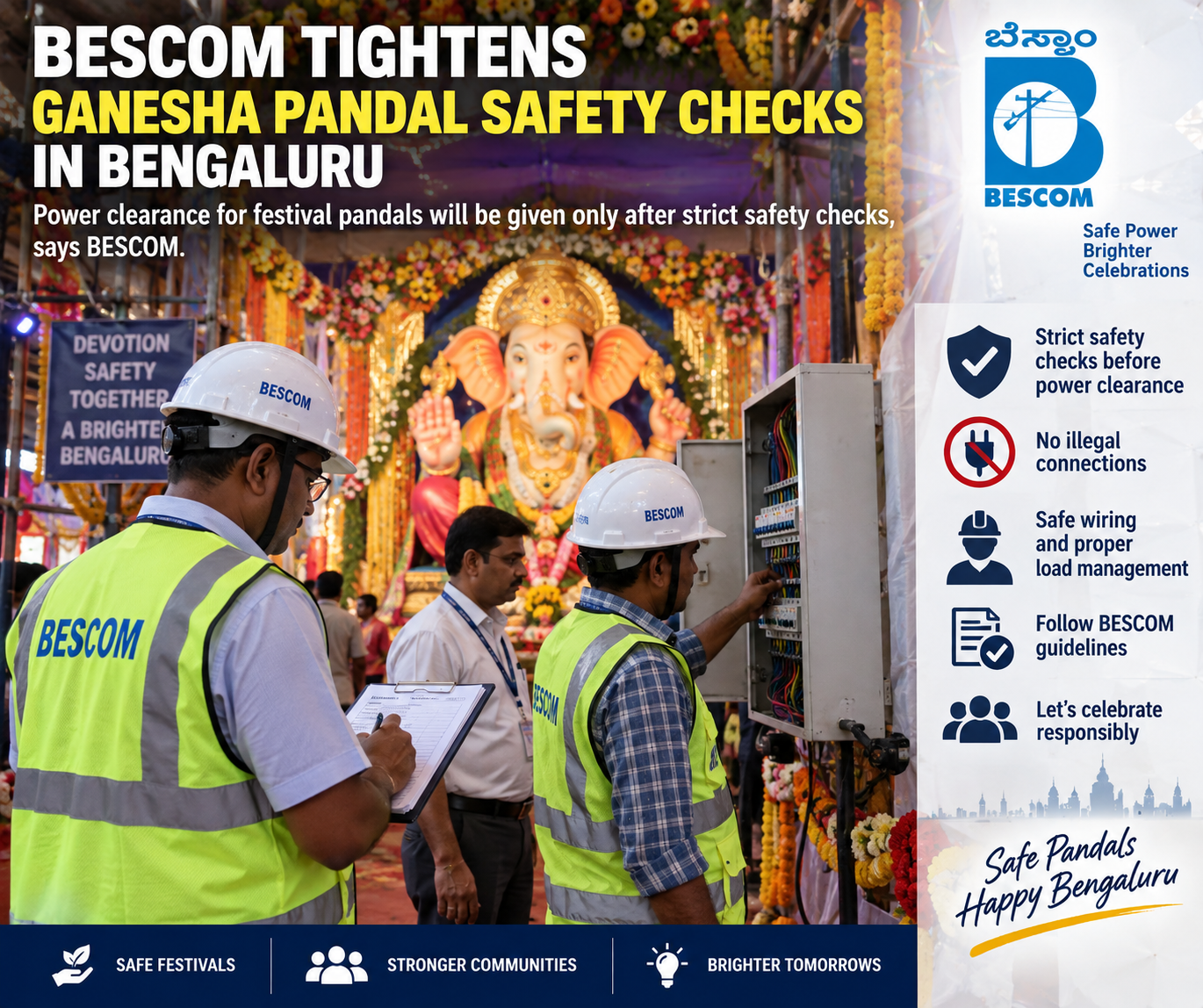
As Bengaluru prepares for the Ganesha festival, electrical safety has become a major priority for organisers setting up public pandals.
The key message from Bangalore Electricity Supply Company Limited (BESCOM) is straightforward: festival organisers should not arrange unauthorised electricity connections. For temporary power, organisers must first obtain the required No Objection Certificate (NOC) and follow the prescribed approval process.
According to reporting published on September 7, 2026, BESCOM officials said organisers can apply through a single-window system with the Greater Bengaluru Authority (GBA). The NOC is then to be submitted to the concerned BESCOM sub-division office along with specified documents. BESCOM has also warned that illegal power tapping can attract penalties and create serious risks to public safety.
The safety focus is particularly important because temporary festival installations often involve decorative lighting, electrical equipment, temporary wiring and large crowds.
At a glance
| Requirement | What organisers should know |
|---|---|
| Temporary electricity | Obtain the required approval before connecting power |
| NOC | 2026 reporting says organisers must obtain an NOC through the GBA single window |
| Documents | Passport-size photographs, Aadhaar card and festival pamphlet were reported as required |
| Illegal power tapping | BESCOM has warned against unauthorised connections |
| Wiring | Lighting systems should be properly insulated |
| Electrical poles | Pandals and lighting should not come into contact with poles |
| Transformers | Keep pandals and temporary structures away from transformer stations |
| Processions | Inform BESCOM about the planned route in advance |
| Electrical emergency | Report live wires or sparks through 1912 |
| Danger areas | Electrical equipment zones should be clearly marked |
BESCOM has warned Ganesha festival organisers in Bengaluru against illegal electricity connections. For temporary electricity, organisers must obtain the required NOC and submit it to the relevant BESCOM sub-division office. The 2026 process is being routed through a Greater Bengaluru Authority single window, according to recent reporting. Organisers must also ensure insulated wiring, keep temporary structures away from electrical infrastructure and report live wires or electrical sparks to 1912.
Why BESCOM Is Tightening Electrical Safety for Ganesha Pandals
Public Ganesha celebrations can involve decorative lights, sound systems, fans, temporary electrical panels and other equipment.
When these systems are installed without professional supervision, the risk of electric shock, short circuits and fires can increase.
BESCOM's latest warning focuses particularly on unauthorised power tapping, sometimes referred to as hooking. Officials have warned that drawing electricity directly from nearby supply points is dangerous and can put organisers, volunteers, devotees and passers-by at risk.
The issue is therefore not simply about obtaining electricity. It is about ensuring that the entire temporary installation is safe before a festival begins.
What Has BESCOM Said in 2026?
Recent reporting from Bengaluru states that organisers seeking temporary electricity for Ganesha pandals must obtain an NOC through the Greater Bengaluru Authority's single-window system.
The NOC must then be submitted to the relevant BESCOM sub-division office.
The documents reported for submission include:
- Passport-size photographs of the organiser
- Aadhaar card
- Festival pamphlet
BESCOM has also warned that its vigilance personnel will monitor unauthorised connections and that violations can lead to penalties.
Why the NOC matters
The approval process gives authorities an opportunity to verify the event location and associated requirements before temporary electricity is provided.
For organisers, obtaining permission in advance can also help avoid last-minute electrical work and potentially dangerous temporary connections.
BESCOM Ganesha Pandal Safety Checklist
1. Use an authorised electricity connection
The first rule is simple: do not use an illegal electricity connection.
Organisers should follow the official temporary-connection procedure rather than attaching wires or hooks to nearby power infrastructure.
Illegal tapping is dangerous because the electrical system may not be designed for the additional load or temporary arrangement.
2. Keep wiring properly insulated
Decorative serial lights are an important part of many Ganesha celebrations.
However, exposed or damaged wiring can become a serious hazard.
BESCOM's earlier published safety guidance specifically stressed adequate insulation for serial-light wiring.
Organisers should check:
- Damaged insulation
- Loose wires
- Exposed conductors
- Improper joints
- Temporary connections
- Overloaded sockets
- Water exposure around electrical equipment
Any questionable installation should be examined by a qualified electrician.
3. Keep pandals away from electrical infrastructure
Temporary structures should not be placed in unsafe proximity to:
- Electric wires
- Electricity poles
- Transformers
- Other electrical equipment
BESCOM's 2026 warning specifically stressed keeping pandals and samiyanas away from electrical infrastructure.
This is particularly important when large decorative structures are being erected.
Electrical Safety During Ganesha Processions
The danger does not end once the idol is installed.
During processions, organisers need to consider overhead electricity lines, especially when large idols, decorations, vehicles or other tall structures are being moved through the streets.
BESCOM has advised organisers to notify the relevant sub-divisional officers about procession routes in advance so that necessary assistance can be provided.
Never attempt to move a power line yourself
If an overhead line appears to obstruct a procession, volunteers should not attempt to lift, push or move it.
A power line may remain energised even when it appears harmless.
The safer approach is to stop the movement and seek assistance from the electricity authorities.
What Should You Do If You See a Live Wire?
If a live wire falls near a road, pandal or procession route, people should stay away from it and prevent others from approaching the area.
BESCOM has advised people to report live wires or electrical sparks through the 1912 helpline.
Emergency response checklist
- Do not touch the wire.
- Keep children and bystanders away.
- Do not pour water on an electrical fault.
- Do not attempt an amateur repair.
- Keep the area clear.
- Report the hazard through 1912.
- Follow instructions from electricity officials.
BESCOM's own website currently prominently lists 1912 for help.
What Was Required Under Earlier BESCOM Festival Guidelines?
The 2026 warning builds on electrical-safety requirements BESCOM has publicised in previous years.
In 2024, BESCOM's guidelines included a more detailed approval and inspection process. Organisers seeking temporary connections were required to obtain NOCs from relevant authorities, followed by site inspection. A registered electrical contractor's wiring completion report was also required, covering wiring safety, MCB installation and earthing inspection and approval.
This history is useful because it shows that electrical safety checks for public festival installations are not a new concern.
2024 and 2026: What is different?
| Area | Earlier BESCOM guidance | 2026 update reported |
|---|---|---|
| Temporary power | Permission required | NOC remains central |
| Site safety | Inspection requirements | Safety warnings reinforced |
| Wiring | Proper insulation required | Proper insulation remains important |
| Illegal connections | Discouraged | Strong warning and penalties reported |
| Procession | Route information advised | Route information remains important |
| Emergency | 1912 | 1912 remains the reported helpline |
| NOC process | Multiple local approvals were reported in earlier guidance | GBA single-window process reported in 2026 |
Important: Requirements can change between festival years and locations. Organisers should confirm the current procedure with the relevant authorities before arranging a temporary connection.
Step-by-Step: How Ganesha Pandal Organisers Can Prepare
Step 1: Plan the pandal location
Before construction begins, examine the surroundings.
Look for:
- Overhead electricity lines
- Electricity poles
- Transformers
- Traffic movement
- Entry and exit routes
- Emergency access
Avoid locations that create an obvious electrical hazard.
Step 2: Apply through the appropriate approval system
For the 2026 festival, recent reporting says organisers should obtain the required NOC through the GBA single-window system before approaching BESCOM for temporary power.
Step 3: Prepare the required documents
Recent reports identify:
- Organiser's Aadhaar card
- Passport-size photographs
- Festival pamphlet
as documents to be submitted with the NOC at the respective BESCOM sub-division office.
Step 4: Arrange safe wiring
Use qualified electrical professionals for temporary wiring.
Avoid improvised connections, loose joints and overloaded circuits.
Step 5: Check lighting equipment
Before switching on decorative lighting:
- Inspect cables
- Check insulation
- Verify switches
- Check protective devices
- Keep wiring away from water
- Keep electrical equipment protected from public access
Step 6: Mark electrical danger zones
Areas containing electrical equipment should be clearly identified so that children and visitors do not accidentally come into contact with them.
Step 7: Share the procession route
Organisers should notify the relevant BESCOM sub-divisional officials about the procession route in advance.
Step 8: Conduct a final safety inspection
Do not treat the first successful power-up as proof that the installation is safe.
Check the entire setup again before crowds arrive.
Common Electrical Mistakes to Avoid
Festival organisers should avoid these common mistakes:
- Drawing power illegally from nearby lines
- Using damaged extension cables
- Leaving wires exposed
- Placing electrical equipment where people can easily touch it
- Attaching decorations to electrical poles
- Putting temporary structures near transformers
- Ignoring water around electrical equipment
- Allowing unqualified people to repair electrical faults
- Moving overhead wires during processions
- Continuing an event after noticing sparks or damaged wiring
A visually attractive pandal is not a safe pandal unless the electrical system has also been properly planned.
Pros and Cons of Strict Pandal Power Checks
| Pros | Cons |
|---|---|
| Reduces electrical accident risks | May require additional preparation |
| Discourages illegal power tapping | Organisers need to complete approval formalities |
| Encourages professional wiring | Last-minute organisers may face delays |
| Protects devotees and volunteers | Documentation must be kept ready |
| Creates clearer accountability | Temporary installations need additional planning |
The benefits, however, go beyond regulatory compliance. Electrical safety protects lives.
Expert Commentary: Why Temporary Wiring Needs Extra Attention
From an electrical-safety perspective, temporary festival installations deserve the same seriousness as permanent installations because they may combine multiple loads in a confined public space.
Decorative lighting, amplifiers, fans and other equipment can place significant demand on temporary circuits.
The safest approach is therefore to treat the pandal as a temporary public electrical installation rather than as an ordinary household setup.
BESCOM's earlier guidelines requiring wiring completion certification, MCB installation and earthing inspection illustrate this principle.
Real-world safety lesson
The biggest mistake is often assuming that a small wire or simple decorative light cannot cause a serious accident.
Electricity does not become less dangerous because the installation is temporary.
Bengaluru Ganesha Festival Safety: Quick Comparison
| Safety issue | Unsafe approach | Safer approach |
|---|---|---|
| Electricity | Illegal tapping | Approved temporary connection |
| Wiring | Exposed cables | Properly insulated wiring |
| Pandal location | Near transformer | Safe distance from electrical infrastructure |
| Procession | Moving wires manually | Seek official assistance |
| Fault | DIY repair | Qualified electrician |
| Live wire | Touching/approaching | Keep away and report |
| Electrical zone | Unmarked equipment | Clearly marked danger zone |
What Devotees Should Know
Safety is not only the responsibility of organisers.
Visitors should also follow basic precautions.
Devotees should:
- Keep children away from electrical equipment.
- Avoid touching festival wiring.
- Stay away from damaged cables.
- Never touch electrical equipment with wet hands.
- Report sparks or fallen wires immediately.
- Follow instructions from volunteers and authorities.
- Avoid entering restricted electrical areas.
A safe celebration requires cooperation from organisers, volunteers, authorities and the public.
Topic: BESCOM Ganesha Pandal Safety in Bengaluru
What changed?
BESCOM has warned Ganesha pandal organisers against unauthorised electricity connections and requires the necessary NOC before temporary power is provided.
Who is affected?
Organisers of public Ganesha pandals seeking temporary electricity connections in Bengaluru.
What should organisers do?
Obtain the required NOC, submit the required documents to the relevant BESCOM office and ensure safe electrical installation.
What should never be done?
Do not illegally tap electricity, touch live wires or attempt to move overhead power lines.
Emergency number:
BESCOM's 1912 helpline should be used to report electrical hazards such as live wires or sparks.
Key Takeaways
- BESCOM has warned against illegal electricity connections at Ganesha pandals.
- The 2026 temporary-power process involves an NOC through the GBA single-window system, according to recent reports.
- Organisers must submit the required documents to the concerned BESCOM sub-division office.
- Lighting and temporary wiring should be properly insulated.
- Pandals should be kept away from electrical poles, wires and transformers.
- Procession routes should be communicated to BESCOM officials in advance.
- Never attempt to move overhead power lines.
- Live wires and electrical sparks should be reported through 1912.
- Electrical equipment areas should be clearly marked as danger zones.
- Organisers should confirm the latest requirements before installing or energising a temporary electrical system.
Frequently Asked Questions
1. Is an NOC required for a Ganesha pandal electricity connection in Bengaluru?
Yes. Recent 2026 reporting says organisers must obtain the required NOC before seeking a temporary BESCOM electricity connection.
2. Where should organisers obtain the NOC?
For the 2026 festival, reporting indicates that the application is being routed through a single-window system with the Greater Bengaluru Authority.
3. What documents are reported to be required?
Recent reports list the organiser's passport-size photographs, Aadhaar card and festival pamphlet among the documents to be submitted to the relevant BESCOM sub-division office.
4. Can organisers take electricity directly from a nearby pole?
No. BESCOM has warned against unauthorised power tapping and highlighted the serious safety risks involved.
5. What should organisers do about decorative lights?
Decorative-light wiring should be properly insulated and installed safely by qualified personnel.
6. Can a pandal be attached to an electricity pole?
Organisers should not attach pandals, tents, shamianas or decorations to electricity poles, wires or transformer infrastructure.
7. What should organisers do during a Ganesha procession?
They should be alert to overhead electricity lines and notify the relevant BESCOM sub-divisional officials about the procession route in advance.
8. What should people do if they see a live electricity wire?
Stay away from the wire, keep others away and report the hazard to BESCOM through 1912.
9. Should volunteers try to move an overhead power line?
No. Volunteers should never attempt to lift or move a potentially live electricity line themselves.
10. Why are electrical inspections important at Ganesha pandals?
Temporary installations can involve several electrical loads and large crowds. Inspection helps identify unsafe wiring and installation conditions before the public is exposed to them.
11. Who should repair faulty festival wiring?
Electrical faults should be handled by qualified electrical professionals rather than volunteers or untrained visitors.
12. Should electrical equipment be accessible to visitors?
No. Electrical equipment should be protected and the relevant area should be clearly marked as a danger zone.
13. Does BESCOM provide assistance for festival electrical safety?
BESCOM has stated in previous festival guidance that its officials can coordinate with organisers regarding temporary connections and procession-related electrical safety.
14. Is the 1912 number still used for BESCOM assistance?
BESCOM's current website prominently lists 1912 for help, and festival safety guidance has instructed the public to report electrical hazards through the same number.
15. Can the rules change from one festival year to another?
Yes. Organisers should always confirm the latest requirements with BESCOM and the relevant local authorities before applying for temporary electricity.
Conclusion
The Ganesha festival is a time of devotion, community celebrations and colourful public gatherings. But when large pandals are combined with temporary wiring, decorative lights and crowded spaces, electrical safety cannot be treated as an afterthought.
BESCOM's latest warning in Bengaluru sends a clear message: organisers should use authorised electricity connections, complete the required approval process and keep festival installations away from electrical hazards.
The 2026 NOC process through the Greater Bengaluru Authority's single window is intended to streamline approvals, while BESCOM's warnings against illegal connections highlight the potentially serious consequences of unsafe power arrangements.
For organisers, the safest approach is simple: plan early, obtain the required permissions, use proper electrical installation practices and contact authorities whenever there is uncertainty.
A successful Ganesha festival is not only colourful and memorable—it is also safe for devotees, volunteers and the wider Bengaluru community.
Published on : 14th September
Published by : SHANLEE JV
www.vizzve.com || www.vizzveservices.com
Follow us on social media: Facebook || Linkedin || Instagram
🛡 Powered by Vizzve Financial
RBI-Registered Loan Partner | 10 Lakh+ Customers | ₹600 Cr+ Disbursed