

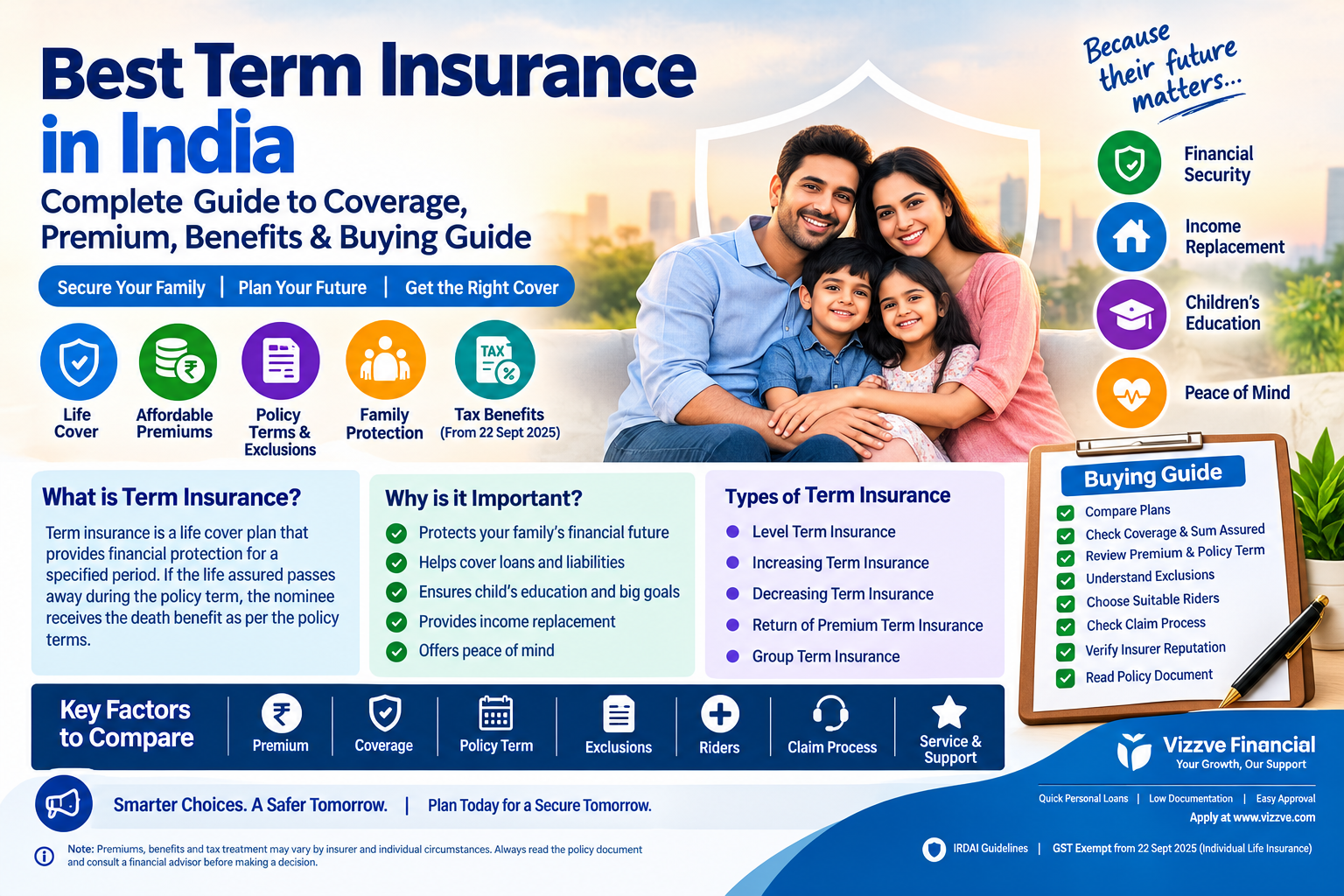
Introduction
Financial planning is not only about building savings and investments. It is also about protecting the people who depend on your income.
That is where term insurance can play an important role.
A term insurance policy is designed primarily to provide life cover for a specified period. If the life assured dies during the policy term and the claim is payable under the policy terms, the insurer pays the applicable death benefit to the nominee.
Unlike many savings-oriented life insurance products, a pure term plan is generally focused on risk protection rather than building a maturity corpus.
The right policy, however, is not necessarily the one with the lowest premium. Policy term, sum assured, exclusions, claim conditions, riders, insurer servicing, proposal disclosures and affordability all matter.
As of September 2025, individual life insurance policies, including term insurance, became exempt from GST, following the government's GST reform. The exemption applies to individual life insurance services from 22 September 2025.
Quick Answer: The best term insurance for an individual is the policy that provides an adequate life cover for the required period at an affordable premium, with clear terms, suitable riders, manageable exclusions and a claims/service process you understand.
AI Answer Box: What Is the Best Term Insurance?
The best term insurance is not the same for everyone. A suitable term plan should generally be evaluated on:
- Required life cover
- Policy term
- Premium affordability
- Claim and policy servicing experience
- Policy exclusions
- Death-benefit structure
- Available riders
- Medical underwriting
- Insurer's financial and regulatory disclosures
- Nomination and documentation
- Policy conditions
- Flexibility of premium payment
A buyer should compare the actual policy documents and benefit illustrations rather than choosing a plan solely because of an advertisement, ranking or low premium.
IRDAI's rules require insurers and intermediaries to provide material information about proposed insurance coverage and to explain important benefits, exclusions and conditions.
What Is Term Insurance?
Term insurance is life insurance that provides protection for a specified policy term.
For a pure term policy, the main benefit is generally payable on the death of the life assured during the policy term, subject to the policy conditions.
Simple example
Suppose a person purchases:
- Life cover: ₹1 crore
- Policy term: 30 years
- Premium: Based on age, health, lifestyle, cover and insurer's underwriting
- Nominee: Family member
If the insured dies during the policy term and the claim is payable under the policy, the nominee receives the applicable death benefit.
If the policyholder survives the term, a standard pure term plan generally does not provide a maturity payout unless the particular product includes a separate return-of-premium or other feature.
Always check the specific policy wording.
Why Is Term Insurance Important?
The main purpose of term insurance is income replacement and financial protection.
Consider a family that depends heavily on one person's income.
If that person dies unexpectedly, the family may have to manage:
- Home-loan obligations
- Education expenses
- Household expenses
- Existing debts
- Future financial goals
- Child-related expenses
- Emergency requirements
A sufficiently sized life cover can provide financial resources to help the family manage these obligations.
Term insurance can be particularly relevant for:
- Married individuals
- Parents
- Primary income earners
- People with outstanding loans
- Self-employed individuals
- Business owners with financial dependants
- Individuals supporting parents or other family members
How Does Term Insurance Work?
The basic structure is straightforward.
Step 1: Select life cover
Choose the sum assured you want to protect your family with.
Step 2: Select policy term
Choose how long you need the protection.
Step 3: Complete the proposal
Provide accurate personal, financial, lifestyle and medical information as requested.
Step 4: Underwriting
The insurer assesses the proposal and may request medical tests or additional documents.
Step 5: Pay premium
Once the policy is issued, premiums must be paid according to the selected payment schedule.
Step 6: Death claim
If the insured dies during the policy term, the nominee can submit a claim according to the insurer's procedure.
Types of Term Insurance Plans
1. Level Term Insurance
The sum assured remains broadly constant throughout the policy term.
Example
A ₹1 crore level-term policy may provide ₹1 crore of death cover throughout the specified term, subject to policy conditions.
This structure is simple and easy to understand.
2. Increasing Term Insurance
Some products offer a death benefit that increases according to specified terms.
This can be considered by people who want their life cover to increase over time.
The exact increase and maximum benefit depend on the product.
3. Decreasing Term Insurance
The coverage decreases according to a predetermined schedule.
Such structures can be associated with specific financial liabilities or loan-related protection.
The suitability depends on the individual's financial obligation and policy structure.
4. Return of Premium Term Insurance
Some term products may return eligible premiums if the insured survives the policy term.
However, these plans can have a different premium structure from pure term insurance.
If your primary objective is maximum life cover at an affordable cost, compare the premium and benefits carefully rather than assuming that a return-of-premium feature is automatically better.
5. Group Term Insurance
Employers and other organisations may provide group life cover.
It can be useful, but employees should understand that employer-provided insurance may have conditions linked to employment.
For long-term family protection, an individually owned policy can be considered separately where appropriate.
Best Term Insurance: What Should You Compare?
There is no universal "best" plan.
Instead, compare the following factors.
| Factor | Why It Matters |
|---|---|
| Life Cover | Determines the amount payable under applicable death-claim conditions |
| Policy Term | Determines how long protection continues |
| Premium | Determines affordability |
| Exclusions | Defines circumstances not covered |
| Riders | Can provide additional specified benefits |
| Medical Underwriting | Determines risk assessment and policy terms |
| Claim Process | Important when nominees need support |
| Policy Conditions | Define rights, obligations and benefits |
| Nomination | Helps identify intended recipient(s) of policy proceeds |
| Service | Affects policy administration |
| Insurer Disclosures | Provides additional information for comparison |
How Much Term Insurance Do I Need?
This is one of the most important questions when buying life insurance.
There is no single formula that works for everyone.
A useful starting point is:
Life Cover Requirement =
Outstanding liabilities + future family goals + income replacement requirement − existing financial assets
This is only a planning framework, not an official regulatory formula.
Factors to Consider When Calculating Life Cover
1. Current income
Your annual income helps estimate how much financial support your family may need if your income stops.
2. Outstanding loans
Consider:
- Home loan
- Personal loan
- Education loan
- Business liabilities
- Other major debts
3. Children's education
Estimate future education costs rather than only today's expenses.
4. Marriage and family goals
Depending on your circumstances, future family commitments may need to be considered.
5. Existing investments
Savings, investments and other financial assets may reduce the amount of additional life cover required.
6. Inflation
Future expenses may be substantially higher than current expenses.
7. Number of dependants
A household with several dependants may have a larger protection requirement.
Term Insurance Example
Suppose an individual has:
- Outstanding loans: ₹40 lakh
- Future family goals: ₹60 lakh
- Income replacement requirement: ₹1 crore
- Existing financial assets: ₹30 lakh
A simplified planning estimate would be:
₹40 lakh + ₹60 lakh + ₹1 crore − ₹30 lakh = ₹1.70 crore
This is only an illustrative calculation.
Actual life-cover requirements should consider income, inflation, liabilities, assets, dependants and future goals.
How Is Term Insurance Premium Calculated?
The premium depends on several factors.
Common factors include:
- Age
- Gender
- Health profile
- Smoking/tobacco use
- Alcohol use
- Occupation
- Policy term
- Sum assured
- Premium payment frequency
- Medical history
- Family medical history where relevant
- Lifestyle
- Selected riders
- Underwriting outcome
Age matters
Younger applicants may often receive lower premiums because the insurer is pricing a different risk profile, although actual rates vary by insurer and individual underwriting.
Smoking matters
Tobacco use can materially affect life-insurance pricing.
Health matters
Medical conditions and health history may affect underwriting, premium or eligibility.
Should You Buy Term Insurance at a Young Age?
Buying life insurance earlier can have practical advantages, particularly when you already have financial dependants or expect future responsibilities.
However, a policy should be purchased based on an actual protection requirement and long-term affordability.
Potential advantages of starting earlier
- Longer protection period can be secured.
- Premiums may be lower at younger ages for comparable underwriting.
- Financial responsibilities can be protected early.
- Health underwriting may be simpler for some applicants, although this varies individually.
The important point is to choose a policy you can maintain over the required period.
Term Insurance for Married Couples
Couples should assess their protection requirements separately.
If both partners earn, calculate:
- Each person's income contribution
- Outstanding loans
- Children's expenses
- Household costs
- Existing savings
- Financial dependants
A dual-income household may still require substantial life cover for both partners because the surviving partner may need to replace lost income and manage additional responsibilities.
Term Insurance for Parents
Parents who financially support children may consider life insurance as part of their financial plan.
The cover should account for:
- Children's education
- Household expenses
- Existing debt
- Future financial commitments
- Existing investments
The objective should be to create sufficient financial protection rather than simply purchasing the largest available policy.
Term Insurance for Self-Employed People
Self-employed individuals may have additional financial responsibilities.
Their protection assessment can include:
- Personal income
- Business liabilities
- Business loans
- Family dependence on business income
- Co-borrower obligations
- Education expenses
- Household expenses
Business and personal insurance requirements should be assessed separately where necessary.
What Are Term Insurance Riders?
Riders are optional benefits attached to an insurance policy, subject to product availability and policy terms.
Common riders may include:
Accidental Death Benefit Rider
May provide an additional benefit in specified accidental-death circumstances.
Critical Illness Rider
May provide a specified benefit following diagnosis of covered critical illnesses, subject to definitions and conditions.
Disability Rider
May provide specified benefits following qualifying disability events.
Waiver of Premium Rider
Under specified conditions, future premiums may be waived according to the rider terms.
Important
Do not purchase every rider automatically.
Consider:
- Existing insurance
- Employer benefits
- Health insurance
- Personal risk
- Rider exclusions
- Additional premium
- Benefit amount
IRDAI's product framework requires important benefit and exclusion information to be communicated clearly, and rider terms should be examined separately.
Term Insurance vs Life Insurance Savings Plans
| Feature | Pure Term Insurance | Savings/Investment-Oriented Life Plan |
|---|---|---|
| Main purpose | Life protection | Protection + savings/investment features |
| Premium | Generally lower for a given death cover | Generally higher for comparable death cover |
| Maturity benefit | Usually none in a pure term plan | May be available depending on product |
| Investment element | Generally absent | May exist depending on product |
| Simplicity | Usually straightforward | Can have more features |
| Main comparison | Protection amount and policy terms | Benefits, returns, guarantees, charges and protection |
The right product depends on the individual's objective.
Term Insurance vs Health Insurance
These policies serve different purposes.
| Feature | Term Insurance | Health Insurance |
|---|---|---|
| Main protection | Life/death risk | Medical expenses |
| Main beneficiary | Nominee/family according to policy and law | Insured/person covered, according to policy |
| Purpose | Income and family protection | Healthcare-cost protection |
| Premium | Based on life-insurance underwriting | Based on health-insurance terms |
| Replaces the other? | No | No |
A comprehensive financial-protection strategy may require both life and health insurance.
What Does Term Insurance Usually Not Cover?
A policy's exclusions depend on the product.
Possible exclusions or special conditions may include:
- Suicide-related provisions
- Misrepresentation or material non-disclosure
- Policy-specific exclusions
- Fraud
- Events specifically excluded by the contract
Do not rely on generic online summaries.
Read the actual policy wording and applicable exclusions.
IRDAI rules require important exclusions, conditions and limitations to be disclosed in insurance product information.
Why Full Disclosure Is Important
When purchasing term insurance, answer the proposal questions accurately.
Disclose relevant information about:
- Smoking
- Tobacco use
- Alcohol consumption where asked
- Medical history
- Existing diseases
- Previous medical tests
- Existing insurance
- Occupation
- Income
- Lifestyle activities where requested
Why?
Life insurance is based on the information provided during underwriting.
Incomplete or inaccurate information can create complications during claim assessment.
Practical rule
Never hide a medical condition or lifestyle habit simply to get a lower premium.
Accuracy is more important than a small difference in premium.
Medical Tests for Term Insurance
The insurer may ask applicants to undergo medical examinations depending on factors such as:
- Age
- Sum assured
- Medical history
- Lifestyle
- Existing conditions
- Underwriting requirements
Medical tests can help the insurer assess the risk before issuing the policy.
The exact tests vary by insurer and applicant.
Documents Required for Term Insurance
Commonly requested documents may include:
- PAN or other accepted identity documentation
- Address proof
- Age proof
- Income proof
- Bank details
- Passport-size photograph where required
- Medical reports where requested
- Existing policy details where relevant
Requirements vary depending on the insurer and application.
How to Buy Term Insurance Online
Step 1: Calculate your protection requirement
Estimate:
- Loans
- Future goals
- Family expenses
- Income replacement
- Existing assets
Step 2: Choose the policy term
The term should broadly match the period during which your family would depend on your income.
Step 3: Compare policies
Compare:
- Premium
- Sum assured
- Policy term
- Exclusions
- Riders
- Claim procedures
- Service features
Step 4: Complete the proposal form accurately
Do not allow someone else to enter information you have not verified.
Step 5: Complete medical underwriting
Provide requested reports and undergo tests if required.
Step 6: Review the policy document
Check:
- Name
- Date of birth
- Sum assured
- Policy term
- Premium
- Nominee
- Riders
- Exclusions
- Special conditions
Step 7: Use the free-look period if required
IRDAI's 2024 life-insurance product master circular provides a 30-day free-look period from receipt of the policy document for reviewing policy terms, subject to applicable conditions.
What Is the Free-Look Period in Term Insurance?
The free-look period gives a policyholder time to review the policy after receiving the policy document.
Under the current IRDAI life-insurance product framework, a 30-day period is available for policyholders to review the terms and conditions and cancel the policy if dissatisfied, subject to the applicable rules and deductions.
What should you check during this period?
- Sum assured
- Policy term
- Premium
- Nominee
- Riders
- Exclusions
- Medical disclosures
- Special conditions
- Death-benefit structure
This is an important reason to read the policy after purchase instead of simply storing the document.
Term Insurance Premium Payment and Grace Period
Premiums need to be paid according to the policy schedule.
The IRDAI life-insurance product master circular states a grace period of:
- 15 days for monthly premium payments
- 30 days for quarterly, half-yearly and annual payments
subject to applicable policy terms and regulations.
Do not deliberately rely on the grace period. Set reminders for premium due dates.
What Happens If Term Insurance Premium Is Not Paid?
Failure to pay premiums can affect the policy's status according to the product terms.
Depending on the product and circumstances, the policy may:
- Remain in force during the applicable grace period
- Lapse after the applicable period
- Require revival
- Have altered benefits according to policy terms
Always check the policy document for the specific consequences.
How to Claim Term Insurance
If the policyholder dies during the policy term, the nominee or claimant should inform the insurer and submit the required documents.
Step 1: Inform the insurer
Contact the insurer through its official claims channel.
Step 2: Submit the claim form
Complete the applicable death-claim form.
Step 3: Provide documents
Documents may include:
- Policy document
- Death certificate
- Claimant's identity documents
- Bank details
- Nominee details
- Medical/hospital records where applicable
- Other documents requested by the insurer
Step 4: Respond to queries
The insurer may request additional information depending on the claim.
Step 5: Claim assessment
The insurer assesses the claim under the policy terms.
Step 6: Settlement
If the claim is admissible, the applicable benefit is paid according to the policy and legal requirements.
How to Make the Claim Process Easier for Your Family
A good insurance plan is only useful if your family knows it exists.
Keep the following information accessible:
- Insurer name
- Policy number
- Policy document
- Premium details
- Nominee information
- Customer-care information
- Insurance repository details, if applicable
IRDAI's insurance-repository information explains that electronic insurance accounts can help maintain policy information digitally and that an authorised representative can facilitate access to the e-insurance account after the account holder's death or incapacity.
Nomination in Term Insurance
Nomination is an important part of life insurance.
Under Section 39 of the Insurance Act, a policyholder may nominate a person or persons to whom the policy money is to be paid in the event of death, subject to applicable law.
Best practice
Review your nomination after major life events such as:
- Marriage
- Divorce
- Birth of a child
- Death of a nominee
- Change in family circumstances
Keep nominee details updated with the insurer.
Current GST Update for Term Insurance
A major recent development for Indian life-insurance buyers is the GST change announced in 2025.
The Government announced exemption of individual life insurance policies, including term insurance, from GST effective 22 September 2025.
This means eligible individual term-life insurance premiums are not subject to the earlier 18% GST charge.
Important distinction
The exemption concerns GST on eligible individual life-insurance services. It should not be confused with income-tax deductions or other tax rules.
Tax treatment can depend on the specific policy and taxpayer circumstances, so verify current income-tax provisions separately.
Best Term Insurance: Premium vs Coverage
A common mistake is to choose the policy with the lowest quoted premium.
Instead, compare:
Premium + Life Cover + Policy Term + Exclusions + Riders + Service + Claim Process
Example
| Policy | Premium | Cover | Term | What to Check |
|---|---|---|---|---|
| Plan A | Lower | ₹1 crore | 30 years | Exclusions and benefits |
| Plan B | Higher | ₹1.5 crore | 30 years | Additional cover and conditions |
| Plan C | Moderate | ₹1 crore | 40 years | Longer protection period |
The table does not identify a winner because suitability depends on the individual's financial needs.
Pros and Cons of Term Insurance
Advantages
- Provides focused life protection.
- Can provide substantial coverage at comparatively affordable premiums.
- Helps protect family income.
- Can help address outstanding debts.
- Simple structure compared with many investment-linked products.
- Online purchase and servicing can be convenient.
- Optional riders may extend protection.
Disadvantages
- Pure term insurance generally does not create a maturity corpus.
- Premiums must be paid according to policy conditions.
- Coverage ends when the policy term ends, unless the product provides otherwise.
- Exclusions and special conditions apply.
- Incorrect information can create claim complications.
- Premiums may be higher when purchased at an older age or with higher-risk underwriting factors.
Common Term Insurance Mistakes
1. Buying too little cover
A ₹25 lakh policy may be inadequate for a family with large loans and long-term financial commitments.
2. Choosing the shortest possible term
The policy should cover the period when your income is most important to your dependants.
3. Hiding health information
Never provide incomplete or inaccurate information to reduce premiums.
4. Ignoring nominee details
Keep nomination information updated.
5. Choosing riders without understanding them
Read the rider conditions and exclusions.
6. Comparing only premiums
A lower premium does not automatically mean better suitability.
7. Forgetting premium due dates
A policy can be affected if premiums are not paid according to its conditions.
8. Not reading the policy document
Review the policy after issuance, especially during the free-look period.
Expert Commentary: What Makes a Term Plan Suitable?
The word "best" should be treated carefully in insurance.
A plan that is suitable for a young single person may not be suitable for a parent with multiple dependants and a large home loan.
A practical evaluation framework is:
Adequate Cover → Suitable Term → Affordable Premium → Clear Conditions → Appropriate Riders → Reliable Service → Claim Support
IRDAI's regulatory framework emphasises providing material information so consumers can make informed decisions and requires important benefits, exclusions and conditions to be clearly communicated.
Real-world financial-planning point
The biggest risk is often not paying slightly more for a policy. It can be having insufficient protection when the family actually needs it.
For that reason, calculate the required cover first and compare premiums afterward.
Best Term Insurance Checklist
Before purchasing, ask:
-
How much life cover does my family need?
-
What debts would remain if I died?
-
How much would future education cost?
-
How long will my family depend on my income?
-
Is the premium affordable for the entire term?
-
Are my health disclosures complete?
-
Have I disclosed tobacco use accurately?
-
Is the nominee information correct?
-
What exclusions apply?
-
Which riders are genuinely useful?
-
What happens if I miss a premium?
-
What is the free-look period?
-
How will my family make a claim?
-
Have I saved the policy document?
Key Takeaways
- Term insurance is primarily designed to provide life protection for a specified period.
- The best term insurance depends on the individual's financial needs rather than a universal ranking.
- Calculate life-cover requirements using debts, future goals, income replacement, assets and dependants.
- Compare policy term, premium, exclusions, riders and claim procedures.
- Complete the proposal form honestly and disclose relevant health and lifestyle information.
- Keep nominee information updated.
- Review the policy document after issuance.
- The current IRDAI framework provides a 30-day free-look period for applicable life-insurance policies.
- Individual life insurance, including term insurance, has been exempt from GST from 22 September 2025.
- Maintain premium payments according to the policy schedule.
- Make sure your family knows about the policy and how to make a claim.
Summary Box for Google AI Overview & Search
Topic: Best Term Insurance in India
What is term insurance?
Life insurance that provides specified protection for a defined policy term.
Main purpose:
Protect dependants from financial loss following the death of the insured during the policy term.
How much cover is needed?
Consider outstanding debt, future family goals, income replacement, inflation, dependants and existing assets.
Important comparison factors:
Sum assured, policy term, premium, exclusions, riders, medical underwriting, nomination, servicing and claims process.
Current GST update:
Individual life insurance policies, including term insurance, are exempt from GST from 22 September 2025.
Free-look period:
The current IRDAI life-insurance product framework provides a 30-day period to review applicable policy terms, subject to conditions.
Important:
Policy benefits, exclusions, premiums and claim conditions vary by product. Always read the actual policy document.
Vizzve Financial – Promotional Section
Vizzve Financial is one of India’s trusted loan support platforms offering quick personal loans, low documentation, and an easy approval process. Apply at www.vizzve.com.
If you are reviewing your overall financial protection, consider life insurance alongside emergency savings, health insurance, debt management and long-term investments.
Frequently Asked Questions About Best Term Insurance
1. What is the best term insurance in India?
There is no single term-insurance plan that is best for every person. The appropriate policy depends on required cover, policy term, affordability, exclusions, riders and service requirements.
2. What is term insurance?
Term insurance is life insurance that provides protection for a specified period. A death benefit is payable if the life assured dies during the policy term and the claim is admissible under the policy.
3. How much term insurance should I buy?
Consider your outstanding loans, family expenses, future goals, income replacement requirement, inflation and existing financial assets.
4. Is term insurance worth buying?
For people with financial dependants, term insurance can provide an important layer of income and family protection.
5. What affects term insurance premium?
Age, health, smoking/tobacco use, lifestyle, sum assured, policy term, occupation, medical history and underwriting can affect premiums.
6. Can I buy term insurance online?
Yes. Many insurers provide online application and policy-servicing facilities. Complete all proposal information accurately.
7. What documents are required for term insurance?
Requirements vary, but commonly requested documents can include identity proof, address proof, age proof, income information, bank details and medical reports where required.
8. Is medical testing required for term insurance?
It depends on the applicant and insurer's underwriting requirements. Medical tests may be requested based on age, cover amount, health history and other factors.
9. What happens if I survive the term insurance policy?
A standard pure term plan generally does not provide a maturity benefit if the insured survives the policy term. However, specific products may offer return-of-premium or other features.
10. What are term insurance riders?
Riders are optional benefits that can provide additional protection for specified events, such as accidental death, critical illness or disability, depending on the product.
11. What is the free-look period for term insurance?
Under the current IRDAI life-insurance product framework, a 30-day free-look period is available to review applicable policy terms from receipt of the policy document, subject to applicable conditions.
12. Is GST applicable to term insurance in India?
Individual life insurance policies, including term insurance, are exempt from GST from 22 September 2025 under the government-approved reform.
13. Can I change my nominee?
Nomination can generally be changed according to applicable law and insurer procedures. Keep nominee information updated after major family changes.
14. What happens if I miss a term insurance premium?
The policy may continue during the applicable grace period, but non-payment beyond the permitted period can affect policy status. Check the specific policy conditions.
15. How does a nominee claim term insurance?
The nominee should notify the insurer, submit the claim form and required documents, and follow the insurer's claim process. The insurer then assesses the claim according to the policy terms.
Internal Linking Suggestions
For a finance website, link this article naturally to:
- Life Insurance Guide – Explain different types of life insurance.
- Motor Insurance Guide – Explain vehicle protection.
- Health Insurance Guide – Explain medical-cost protection.
- Personal Loan Eligibility Guide – Help readers understand borrowing eligibility.
- Loan Interest Rate Guide – Explain borrowing costs.
- Credit Score Guide – Explain responsible credit management.
- Financial Planning Guide – Connect insurance with long-term planning.
- Emergency Fund Guide – Explain the importance of liquid savings.
- Car Loan Guide – Connect insurance and vehicle financing.
External Linking Suggestions
For authoritative references, link to:
- IRDAI – Life Insurance Products — Official regulatory information on life-insurance products.
- IRDAI – Policyholder Protection Information — Official information on policyholder protection and insurance operations.
- Ministry of Finance / PIB – GST Update on Individual Life Insurance — Government information on the GST exemption for individual life insurance.
- IRDAI – Insurance Repository Information — Information on electronic insurance accounts and authorised representatives.
Conclusion
The best term insurance is the one that provides adequate financial protection for your family at a premium you can comfortably maintain for the required period.
Instead of choosing a plan solely because it is advertised as the "best" or because it has the lowest premium, compare the sum assured, policy term, exclusions, riders, premium, underwriting requirements, nomination process, servicing and claims procedure.
Start by calculating how much your family would need if your income suddenly disappeared. Then compare policies based on that requirement.
The regulatory environment has also changed recently. Individual life insurance, including term insurance, became GST-exempt from 22 September 2025, while IRDAI's current life-insurance product framework provides a 30-day free-look period for applicable policies.
Published on : 27th september
Published by : Siva Nagaiah K
www.vizzve.com || www.vizzveservices.com
Follow us on social media: Facebook || Linkedin || Instagram
🛡 Powered by Vizzve Financial
RBI-Registered Loan Partner | 10 Lakh+ Customers | ₹600 Cr+ Disbursed
Hastags
#BestTermInsurance #TermInsurance #TermInsuranceIndia #LifeInsurance #TermLifeInsurance #LifeCover #InsurancePlanning #FinancialPlanning #FamilyProtection #TermInsurancePlan #InsurancePremium #InsurancePolicy #InsuranceBenefits #InsuranceClaim #InsuranceRiders #PersonalFinance #FinancialSecurity #RiskProtection #MoneyManagement #VizzveFinancial