

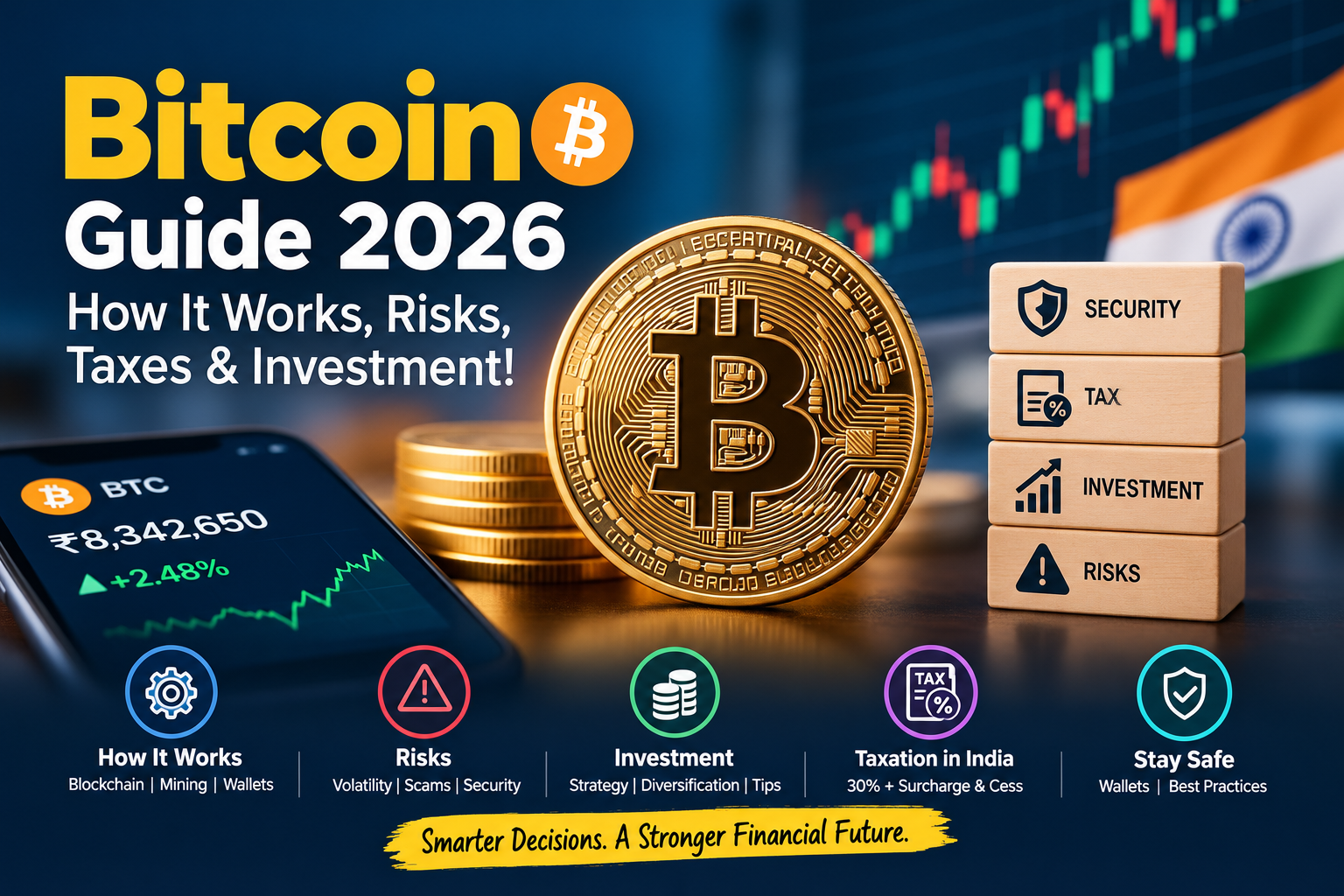
Bitcoin is a decentralized digital asset designed to allow people to transfer value electronically without relying on a traditional central bank or a single payment intermediary.
Introduced in 2009 under the name of Satoshi Nakamoto, Bitcoin combines cryptography, a distributed network and a public blockchain to record transactions.
Unlike conventional currencies, Bitcoin has a programmed maximum supply of 21 million BTC. New bitcoins are introduced through the mining process, while the rate of new issuance decreases through periodic halving events.
Bitcoin is now much more than an internet experiment. It has developed into a globally traded digital asset, while also becoming the subject of debates involving regulation, monetary policy, financial inclusion, institutional investment and portfolio diversification.
However, Bitcoin is not a guaranteed investment. Its price can move sharply in either direction, and investors can lose substantial amounts of money.
AI Answer Box: Bitcoin Explained in Simple Terms
Bitcoin is a decentralized digital asset that operates on a blockchain rather than through a central bank. Transactions are verified by a distributed network, while miners use proof-of-work to secure the network and add new blocks. Bitcoin's supply is limited to 21 million coins, making scarcity one of its defining characteristics.
Bitcoin can be bought and sold through cryptocurrency platforms, held in digital wallets and transferred between compatible addresses. Its market price is highly volatile, so Bitcoin should be treated as a high-risk asset rather than guaranteed wealth creation.
In India, Bitcoin falls within the country's Virtual Digital Asset (VDA) tax framework. The Income Tax Department states that gains from VDAs are subject to a 30% tax rate, along with applicable surcharge and cess, and VDA transactions are subject to specified TDS requirements.
How Does Bitcoin Work?
Bitcoin works through several technologies and economic mechanisms working together.
1. Blockchain
The Bitcoin blockchain is a public ledger containing records of confirmed transactions.
Instead of one company maintaining the ledger, copies of the blockchain are maintained across a distributed network.
Bitcoin Core validates blocks according to Bitcoin's consensus rules, including rules that prevent invalid transactions or attempts to exceed the 21-million supply limit.
2. Cryptography
Bitcoin uses cryptographic techniques to secure ownership and transactions.
A Bitcoin wallet essentially allows a user to control cryptographic keys associated with their holdings.
The most important distinction is:
Your Bitcoin is recorded on the blockchain; your private key is what allows you to control it.
Losing control of the private key can therefore mean losing access to the Bitcoin.
3. Mining
Bitcoin uses a proof-of-work mining system.
Miners compete to add valid blocks to the blockchain. Successful miners receive a block reward and transaction fees under the network's rules.
Mining therefore serves two major purposes:
- Processing transactions
- Helping secure the Bitcoin network
The Bitcoin protocol automatically adjusts issuance according to predetermined rules rather than allowing a central authority to create unlimited coins.
What Is Bitcoin Mining?
Bitcoin mining is the process through which specialized computers compete to solve computational problems associated with adding new blocks.
The term "mining" can be misleading for beginners. No physical Bitcoin is discovered underground.
Instead, miners:
- Collect pending transactions.
- Build a candidate block.
- Perform computational work.
- Compete with other miners.
- Broadcast a valid block.
- Receive rewards if their block is accepted under the network's rules.
What Is the Bitcoin Block Reward?
Bitcoin's block subsidy decreases approximately every four years.
The fourth halving occurred in April 2024, reducing the block reward from 6.25 BTC to 3.125 BTC. Bitcoin's next halving is currently estimated for 2028, when the reward is expected to fall to 1.5625 BTC.
| Bitcoin Halving | Approximate Block Reward |
|---|---|
| 2009 launch | 50 BTC |
| 2012 | 25 BTC |
| 2016 | 12.5 BTC |
| 2020 | 6.25 BTC |
| 2024 | 3.125 BTC |
| 2028 estimated | 1.5625 BTC |
The exact timing of future halvings is an estimate because Bitcoin's block production is based on an average target rather than a fixed clock.
Why Does Bitcoin Have a 21 Million Supply Limit?
One of Bitcoin's defining characteristics is scarcity.
The Bitcoin protocol is designed so that no more than approximately 21 million BTC will ever be issued. New issuance decreases through halvings and is expected to reach zero around 2140.
Bitcoin can still be divided into extremely small units.
What Is a Satoshi?
One Bitcoin contains:
100,000,000 satoshis.
Therefore:
1 BTC = 100 million satoshis
This means people do not need to purchase an entire Bitcoin.
For example, someone could buy a small fraction of BTC rather than purchasing 1 BTC.
Bitcoin Price: Why Does BTC Move So Much?
Bitcoin's price is determined by market supply and demand.
However, several factors can influence that demand.
Major Bitcoin Price Drivers
- Investor sentiment
- Institutional demand
- Global liquidity
- Interest rates
- Inflation expectations
- Regulation
- Exchange activity
- Bitcoin ETF flows
- Mining economics
- Halving expectations
- Macroeconomic uncertainty
- Risk appetite
- Adoption and network activity
Bitcoin has historically experienced substantial price swings. SEC-filed financial disclosures also demonstrate that Bitcoin prices can move significantly over relatively short periods. For example, one U.S. Bitcoin investment trust reported Bitcoin prices ranging from approximately $58,579 to $97,568 during the first half of 2026.
Important: A historical price range does not predict where Bitcoin will trade in the future.
Is Bitcoin a Good Investment in 2026?
There is no universal answer.
Bitcoin may appeal to investors who understand high volatility and want exposure to a digital asset with a predetermined supply schedule.
At the same time, Bitcoin may be unsuitable for people who:
- Need guaranteed returns
- Cannot tolerate large price fluctuations
- Need their money for short-term expenses
- Are investing using borrowed money
- Do not understand wallet and security risks
- Are influenced primarily by social-media hype
A Better Question to Ask
Instead of asking:
"Will Bitcoin go up?"
a more useful question is:
"Can I financially tolerate Bitcoin falling sharply without being forced to sell?"
That question focuses on risk management rather than prediction.
Bitcoin Investment: What Beginners Should Know
Bitcoin investing is different from investing in a traditional bank deposit or a guaranteed-return product.
Before purchasing BTC, consider:
1. Investment Horizon
Short-term Bitcoin prices can be extremely unpredictable.
A longer investment horizon may reduce the importance of individual daily price movements, but it does not eliminate risk.
2. Position Size
A common risk-management principle is to avoid putting an amount into a highly volatile asset that you cannot afford to lose.
3. Diversification
Bitcoin should not automatically become an investor's entire portfolio.
A diversified financial plan can include different asset classes depending on an individual's financial circumstances, goals and risk tolerance.
4. Liquidity Needs
Do not use emergency savings for speculative investments.
5. Taxes
Indian investors should maintain detailed transaction records because cryptocurrency taxation can materially affect post-tax returns.
Bitcoin in India: What Investors Should Know
Bitcoin can be bought and sold by Indian users through platforms that provide access to crypto markets, subject to applicable laws, regulations and platform requirements.
However, Bitcoin should not be confused with India's official currency.
The Reserve Bank of India has repeatedly highlighted risks associated with private cryptocurrencies, including financial, consumer-protection, security and macroeconomic concerns.
Bitcoin Taxation in India
India has a specific tax framework for Virtual Digital Assets.
The Income Tax Department states that income from the transfer of VDA is subject to a 30% tax rate, along with applicable surcharge and 4% cess, under the relevant provisions.
The tax framework also includes TDS provisions for VDA transfers.
The Income Tax Department's current guidance identifies VDA transfer reporting and TDS procedures under the new tax framework, including Form 141 for specified VDA transactions from the relevant 2026 tax period.
Simple Illustration
Suppose an investor buys Bitcoin for:
₹1,00,000
and later sells it for:
₹1,50,000
The basic gain is:
₹50,000
The applicable tax treatment should then be determined under the current VDA provisions, taking into account the investor's circumstances and applicable surcharge and cess.
This is only an illustration and not tax advice.
For substantial transactions, consult a qualified tax professional.
Bitcoin vs Traditional Currency
| Feature | Bitcoin | Traditional Currency |
|---|---|---|
| Central issuer | No central issuer | Usually central bank/government |
| Supply | Protocol-defined | Managed through monetary policy |
| Physical form | Digital | Physical and digital |
| Blockchain | Yes | No |
| Transactions | Peer-to-peer network | Banks/payment networks |
| Price stability | Highly volatile | Generally more stable |
| Reversibility | Generally difficult | Often possible through institutions |
| Regulation | Varies by jurisdiction | Established financial framework |
| Maximum supply | 21 million BTC | Depends on monetary system |
Bitcoin vs Ethereum
Bitcoin and Ethereum are both major blockchain-based assets, but their primary design goals differ.
| Feature | Bitcoin | Ethereum |
|---|---|---|
| Primary concept | Digital money / scarce digital asset | Programmable blockchain |
| Native asset | BTC | ETH |
| Launch | 2009 | 2015 |
| Consensus | Proof of Work | Proof of Stake |
| Supply model | Maximum supply of 21 million BTC | Different monetary design |
| Smart contracts | Limited scripting capabilities | Major feature |
| Main ecosystem | Payments, savings narrative, digital asset | Smart contracts, applications, tokens |
Neither is automatically "better."
The appropriate choice depends on what an investor is trying to achieve and how much risk they are willing to accept.
Advantages of Bitcoin
1. Limited Supply
Bitcoin's 21-million supply cap is one of its most distinctive features.
2. Decentralized Architecture
No single bank or company operates the Bitcoin network.
3. Global Accessibility
Bitcoin can be transferred across borders without relying on the traditional banking infrastructure for the underlying blockchain transaction.
4. Divisibility
Users can transact in satoshis rather than purchasing one whole BTC.
5. Transparent Ledger
Bitcoin transactions are recorded on a public blockchain.
Disadvantages and Risks of Bitcoin
1. High Volatility
Bitcoin can experience major price movements.
2. Regulatory Risk
Rules can differ significantly between countries and can change over time.
3. Security Risk
Poor wallet security, phishing attacks, fraudulent platforms and compromised devices can result in losses.
4. No Guaranteed Returns
Bitcoin does not generate a guaranteed interest payment merely because it is held.
5. Tax Complexity
Tax treatment can reduce actual investment returns.
6. Emotional Investing
Fear of missing out can encourage investors to buy after rapid price increases.
Bitcoin Pros and Cons
| Pros | Cons |
|---|---|
| Limited supply | High volatility |
| Decentralized network | Regulatory uncertainty |
| Global transferability | Security risks |
| Divisible into satoshis | No guaranteed returns |
| Transparent blockchain | Tax considerations |
| Large global market | Potential for scams and fraud |
How to Buy Bitcoin in India: Step-by-Step Guide
The exact process varies between platforms, but the general process is straightforward.
Step 1: Understand Bitcoin
Learn the basics before depositing money.
Step 2: Choose a Reputable Platform
Check the platform's security practices, fees, withdrawal options, compliance requirements and reputation.
Step 3: Complete Required Verification
A platform may require identity and compliance checks before allowing transactions.
Step 4: Deposit Funds
Use the payment methods supported by the platform.
Step 5: Purchase BTC
You can generally purchase a fraction of Bitcoin rather than one complete BTC.
Step 6: Secure Your Account
Use:
- A strong unique password
- Two-factor authentication
- Device security
- Withdrawal protections where available
Step 7: Keep Transaction Records
Maintain records of:
- Purchase price
- Date of purchase
- Quantity
- Sale price
- Fees
- Transfers
- Wallet addresses where relevant
These records can be useful for tax reporting.
How to Store Bitcoin Safely
Bitcoin security is one area where simple habits can prevent serious mistakes.
Hot Wallets
A hot wallet is connected to the internet.
Advantages:
- Convenient
- Easy for frequent transactions
Risks:
- Greater exposure to online attacks
Hardware Wallets
A hardware wallet stores private keys using a dedicated physical device.
Advantages:
- Stronger protection for long-term holdings when used correctly
- Private keys can remain isolated from many online threats
Risks:
- Device loss
- Backup mistakes
- Phishing during setup or recovery
Golden Rule
Never share your seed phrase or private keys with another person.
Anyone who obtains the necessary recovery credentials may be able to control the associated funds.
Common Bitcoin Scams to Avoid
Bitcoin's popularity has attracted scammers.
Watch for:
- Fake investment schemes
- Guaranteed Bitcoin returns
- Fake celebrity endorsements
- Impersonation of exchanges
- Fake customer-support accounts
- Phishing websites
- Fake mining contracts
- Ponzi schemes
- "Double your Bitcoin" offers
- Requests to send crypto to unlock withdrawals
Remember
There is no legitimate investment that can guarantee Bitcoin profits simply because someone sends you a message or asks for an upfront fee.
Bitcoin and Real-World Adoption
Bitcoin's role in the real economy remains an important experiment.
El Salvador provides one of the most closely watched examples.
The country adopted Bitcoin with legal-tender status in 2021, but subsequent reforms significantly reduced the mandatory nature of Bitcoin acceptance. The IMF reported that the 2025 reforms made private-sector acceptance voluntary and removed essential features of Bitcoin's legal-tender status.
This provides an important lesson:
Bitcoin adoption is not simply a technology question. It also involves economics, regulation, consumer behavior and financial infrastructure.
Expert Commentary: What Matters More Than a Bitcoin Price Prediction?
From a financial-planning perspective, the strongest approach is not to build an investment decision around a single price forecast.
A more useful framework is to evaluate:
- Risk capacity — how much loss your finances can withstand.
- Risk tolerance — how much volatility you can emotionally tolerate.
- Time horizon — when you may need the money.
- Position size — how much of your portfolio is exposed.
- Liquidity — how easily you can access funds.
- Tax impact — what remains after tax.
- Security — how your holdings are protected.
Bitcoin can be an interesting financial technology and investment asset, but understanding its risks is just as important as understanding its potential.
Bitcoin for Beginners: A Practical Checklist
Before buying BTC, ask yourself:
Do I understand what Bitcoin is?
Do I understand blockchain basics?
Do I know how much I can afford to lose?
Do I have emergency savings?
Have I considered taxes?
Do I understand wallet security?
Am I investing because of research rather than social-media hype?
Can I handle a large price decline?
Do I have a record of my transactions?
Have I avoided borrowing money to speculate?
If several answers are "no," spend more time learning before investing.
Key Takeaways
- Bitcoin is a decentralized digital asset built on blockchain technology.
- BTC has a maximum supply of 21 million coins.
- Bitcoin uses proof-of-work mining to help secure its network.
- The block reward is periodically reduced through Bitcoin halvings.
- The latest completed halving occurred in April 2024.
- Bitcoin remains highly volatile and does not offer guaranteed returns.
- Wallet and private-key security are essential.
- Indian VDA taxation can significantly affect investment returns.
- The Income Tax Department states that VDA gains are subject to a 30% tax rate plus applicable surcharge and cess.
- Investors should maintain detailed transaction records.
- Bitcoin should be considered within a broader financial plan rather than as a guaranteed path to wealth.
Summary Table: Bitcoin at a Glance
| Topic | Key Fact |
|---|---|
| Name | Bitcoin |
| Symbol | BTC |
| Launch | 2009 |
| Technology | Blockchain |
| Consensus | Proof of Work |
| Maximum Supply | 21 million BTC |
| Smallest common unit | Satoshi |
| Satoshis per BTC | 100 million |
| 2024 block reward | 3.125 BTC |
| Next estimated halving | 2028 |
| Main risk | Price volatility |
| India tax category | Virtual Digital Asset |
| VDA tax rate | 30% plus applicable surcharge and cess |
| Investment guarantee | None |
Frequently Asked Questions About Bitcoin
1. What is Bitcoin?
Bitcoin is a decentralized digital asset that uses blockchain technology to record transactions without relying on a central bank or single controlling institution.
2. Who created Bitcoin?
Bitcoin was introduced in 2009 by the pseudonymous person or group known as Satoshi Nakamoto.
3. How does Bitcoin work?
Bitcoin uses a decentralized network, cryptography, blockchain technology and proof-of-work mining to process and secure transactions.
4. How many Bitcoins will ever exist?
The Bitcoin protocol is designed around a maximum supply of approximately 21 million BTC.
5. What is Bitcoin mining?
Bitcoin mining is the process through which miners use computing power to help validate and add blocks of transactions to the blockchain.
6. What is Bitcoin halving?
A Bitcoin halving is an event in which the block subsidy paid to miners is reduced by half. It occurs every 210,000 blocks, approximately every four years.
7. Is Bitcoin legal in India?
Bitcoin's treatment in India involves taxation, regulatory and compliance considerations. Investors should not interpret the existence of a tax framework as a blanket statement that every crypto activity is approved or risk-free. The RBI has continued to highlight risks associated with private cryptocurrencies.
8. How is Bitcoin taxed in India?
The Income Tax Department states that gains from Virtual Digital Assets are subject to a 30% tax rate, along with applicable surcharge and cess. Specific TDS and reporting requirements also apply.
9. Can I buy less than one Bitcoin?
Yes. Bitcoin is divisible into smaller units called satoshis. One Bitcoin contains 100 million satoshis.
10. Is Bitcoin a safe investment?
Bitcoin is not risk-free. Its price can be highly volatile, and investors also face cybersecurity, fraud, regulatory and operational risks.
11. Can Bitcoin make you rich?
Bitcoin has generated substantial returns during some historical periods, but that does not guarantee future performance. It can also experience severe declines.
12. What is a Bitcoin wallet?
A Bitcoin wallet is software or hardware used to manage the cryptographic keys that allow a user to control Bitcoin associated with their addresses.
13. What happens if I lose my Bitcoin private key?
If you lose access to the private key or recovery information and have no valid backup, you may permanently lose access to the associated Bitcoin.
14. Is Bitcoin better than Ethereum?
Neither is universally better. Bitcoin and Ethereum were designed with different purposes and technical architectures.
15. Should beginners invest in Bitcoin?
Beginners should first understand volatility, taxation, security and portfolio risk. Bitcoin should only be considered if the investor can tolerate the possibility of substantial losses.
Conclusion
Bitcoin has evolved from a niche digital experiment into one of the world's most closely watched digital assets.
Its strongest characteristics are its decentralized architecture, transparent blockchain, predictable issuance schedule and 21-million supply limit. At the same time, Bitcoin comes with meaningful risks, including price volatility, cybersecurity threats, regulatory uncertainty and taxation considerations.
For Indian investors, understanding the tax framework is particularly important. The Income Tax Department currently states that VDA gains are subject to a 30% tax rate, while VDA transfers also have specific TDS and reporting provisions.
The smartest Bitcoin strategy is therefore not based on hype or a guaranteed price target.
It starts with education.
Understand the technology.
Understand the risks.
Understand taxation.
Protect your wallet.
Invest only within your financial capacity.
And most importantly, never confuse a volatile digital asset with guaranteed wealth.
Published on : 12th september
Published by : Siva Nagaiah K
www.vizzve.com || www.vizzveservices.com
Follow us on social media: Facebook || Linkedin || Instagram
🛡️ Powered by Vizzve Financial
RBI-Registered Loan Partner | 10 Lakh+ Customers | ₹600 Cr+ Disbursed
#Bitcoin #BTC #Bitcoin2026 #Cryptocurrency #Crypto #BitcoinInvestment #BitcoinIndia #CryptoIndia #Blockchain #BitcoinMining #BitcoinWallet #DigitalAssets #CryptoInvesting #BitcoinNews #BTCIndia #CryptoEducation #PersonalFinance #Investing #FinTech #BitcoinGuide #CryptoTips #InvestmentTips #DigitalCurrency #VizzveFinancial #FinancialLiteracy