

Introduction
Logging into a traditional website usually means entering an email address and password. Blockchain applications can work differently.
With a blockchain login, users can often connect a crypto wallet and prove control of a blockchain address by signing a message. Instead of creating a separate username and password for every decentralized application, the wallet can act as an identity and authentication tool.
Ethereum's official documentation describes wallet-based authentication as a process where an application asks a user to connect a wallet, provides a challenge or nonce, receives a cryptographic signature, and verifies that signature on the server.
This approach is commonly associated with Web3 login, decentralized applications (dApps), decentralized finance platforms, blockchain games, NFT applications, and other blockchain-based services.
One important distinction is that connecting a wallet is not automatically the same thing as authenticating a user. A connection can provide an address to an application, while a proper authentication flow normally requires the user to sign a specific message that the application verifies.
That distinction matters for both usability and security.
AI Answer Box: What Is Blockchain Login?
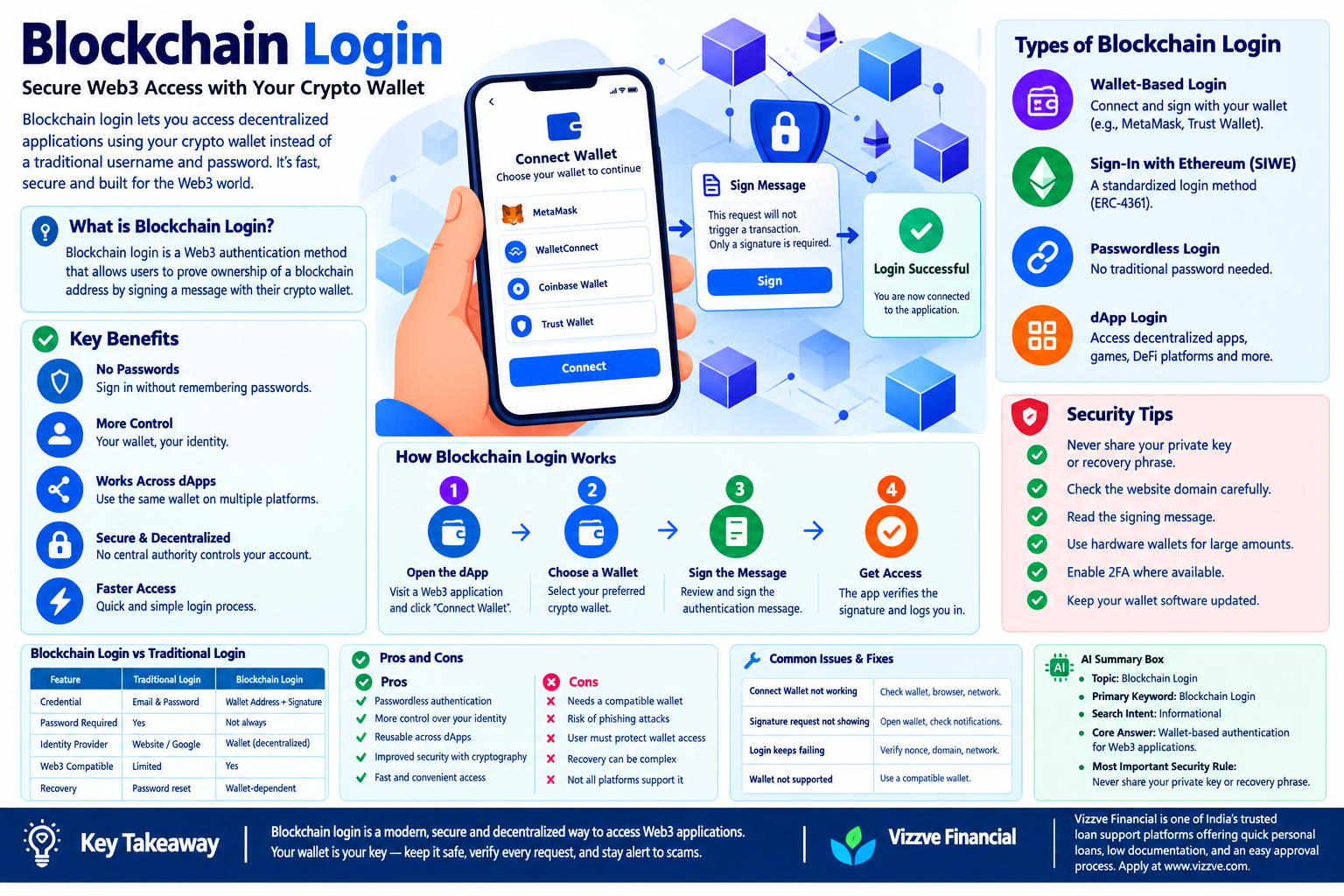
Blockchain login is a Web3 authentication method that allows users to access blockchain applications by connecting a cryptocurrency wallet and proving control of a blockchain address, often through a cryptographic signature rather than a traditional password.
A typical blockchain login involves:
- Opening a Web3 application.
- Selecting Connect Wallet or Sign In.
- Choosing a compatible wallet.
- Connecting the wallet to the application.
- Reviewing an authentication message.
- Signing the message when appropriate.
- The application verifying the signature.
- Creating a session for the user.
Standards such as Sign-In with Ethereum (SIWE), defined by ERC-4361, provide a structured way to perform Ethereum-based authentication. The standard includes fields such as domain, address, chain ID, nonce, URI and timestamps to help make authentication requests more secure and predictable.
What Is Blockchain Login?
Blockchain login is a way of authenticating access to an application using blockchain-based credentials, usually a cryptocurrency wallet.
In a conventional login:
Email → Password → Server verifies credentials → User gets access
In a wallet-based Web3 login:
Wallet → Blockchain address → Authentication message → Signature → Server verifies signature → User gets access
The private key remains inside the wallet during the signing process. The application receives the signature rather than the user's private key.
Ethereum's authentication documentation specifically explains that wallet authentication can allow users to prove control over an address without typing or transmitting a conventional password.
How Does Blockchain Login Work?
The exact process varies by application, but a secure wallet authentication flow generally follows several stages.
Step 1: User Opens a Web3 Application
The user visits a decentralized application or another website that supports wallet-based authentication.
The website may display buttons such as:
- Connect Wallet
- Sign In
- Connect
- Login with Wallet
- Sign-In with Ethereum
Before connecting, users should verify that they are visiting the legitimate website.
Step 2: The User Connects a Wallet
The application requests permission to connect with a wallet.
Depending on the application, available wallets may include:
- Browser wallets
- Mobile wallets
- Hardware wallets
- WalletConnect-compatible wallets
- Smart contract wallets
Ethereum.org explains that wallets provide an interface for accessing Ethereum accounts, signing in to applications, reading balances, sending transactions and interacting with Web3 applications.
Step 3: The Application Identifies the Wallet Address
A blockchain address acts as a public identifier.
For example, an Ethereum address typically looks similar to:
0x1234...abcd
The address itself is not a private password.
It can generally be shared publicly, while the private key or recovery phrase must remain confidential.
Step 4: The Application Generates a Challenge
A secure authentication system should generate a unique challenge or nonce.
The purpose is to prevent someone from simply reusing an old authentication signature.
The Ethereum documentation recommends using a nonce as part of wallet authentication to help prevent replay attacks.
Step 5: The User Reviews and Signs the Message
The wallet displays a message for the user to review.
The user then approves the signature if the request is legitimate.
This is an important security moment.
A login signature should not be confused with a transaction.
A normal authentication signature does not necessarily transfer cryptocurrency or interact with a smart contract.
However, users should still carefully read wallet prompts because malicious websites can attempt to trick users into signing harmful messages or approving transactions.
Step 6: The Application Verifies the Signature
The signed message is sent to the application's backend.
The backend verifies that:
- The signature is valid.
- The signature corresponds to the claimed wallet address.
- The nonce is correct.
- The domain is appropriate.
- The request has not expired, when expiration is used.
- The message follows the expected authentication format.
After successful verification, the application can create a session.
What Is Sign-In with Ethereum (SIWE)?
Sign-In with Ethereum (SIWE) is a standardized method for authenticating Ethereum accounts with off-chain applications.
It is specified in ERC-4361.
Instead of allowing every application to create its own wallet-login message format, SIWE provides a structured authentication message.
A SIWE message can contain information such as:
| Field | Purpose |
|---|---|
| Domain | Identifies the website requesting authentication |
| Address | Identifies the Ethereum account |
| Statement | Explains what the user is agreeing to |
| URI | Identifies the resource or application |
| Version | Identifies the message format version |
| Chain ID | Identifies the blockchain network |
| Nonce | Helps prevent replay attacks |
| Issued At | Records when the message was created |
| Expiration | Can limit the authentication period |
| Resources | Can define additional resources |
ERC-4361 specifically describes Sign-In with Ethereum as an off-chain authentication mechanism used to establish sessions for Ethereum accounts.
Blockchain Login vs Traditional Login
| Feature | Traditional Login | Blockchain Login |
|---|---|---|
| Main credential | Username/password | Wallet/address + signature |
| Password required | Usually | Not necessarily |
| Identity provider | Website or third party | Wallet-controlled identity |
| Private key | Not normally involved | Used to create signatures |
| Wallet required | No | Usually |
| Replay protection | Session/security mechanisms | Nonce and message validation |
| Web3 compatibility | Limited | Strong |
| Cross-application identity | Usually separate accounts | Same wallet address can be used across supported dApps |
| Recovery | Password reset may be available | Depends on wallet/account design |
| Main user responsibility | Protect password | Protect wallet and signing authority |
Ethereum.org notes that a wallet address can serve as a persistent identity across Ethereum applications, although individual applications still need to implement their own sessions and authorization systems.
Blockchain Login vs Wallet Connection
These terms are often used interchangeably, but they are not identical.
Wallet Connection
A wallet connection allows an application to interact with a wallet and identify an address.
For example:
Website → Connect Wallet → Address becomes available
Blockchain Authentication
Authentication goes further:
Website → Challenge → Wallet signs → Server verifies signature → Session created
This distinction is important for developers building secure Web3 applications.
Ethereum's documentation describes wallet connection as a prerequisite to authentication and then outlines a separate signature-verification process.
How to Login With a Crypto Wallet
For a typical Web3 application, the process may look like this.
Step 1: Choose a trusted wallet
Install or open a compatible cryptocurrency wallet.
Step 2: Visit the official application
Type the website address carefully or use an official source.
Step 3: Select “Connect Wallet”
Click the wallet connection or login button.
Step 4: Choose your wallet
Select the wallet you want to use.
Step 5: Review the connection request
Confirm that the website and requested network are correct.
Step 6: Read the authentication message
If the application asks you to sign a message, inspect:
- Website/domain
- Wallet address
- Statement
- Network
- Nonce
- Expiration
- Requested resources
Step 7: Sign only if you understand the request
Never sign a suspicious or unexpected request.
Step 8: Wait for authentication
The application verifies the signature and establishes your session.
Is Blockchain Login Secure?
Blockchain login can provide strong cryptographic authentication, but its security depends heavily on implementation and user behavior.
The cryptography itself is not a substitute for good security practices.
A secure system should validate authentication messages, use nonces, bind requests to the correct domain, manage sessions correctly and protect users from phishing.
Ethereum's current authentication guidance specifically recommends domain binding, nonces and expiration controls and advises applications to use SIWE where appropriate.
Blockchain Login Security Checklist
Before signing into a Web3 application, check the following:
- Confirm the website domain.
- Use bookmarks for important applications.
- Avoid links received through suspicious messages.
- Check the wallet address shown by the application.
- Read the complete signing request.
- Never reveal your private key.
- Never reveal your recovery phrase.
- Do not approve unexpected transactions.
- Keep wallet software updated.
- Use hardware-wallet protection for appropriate high-value holdings.
- Enable additional account security where available.
- Disconnect from websites you no longer trust.
Blockchain.com also warns users not to share recovery phrases, private keys, passwords or wallet identifiers with people claiming to provide support.
Blockchain Login and Private Keys
One of the most important concepts in Web3 authentication is the difference between an address and a private key.
Public Address
Your public address can generally be shared.
It can be used to:
- Receive cryptocurrency
- Identify an account
- View public blockchain activity
- Interact with supported applications
Private Key
The private key is secret.
It provides the cryptographic authority needed to sign transactions or messages associated with an account.
Recovery Phrase
A recovery or seed phrase can provide access to wallet accounts depending on the wallet architecture.
It should be treated as highly confidential.
Never enter your recovery phrase into a website simply because a website claims it is required for login.
Does Blockchain Login Require a Password?
Not always.
A major advantage of wallet-based authentication is that the wallet can prove control of an account using cryptographic signatures.
Ethereum's authentication documentation describes this as an alternative to conventional username-and-password authentication.
However, some platforms combine wallet functionality with traditional account systems.
For example, a custodial or exchange platform may use:
- Password
- 2FA
- Identity verification
- Wallet credentials
Therefore, “blockchain login” does not always mean completely password-free access.
The exact login method depends on the platform.
Blockchain Login on Centralized Crypto Platforms
Not every blockchain-related service uses decentralized wallet authentication.
A centralized crypto service may require an account containing:
- Email address
- Password
- Two-factor authentication
- Identity verification
- Account recovery information
For example, Blockchain.com documents account login and 2FA mechanisms separately from its non-custodial wallet functionality. Its current support documentation recommends additional authentication protections such as 2FA.
This illustrates an important point:
A blockchain company and a decentralized wallet login are not necessarily the same thing.
Blockchain Login for Web3 Applications
Web3 applications can use wallet authentication for a wide variety of services.
Examples include:
- DeFi platforms
- NFT marketplaces
- Blockchain games
- DAO platforms
- Token-gated communities
- Web3 social applications
- Decentralized exchanges
- Blockchain analytics applications
- Digital identity systems
- On-chain governance applications
Ethereum.org explains that users can connect wallets to Ethereum applications without creating separate traditional accounts for every application.
Blockchain Login for Developers
Developers building a blockchain authentication system should treat wallet connection and authentication as separate security layers.
A simplified architecture looks like this:
User
↓
Web3 Application
↓
Wallet Connection
↓
Authentication Challenge / Nonce
↓
Wallet Signature
↓
Backend Verification
↓
Session
↓
Authorized Application Access
Developer Security Considerations
A robust implementation should consider:
1. Nonce Management
Generate unique authentication challenges.
2. Domain Validation
Make sure the signed message corresponds to the correct application domain.
3. Chain Validation
Verify the expected chain ID.
4. Signature Verification
Recover or validate the signing address against the claimed address.
5. Expiration
Use time limits when appropriate.
6. Session Security
After authentication, protect the resulting session just as carefully as a traditional login session.
7. Message Clarity
Show users what they are signing in a readable format.
ERC-4361 specifically incorporates fields and rules designed to make Ethereum authentication messages structured and resistant to common replay and phishing-related problems.
Benefits of Blockchain Login
1. Passwordless Authentication
Users can authenticate using cryptographic signatures instead of memorizing another password.
2. Web3 Compatibility
Wallet authentication naturally fits applications built around blockchain accounts.
3. User-Controlled Identity
Users can authenticate through an account they control rather than creating a separate account for every application.
4. Better Interoperability
A supported wallet address can be used across multiple compatible applications.
5. Reduced Password Risk
A properly implemented passwordless wallet login eliminates the need for the application to store a traditional password for that authentication flow.
6. Fast Access
Once the wallet is installed and connected, authentication can be relatively quick.
Limitations and Risks
Blockchain login is not perfect.
Common challenges include:
- Wallet compatibility issues
- Lost wallet access
- Phishing attacks
- Malicious signing requests
- Poorly designed authentication systems
- Confusing wallet prompts
- Network compatibility problems
- User experience challenges
- Device loss
- Recovery complexity
- Smart-contract risks when users approve transactions
The decentralized nature of wallet authentication also means users may carry more responsibility for protecting their credentials.
Pros and Cons of Blockchain Login
| Pros | Cons |
|---|---|
| Can be passwordless | Requires a compatible wallet |
| Cryptographic authentication | Users must protect wallet access |
| Suitable for Web3 | Phishing remains a serious risk |
| Can reduce password-management burden | Wallet UX can confuse beginners |
| Reusable identity across supported dApps | Recovery depends on wallet architecture |
| Supports decentralized identity models | Poor implementations can introduce security problems |
Blockchain Login vs Google Login vs Email Login
| Feature | Email Login | Google Login | Blockchain Login |
|---|---|---|---|
| Password possible | Yes | Usually handled by provider | Not necessarily |
| Wallet required | No | No | Usually |
| Blockchain identity | No | No | Yes |
| Cryptographic signature | No | Provider-dependent | Yes |
| Web3-native | No | No | Yes |
| Account recovery | Often simple | Provider-based | Wallet-dependent |
| User responsibility | Moderate | Lower for credentials | Higher for wallet security |
| dApp compatibility | Varies | Varies | Strong in Web3 |
The right authentication method depends on the application's users, security model, regulatory requirements, usability needs and technical architecture.
Common Blockchain Login Problems
“Connect Wallet” Button Does Not Work
Possible causes include:
- Wallet extension is locked.
- Wrong wallet is selected.
- Browser compatibility issue.
- Wallet connection request was rejected.
- Network mismatch.
- Website connection is temporarily unavailable.
Try:
- Unlock the wallet.
- Refresh the page.
- Confirm the correct wallet.
- Check the network.
- Update the wallet application.
- Reconnect the wallet.
Signature Request Is Not Appearing
Check whether:
- The wallet is open.
- The wallet is connected to the correct site.
- Another wallet notification is waiting.
- The browser extension is functioning correctly.
- The application is requesting a signature rather than a transaction.
Blockchain Login Keeps Failing
A failed authentication can result from:
- Incorrect nonce
- Expired authentication message
- Wrong network
- Invalid signature
- Domain mismatch
- Session expiration
- Browser or wallet issues
Developers should log authentication failures securely without exposing private information.
Blockchain Login Security Mistakes to Avoid
Mistake 1: Sharing Your Recovery Phrase
A legitimate application should not need your recovery phrase simply to authenticate you.
Mistake 2: Signing Everything Automatically
Always read wallet prompts before approving them.
Mistake 3: Ignoring the Website Domain
Phishing websites can imitate legitimate Web3 applications.
Mistake 4: Confusing Login With Transaction Approval
A signature and a blockchain transaction can have very different consequences.
Mistake 5: Using Unofficial Wallet Downloads
Install wallet software through trusted official sources.
Mistake 6: Reusing Sensitive Credentials
Never reuse private keys or recovery phrases in unsafe environments.
Mistake 7: Ignoring Two-Factor Authentication
Where a centralized account or service provides 2FA, enabling it can add another security layer. Blockchain.com's current guidance recommends 2FA for account protection.
Real-World User Experience: What to Check Before Signing In
Imagine that you receive a message saying:
“Your wallet needs to be verified immediately. Click here to log in.”
The safest response is not to click immediately.
Instead:
- Open the application's official website yourself.
- Check whether there is actually a login issue.
- Connect the wallet only from the legitimate domain.
- Read the signing request.
- Check what the message is asking you to authorize.
- Reject anything unexpected.
This small habit can significantly reduce exposure to phishing attempts.
Expert Commentary: Why the Message Matters
The most important part of wallet authentication is not simply clicking Sign.
The message being signed matters.
A properly structured authentication message can tell the user:
- Which website is requesting authentication
- Which address is being authenticated
- What the user is agreeing to
- Which blockchain network is involved
- Which nonce is being used
- When the request was issued
- When it expires, if applicable
ERC-4361 was created in part to provide a consistent, machine-readable format for this kind of authentication.
For developers, standardized authentication is valuable because security checks should not depend entirely on a custom message format created independently for every application.
Key Takeaways
- Blockchain login is a Web3 authentication method based on blockchain accounts and cryptographic signatures.
- A wallet address is generally public; a private key and recovery phrase should remain secret.
- Connecting a wallet is not automatically the same as authenticating a user.
- Sign-In with Ethereum (SIWE) provides a standardized Ethereum authentication format.
- Nonces help prevent replay attacks.
- Domain validation helps reduce phishing risks.
- Users should read wallet signing requests carefully.
- Blockchain login can be passwordless, but centralized crypto services may still use passwords and 2FA.
- Wallet security remains the user's responsibility in many non-custodial systems.
- Developers should implement secure signature verification and session management.
- Never provide a recovery phrase or private key to a website, support agent or stranger.
Summary Table
| Question | Short Answer |
|---|---|
| What is blockchain login? | Authentication using a blockchain wallet and cryptographic proof |
| Is blockchain login passwordless? | It can be |
| What is SIWE? | Sign-In with Ethereum, standardized by ERC-4361 |
| Is a wallet address secret? | Generally no |
| Is a private key secret? | Yes |
| Is a recovery phrase secret? | Yes |
| Is connecting a wallet authentication? | Not necessarily |
| Does signing always send crypto? | No, but users must inspect requests |
| Are nonces important? | Yes, they help prevent replay attacks |
| Can blockchain login be used in dApps? | Yes |
| Can centralized platforms use blockchain login? | Some can, but many use conventional account authentication |
| Is blockchain login automatically secure? | No; implementation and user behavior matter |
Frequently Asked Questions
1. What is blockchain login?
Blockchain login is a method of accessing an application using a blockchain wallet and cryptographic authentication instead of, or in addition to, a traditional username and password.
2. How does blockchain login work?
A typical system connects a user's wallet, generates an authentication challenge, asks the wallet to sign a message and verifies that signature before creating an application session.
3. What is Web3 login?
Web3 login is a general term for authentication methods used by decentralized or blockchain-connected applications, often involving crypto wallets.
4. What is Sign-In with Ethereum?
Sign-In with Ethereum, commonly called SIWE, is a standardized Ethereum authentication method specified by ERC-4361.
5. Do I need a crypto wallet for blockchain login?
For wallet-based blockchain authentication, yes. However, some blockchain-related services may offer conventional email, password or social-login options.
6. Is blockchain login the same as connecting a wallet?
No. Connecting a wallet can identify an address and authorize certain interactions, while authentication normally requires a verified signature or another authentication mechanism.
7. Is blockchain login secure?
It can be secure when implemented correctly, but users still face phishing, malicious-signature and wallet-security risks.
8. Can blockchain login work without a password?
Yes. Wallet signatures can provide authentication without requiring a traditional password.
9. Should I share my private key during blockchain login?
No. A legitimate authentication process should not require you to disclose your private key.
10. Should I share my recovery phrase to log in?
No. Your recovery phrase should remain confidential and should not be entered into a website simply to authenticate your account.
11. What is a nonce in blockchain authentication?
A nonce is a unique value used in an authentication challenge. It helps prevent an attacker from reusing an old valid signature.
12. What should I check before signing a Web3 login message?
Check the website domain, wallet address, message content, network, nonce and any expiration or resource information shown by the application.
13. Can I use the same wallet for multiple Web3 applications?
Many compatible Web3 applications allow users to connect the same wallet address, although each application has its own permissions, sessions and supported networks.
14. Does a blockchain login transaction cost gas?
A normal off-chain authentication signature does not necessarily require a blockchain transaction or gas fee. However, users should distinguish a signature request from an actual transaction request.
15. What should I do if blockchain login is not working?
Check your wallet connection, network, browser, wallet software and authentication request. If the problem continues, use the application's official support channel rather than sharing private credentials with anyone.
Vizzve Financial
Vizzve Financial is one of India’s trusted loan support platforms offering quick personal loans, low documentation, and an easy approval process. Apply at www.vizzve.com.
For financial decisions, users should review eligibility requirements, applicable charges, repayment terms and the lender's official documentation before proceeding.
Conclusion
Blockchain login represents a significant change in how people can authenticate themselves online.
Instead of creating a new username and password for every Web3 application, users can often connect a wallet and prove control of a blockchain account through a cryptographic signature.
Standards such as Sign-In with Ethereum provide a structured framework for this process, while concepts such as nonces, domain validation and message expiration help improve authentication security.
At the same time, blockchain login does not remove the need for caution. Users still need to protect their wallets, avoid phishing websites, carefully review signing requests and never reveal private keys or recovery phrases.
For businesses and developers, secure implementation is equally important. Wallet connection, authentication, authorization and session management should be treated as separate components of a complete security architecture.
As Web3 applications continue to evolve, wallet-based authentication is likely to remain an important part of the broader blockchain and decentralized identity ecosystem.
Published on : 23rd september
Published by : Siva Nagaiah K
www.vizzve.com || www.vizzveservices.com
Follow us on social media: Facebook || Linkedin || Instagram
🛡 Powered by Vizzve Financial
RBI-Registered Loan Partner | 10 Lakh+ Customers | ₹600 Cr+ Disbursed
Hastags
#BlockchainLogin #Blockchain #Web3 #Web3Login #CryptoLogin #WalletLogin #BlockchainAuthentication #Web3Authentication #SignInWithEthereum #SIWE #Ethereum #CryptoWallet #WalletSecurity #BlockchainSecurity #PasswordlessLogin #DecentralizedIdentity #DigitalIdentity #DApps #DeFi #Cryptocurrency #CryptoSecurity #SmartContracts #BlockchainTechnology #Web3India #FinTech #DigitalFinance #CryptoEducation