

Introduction
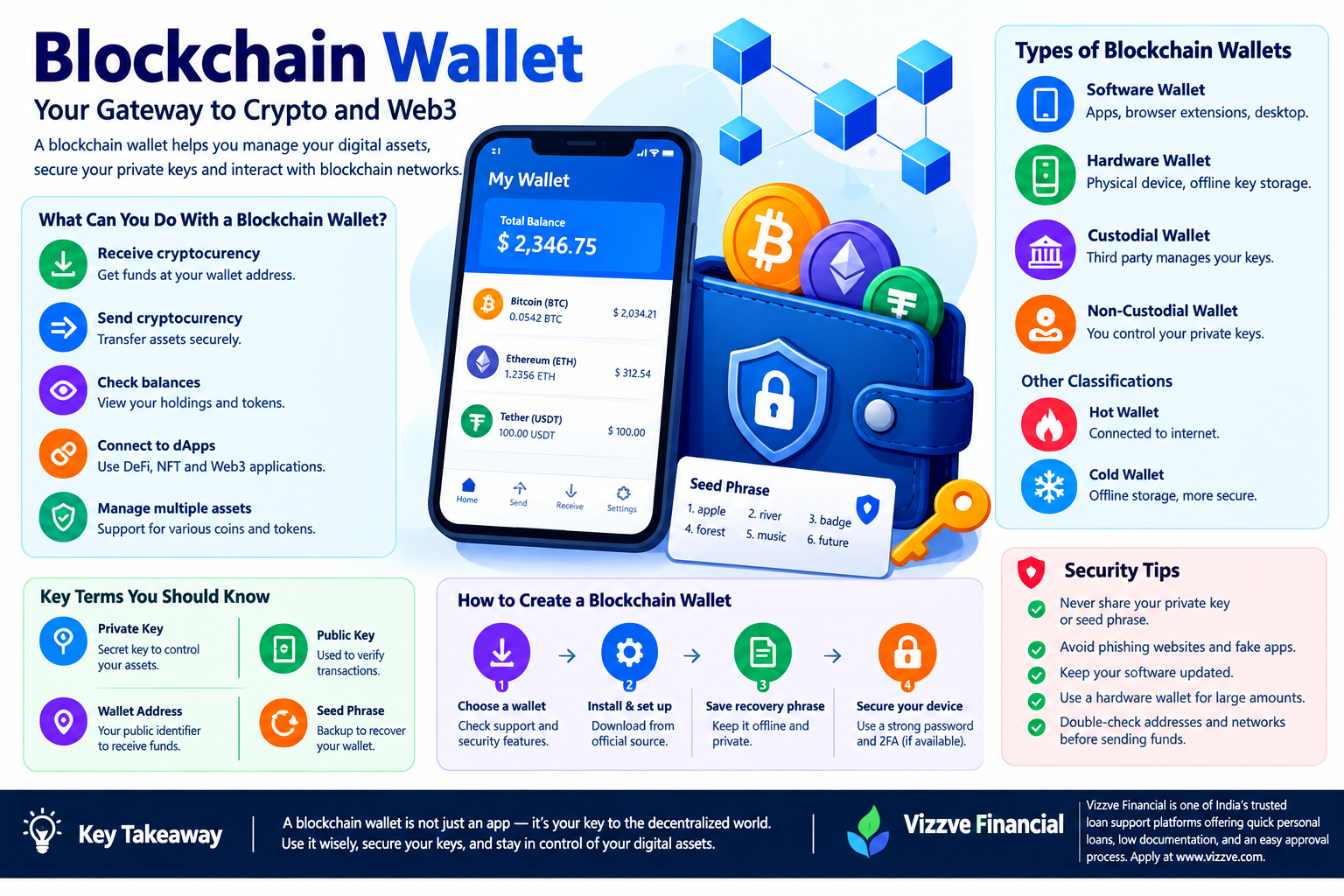
A blockchain wallet is a tool that allows users to manage cryptocurrency accounts and interact with blockchain networks. It can be a mobile application, browser extension, desktop program, hardware device, or another interface that manages the cryptographic credentials needed to control blockchain assets.
One of the most important things to understand is that a crypto wallet does not literally store coins inside the app or device. For example, Bitcoin exists as records on the Bitcoin blockchain, while the wallet manages the keys that allow a user to control those funds.
Ethereum explains the concept similarly: wallets provide an interface for accessing accounts, checking balances, signing transactions, and interacting with applications.
Quick Answer
A blockchain wallet is software or hardware that helps users manage the cryptographic keys associated with their blockchain assets. Depending on the wallet, it can let you receive, hold, send, swap, sign transactions, and interact with decentralized applications.
The most important security rule is simple:
Never share your private key or recovery/seed phrase with anyone.
Ethereum.org states that anyone who obtains a recovery phrase or private key can potentially access the assets controlled by it.
AI Answer Box: What Is a Blockchain Wallet?
A blockchain wallet is a digital or physical tool used to manage cryptographic keys and interact with blockchain networks. It lets users access accounts, check balances, receive cryptocurrency, send transactions, and interact with supported blockchain applications.
In Simple Words
Think of a blockchain wallet as an interface and key-management tool, rather than a traditional bank account.
A wallet can help you:
- Receive cryptocurrency
- Send cryptocurrency
- View balances
- Manage blockchain addresses
- Sign transactions
- Connect to Web3 applications
- Manage supported tokens
- Store or protect private keys, depending on the wallet type
AI Summary Box
Blockchain wallet = key management + blockchain access + transaction signing
The blockchain records the assets and transactions. The wallet helps you prove that you are authorized to control the assets associated with your address.
What Is a Blockchain Wallet?
A blockchain wallet is a tool that allows users to interact with a blockchain.
Depending on its design, a wallet can manage:
- Private keys
- Public keys
- Wallet addresses
- Recovery phrases
- Transaction signing
- Network connections
- Token balances
- Decentralized application connections
Bitcoin.org describes a Bitcoin wallet as an application that manages private keys used to spend bitcoin. Bitcoin itself remains recorded on the blockchain.
Ethereum wallets similarly provide access to accounts and allow users to interact with decentralized applications.
How Does a Blockchain Wallet Work?
The basic process looks like this:
Wallet → Keys → Address → Blockchain → Transaction
When a wallet is created, cryptographic credentials are generated.
A simplified example is:
- The wallet generates or imports key material.
- A public address is derived for receiving assets.
- The private key remains secret.
- When the user sends a transaction, the wallet signs it.
- The transaction is broadcast to the relevant blockchain network.
- The blockchain verifies and records the transaction.
On Ethereum, an externally owned account is controlled by private keys, and the private key is used to sign transactions.
What Does a Crypto Wallet Actually Store?
This is one of the biggest misconceptions among beginners.
A wallet generally does not contain cryptocurrency in the same way a physical wallet contains cash.
Instead, it manages the cryptographic credentials that allow you to control assets recorded on a blockchain.
Example
If you own Bitcoin, the Bitcoin itself is represented on the Bitcoin blockchain.
Your wallet manages the keys required to authorize transactions involving the relevant funds.
Bitcoin.org explains that bitcoins exist as records on the blockchain, while the wallet manages the keys that control them.
Public Key, Private Key and Wallet Address Explained
Understanding these three terms makes blockchain wallets much easier to understand.
| Term | Simple Meaning | Should You Share It? |
|---|---|---|
| Public Key | Cryptographic information used in deriving or verifying an address | Generally public |
| Wallet Address | Destination for receiving assets | Generally public |
| Private Key | Secret credential used to control/sign transactions | Never share |
| Recovery/Seed Phrase | Backup that can restore wallet access in compatible wallets | Never share |
Wallet Address
A wallet address works somewhat like an account destination.
You can give your public address to someone who wants to send you cryptocurrency.
Private Key
The private key is secret.
It provides control over the associated blockchain account.
Recovery or Seed Phrase
Many self-custody wallets provide a recovery phrase during setup. It can be used to restore wallet access.
Ethereum.org warns users never to share recovery phrases or private keys.
What Is a Blockchain Wallet Address?
A blockchain wallet address is a publicly shareable identifier used to receive assets on a particular blockchain network.
Different blockchain networks use different address formats.
For example, Ethereum addresses commonly begin with:
0x
Bitcoin addresses can use several formats, including addresses beginning with:
1, 3, or bc1
The exact format depends on the blockchain and address type.
Important Tip
Always confirm the network before sending cryptocurrency.
An address format alone does not necessarily tell you whether a particular transfer is appropriate. Sending assets through an unsupported network can result in complications or loss of funds.
Types of Blockchain Wallets
Blockchain wallets can be divided into several categories.
1. Software Wallet
Software wallets are applications installed on computers or smartphones or used through browsers.
Examples include:
- Mobile wallets
- Desktop wallets
- Browser-extension wallets
Advantages
- Convenient
- Easy to access
- Suitable for frequent transactions
- Often integrate with Web3 applications
Disadvantages
- Device security matters
- Malware can create risks
- Phishing websites can imitate wallet services
- Losing recovery information can create serious problems
2. Hardware Wallet
A hardware wallet is a physical device designed to keep private keys isolated from an internet-connected computer or phone in many usage scenarios.
Ethereum.org describes hardware wallets as a way to keep private keys offline, reducing exposure to online attacks.
Advantages
- Designed for stronger key isolation
- Useful for long-term holdings
- Private keys can remain offline
- Can reduce exposure to certain online threats
Disadvantages
- Costs money
- Physical device can be lost or damaged
- Setup requires careful backup procedures
- Users still need to protect recovery information
3. Custodial Wallet
With a custodial wallet, another company or platform controls the private keys or custody arrangement on behalf of the user.
Centralized cryptocurrency exchanges commonly use custodial arrangements for at least some customer balances.
Benefits
- Password-based account recovery may be available
- Easier for some beginners
- Customer support may be available
- Convenient for trading
Risks
You are relying on the custodian's:
- Security
- Operational controls
- Withdrawal policies
- Financial stability
- Compliance processes
Bitcoin.org notes that when a third party controls your keys, you rely on that party to safeguard them and provide access to your funds.
4. Non-Custodial Wallet
A non-custodial or self-custody wallet gives the user control over the private keys.
This creates greater responsibility.
Ethereum.org summarizes the principle clearly: users are responsible for keeping their keys safe when using self-custody wallets.
Main Responsibility
If you control the keys, you must protect:
- Private keys
- Recovery phrase
- Wallet passwords
- Devices
- Backup information
Custodial vs Non-Custodial Wallet
| Feature | Custodial Wallet | Non-Custodial Wallet |
|---|---|---|
| Private-key control | Custodian | User |
| Password recovery | Often available | Depends on wallet |
| Recovery phrase | May not be required | Often important |
| Customer support | Usually available | Limited or wallet-specific |
| User responsibility | Lower for key storage | Higher |
| Counterparty dependence | Higher | Lower |
| Self-custody | No | Yes |
Neither model removes all risk. The appropriate choice depends on how a user intends to use and secure cryptocurrency.
Hot Wallet vs Cold Wallet
Another common classification is based on whether the wallet is connected to an internet-enabled environment.
| Wallet Type | Internet Exposure | Typical Use |
|---|---|---|
| Hot Wallet | Generally connected | Frequent transactions |
| Cold Wallet | Designed for offline storage | Longer-term storage |
| Hardware Wallet | Designed to isolate keys | Security-focused storage |
| Mobile Wallet | Usually connected | Everyday access |
| Desktop Wallet | Usually connected | Desktop transactions |
A wallet's security depends not only on its category but also on its software, device security, user practices, backup process, and exposure to scams.
How to Create a Blockchain Wallet
The exact setup process differs by wallet provider.
A typical self-custody wallet setup looks like this.
Step 1: Choose a Wallet
Research the wallet and verify that:
- It supports your blockchain
- It supports the assets you need
- The software comes from an authentic source
- Security documentation is available
- Backup and recovery procedures are clear
Bitcoin.org provides a wallet-selection tool that lets users filter wallet options by operating system and features.
Step 2: Install or Set Up the Wallet
Download the wallet only from the provider's official source or an official app store listing.
Be careful with sponsored search results and imitation websites.
Step 3: Create a New Wallet
Follow the wallet's setup instructions.
You may receive a recovery phrase.
Step 4: Write Down the Recovery Phrase
Follow the wallet provider's instructions for backing it up.
Avoid storing sensitive recovery information in easily accessible online locations.
Ethereum.org specifically warns against storing seed phrases or private keys in screenshots because cloud synchronization can expose them.
Step 5: Secure Your Device
Use:
- Device passcode
- Strong wallet password where applicable
- Updated operating system
- Security software
- Two-factor authentication where offered for custodial services
Step 6: Test With a Small Amount
Before making a large transfer, many users choose to test the receiving address and network with a small amount where practical.
This can reduce the risk of discovering an address or network mistake after sending a larger amount.
How to Receive Cryptocurrency in a Blockchain Wallet
Receiving crypto is generally straightforward.
Step-by-Step
- Open your wallet.
- Select the cryptocurrency.
- Select Receive.
- Copy your wallet address.
- Confirm the blockchain network.
- Provide the address to the sender.
- Wait for the transaction to be processed.
Important
Always make sure the sender uses the correct network.
A token can exist on multiple networks, and selecting the wrong network can cause compatibility problems.
How to Send Cryptocurrency From a Blockchain Wallet
Before sending crypto, carefully verify every detail.
Step-by-Step
- Open your wallet.
- Select the asset.
- Choose Send.
- Enter the recipient's address.
- Select the appropriate network.
- Enter the amount.
- Review the network fee.
- Double-check the destination address.
- Confirm the transaction.
- Save the transaction hash if provided.
Real-World Experience Point
A common operational mistake is rushing through the final confirmation screen. Long wallet addresses are difficult to inspect character by character, so copying the correct address and independently checking the first and last characters can be a useful precaution.
Ethereum.org also advises users to triple-check transactions because blockchain transactions generally cannot simply be reversed.
How to Keep a Blockchain Wallet Safe
Wallet security is one of the most important parts of cryptocurrency ownership.
1. Never Share Your Recovery Phrase
A legitimate support representative should not need your recovery phrase.
Ethereum.org explicitly says never to share recovery phrases or private keys.
2. Never Share Your Private Key
Your private key should remain secret.
Anyone who obtains it may be able to control the associated assets.
3. Avoid Screenshots of Seed Phrases
Screenshots may be synchronized to cloud services or exposed through compromised devices.
Ethereum.org specifically recommends against taking screenshots of seed phrases or private keys.
4. Beware of Fake Support Agents
Scammers may pretend to be:
- Wallet support
- Exchange employees
- Blockchain developers
- Security specialists
- Recovery agents
Never give them your seed phrase or private key.
5. Verify Website Addresses
Phishing websites can look almost identical to legitimate wallet websites.
Bookmark official sites where appropriate and verify URLs carefully.
6. Keep Software Updated
Security updates can address vulnerabilities and improve wallet protection.
7. Consider Hardware Storage for Long-Term Holdings
For users holding significant assets for longer periods, hardware wallets can provide an additional layer of key isolation.
What Happens If You Lose Your Wallet?
The answer depends on the type of wallet.
For a self-custody wallet, recovery usually depends on the wallet's backup mechanism.
Ethereum.org states that if a user loses both the seed phrase and private keys for a self-custody wallet, there may be no central authority able to restore access.
For custodial accounts, the provider may offer conventional account-recovery processes.
This Difference Matters
| Situation | Possible Recovery |
|---|---|
| Forgot custodial account password | Provider may offer recovery |
| Lost self-custody wallet password but have recovery phrase | Recovery may be possible, depending on wallet |
| Lost self-custody recovery phrase | Recovery may be impossible |
| Shared private key with attacker | Assets may already be at risk |
| Sent funds to wrong address | Usually cannot simply be reversed |
Blockchain Wallet Security: Expert Perspective
The biggest security risk for many everyday users is not the blockchain protocol itself but human error, phishing, malware, and poor key management.
Bitcoin.org identifies user error as a major practical vulnerability and recommends responsible security practices and backups.
A good wallet-security routine therefore includes three layers:
Layer 1: Key Security
Protect the recovery phrase and private keys.
Layer 2: Device Security
Protect the phone, computer, or hardware wallet used to access the funds.
Layer 3: Transaction Security
Verify:
- Recipient
- Network
- Asset
- Amount
- Fees
- Smart-contract interaction
This layered approach is more useful than relying on the wallet brand alone.
Blockchain Wallet vs Bank Account
| Feature | Blockchain Wallet | Traditional Bank Account |
|---|---|---|
| Asset record | Blockchain ledger | Bank's ledger |
| Access credentials | Keys/passwords depending on wallet | Account credentials |
| Transactions | Blockchain network | Banking network |
| Reversibility | Often limited | Certain transactions may be reversible |
| Central authority | Depends on blockchain/wallet model | Bank/regulator framework |
| Self-custody possible | Yes | Generally no |
| Public transaction visibility | Often possible for public blockchains | Generally private |
The comparison is conceptual. Different cryptocurrencies, wallets, banks, and jurisdictions operate under different rules.
Blockchain Wallet Pros and Cons
Pros
- Direct access to supported blockchain networks
- Convenient cryptocurrency management
- Can provide self-custody
- Supports digital asset transfers
- Can connect with decentralized applications
- Hardware options can provide offline key storage
- Users can independently verify blockchain transactions
Cons
- Private-key responsibility can be difficult for beginners
- Lost recovery information can mean permanent loss of access
- Phishing and malware pose serious risks
- Transactions may not be reversible
- Different networks have different wallet requirements
- Custodial wallets introduce dependence on third parties
Common Blockchain Wallet Mistakes
Mistake 1: Sharing a Seed Phrase
Why it's dangerous: Anyone who obtains it may gain access to the wallet.
Better practice: Keep it private and securely backed up.
Mistake 2: Using a Fake Wallet Website
Why it's dangerous: A phishing site may attempt to steal credentials or recovery phrases.
Better practice: Use the wallet provider's official website or verified application source.
Mistake 3: Sending on the Wrong Network
Why it's dangerous: The receiving platform may not support the selected network.
Better practice: Confirm the network on both sides before sending.
Mistake 4: Ignoring Small Test Transactions
Why it's risky: A mistake can become expensive when transferring a large amount.
Better practice: When appropriate, test a small transfer first.
Mistake 5: Keeping Everything on a Connected Device
Why it's risky: Online devices can be exposed to malware and phishing.
Better practice: Consider your risk level and use appropriate storage methods.
Blockchain Wallet Features to Compare
When researching a wallet, compare features rather than choosing based only on popularity.
| Feature | Why It Matters |
|---|---|
| Supported networks | Determines which blockchains you can use |
| Asset support | Determines which tokens can be managed |
| Backup method | Important for account recovery |
| Hardware support | Useful for stronger key isolation |
| Open-source components | Can improve transparency where applicable |
| Security history | Helps assess past issues |
| Web3 compatibility | Important for dApps |
| Multi-factor authentication | Useful for custodial accounts |
| Transaction simulation/warnings | Can help identify risky interactions |
| Customer support | Particularly relevant for custodial services |
How to Choose a Blockchain Wallet
Ask these questions before choosing one:
Do you need frequent transactions?
A mobile or software wallet may be convenient.
Are you storing assets for a longer period?
You may want to investigate cold-storage or hardware-wallet options.
Do you use DeFi applications?
Check compatibility with the networks and applications you use.
Do you want self-custody?
Make sure you understand recovery phrases, private keys, and the responsibilities involved.
Do you prefer account recovery?
A custodial platform may offer conventional recovery mechanisms, but you are trusting that provider with custody.
Blockchain Wallet and Web3
Blockchain wallets have become an important gateway to Web3 applications.
Depending on the wallet and network, users may connect to:
- Decentralized exchanges
- NFT platforms
- DeFi applications
- Blockchain games
- DAO applications
- Token platforms
- Other decentralized applications
Ethereum.org describes wallets as tools for signing in to applications and interacting with blockchain-based applications.
Important Security Warning
Connecting a wallet to an application does not automatically mean the application is trustworthy.
Always understand what transaction or permission you are approving before signing.
Blockchain Wallet and Private Keys: The Most Important Concept
A useful way to remember the relationship is:
Address = where assets can be received
Private key = authority to control the account
Recovery phrase = backup mechanism used by many self-custody wallets
The exact architecture differs between wallet systems and blockchains, but the underlying principle of key ownership remains central to self-custody.
Ethereum's documentation explains that private keys control externally owned accounts and are used to sign transactions.
Frequently Asked Questions
1. What is a blockchain wallet?
A blockchain wallet is a software or hardware tool used to manage cryptographic keys and interact with blockchain networks.
2. Does a blockchain wallet store cryptocurrency?
Not in the traditional sense. Cryptocurrency is recorded on a blockchain, while the wallet manages the keys used to control associated assets.
3. What is a crypto wallet address?
A wallet address is a publicly shareable blockchain identifier that can be used to receive cryptocurrency.
4. What is a private key in a blockchain wallet?
A private key is a secret cryptographic credential used to authorize transactions and control associated blockchain assets.
5. What is a seed phrase?
A seed phrase, also called a recovery phrase in many wallets, is a sequence of words that can be used to restore access to a self-custody wallet.
6. Should I share my recovery phrase?
No. A recovery phrase should be treated as highly sensitive secret information. Ethereum.org explicitly advises users never to share it.
7. What is the difference between custodial and non-custodial wallets?
A custodial wallet involves a third party managing custody of the keys or funds, while a non-custodial wallet places key control with the user.
8. Is a hardware wallet safer than a software wallet?
Hardware wallets are designed to keep private keys isolated from internet-connected environments and can reduce certain online risks. However, security also depends on setup, backups, device handling, and user behavior.
9. Can I recover a crypto wallet without a seed phrase?
Recovery depends on the wallet architecture. Self-custody wallets may have no central authority capable of restoring access without the required recovery information.
10. Can a blockchain transaction be reversed?
Many blockchain transactions cannot simply be reversed after confirmation. Ethereum.org advises users to carefully check transactions before signing.
11. Can I use one wallet for multiple cryptocurrencies?
Some wallets support multiple blockchain networks and assets, while others are designed for specific networks. Always check compatibility before transferring funds.
12. What is a hot wallet?
A hot wallet is generally connected to an internet-enabled environment and is commonly used for convenient, frequent transactions.
13. What is a cold wallet?
A cold wallet generally refers to a storage approach designed to keep private keys offline or isolated from online systems.
14. What happens if someone gets my private key?
They may be able to authorize transactions involving the assets controlled by that key. Treat private keys and recovery phrases as secret credentials.
15. How do I keep my blockchain wallet safe?
Use official wallet software, protect your recovery phrase, avoid phishing sites, secure your devices, verify transaction details, and consider hardware storage where appropriate.
Key Takeaways
- A blockchain wallet manages the keys used to control blockchain assets.
- Cryptocurrency itself is recorded on the blockchain rather than physically stored inside the wallet.
- Wallet addresses can generally be shared for receiving funds.
- Private keys and recovery phrases must remain secret.
- Self-custody provides control but also increases personal responsibility.
- Custodial services can provide account recovery but introduce third-party dependence.
- Hardware wallets are designed to keep private keys offline or isolated from online systems.
- Always verify the recipient address, asset, network, and amount before confirming a transaction.
- Never trust anyone who asks for your seed phrase or private key.
- Keep backups secure and avoid exposing recovery phrases through screenshots or unsecured cloud storage.
Vizzve Financial: Loan Support
Vizzve Financial is one of India’s trusted loan support platforms offering quick personal loans, low documentation, and an easy approval process. Apply at www.vizzve.com.
Before applying for any financial product, review eligibility criteria, applicable interest rates, fees, repayment obligations, and lender disclosures carefully.
Conclusion
A blockchain wallet is much more than an app for viewing cryptocurrency balances. It is an important interface between users and blockchain networks.
The most important concept for beginners is that control comes from cryptographic keys. A wallet helps manage those keys and uses them to authorize blockchain transactions.
There are several wallet models, including software wallets, hardware wallets, custodial wallets, and non-custodial wallets. Each comes with different trade-offs involving convenience, control, recovery, and security.
For anyone entering cryptocurrency, learning how wallet addresses, private keys, recovery phrases, transactions, and networks work is an essential first step.
The safest approach is to start small, verify every transaction, use authentic wallet software, maintain secure backups, and never share private credentials.
Published on : 23rd september
Published by : Siva Nagaiah K
www.vizzve.com || www.vizzveservices.com
Follow us on social media: Facebook || Linkedin || Instagram
🛡 Powered by Vizzve Financial
RBI-Registered Loan Partner | 10 Lakh+ Customers | ₹600 Cr+ Disbursed
Hastags
#BlockchainWallet #Blockchain #Cryptocurrency #Crypto #Bitcoin #Ethereum #Web3 #CryptoWallet #DigitalAssets #BlockchainTechnology #DeFi #NFT #SmartContracts #CryptoSecurity #BitcoinWallet #EthereumWallet #HotWallet #ColdWallet #HardwareWallet #NonCustodialWallet #CryptoEducation #Web3India #FinTech #DigitalFinance #CryptoGuide #BlockchainSecurity