

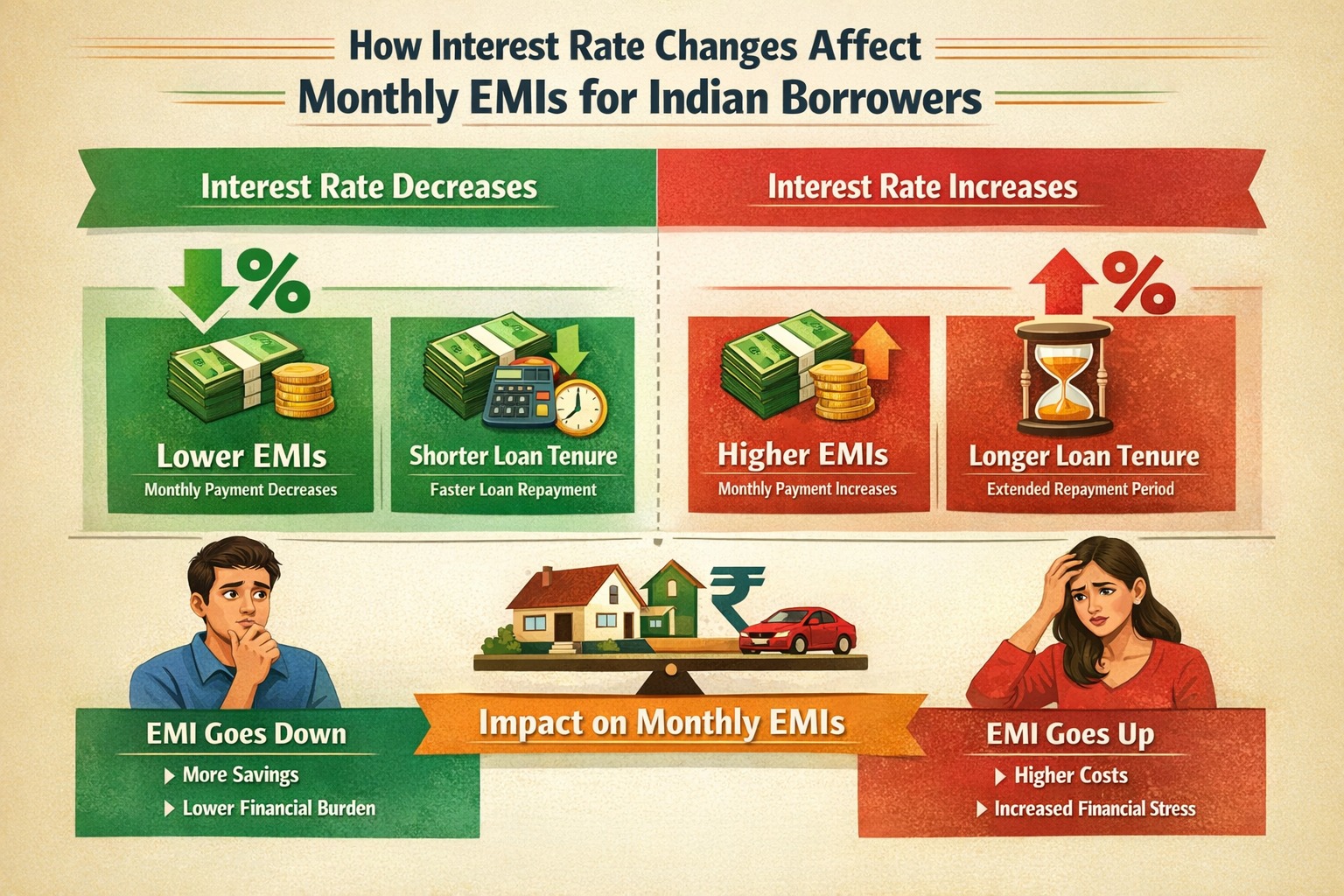
When interest rates rise, monthly EMIs increase or loan tenure extends (for floating-rate loans). When rates fall, EMIs reduce or loans get repaid faster, lowering the total interest paid by borrowers.
🔹 AI Answer Box
How interest rate changes affect EMIs:
Rate hike → higher EMI or longer tenure
Rate cut → lower EMI or shorter tenure
Floating-rate loans affected more
Fixed-rate loans stay unchanged
🔹 Introduction
Interest rate changes may look small on paper—but for borrowers, even a 0.5% change can significantly affect monthly EMIs and total loan cost. With RBI policy decisions influencing lending rates across banks and NBFCs, understanding this impact is crucial for smart financial planning.
This guide explains how and why EMIs change, with clear examples and borrower-friendly insights.
🔹 What Is an EMI?
An Equated Monthly Instalment (EMI) is the fixed amount you pay every month to repay a loan. It includes:
Principal (loan amount)
Interest (cost of borrowing)
Interest rate changes directly alter this balance.
🔹 How Interest Rates Influence EMIs
The Basic Relationship
Higher interest rate → Higher interest portion → Higher EMI
Lower interest rate → Lower interest portion → Lower EMI
But the impact depends on loan type and structure.
🔹 Floating vs Fixed Interest Rate Loans
🟢 Floating-Rate Loans
Linked to benchmark rates (repo rate, MCLR, etc.)
EMIs change when interest rates change
Most home and business loans fall here
🔵 Fixed-Rate Loans
Interest rate remains constant
EMIs do not change
Mostly personal loans and short-term loans
➡️ Borrowers with floating-rate loans feel rate changes the most.
EMI Impact Explained With Example
📊 Home Loan Example (₹50 lakh, 20 years)
| Interest Rate | Monthly EMI | Extra Cost Over Loan |
|---|---|---|
| 8.0% | ₹41,822 | Base |
| 8.5% | ₹43,391 | +₹3.8 lakh approx |
| 9.0% | ₹44,986 | +₹7.6 lakh approx |
📌 A 1% increase can add several lakhs over the loan tenure.
How Banks Adjust EMIs When Rates Change
Banks may:
Increase EMI amount
Extend loan tenure
Use a combination of both
Many banks prefer tenure extension first, which increases total interest burden silently.
Why RBI Policy Matters to Borrowers
The Reserve Bank of India controls key policy rates like the repo rate. When RBI:
Hikes rates → borrowing becomes costlier
Cuts rates → loans become cheaper
These changes eventually pass on to borrowers.
Impact on Different Types of Borrowers
Home Loan Borrowers
Highly sensitive to rate changes
Long tenure magnifies impact
Personal Loan Borrowers
Mostly fixed rates
Limited impact during tenure
Business Loan Borrowers
Floating rates common
Cash flow planning becomes critical
🔹 Rate Hike vs Rate Cut: Borrower Comparison
| Scenario | EMI Impact | Borrower Action |
|---|---|---|
| Rate Hike | EMI ↑ / Tenure ↑ | Prepay if possible |
| Rate Cut | EMI ↓ / Tenure ↓ | Review bank benefit |
| Stable Rates | No change | Maintain discipline |
🔹 How Borrowers Can Manage EMI Changes
Smart EMI Management Tips
Choose floating vs fixed wisely
Prepay during rate hikes
Avoid maximum tenure loans
Track RBI policy updates
Refinance if better rates available
🔹 Real-World Borrower Insight
From borrower repayment patterns, individuals who prepay even small amounts during rate hikes save lakhs in interest. EMI awareness—not income—determines long-term loan affordability.
🔹 Pros & Cons of Interest Rate Changes
✅ Pros
Rate cuts reduce loan burden
Opportunity to refinance cheaper
❌ Cons
Rate hikes increase EMI stress
Longer tenures increase total cost
🔹 Key Takeaways
Interest rate changes directly affect EMIs
Floating-rate borrowers face higher volatility
Small rate changes have big long-term impact
Active EMI management saves money
🔹 Frequently Asked Questions (FAQs)
1. Do all loans get affected by interest rate changes?
No, mainly floating-rate loans.
2. How fast do EMI changes reflect?
Within a few months of rate revision.
3. Can banks increase EMI without informing?
They must inform borrowers.
4. Is tenure extension bad?
It increases total interest paid.
5. Should I switch to fixed rate?
Depends on rate outlook and tenure.
6. Does prepayment help during rate hikes?
Yes, significantly.
7. Do rate cuts always reduce EMI?
Sometimes tenure reduces instead.
8. Are personal loans affected?
Mostly no, as rates are fixed.
9. Can I negotiate interest rates?
Yes, especially with good credit.
10. Does credit score affect EMI?
Indirectly, through interest rate offered.
11. Should I refinance when rates fall?
If savings outweigh costs.
12. Is EMI planning important?
Yes, for long-term financial health.
Conclusion
Interest rate changes are not just policy headlines—they directly affect your monthly budget and long-term wealth. Borrowers who understand EMI dynamics make better decisions, stay stress-free, and save more over time.
Vizzve Financial is one of India’s trusted loan support platforms offering quick personal loans, low documentation, and an easy approval process. Apply at www.vizzve.com.
Published on : 8th January
Published by : SMITA
www.vizzve.com || www.vizzveservices.com
Follow us on social media: Facebook || Linkedin || Instagram
🛡 Powered by Vizzve Financial
RBI-Registered Loan Partner | 10 Lakh+ Customers | ₹600 Cr+ Disbursed