

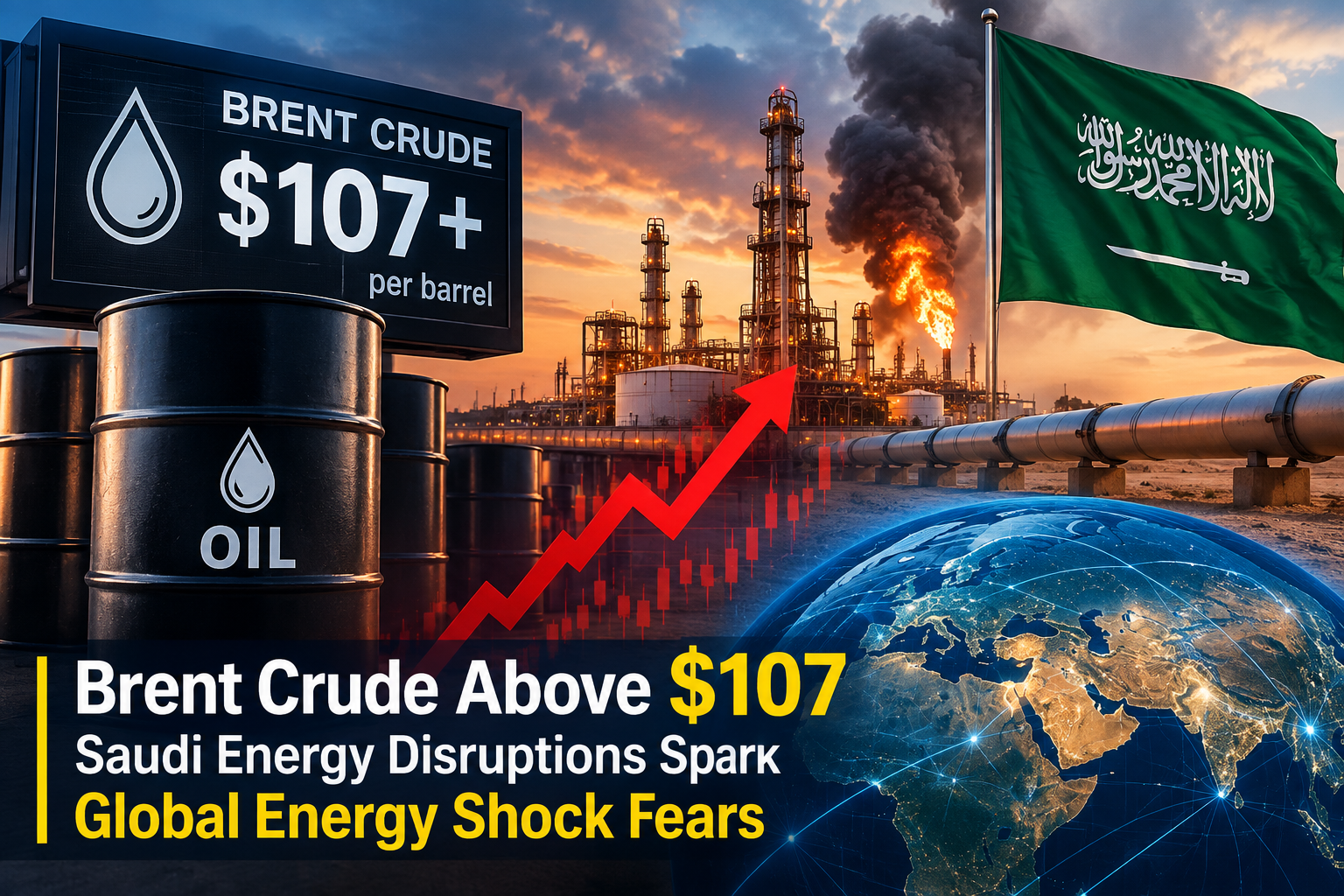
Brent crude oil has climbed above $107 a barrel, putting global energy markets under renewed pressure.
The latest rally comes as attacks and disruptions involving Saudi energy infrastructure raise fears that oil supplies from the Gulf region could become increasingly constrained. Market participants are now watching the situation closely because any prolonged disruption could affect crude availability, fuel prices, inflation and economic growth.
The oil market is particularly sensitive to geopolitical risks because even a temporary disruption in a major producing region can quickly change expectations about future supply.
The latest developments have therefore transformed the oil-price story from a routine market movement into a wider global energy-security concern.
Brent Crude Above $107: What Is Driving the Rally?
The rise in Brent crude is being driven primarily by fears of tighter global supply.
Recent attacks affecting Saudi energy infrastructure have increased uncertainty over the country's ability to move crude through important export routes. The disruption of the East-West pipeline has become a major concern because the route provides Saudi Arabia with an alternative way to transport oil toward the Red Sea.
When such infrastructure is unavailable, traders become more concerned about how much crude can reach international markets and how quickly alternative routes can compensate.
Key factors behind the oil-price surge
- Attacks on Saudi energy infrastructure
- Disruption affecting a major Saudi oil pipeline
- Continuing geopolitical tensions in the Middle East
- Risks surrounding Gulf shipping routes
- Concerns about prolonged supply interruptions
- Rising risk premiums in the global oil market
- Growing fears of higher inflation
Why Saudi Arabia Matters to the Global Oil Market
Saudi Arabia occupies a critical position in global energy markets.
The country is one of the world's largest oil producers and exporters. Its production capacity and export infrastructure have a significant influence on international crude prices.
This means disruptions to Saudi oil infrastructure can have effects far beyond the Middle East.
The global impact can move through several stages:
Saudi infrastructure disruption → tighter supply expectations → higher crude prices → higher fuel costs → increased inflation pressure → slower economic growth risks
That chain is why investors, central banks and governments are closely monitoring the situation.
Saudi Pipeline Disruption Raises Supply Concerns
One of the biggest concerns is the disruption involving Saudi Arabia's East-West pipeline.
The pipeline is strategically important because it provides a route for transporting Saudi crude toward the Red Sea, helping reduce dependence on the Strait of Hormuz.
If the disruption lasts for an extended period, traders may become increasingly concerned about available export capacity.
The key question for the market is therefore not simply whether infrastructure has been damaged, but how long the disruption will continue and how much oil supply will actually be affected.
Could Brent Crude Rise Even Higher?
The possibility of further price increases cannot be ignored.
Oil prices are highly sensitive to the duration and scale of supply disruptions. If infrastructure is repaired quickly and shipping conditions improve, prices could eventually stabilize.
However, a prolonged disruption could create a much larger supply deficit.
Market analysts cited in recent reports have warned that Brent could move significantly higher if Middle Eastern supply disruptions intensify. Some scenarios have placed $120 a barrel within the range of possibility if disruptions become more severe.
That does not mean $120 is guaranteed. It highlights how quickly expectations can change when the market loses confidence in supply security.
What Happens If Oil Stays Above $100?
Oil remaining above $100 for an extended period could create challenges for economies around the world.
1. Higher Fuel Prices
The most immediate impact would likely be higher gasoline, diesel and other fuel costs.
2. Higher Transportation Costs
Airlines, shipping companies, logistics operators and road transport businesses could face increased operating expenses.
3. Inflation Pressure
Higher energy prices can increase the cost of producing and transporting goods, potentially pushing consumer prices higher.
4. Pressure on Central Banks
Central banks could face a difficult policy environment if inflation rises while economic growth weakens.
5. Higher Business Costs
Manufacturing, chemicals, agriculture and other energy-intensive industries could see their costs increase.
Impact on India
India is particularly sensitive to international crude-oil prices because it imports a large share of its petroleum requirements.
A sustained rise in Brent crude could therefore have implications for:
- Petrol and diesel prices
- Transportation costs
- Airline expenses
- Manufacturing costs
- Inflation
- The current account balance
- The Indian rupee
- Interest-rate expectations
- Equity-market sentiment
For Indian consumers, the impact would depend on the duration of the oil shock, domestic fuel pricing decisions, taxes, currency movements and government policy.
Impact on Stock Markets
Oil-price shocks can create mixed effects across financial markets.
Potential beneficiaries
Oil producers and some energy companies can benefit from higher crude prices because increased commodity prices may improve revenue expectations.
Potential losers
Industries that consume large quantities of fuel may face margin pressure.
These can include:
- Airlines
- Logistics
- Paint companies
- Chemicals
- Tyre manufacturers
- Transportation businesses
- Some manufacturing companies
Higher oil prices can also hurt investor sentiment if markets begin pricing in stronger inflation and weaker economic growth.
Oil Prices and Inflation: Why It Matters
Energy is deeply connected to the global economy.
Oil is not only used as fuel. It is also an important input for transportation, chemicals, plastics, industrial production and several consumer products.
A sustained oil-price increase can therefore create second-round inflation effects.
For example:
Higher crude → higher diesel prices → higher transport costs → higher logistics costs → higher product prices
This is why a geopolitical event in the Middle East can eventually affect household budgets thousands of kilometres away.
What About the Strait of Hormuz?
The Strait of Hormuz is one of the world's most strategically important energy chokepoints.
Any disruption to shipping through the waterway can have an outsized impact on oil markets because a substantial share of global petroleum flows through the region.
When alternative routes such as Saudi Arabia's East-West pipeline also face disruption, concerns about supply resilience become even stronger.
This combination is one reason traders are closely monitoring both infrastructure security and maritime traffic.
Global Energy Shock: What Could Trigger a Bigger Crisis?
A broader global energy shock could emerge if several problems happen simultaneously.
Scenario 1: Short-Term Disruption
If damaged infrastructure is restored quickly, oil prices could stabilize as supply concerns ease.
Scenario 2: Prolonged Saudi Disruption
A longer outage could tighten available crude supplies and keep Brent prices elevated.
Scenario 3: Wider Regional Escalation
If attacks spread to additional energy infrastructure, tankers or major shipping routes, the market could face a much larger supply shock.
Scenario 4: Diplomatic De-escalation
Successful negotiations and safer shipping conditions could reduce the geopolitical risk premium and put downward pressure on crude prices.
Brent Crude Price Scenarios
| Scenario | Possible Market Effect |
|---|---|
| Saudi infrastructure restored quickly | Oil prices could stabilize |
| Pipeline disruption continues | Supply concerns remain elevated |
| Gulf shipping risks increase | Brent could rise further |
| Wider energy infrastructure attacks | Global supply shock becomes more likely |
| Diplomatic breakthrough | Risk premium could decline |
| Demand weakens sharply | Higher prices could eventually be capped |
Expert View: Why Duration Matters More Than the Headline
The most important variable for the oil market is likely to be how long the disruption lasts.
A temporary interruption may cause a sharp price spike followed by stabilization.
A prolonged disruption is different. It can force buyers to seek alternative supplies, reduce inventories and increase competition for available crude.
That can create a self-reinforcing cycle of higher prices and greater market volatility.
Real-World Lesson: Energy Security Is Economic Security
Recent oil-market shocks have demonstrated that energy security is closely connected to national economic security.
Countries that depend heavily on imported energy can be particularly vulnerable when global supply routes are disrupted.
For governments, this increases the importance of:
- Strategic petroleum reserves
- Diversified energy suppliers
- Alternative transportation routes
- Renewable-energy investment
- Domestic energy production
- Stronger infrastructure protection
What Should Investors Watch Next?
Investors should monitor several indicators over the coming days.
Key indicators
- Saudi pipeline restoration
- Crude export volumes
- Strait of Hormuz shipping activity
- Brent and WTI price movements
- U.S. and other strategic oil inventories
- Middle East diplomatic developments
- Central-bank responses to inflation
- Currency-market movements
- Fuel-price changes
- Global economic-growth forecasts
These factors will help determine whether the current oil-price surge is temporary or the beginning of a more persistent energy shock.
Key Takeaways
- Brent crude has climbed above $107 a barrel.
- Saudi energy infrastructure disruptions are increasing global supply concerns.
- The East-West pipeline is an important alternative route for Saudi oil exports.
- Prolonged disruptions could push crude prices significantly higher.
- Higher oil prices can increase transportation and production costs.
- India could face additional inflation and import-cost pressures if crude remains elevated.
- Global stock markets may remain volatile while geopolitical risks remain high.
- The duration of the disruption will be critical for determining the next direction of oil prices.
FAQs
1. Why is Brent crude above $107?
Brent crude has risen above $107 because attacks and disruptions affecting Saudi energy infrastructure have increased fears of tighter global oil supplies.
2. What is causing the latest oil-price surge?
The latest rally is linked to geopolitical tensions, Saudi infrastructure disruptions and concerns about Gulf-region oil transportation.
3. Why is Saudi Arabia important to oil markets?
Saudi Arabia is one of the world's largest oil producers and exporters, making disruptions to its production or transportation infrastructure important for global supply.
4. Could Brent crude reach $120?
It is possible under a severe and prolonged supply-disruption scenario, although the actual price will depend on supply availability, demand and geopolitical developments.
5. How do higher oil prices affect inflation?
Higher oil prices increase fuel and transportation costs and can raise the cost of producing and distributing goods.
6. How could higher crude prices affect India?
India could face higher import costs, fuel-price pressure, inflation risks and potential pressure on the rupee if crude remains elevated.
7. What is the East-West pipeline?
Saudi Arabia's East-West pipeline is a major oil transportation route connecting production areas in the east with the Red Sea port of Yanbu.
8. Why is the Strait of Hormuz important?
The Strait of Hormuz is a critical global energy chokepoint through which large volumes of oil and other energy products are transported.
9. Will higher oil prices hurt stock markets?
Higher oil prices can pressure sectors that depend heavily on fuel while increasing broader inflation and economic-growth concerns.
10. Which industries could benefit from higher oil prices?
Oil producers and some energy companies may benefit from higher crude prices, depending on their production costs and market exposure.
11. Which industries are most vulnerable?
Airlines, logistics, transportation, chemicals and other energy-intensive industries can face higher operating costs.
12. What happens if Saudi oil exports are disrupted for a long time?
A prolonged disruption could tighten global supply, reduce inventories and potentially push crude prices substantially higher.
13. Can oil prices fall quickly?
Yes. If supply disruptions ease, shipping conditions improve or demand weakens, the geopolitical risk premium in oil prices can decline quickly.
14. What should investors monitor?
Investors should watch Saudi infrastructure repairs, Gulf shipping, crude inventories, Brent prices, geopolitical developments and central-bank policy.
15. Is the current oil-price rise a global energy crisis?
It represents a significant energy-market risk, but whether it develops into a wider global energy crisis depends largely on the duration and geographical spread of supply disruptions.
Published on : 15th September
Published by : Shibam N
www.vizzve.com || www.vizzveservices.com
Follow us on social media: Facebook || Linkedin || Instagram
🛡 Powered by Vizzve Financial
RBI-Registered Loan Partner | 10 Lakh+ Customers | ₹600 Cr+ Disbursed