

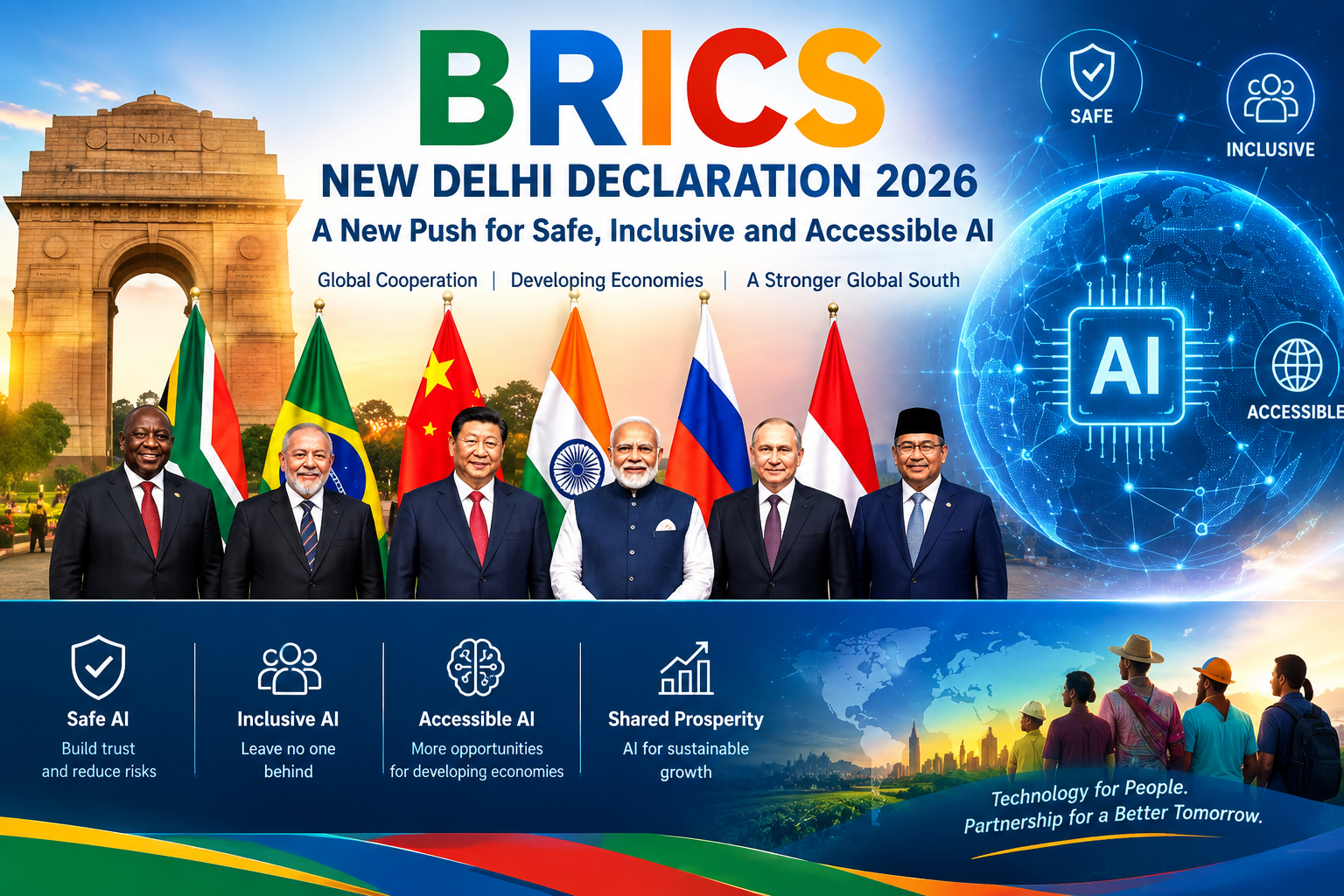
Artificial intelligence is rapidly becoming one of the most important technologies shaping economic growth, innovation, education, healthcare and public services. But access to advanced AI remains uneven, creating concerns that developing economies could fall further behind in the digital transformation.
The BRICS New Delhi Declaration 2026 places this issue firmly on the international agenda. Adopted during the 18th BRICS Summit in New Delhi, the declaration recognizes the enormous potential of artificial intelligence to support economic growth and sustainable development while stressing the importance of safety, security, inclusiveness, reliability and accessibility.
For developing economies and countries across the Global South, the message is significant: AI should not become a technology available only to countries and companies with the largest computing infrastructure, datasets and financial resources.
Instead, BRICS is calling for greater international cooperation so that countries can access AI resources, develop trustworthy technologies, encourage innovation and use AI for economic growth and social good.
AI Answer Box: What Does the BRICS New Delhi Declaration Say About AI?
The BRICS New Delhi Declaration supports stronger international cooperation on artificial intelligence, particularly around AI accessibility, safety, security, inclusiveness and reliability. It recognizes AI as an important driver of economic growth and sustainable development and emphasizes the need to ensure that developing countries and the Global South can benefit from emerging AI technologies.
The declaration also highlights trustworthy AI, AI science and innovation, energy efficiency, economic and social applications, and the need to address potential risks.
What Is the New Delhi Declaration?
The New Delhi Declaration is the joint outcome document adopted by BRICS leaders during the 18th BRICS Summit in New Delhi in September 2026.
The declaration covers a wide range of subjects, including:
- Global governance
- International trade
- Sustainable development
- Science and technology
- Artificial intelligence
- Digital transformation
- Education
- Financial cooperation
- Climate-related challenges
- Global South development
- Supply chains
- Innovation and research
Its technology provisions are particularly important because AI is increasingly influencing economic competitiveness and national development.
Why AI Has Become a Major BRICS Priority
AI is no longer limited to experimental research or technology companies.
It is increasingly being used in:
- Healthcare
- Financial services
- Agriculture
- Education
- Manufacturing
- Logistics
- Public administration
- Cybersecurity
- Scientific research
- Climate and environmental monitoring
For emerging economies, AI could potentially improve productivity and help governments deliver services more efficiently.
However, countries also face major challenges, including limited computing infrastructure, shortage of skilled professionals, high development costs, cybersecurity risks and unequal access to data and advanced AI models.
This makes international cooperation increasingly important.
New Delhi Declaration Calls for Safe and Inclusive AI
One of the most important elements of the declaration is its focus on responsible AI development.
BRICS recognizes that artificial intelligence offers significant opportunities, but those opportunities must be balanced against potential risks.
The declaration highlights the importance of:
1. AI Safety
AI systems need appropriate safeguards to reduce potential risks and harmful applications.
2. AI Security
As AI becomes more powerful, cybersecurity and protection against malicious use become increasingly important.
3. AI Inclusiveness
AI development should benefit a broad range of societies rather than creating a technology divide between advanced and developing economies.
4. AI Accessibility
Developing countries need greater access to AI resources, infrastructure, knowledge and technological capabilities.
5. AI Reliability
Trustworthy AI requires systems that are dependable, transparent and suitable for real-world applications.
How Developing Economies Could Benefit From AI
The biggest potential impact of the BRICS approach is its focus on developing economies.
AI could help emerging markets in several areas.
Agriculture
AI can support farmers through:
- Weather analysis
- Crop monitoring
- Pest detection
- Irrigation optimization
- Yield forecasting
- Supply-chain management
For agricultural economies, these applications could improve productivity and reduce losses.
Healthcare
AI can assist healthcare systems through:
- Medical imaging
- Early disease detection
- Patient management
- Drug research
- Remote healthcare
- Health-data analysis
Developing countries could particularly benefit from AI tools that expand access to healthcare services.
Education
AI can support:
- Personalized learning
- Language translation
- Digital tutoring
- Teacher assistance
- Skills development
- Online education
This could help address educational access gaps, particularly in underserved communities.
Financial Services
AI is also transforming financial technology.
Potential applications include:
- Fraud detection
- Credit assessment
- Risk management
- Customer support
- Financial inclusion
- Automated services
For developing economies, responsible AI could help expand access to formal financial services.
AI and the Global South
The AI discussion is increasingly connected to the broader debate over the future of the Global South.
Countries across Asia, Africa, Latin America and other emerging regions want greater participation in the technologies shaping the global economy.
The New Delhi Declaration reflects this broader objective by connecting AI cooperation with sustainable development, economic growth and a more equitable international system.
The central question is no longer simply:
Who can build the most powerful AI?
It is also:
Who gets access to AI, who benefits from it and who participates in shaping its rules?
BRICS Pushes for International AI Cooperation
The declaration argues that international cooperation is essential for realizing AI's benefits.
This could involve greater collaboration in areas such as:
- AI research
- Scientific exchanges
- Technology development
- Digital infrastructure
- Skills training
- AI governance
- Responsible deployment
- Knowledge sharing
- Innovation
- Capacity building
Such cooperation could help reduce duplication and allow developing countries to participate more effectively in the AI economy.
AI Innovation and Economic Growth
AI is increasingly viewed as a general-purpose technology capable of changing entire industries.
For BRICS economies, AI could contribute to:
| Sector | Potential AI Impact |
|---|---|
| Agriculture | Higher productivity and better forecasting |
| Healthcare | Faster diagnosis and improved access |
| Education | Personalized learning and digital skills |
| Manufacturing | Automation and productivity |
| Finance | Fraud detection and financial inclusion |
| Logistics | Better routing and supply-chain management |
| Energy | Efficiency and demand forecasting |
| Public Services | Faster and more efficient delivery |
The economic opportunity is substantial, but successful adoption will depend on infrastructure, skills, investment and responsible governance.
The Importance of Trustworthy AI
AI adoption depends heavily on public confidence.
People need to know that AI systems are being developed and deployed responsibly.
Trustworthy AI requires attention to issues such as:
- Data protection
- Cybersecurity
- Accuracy
- Transparency
- Accountability
- Human oversight
- Fairness
- Safety
- Responsible innovation
Without these safeguards, rapid AI adoption could create new social and economic risks.
India’s Role in the AI Agenda
India's position is particularly important because the country hosted the 18th BRICS Summit in New Delhi and has increasingly promoted the idea of AI serving broad public and development objectives.
The BRICS declaration also recognizes India's AI Impact Summit 2026, linking its outcomes with wider international cooperation on AI.
India has positioned itself as an advocate of technology access and development-oriented AI cooperation, particularly for countries that may not have the same resources as the world's largest technology markets.
This makes AI an important component of India's broader Global South diplomacy.
AI and Sustainable Development
The New Delhi Declaration connects AI with sustainable development rather than treating artificial intelligence purely as a commercial technology.
Potential applications include:
- Climate monitoring
- Renewable-energy optimization
- Disaster prediction
- Smart agriculture
- Resource management
- Energy efficiency
- Sustainable transport
- Environmental monitoring
However, AI itself consumes significant amounts of electricity and computing resources.
Therefore, improving the energy efficiency of AI systems will become increasingly important as AI adoption expands.
The Digital Divide Remains a Major Challenge
One of the biggest obstacles to inclusive AI is the digital divide.
A country cannot fully benefit from advanced AI without adequate:
- Internet connectivity
- Computing infrastructure
- Digital skills
- Data systems
- Investment
- Research institutions
- AI talent
- Cybersecurity capabilities
If these foundations are missing, the benefits of AI could remain concentrated in a relatively small number of countries and companies.
This is why AI accessibility is central to the developing-economy debate.
AI Could Create Jobs — But Also Disrupt Work
AI can create new employment opportunities in areas such as:
- Software development
- Data science
- AI engineering
- Cybersecurity
- Digital services
- AI research
- Automation management
- Technology consulting
At the same time, automation could transform or reduce demand for certain repetitive tasks.
This creates an important policy challenge for governments.
Workers may need:
- Reskilling
- Upskilling
- Digital education
- New vocational training
- Lifelong learning opportunities
The AI transition therefore needs to focus not only on technology but also on people.
What the New Delhi Declaration Could Mean for Businesses
Businesses in BRICS economies could benefit from increased cooperation around AI.
Potential opportunities include:
Technology Companies
Greater demand for AI platforms, cloud computing and specialized software.
Startups
New markets for AI solutions addressing local problems.
Manufacturers
Increased adoption of automation and predictive technologies.
Financial Institutions
More AI-powered risk management and customer services.
Agriculture Companies
AI-driven precision agriculture and supply-chain technologies.
Healthcare Companies
Digital diagnostics and AI-assisted healthcare solutions.
Challenges Ahead
Despite the positive AI agenda, implementation will not be easy.
Infrastructure Costs
Advanced AI requires expensive computing infrastructure and data centers.
Skills Shortage
Developing countries need larger pools of AI engineers, researchers and digital professionals.
Data Governance
Countries have different rules concerning privacy, data sovereignty and cross-border data flows.
Cybersecurity
AI can potentially be misused for cyberattacks, fraud and disinformation.
Unequal Access
The largest technology companies and wealthiest countries still possess major advantages in computing power and AI research.
Implementation
Declarations establish political commitments, but practical results require funding, institutions and measurable projects.
What Happens Next?
The most important test for the BRICS AI agenda will be implementation.
Future cooperation could focus on:
- Joint AI research
- Shared technical expertise
- AI education
- Computing infrastructure
- Open research platforms
- Responsible AI standards
- Cross-border innovation
- Developing-country capacity building
The success of the declaration will ultimately depend on whether these principles translate into practical programs.
New Delhi Declaration vs Traditional AI Development
| Traditional AI Approach | Inclusive BRICS Approach |
|---|---|
| Focus on commercial growth | Growth plus social development |
| Concentration of technology | Wider technology access |
| National competition | International cooperation |
| Advanced economies dominate | Greater Global South participation |
| Profit-focused applications | Economic and social applications |
| Technology first | People-centered development |
Expert Perspective: Why Inclusive AI Matters
The most important feature of the BRICS AI agenda is that it treats access as part of AI governance.
AI leadership cannot be measured only by who develops the largest models. It must also consider whether countries have the infrastructure, skills and financial capacity to use those technologies effectively.
For developing economies, access to AI could become a major productivity advantage if combined with education, infrastructure and responsible regulation.
The challenge is turning international declarations into practical cooperation.
Key Takeaways
- The BRICS New Delhi Declaration recognizes AI as a major driver of economic growth and sustainable development.
- It supports international cooperation on AI accessibility, safety, security, inclusiveness and reliability.
- Developing economies and the Global South are central to the declaration's AI vision.
- AI could benefit agriculture, healthcare, education, finance and manufacturing.
- Responsible AI requires cybersecurity, data protection, reliability and human-centered governance.
- Skills development will be essential as AI changes the labor market.
- Infrastructure and unequal access remain major barriers.
- The success of the declaration will depend on practical implementation.
Frequently Asked Questions
1. What is the BRICS New Delhi Declaration 2026?
The BRICS New Delhi Declaration is the joint outcome document adopted during the 18th BRICS Summit in New Delhi in September 2026.
2. What does the declaration say about AI?
It recognizes AI's potential to support economic growth and sustainable development while emphasizing safety, security, inclusiveness, reliability and accessibility.
3. Why is AI important for developing countries?
AI can help developing economies improve productivity and expand services in healthcare, agriculture, education, finance and other sectors.
4. What is inclusive AI?
Inclusive AI means ensuring that AI technologies and their benefits are accessible to a broad range of countries, communities and people.
5. What is trustworthy AI?
Trustworthy AI refers to AI systems designed and deployed with appropriate attention to reliability, safety, accountability and responsible use.
6. How can BRICS countries cooperate on AI?
Cooperation could include research, skills development, technology sharing, innovation, governance discussions and capacity building.
7. Can AI help the Global South?
Yes. AI could support development in areas including agriculture, healthcare, education, financial inclusion and public services.
8. What are the biggest challenges to AI adoption?
Infrastructure costs, limited skills, cybersecurity, data governance and unequal access to technology are major challenges.
9. Will AI create jobs?
AI can create new jobs while also changing or automating existing tasks. Reskilling and upskilling will therefore be important.
10. What role does India play in AI cooperation?
India has promoted development-oriented and inclusive approaches to AI and hosted major international AI discussions in 2026.
11. Why is AI accessibility important?
Without affordable access to AI resources, developing economies could fall behind countries with greater computing power, investment and technical expertise.
12. Can AI support sustainable development?
Yes. AI can be applied to areas such as energy efficiency, climate monitoring, agriculture, disaster preparedness and resource management.
13. What is the Global South's interest in AI?
Countries in the Global South are seeking greater access to technology, investment, skills and participation in shaping international AI governance.
14. Does the declaration guarantee AI technology access?
No. A declaration establishes political commitments and priorities; actual access depends on future policies, investment and implementation.
15. What is the biggest test for the BRICS AI agenda?
The key test will be whether the declaration's principles lead to practical cooperation, measurable projects and broader AI access for developing economies.
Conclusion
The BRICS New Delhi Declaration 2026 sends an important message about the future of artificial intelligence: technological progress should be accompanied by wider access, international cooperation and responsible development.
For developing economies, AI represents both an opportunity and a challenge. It could accelerate productivity, improve public services and create new industries, but only if countries have access to infrastructure, skills, investment and trustworthy technology.
The declaration's emphasis on safe, secure, inclusive and accessible AI therefore has significance beyond BRICS itself.
The coming years will show whether these commitments can translate into practical cooperation and help ensure that the next generation of AI benefits not only the world's most technologically advanced economies, but also countries across the Global South.
Published on : 14th September
Published by : Shibam N
www.vizzve.com || www.vizzveservices.com
Follow us on social media: Facebook || Linkedin || Instagram
🛡 Powered by Vizzve Financial
RBI-Registered Loan Partner | 10 Lakh+ Customers | ₹600 Cr+ Disbursed