

Introduction
If you are new to the stock market, you may notice that the amount shown when you buy or sell shares is not always the final amount charged to your account.
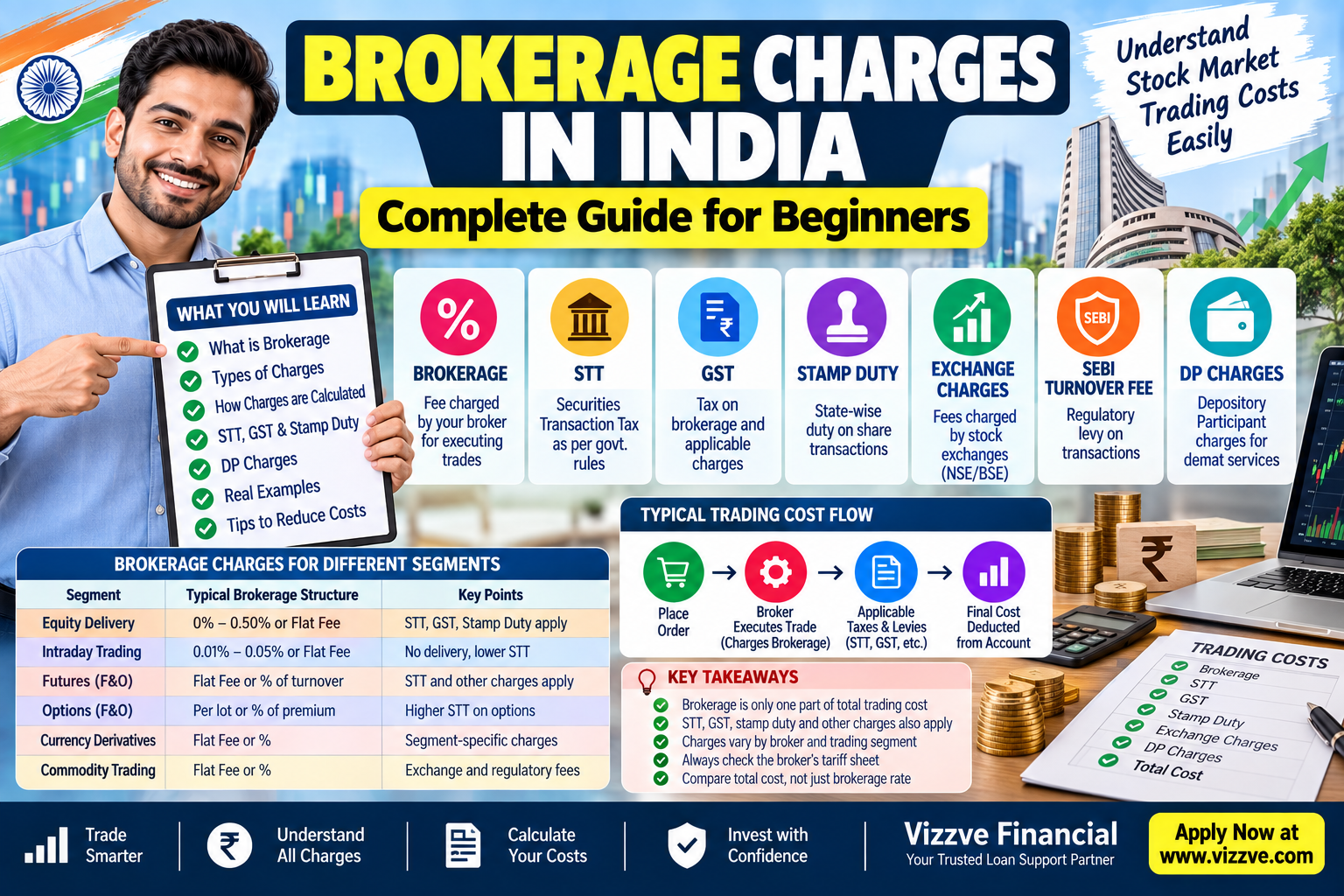
A stock market transaction can involve several components, including brokerage, Securities Transaction Tax (STT), exchange-related charges, SEBI turnover fees, GST, stamp duty and, in some cases, depository participant (DP) charges.
Understanding these costs is important because even a small charge can affect your effective return when you trade frequently.
What are brokerage charges in India?
Brokerage charges are fees charged by a stock broker for executing buy or sell transactions on behalf of an investor.
The actual brokerage depends on the broker, product, trading segment, transaction value and pricing plan. Investors should therefore check the broker's current tariff sheet rather than assuming that every broker follows the same rate.
SEBI requires stock brokers to provide clients with a tariff sheet specifying applicable charges.
Quick answer
Brokerage is only one part of the total cost of trading. Your final trading cost may also include statutory taxes and levies such as STT, GST, stamp duty, exchange transaction charges and SEBI turnover fees. Some transactions may also attract DP charges.
AI Answer Box: Brokerage Charges in India
Brokerage charges in India are fees paid to a stock broker for executing trades in shares, derivatives or other securities.
The amount can be:
- A percentage of transaction value
- A fixed amount per executed order
- A percentage subject to a maximum amount
- A segment-specific charge
- A broker-specific pricing structure
For example, if a broker charges 0.10% brokerage on a ₹50,000 transaction:
Brokerage = ₹50,000 × 0.10% = ₹50
However, the investor's total cost may be higher because brokerage is separate from applicable statutory levies and other transaction charges.
Important: A "zero brokerage" offer does not necessarily mean a trade has zero total cost.
What Is Brokerage in the Stock Market?
A stock broker acts as an intermediary between investors and the securities market. SEBI describes brokers as registered intermediaries that facilitate buying and selling of securities on behalf of investors.
When you place an order through a broker, the broker's trading system sends the order to the relevant exchange.
Depending on the broker and product, the service may involve:
- Order execution
- Trading platform access
- Market information
- Contract notes
- Account statements
- Research services
- Customer support
- Demat-related services
- Other permitted services
The broker may charge brokerage for the execution service according to its disclosed tariff.
Why Do Stock Brokers Charge Brokerage?
Running a stock broking business involves technology, exchange connectivity, compliance, risk management, customer support and operational infrastructure.
Brokerage can therefore represent a source of revenue for the broker.
The pricing model differs from one broker to another.
Some brokers may offer:
- Percentage-based brokerage
- Flat-fee brokerage
- Different pricing for different segments
- Subscription-based plans
- Brokerage-free offers for selected products
- Additional charges for selected services
Therefore, investors should compare the complete cost structure, not just the headline brokerage number.
Types of Brokerage Charges in India
Brokerage can differ according to the type of transaction.
| Trading Segment | Brokerage Structure | Important Cost Considerations |
|---|---|---|
| Equity Delivery | Broker-specific | STT, GST, stamp duty and other levies may apply |
| Intraday Equity | Broker-specific | Brokerage and statutory charges can apply |
| Futures | Broker-specific | Brokerage, STT and other applicable charges |
| Options | Broker-specific | Brokerage may be based on premium/order structure |
| Commodity | Broker-specific | Commodity-specific charges and taxes |
| Currency Derivatives | Broker-specific | Broker and regulatory charges may apply |
The exact charges should always be checked against the broker's current tariff sheet.
Equity Delivery Brokerage Charges
Equity delivery refers broadly to buying shares with the intention of holding them beyond the trading session, with settlement resulting in delivery of securities.
A broker may charge:
- Brokerage
- STT
- Exchange transaction charges
- SEBI turnover fees
- GST on applicable services
- Stamp duty
- DP charges when securities are debited from the demat account, depending on the broker/depository arrangement
For equity delivery, STT is currently 0.10% on both purchase and sale of qualifying equity shares settled by actual delivery, according to NSE's levy information applicable from April 1, 2026.
Example
Suppose you purchase shares worth ₹1,00,000.
Your broker may advertise a low or zero brokerage rate for delivery, but the transaction can still attract applicable statutory charges.
This is why zero brokerage does not automatically mean zero transaction cost.
Intraday Brokerage Charges
Intraday trading involves buying and selling securities during the same trading session without taking delivery of the shares in the normal delivery sense.
Depending on the broker, intraday brokerage may be:
- A percentage of turnover
- A fixed amount per executed order
- A percentage subject to a maximum limit
Example
Suppose:
- Buy value = ₹50,000
- Sell value = ₹50,500
- Total turnover = ₹1,00,500
If the broker charges 0.03%:
Brokerage = ₹1,00,500 × 0.03% = ₹30.15
This is only an illustrative brokerage calculation. Applicable taxes and other charges would be additional.
F&O Brokerage Charges
Futures and Options have a different cost structure from ordinary equity transactions.
Investors should examine:
- Brokerage
- STT
- Exchange transaction charges
- GST
- Stamp duty
- SEBI turnover fees
- Applicable regulatory charges
NSE's current STT information shows that, from April 1, 2026, STT on the sale of an equity option is 0.15% of the option premium, while STT on sale of qualifying equity futures is 0.05%.
These rates are statutory and are separate from the brokerage charged by the broker.
How Is Brokerage Calculated?
There are several common methods.
1. Percentage-Based Brokerage
Formula:
Brokerage = Transaction Value × Brokerage Rate
Example:
Transaction value = ₹2,00,000
Brokerage rate = 0.10%
Brokerage:
₹2,00,000 × 0.10% = ₹200
2. Flat Brokerage
Some brokers use a fixed charge for a qualifying order.
For example, if the applicable brokerage is ₹20 per executed order:
- One executed buy order = ₹20
- One executed sell order = ₹20
- Two executed orders = ₹40
The actual pricing structure depends on the broker.
3. Percentage With a Maximum Cap
A broker may charge a percentage subject to a maximum amount.
For example, a hypothetical pricing model could state:
0.05% or ₹20, whichever is lower.
For a ₹10,000 trade:
0.05% = ₹5
Brokerage = ₹5.
For a ₹1,00,000 trade:
0.05% = ₹50
But if the maximum is ₹20:
Brokerage = ₹20.
Always read the exact terms of the broker's tariff sheet.
Is There a Maximum Brokerage Limit in India?
SEBI's investor FAQ states that the maximum brokerage chargeable by a stock broker for trades executed on a stock exchange is 2.5% of contract value, exclusive of statutory levies. For option contracts, the FAQ states that brokerage is charged on the option premium and is subject to the specified regulatory ceiling.
This should not be confused with the rates actually advertised by individual brokers.
Many brokers charge substantially lower rates depending on their pricing model and the trading segment.
The practical rule for an investor is simple:
Check the current tariff sheet before trading.
Brokerage vs Other Stock Market Charges
One of the biggest mistakes beginners make is treating every deduction from their trading account as brokerage.
They are different.
| Charge | Meaning | Usually Paid To / Collected For |
|---|---|---|
| Brokerage | Fee for broker's trading service | Stock broker |
| STT | Securities Transaction Tax | Government |
| GST | Tax on applicable services | Government |
| Stamp Duty | Duty on specified securities transactions | Government |
| SEBI Turnover Fee | Regulatory levy | SEBI |
| Exchange Transaction Charges | Exchange-related transaction cost | Exchange |
| DP Charge | Depository-related debit/service charge | Depository Participant |
| Other Charges | Depends on service/product | Broker/concerned entity |
NSE's current information lists SEBI turnover fees and applicable stamp-duty and STT rates separately from brokerage.
What Is STT?
STT means Securities Transaction Tax.
It is a tax imposed on specified securities transactions.
For example, NSE's current table shows that qualifying equity shares purchased and sold on delivery basis attract STT of 0.10%, payable by the purchaser on purchase and seller on sale.
STT is not brokerage.
This distinction matters when calculating the actual cost of a trade.
What Is GST on Brokerage?
GST can apply to stock broking services.
CBIC's GST FAQ specifically states that brokerage earned from stock broking services is subject to applicable GST.
In practice, GST is generally charged on taxable brokerage/service components according to the applicable GST rules and rate.
Investors should check the contract note or broker's current tariff for the exact calculation.
What Is Stamp Duty on Stock Market Transactions?
Stamp duty is a statutory charge applicable to specified securities transactions.
NSE's current levy table lists stamp-duty rates for different securities and transaction types. For example, it currently shows 0.015% for transfer of securities other than debentures on delivery basis and 0.003% on non-delivery transactions, with the applicable charge shown as payable by the buyer.
Because rates can differ by instrument and transaction type, investors should not assume that one stamp-duty rate applies to every trade.
What Are SEBI Turnover Fees?
SEBI turnover fees are regulatory charges associated with securities transactions.
NSE currently lists the SEBI turnover fee for transactions in securities other than debt securities at 0.0001% of the transaction value, equivalent to ₹10 per crore.
The amount is small for an individual trade, but it forms part of the overall transaction-cost calculation.
What Are Exchange Transaction Charges?
Stock exchanges charge transaction-related fees for trades executed on their platforms.
The amount can vary according to:
- Exchange
- Segment
- Trading product
- Applicable exchange schedule
- Regulatory changes
These charges are different from brokerage.
Therefore, when comparing two brokers, compare their complete charge structure rather than looking only at the brokerage headline.
What Are DP Charges?
DP means Depository Participant.
A DP provides access to depository services associated with your demat account.
A DP-related debit charge may apply when securities are transferred out of the demat account as part of a sale or another eligible transaction, depending on the DP's tariff.
CDSL's operating instructions, for example, specify a flat charge framework for certain debit transactions from October 1, 2024, with specific exemptions and discounts for certain categories.
However, the amount charged to a customer can depend on the DP's own tariff and applicable taxes.
Brokerage Charges Example: Complete Calculation
Consider a hypothetical equity trade.
Example
You buy shares worth:
₹1,00,000
Assume for illustration:
- Brokerage = ₹20
- Exchange transaction charges = ₹5
- SEBI turnover fee = ₹0.10
- GST and other applicable charges = calculated according to applicable rules
- STT = applicable according to transaction type
- Stamp duty = applicable according to transaction type
- DP charge = potentially applicable when shares are debited on sale
The important lesson is that:
Total trading cost ≠ brokerage alone.
A broker's pricing page might highlight brokerage, but the contract note provides a more complete view of the transaction.
Brokerage Calculation Formula
A simple approach is:
Total Trading Cost
Total Trading Cost = Brokerage + STT + Exchange Charges + SEBI Charges + GST + Stamp Duty + DP Charges + Other Applicable Charges
The exact components depend on the product and transaction.
Effective Cost Percentage
Investors can also calculate:
Effective Cost % = Total Charges ÷ Total Transaction Value × 100
This can be useful when comparing different brokers.
Why Small Brokerage Charges Matter
Suppose an investor makes many trades.
A ₹10 difference per executed order may look insignificant.
But consider:
- 10 orders per month = ₹100
- 100 orders per month = ₹1,000
- 1,000 orders per month = ₹10,000
And this calculation considers only the hypothetical brokerage difference, not taxes or other charges.
Frequent traders should therefore pay close attention to their total transaction costs.
Zero Brokerage: Is It Really Free?
The term zero brokerage can be misleading if interpreted as "zero total cost."
A broker may charge zero brokerage for a particular segment while statutory levies and other charges continue to apply.
Depending on the product, an investor may still encounter:
- STT
- GST
- Stamp duty
- Exchange transaction charges
- SEBI turnover fees
- DP charges
- Account-related fees
- Other applicable service charges
Beginner rule
Always ask: "Zero brokerage for which segment, and what other charges still apply?"
Brokerage Charges for Buying and Selling Shares
The total cost can differ between buying and selling because certain statutory charges apply differently depending on the side of the transaction.
For example, current NSE information shows STT on qualifying delivery-based equity purchases and sales at 0.10%, with the purchaser paying on purchase and seller paying on sale.
DP charges may also become relevant when securities are debited from a demat account.
This means the cost of buying and the cost of selling should not automatically be assumed to be identical.
Brokerage Charges for Intraday vs Delivery
| Feature | Equity Delivery | Intraday |
|---|---|---|
| Holding | Shares are intended to be delivered/held | Position generally closed during session |
| Brokerage | Broker-specific | Broker-specific |
| STT | Delivery-based STT rules apply | Different STT treatment |
| DP Charge | May apply on delivery sale | Generally not the same delivery debit scenario |
| Trading Frequency | Often lower | Can be higher |
| Cost Sensitivity | Important | Extremely important for frequent traders |
The exact charge structure depends on the broker and transaction.
Discount Broker vs Full-Service Broker
The distinction is not simply "cheap vs expensive."
Discount Broker
Typically focuses on:
- Online execution
- Trading platforms
- Competitive pricing
- Self-service investing
- Digital account opening
Full-Service Broker
May offer additional services such as:
- Research
- Advisory-related services where permitted
- Relationship management
- Investment products
- Broader financial services
Comparison
| Factor | Discount Model | Full-Service Model |
|---|---|---|
| Pricing | Often lower for execution | May be higher depending on services |
| Research | May be limited or separately structured | Often broader |
| Customer Support | Primarily digital | May include relationship support |
| Investor Type | Self-directed users | Investors seeking broader services |
| Key Comparison | Total cost + platform | Total cost + services |
The appropriate choice depends on an investor's requirements rather than brokerage alone.
How to Compare Stock Brokers
Do not compare brokers only by asking:
"Who has the lowest brokerage?"
Instead, check:
1. Equity delivery charges
Find out whether delivery trades have brokerage and what other costs apply.
2. Intraday charges
Check percentage rates, order caps and minimum charges.
3. F&O charges
Review futures and options pricing separately.
4. DP charges
Understand charges associated with demat debits.
5. Account maintenance charges
Check whether an annual maintenance charge applies.
6. Call-and-trade charges
Some brokers may charge additional fees for assisted orders.
7. Platform charges
Check whether special platforms, APIs or premium tools have separate fees.
8. Other service charges
Review the complete tariff sheet.
SEBI advises investors to carefully note applicable charges and brokerage, keep records and avoid paying more than the agreed charges.
How to Read a Stock Broker Tariff Sheet
A tariff sheet is one of the most useful documents for a new investor.
Look for:
- Equity delivery brokerage
- Intraday brokerage
- Futures brokerage
- Options brokerage
- Currency charges
- Commodity charges
- DP charges
- AMC
- Account opening charges
- Call-and-trade charges
- Pledge/unpledge charges
- Delayed payment charges
- Other service charges
Expert commentary
A useful way to evaluate a broker is to calculate the expected annual cost based on your actual trading behaviour.
For example, a broker with slightly higher brokerage may still have a different overall cost structure because of other charges or services. Conversely, a low headline brokerage rate may not produce the lowest total cost for every investor.
How to Check Brokerage on a Contract Note
A contract note is an important record of your trade.
Check:
- Trade date
- Security name
- Buy/sell direction
- Quantity
- Price
- Trade value
- Brokerage
- Applicable taxes
- Statutory charges
- Net payable or receivable amount
SEBI advises investors to insist on a valid contract note or confirmation memo and maintain records of their transactions.
If the charges appear different from the agreed tariff, contact the broker and request an explanation.
Step-by-Step: How to Calculate Your Brokerage
Step 1: Identify the segment
Determine whether the trade is:
- Delivery
- Intraday
- Futures
- Options
- Currency
- Commodity
Step 2: Find the broker's rate
Check the current tariff sheet.
Step 3: Calculate transaction value
For a simple equity trade:
Quantity × Price = Transaction Value
Step 4: Calculate brokerage
Apply the broker's pricing formula.
Step 5: Add applicable statutory charges
Include:
- STT
- Stamp duty
- GST
- SEBI turnover fee
- Exchange charges
Step 6: Check for DP charges
This is especially relevant when securities are debited from the demat account.
Step 7: Verify the contract note
Compare the final charge with the broker's disclosed tariff.
Common Brokerage Mistakes Beginners Make
Mistake 1: Looking only at brokerage
A ₹0 brokerage offer does not mean every charge is zero.
Mistake 2: Ignoring taxes
STT, GST and stamp duty can contribute to total transaction costs.
Mistake 3: Trading too frequently
Frequent trading can increase total transaction costs.
Mistake 4: Not reading the tariff sheet
The tariff sheet explains the broker's applicable charges.
Mistake 5: Ignoring DP charges
Investors sometimes discover demat-related charges only after selling holdings.
Mistake 6: Comparing brokers only by advertisements
Marketing claims may highlight one charge while other costs remain separate.
Mistake 7: Not checking contract notes
Contract notes help verify what was actually charged.
Pros and Cons of Understanding Brokerage Charges
Pros
- Helps estimate the true cost of investing
- Makes broker comparison easier
- Helps calculate actual trading profit
- Reduces unexpected charges
- Encourages disciplined trading
- Improves financial awareness
- Makes contract-note verification easier
Cons of Ignoring Brokerage Costs
- Profit calculations may be inaccurate
- Frequent trading can become more expensive
- Small charges can accumulate
- Investors may misunderstand "zero brokerage"
- Unexpected deductions can create confusion
Brokerage Charges and Investment Returns
Brokerage becomes particularly important for short-term trading because the expected price movement may be relatively small compared with the transaction cost.
Suppose an investor buys a stock for ₹100 and sells it for ₹101.
The gross gain is:
₹1 per share
But the investor's actual profit is not simply ₹1.
The investor must account for applicable:
- Brokerage
- STT
- GST
- Exchange charges
- Stamp duty
- SEBI turnover fees
- Other applicable costs
This is why investors should calculate net returns, not only gross price movement.
How to Reduce Brokerage Costs Legally
Investors can manage costs without taking unnecessary risks.
Practical methods
- Compare multiple brokers
- Understand your trading frequency
- Select a pricing plan suitable for your activity
- Avoid unnecessary trades
- Review all applicable charges
- Check contract notes regularly
- Understand DP charges
- Avoid paying charges that were not agreed or disclosed
- Use official broker and exchange information
- Keep proper records
SEBI specifically advises investors not to pay more than the agreed brokerage or charges and not to deal with unregistered brokers or intermediaries.
How to Verify Whether a Stock Broker Is Registered
Before opening an account, investors should verify the broker's regulatory status.
SEBI maintains a recognised-intermediaries database containing registered stock brokers. As of September 25, 2026, the SEBI database listed thousands of registered stock brokers across different segments.
Basic verification process
- Visit the official SEBI website.
- Open the recognised intermediary section.
- Search the broker by name.
- Check the registration details.
- Confirm the relevant market segment.
Do not rely solely on advertisements, social-media claims or messages from unknown representatives.
What Should You Check Before Opening a Trading Account?
Use this checklist:
-
SEBI registration
-
Brokerage rates
-
Delivery charges
-
Intraday charges
-
F&O charges
-
DP charges
-
AMC
-
Account opening charges
-
Call-and-trade charges
-
Other service charges
-
Trading platform reliability
-
Customer support
-
Contract-note process
-
Grievance-redressal process
-
Terms and conditions
The lowest advertised brokerage should not automatically be treated as the most important factor.
Brokerage Calculator: Simple Formula
A basic brokerage calculator can use:
Brokerage
Transaction Value × Brokerage Rate
Total Cost
Brokerage + Applicable Taxes + Statutory Charges + Other Charges
Net Profit
Selling Value − Purchase Value − Total Trading Costs
Example
Purchase value = ₹1,00,000
Selling value = ₹1,02,000
Gross gain = ₹2,000
If total transaction costs are ₹300:
Net gain = ₹2,000 − ₹300 = ₹1,700
This is an illustrative example, not a statement of any particular broker's actual charges.
Real-World Investor Experience: Why Total Cost Matters
A common practical experience among active investors is that the headline brokerage number is easy to remember, while smaller charges are overlooked.
For a person making one long-term investment every few months, the difference between two brokerage plans may have limited practical importance.
For someone executing many trades every week, the cumulative cost can become much more meaningful.
Therefore:
The right comparison depends on how you actually invest or trade.
2026 Brokerage and Regulatory Updates Investors Should Know
The regulatory environment continues to evolve.
SEBI notified the Securities and Exchange Board of India (Stock Brokers) Regulations, 2026 in January 2026. SEBI has also continued issuing circulars affecting stock brokers, technology, compliance and market infrastructure during 2026.
NSE's current levy information reflects Finance Act 2026 changes to STT applicable from April 1, 2026, including higher rates for certain option and futures transactions.
This is an important reason to avoid relying on old blog posts or screenshots when calculating current trading costs.
Always check the latest tariff and statutory levy information before making a transaction.
Key Takeaways
- Brokerage is the fee charged by a broker for specified trading services.
- Brokerage is only one component of total trading costs.
- STT, GST, stamp duty and exchange-related charges are separate from brokerage.
- DP charges may apply to certain demat transactions.
- Brokerage rates vary between brokers and products.
- SEBI requires stock brokers to provide a tariff sheet.
- "Zero brokerage" does not necessarily mean zero total charges.
- Contract notes should be checked after trades.
- Frequent traders should pay close attention to cumulative transaction costs.
- Investors should verify that their broker is registered with SEBI.
- Current statutory rates can change, so use updated official sources.
- Net investment returns should be calculated after applicable transaction costs.
Frequently Asked Questions
1. What are brokerage charges in India?
Brokerage charges are fees charged by a stock broker for executing eligible buy and sell transactions for clients. The amount depends on the broker, trading segment and pricing structure.
2. How is brokerage calculated?
Brokerage can be calculated as a percentage of transaction value, a fixed amount per order, or according to another broker-specific pricing model.
3. Is brokerage charged on both buying and selling?
It depends on the broker's pricing structure and the particular transaction. Investors should check the applicable tariff for both buy and sell orders.
4. Is zero brokerage really free?
No. Zero brokerage generally means the broker does not charge brokerage for a specified product or transaction. Statutory taxes and other applicable charges may still apply.
5. What is the difference between brokerage and STT?
Brokerage is a broker's charge for its service. STT is a statutory Securities Transaction Tax applicable to specified securities transactions.
6. What is GST on brokerage?
GST is applicable to taxable stock broking services according to the applicable GST rules. It can increase the amount payable on brokerage and other taxable service components.
7. What are DP charges?
DP charges are charges associated with depository participant services. They may apply when securities are debited from a demat account, depending on the transaction and DP tariff.
8. Are brokerage charges the same for every broker?
No. Brokers can have different pricing structures and charges. Investors should compare the current tariff sheets.
9. What is intraday brokerage?
Intraday brokerage is the brokerage charged for eligible trades where positions are opened and closed within the trading session. The rate depends on the broker.
10. What is equity delivery brokerage?
It is the brokerage applicable to qualifying equity transactions resulting in delivery of shares. Some brokers may offer low or zero brokerage for certain delivery transactions, subject to their terms.
11. How can I check my brokerage charges?
Review your broker's tariff sheet and compare it with the brokerage shown on your contract note.
12. What is a stock broker tariff sheet?
A tariff sheet is a document provided by the broker that specifies applicable brokerage and other charges. SEBI requires brokers to provide such information to clients.
13. How can I reduce brokerage costs?
Compare brokers, understand your trading pattern, avoid unnecessary trades and select a pricing structure that suits your actual activity.
14. Does brokerage affect investment returns?
Yes. Brokerage and other transaction costs reduce the amount of money you retain from a trade, so net returns should be calculated after applicable costs.
15. Where can I verify whether a stock broker is registered?
Investors can use SEBI's recognised-intermediaries database to verify registered stock brokers.
Published on : 27th September
Published by : G REDDY KUMAR
www.vizzve.com || www.vizzveservices.com
Follow us on social media: Facebook || Linkedin || Instagram
🛡 Powered by Vizzve Financial
RBI-Registered Loan Partner | 10 Lakh+ Customers | ₹600 Cr+ Disbursed