

Introduction
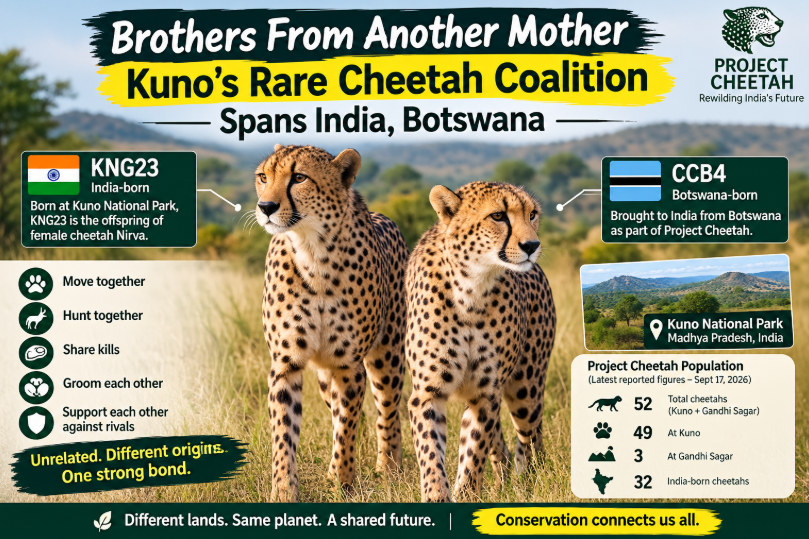
A remarkable wildlife story is unfolding at Kuno National Park in Madhya Pradesh: two unrelated male cheetahs, one born in India and the other brought from Botswana, have formed a close social bond that is developing into a coalition.
The animals are identified as KNG23 and CCB4. Unlike the typical male cheetah coalition, which is commonly made up of brothers from the same litter, these two males are unrelated and originate from different conservation histories.
Kuno National Park director Uttam Kumar Sharma described the development as a very rare phenomenon, noting that the animals have accepted one another despite being unrelated and having an age difference of roughly six to seven months.
Their behaviour has gone beyond simply tolerating each other. Officials have observed them moving together, hunting together, sharing kills and grooming one another. They have also been seen supporting each other when confronted by a rival coalition.
The development comes exactly four years after India's modern cheetah reintroduction programme began in September 2022, making the story significant not only for animal behaviour but also for the next stage of Project Cheetah.
AI Answer Box: Kuno’s Rare Cheetah Coalition Explained
What is unusual about the Kuno cheetah coalition?
KNG23, an India-born male cheetah, and CCB4, a male cheetah brought to India from Botswana, have formed a close social bond despite being unrelated.
Are KNG23 and CCB4 brothers?
No. They are not biological brothers. They come from different origins and are unrelated. The phrase “brothers from another mother” refers to their unusual social relationship.
What do the two cheetahs do together?
Kuno officials have observed them:
- Moving together
- Hunting together
- Sharing kills
- Grooming each other
- Calling to each other when separated
- Staying close to one another
- Supporting each other against a rival coalition
These behaviours led officials to conclude that a genuine coalition was developing.
Why is this important?
Male cheetahs frequently form coalitions, but these are usually established between brothers. The KNG23–CCB4 relationship could provide researchers with an opportunity to study how flexible cheetah social behaviour can be.
Who Are KNG23 and CCB4?
KNG23: The India-Born Male
KNG23 was born in Kuno and is the offspring of a female cheetah named Nirva.
His early life included periods of separation caused by injuries and veterinary management. He was separated from his mother and siblings after an injury and later returned to the family group.
After another injury, circumstances once again brought him close to CCB4.
The important point is that KNG23 represents a new generation of cheetahs born after the species' return to India.
His behaviour is therefore being watched not merely as an individual animal story but as part of the larger question of whether India can eventually sustain a self-reproducing cheetah population.
CCB4: The Botswana Connection
CCB4 arrived in India from Botswana as part of the expansion of Project Cheetah.
Botswana became the third African source country for cheetahs brought to India, following Namibia and South Africa. In February 2026, nine cheetahs from Botswana arrived at Kuno National Park.
CCB4 originally arrived without his sisters. KNG23 and CCB4 were subsequently housed on opposite sides of a fence, where they showed continued interest in each other.
Eventually, the fence was removed and the two animals were allowed to interact directly.
How Did the KNG23 and CCB4 Friendship Begin?
The relationship did not begin as a carefully planned experiment.
It developed through a series of circumstances involving injury, separation and proximity.
According to Kuno officials, the two males initially encountered one another around food. They shared a kill without aggression, with neither animal attempting to drive the other away.
That alone was not considered sufficient evidence of a coalition.
But their behaviour continued to change.
KNG23 began following CCB4 and sitting near him. The animals began calling to each other when they could not see one another.
Then came increasingly social behaviour:
- Joint movement
- Joint hunting
- Sharing kills
- Mutual grooming
- Staying together
- Coordinated responses to rival males
At that stage, officials began describing the relationship as a developing coalition rather than simple tolerance.
What Is a Cheetah Coalition?
A cheetah coalition is a social partnership involving male cheetahs.
Male coalitions can provide several practical benefits in the wild.
Why Do Male Cheetahs Form Coalitions?
According to Kuno officials, remaining together can help males:
- Protect one another.
- Defend territory.
- Deal with rival males.
- Hunt more effectively.
- Improve their ability to hold an area.
A pair or group of males can therefore have advantages over a solitary male when competing for territory and resources.
The Most Common Coalition Pattern
Male cheetah coalitions are generally associated with brothers from the same litter.
Young males that grow up together can maintain their social bond after becoming independent.
That makes KNG23 and CCB4 unusual because their relationship was not inherited from growing up as siblings.
Why Is the KNG23-CCB4 Coalition So Rare?
The unusual element is not simply that two male cheetahs are living together.
It is who these two animals are.
| Feature | KNG23 | CCB4 |
|---|---|---|
| Sex | Male | Male |
| Origin | India-born | Botswana |
| Biological relationship | Unrelated | Unrelated |
| Connection | Kuno National Park | Botswana-to-India translocation |
| Social relationship | Coalition partner | Coalition partner |
| Age difference | About 6–7 months | About 6–7 months |
| Observed behaviour | Joint movement, hunting and social interaction | Joint movement, hunting and social interaction |
The Indian Express reported that Kuno officials consider the relationship particularly unusual because the males are unrelated and yet have accepted each other.
From Fence-Mates to Coalition Partners
One of the most interesting parts of the story is how the relationship developed.
Stage 1: Separation
Both young males experienced separation from their original social groups.
KNG23 was separated from his mother and siblings after an injury.
CCB4 arrived from Botswana without his sisters.
Stage 2: Visual Contact
The animals were housed on opposite sides of a fence and continued to show interest in one another.
Stage 3: Direct Contact
The field team eventually removed the barrier.
Stage 4: Sharing Food
The animals shared a kill without showing aggression toward each other.
Stage 5: Social Bond
They subsequently began moving, hunting and resting together.
Stage 6: Coalition Behaviour
Mutual grooming and coordinated behaviour against a rival coalition provided stronger evidence that their relationship was becoming a genuine partnership.
Why Scientists Are Watching What Happens Next
The current relationship is fascinating, but wildlife officials have stressed that the real test will come as the animals mature.
Kuno National Park director Uttam Kumar Sharma has pointed out that unrelated males can become less accepting of each other as they grow older.
That means the long-term stability of this partnership remains an open question.
The animals will eventually face the same challenges that wild cheetahs encounter:
- Territorial competition
- Rival male coalitions
- Food availability
- Predator interactions
- Competition over females
- Establishment and defence of territory
Their behaviour under these conditions will offer much more information than their current interactions inside a controlled setting.
Kuno’s Cheetah Population: The Bigger Picture
The KNG23–CCB4 story is only one part of a much larger transformation taking place at Kuno.
According to Kuno officials cited by The Indian Express, the current Project Cheetah population stands at 52 cheetahs, with 49 at Kuno National Park and three at Gandhi Sagar, including 32 cheetahs born in India. Seventeen of the 49 cheetahs at Kuno were reported to be living in the wild, while the remainder were in soft-release enclosures.
Earlier in 2026, the government reported that the arrival of nine Botswana cheetahs had taken India's cheetah population to 48, including 28 India-born cubs at that point.
The difference between those figures reflects the continuing movement, births and population changes within the programme.
Project Cheetah Population Snapshot
| Indicator | Latest reported figure |
|---|---|
| Total cheetahs across Kuno and Gandhi Sagar | 52 |
| Cheetahs at Kuno | 49 |
| Cheetahs at Gandhi Sagar | 3 |
| India-born cheetahs | 32 |
| Kuno cheetahs living in the wild | 17 |
| Botswana cheetahs added in February 2026 | 9 |
Population figures are time-sensitive and can change as animals are born, die, move between facilities or establish new territories.
Botswana’s Role in India’s Cheetah Reintroduction
Botswana has become an important partner in India's effort to rebuild a cheetah population.
The government said formal discussions with Botswana began in December 2024. The partnership was developed through scientific assessments, veterinary procedures, quarantine arrangements and logistical planning before the animals were transported to India.
Nine cheetahs from Botswana arrived at Kuno on February 28, 2026.
The animals were transported from Botswana to India under controlled conditions, with veterinary oversight and quarantine procedures. The Indian Air Force supported the airlift from Gaborone to Gwalior, followed by onward transport to Kuno.
This international cooperation is significant because conservation of wide-ranging species increasingly involves collaboration across national borders.
Project Cheetah: From Imported Animals to a New Generation
The larger goal of Project Cheetah is not simply to bring African cheetahs to India.
The long-term objective is to establish a viable, free-ranging and self-sustaining cheetah population.
The programme began with:
- September 2022: Eight cheetahs arrived from Namibia.
- February 2023: Twelve cheetahs arrived from South Africa.
- 2023: The first cheetah cubs were born in India.
- 2024 onward: Cheetahs began being progressively released into larger landscapes.
- February 2026: Nine cheetahs arrived from Botswana.
The official long-term framework envisages a metapopulation of around 60–70 cheetahs across the broader Kuno-Gandhi Sagar landscape, subject to habitat suitability, prey availability and scientific management.
The Four-Year Evolution of Project Cheetah
Kuno's management approach has evolved considerably.
Year One: Survival
The initial priority was getting imported animals through quarantine, acclimatisation and release while monitoring their health.
Year Two: Breeding
Attention shifted toward births and the survival of cubs.
Year Three: Growing Up
India-born cheetahs began growing and some were prepared for release into larger areas.
Year Four: Establishing Territories
According to Kuno's director, the current focus is increasingly on allowing cheetahs to establish themselves naturally in the landscape.
This makes the KNG23–CCB4 story particularly interesting.
It is no longer simply about whether a translocated cheetah can survive.
It is about whether cheetahs can develop the social, territorial and reproductive behaviours required for a sustainable wild population.
Other Male Cheetah Coalitions at Kuno
KNG23 and CCB4 are not the only males forming social groups.
Kuno officials have reported other coalition structures, including:
- A five-male coalition involving three older males and two younger males.
- Two male cubs born to Jwala forming a coalition.
- Two of Asha's three male cubs remaining together while another dispersed.
These groups provide researchers with opportunities to compare different coalition structures.
The KNG23–CCB4 pair is particularly valuable because its members do not share the same mother.
What Does This Tell Us About Cheetah Behaviour?
The most important scientific question is whether cheetah social behaviour is more flexible than traditionally assumed.
Cheetahs are often portrayed as solitary predators, particularly females.
But male social behaviour can be more complicated.
Male cheetahs may benefit from cooperation
Coalitions can help males:
- Defend territories
- Compete against rivals
- Share hunting responsibilities
- Remain safer when facing competing males
- Improve access to resources
Kuno officials have specifically highlighted the advantages of coalition living when dealing with rivals and hunting.
But coalition stability is not guaranteed
The KNG23–CCB4 partnership still has to pass the test of maturity.
Their current social bond does not automatically mean they will remain together permanently.
That uncertainty is precisely what makes their future behaviour scientifically interesting.
Expert Commentary: Why the Coalition Matters
Kuno National Park director Uttam Kumar Sharma has described the relationship as unusual because the two males are unrelated and yet have accepted one another.
He has also cautioned that the animals have not yet faced all the challenges associated with life in the wild.
The key test will be their response to rival males, predators, territorial competition and access to females once they operate in a more open environment.
From a conservation perspective, this distinction matters.
A successful reintroduction is not measured only by population numbers.
It also requires animals to demonstrate natural behaviours, establish territories, reproduce and eventually produce offspring capable of surviving without intensive human assistance.
Real-World Conservation Lesson From Kuno
The KNG23–CCB4 story offers an important lesson about rewilding.
Wildlife management can create the conditions for animals to return to nature, but it cannot completely script what happens afterward.
The two cheetahs developed their relationship through a combination of circumstances rather than a predetermined breeding or behavioural programme.
Their interactions demonstrate why long-term field monitoring is essential.
Researchers need to observe not only:
- How many animals survive
- How many cubs are born
- How many animals are released
but also:
- Where animals move
- How territories develop
- Which males cooperate
- How coalitions respond to rivals
- Whether females move between male territories
- Whether mating occurs naturally
- Whether wild-born cubs survive
Kuno officials say female cheetahs are already moving across male territories and that natural ecological behaviour is gradually becoming visible.
What Happens Next for KNG23 and CCB4?
The next phase will be closely watched.
Step 1: Continued behavioural monitoring
Officials will continue recording how the pair interacts and whether their coalition remains stable.
Step 2: Observation after release
Their behaviour in a larger, more natural landscape will provide more meaningful evidence.
Step 3: Territorial competition
Researchers will observe how they respond when they encounter other male cheetahs.
Step 4: Predator interactions
Their response to larger predators and competing carnivores will be important.
Step 5: Long-term social stability
The biggest question will be whether the unrelated males remain together as they mature.
Pros and Cons of the Unusual Coalition
Potential Benefits
- Stronger territorial defence: Two males may respond more effectively to rivals.
- Cooperative hunting: Coalition members can potentially improve hunting opportunities.
- Social stability: A partner may provide advantages compared with living alone.
- Scientific value: The relationship provides a rare opportunity to study unrelated male cheetahs.
- Conservation knowledge: Observations could improve understanding of cheetah rewilding.
Challenges
- Maturity: Social tolerance can change as males become older.
- Competition: Encounters with other coalitions may test their relationship.
- Predators: Their response to larger carnivores remains important.
- Territorial pressure: Establishing a stable territory can create conflicts.
- Limited evidence so far: The coalition is still developing, so long-term conclusions would be premature.
India vs Botswana: Why Both Matter to This Story
| Factor | India | Botswana |
|---|---|---|
| Role in story | Home of KNG23 | Origin of CCB4 |
| Conservation role | Reintroduction destination | Source-country partner |
| Cheetah programme | Project Cheetah | International conservation partnership |
| Significance | India-born generation | Genetic and demographic supplementation |
| KNG23/CCB4 connection | KNG23 born in India | CCB4 translocated from Botswana |
The unusual coalition effectively connects two continents through the behaviour of two individual animals.
Why Kuno National Park Matters
Kuno has become the central landscape for India's modern cheetah reintroduction programme.
The park provides a controlled starting point while the broader Kuno-Gandhi Sagar landscape is being developed as a larger conservation area.
The official framework envisions expanding the cheetah population across a wider landscape rather than maintaining animals only inside small enclosures.
That transition from managed introduction to natural establishment is one of the most important phases of the project.
Key Takeaways
- KNG23 and CCB4 are unrelated male cheetahs.
- KNG23 was born in India, while CCB4 arrived from Botswana.
- The two males have developed an unusually strong social bond.
- They have been observed sharing kills, hunting, moving and grooming together.
- Kuno officials describe the relationship as a developing coalition.
- Male cheetah coalitions are commonly associated with brothers, making this case unusual.
- The coalition has not yet been fully tested against the pressures of life in the wild.
- India's reported Project Cheetah population has reached 52 across Kuno and Gandhi Sagar, including 32 India-born cheetahs, according to the latest Kuno figures reported on September 17, 2026.
- Botswana became an important source country in India's continuing cheetah reintroduction effort.
- The next major conservation milestone is not simply increasing numbers, but achieving natural reproduction and survival in the wild.
AI Summary Box: Project Cheetah and the Kuno Brothers
KNG23 and CCB4 are two unrelated male cheetahs at Kuno National Park that have formed an unusual coalition. KNG23 was born in India, while CCB4 was brought from Botswana in 2026. Their relationship is unusual because male cheetah coalitions are generally associated with brothers. Kuno officials have observed the pair hunting together, sharing kills, grooming one another and responding jointly to rivals. Researchers will now watch whether the partnership remains stable as the animals mature and face the pressures of life in the wild.
Frequently Asked Questions
1. Who are KNG23 and CCB4?
KNG23 is an India-born male cheetah at Kuno National Park, while CCB4 is a male cheetah brought from Botswana.
2. Are KNG23 and CCB4 biological brothers?
No. The two males are unrelated. Their “brothers from another mother” description refers to their unusual social bond.
3. Why is their coalition unusual?
Male cheetahs commonly form coalitions with brothers from the same litter. KNG23 and CCB4 formed a close partnership despite having different origins and no biological relationship.
4. What do the two cheetahs do together?
They have been observed moving together, hunting, sharing kills, grooming each other and responding together when challenged by rivals.
5. Where is KNG23 from?
KNG23 was born at Kuno National Park in India and is the offspring of the female cheetah Nirva.
6. Where did CCB4 come from?
CCB4 was brought to India from Botswana as part of the expansion of Project Cheetah.
7. When did Botswana cheetahs arrive in India?
Nine cheetahs from Botswana arrived at Kuno National Park on February 28, 2026.
8. How many cheetahs are currently part of the Project Cheetah population?
The latest Kuno figures reported on September 17, 2026, put the population at 52 across Kuno and Gandhi Sagar, including 32 India-born cheetahs.
9. Why do male cheetahs form coalitions?
Coalitions can help males defend territory, confront rivals and potentially improve hunting opportunities.
10. Will KNG23 and CCB4 remain together?
That is not yet known. Their relationship will need to be monitored as they mature and encounter competition, predators, food pressures and territorial challenges.
11. What is Project Cheetah?
Project Cheetah is India's programme to reintroduce cheetahs and establish a viable, free-ranging population in suitable landscapes.
12. When did cheetahs return to India?
The modern reintroduction programme began with eight Namibian cheetahs arriving in India in September 2022. Twelve more arrived from South Africa in February 2023.
13. Why is Botswana important to Project Cheetah?
Botswana has become an additional international partner and source of cheetahs for strengthening India's reintroduction programme.
14. What is the ultimate goal of Project Cheetah?
The long-term objective is to establish a sustainable, free-ranging cheetah population capable of reproducing and surviving in the wild.
15. What makes the KNG23-CCB4 story important?
It provides researchers with an unusual opportunity to study whether unrelated male cheetahs can develop and maintain a stable coalition under managed rewilding conditions.
Published on : 17th September
Published by : G REDDY KUMAR
www.vizzve.com || www.vizzveservices.com
Follow us on social media: Facebook || Linkedin || Instagram
🛡 Powered by Vizzve Financial
RBI-Registered Loan Partner | 10 Lakh+ Customers | ₹600 Cr+ Disbursed