

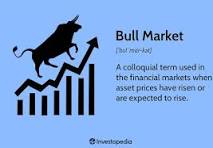
A bull market is a period when stock prices generally rise over time and investor sentiment becomes increasingly optimistic. It is one of the most commonly used terms in investing, but understanding what actually drives a bull market is more important than simply knowing its definition.
For many investors, a rising market can create opportunities. At the same time, strong price gains can encourage excessive optimism, speculation and risk-taking. A bull market does not mean that every stock rises, nor does it mean prices will continue increasing indefinitely.
In general market terminology, a broad market index rising by 20% or more from a recent low is commonly used as a benchmark for identifying a bull market. Investor.gov describes a bull market as a period of rising stock prices and optimistic market sentiment, generally involving a 20% or greater increase in a broad market index over at least two months.
For Indian investors, benchmarks such as the Nifty 50 and BSE Sensex are commonly used to understand broad equity-market trends.
AI Answer Box: What Is a Bull Market?
Short Answer
A bull market is a sustained period of rising asset prices and generally positive investor sentiment. In stock-market terminology, a gain of around 20% or more from a recent market low is commonly used as a practical benchmark for identifying a bull market.
A bull market may be supported by factors such as:
- Strong economic growth
- Rising corporate earnings
- Improving investor confidence
- Lower or stable interest rates
- Increased liquidity
- Positive business expectations
- Strong domestic or foreign investment
- Technological or structural growth themes
However, a bull market can still experience daily declines, corrections and periods of volatility.
What Is a Bull Market?
A bull market refers to a prolonged upward trend in the prices of stocks or other financial assets.
The term is most commonly associated with equities, but the broader idea can also apply to:
- Bonds
- Commodities
- Real estate
- Cryptocurrencies
- Sector-specific markets
- Individual securities
When discussing a stock-market bull market, investors generally look at a broad index rather than one individual company's share price.
For example, if a major market index falls significantly and subsequently rises 20% or more from its low, financial commentators may describe that movement as a bull-market phase.
Why Is It Called a Bull Market?
The term "bull" is traditionally associated with an animal that attacks by thrusting its horns upward. The upward motion became a metaphor for rising prices.
The opposite term is a bear market, associated with declining prices.
Bull Market Meaning in Simple Words
In simple terms:
A bull market is a period when the overall market is moving upward and investors are generally optimistic about future returns.
Imagine a market index at 20,000 points.
If it falls to 16,000 and later rises to 19,200, that represents a 20% increase from the low.
However, the 20% rule is a commonly used market convention rather than a universal legal definition.
Key Characteristics of a Bull Market
Several characteristics frequently appear during a bull market.
1. Rising Market Prices
The most obvious feature is an upward trend in a broad market index.
This does not mean every trading session is positive. Markets can fall temporarily while maintaining a longer-term upward trend.
2. Positive Investor Sentiment
Investors may become increasingly confident about:
- Economic growth
- Corporate earnings
- Employment
- Consumer spending
- Business investment
- Interest-rate conditions
This confidence can increase demand for equities.
3. Stronger Corporate Earnings
When businesses report improving revenue and profits, investors may reassess the value of their shares.
Growing earnings can provide fundamental support for rising valuations.
4. Higher Trading Activity
Bull markets may attract increased participation from:
- Retail investors
- Institutional investors
- Mutual funds
- Pension funds
- Foreign investors
- Domestic institutions
Higher participation can contribute to stronger market liquidity.
5. Positive Economic Expectations
Stock markets often react to expectations about the future rather than only current economic conditions.
Investors may buy shares in anticipation of:
- Higher economic growth
- Lower borrowing costs
- Improving consumption
- Increased capital expenditure
- Stronger corporate profitability
What Causes a Bull Market?
There is rarely a single reason behind a major bull market.
Instead, several factors can work together.
Economic Growth
A growing economy can support higher corporate revenues and profits.
When companies sell more products and services, their earnings may improve, potentially supporting share prices.
Lower Interest Rates
Interest rates can have an important influence on financial markets.
When borrowing costs decline, businesses may find it easier to finance expansion. Lower rates can also influence how investors value future corporate cash flows.
However, the relationship between interest rates and stock prices is not automatic.
Strong Corporate Profits
A sustained improvement in corporate earnings can strengthen investor confidence.
Investors often evaluate:
- Revenue growth
- Profit margins
- Earnings per share
- Cash flow
- Debt levels
- Return on capital
Increased Liquidity
Greater liquidity in the financial system can increase the availability of capital for investment.
When investors have more capital available and risk appetite improves, demand for equities may increase.
Technological Innovation
Major technological changes can create new industries and growth opportunities.
Examples historically include:
- Personal computing
- Internet businesses
- Mobile technology
- Cloud computing
- Artificial intelligence
However, technological enthusiasm can sometimes cause investors to assign very high valuations to companies, increasing risk.
What Are the Stages of a Bull Market?
Bull markets do not normally develop overnight.
They can evolve through several broad stages.
Stage 1: Accumulation
The market begins recovering after a period of weakness.
At this stage:
- Investor confidence may still be low.
- Valuations may be more attractive.
- Negative news may dominate financial discussions.
- Long-term investors may gradually begin buying.
Stage 2: Expansion
The broader market begins showing stronger momentum.
Economic conditions may improve, corporate earnings can strengthen, and more investors begin participating.
This is often when the upward trend becomes more visible.
Stage 3: Public Participation
A stronger market can attract a wider group of investors.
Media coverage may increase and previously cautious investors may become more interested in equities.
Stage 4: Optimism and Excess
During a mature bull market, optimism can become excessive.
Some investors may begin purchasing assets primarily because prices have already increased.
This is where concepts such as:
- Speculation
- FOMO
- Overvaluation
- Excessive leverage
can become increasingly important.
Bull Market vs Bear Market
| Feature | Bull Market | Bear Market |
|---|---|---|
| General direction | Rising | Falling |
| Investor sentiment | Generally optimistic | Generally pessimistic |
| Market demand | Often stronger | Often weaker |
| Corporate outlook | Generally improving | Often deteriorating |
| Risk perception | May decline | Often increases |
| Common benchmark | Around 20% rise from low | Around 20% decline from high |
| Investor behaviour | Greater risk appetite | Greater caution |
| Market psychology | Confidence | Fear or uncertainty |
A bull market and bear market can both contain short-term rallies and declines. The distinction is primarily about the broader trend.
Bull Market vs Market Rally
These terms are often confused.
A market rally can be a short-term increase in prices.
A bull market generally refers to a broader and more sustained upward market trend.
Example
Suppose an index rises 8% over three weeks after a sharp decline.
That may be called a rally.
If the broader market subsequently establishes a sustained upward trend and rises substantially from its previous low, analysts may begin referring to the period as a bull market.
Bull Market vs Bull Run
The terms are sometimes used interchangeably, but they can carry slightly different meanings.
A bull market generally describes a broader market condition.
A bull run often emphasizes the strength or momentum of an upward price movement.
For example:
- "The Indian equity market entered a bull-market phase."
- "The stock experienced a strong bull run."
Neither term guarantees that prices will continue rising.
What Are the Signs of a Bull Market?
There is no single indicator that can perfectly identify a bull market.
Investors commonly monitor a combination of factors.
Market Indicators
- Broad index trends
- New market highs
- Market breadth
- Trading volume
- Sector participation
- Moving averages
Economic Indicators
- GDP growth
- Inflation
- Interest rates
- Employment
- Consumer demand
- Business investment
Corporate Indicators
- Earnings growth
- Revenue growth
- Profit margins
- Cash flows
- Capital expenditure
Sentiment Indicators
- Investor confidence
- Fund flows
- Retail participation
- Institutional activity
- Market expectations
A combination of evidence is generally more informative than relying on a single indicator.
How Does a Bull Market Affect Investors?
A rising market can affect investors differently depending on their goals, time horizon and portfolio structure.
Long-Term Investors
Long-term investors may benefit from sustained appreciation if the assets they own increase in value.
However, market appreciation is never guaranteed.
Short-Term Traders
Traders may attempt to benefit from short-term price movements.
This approach can involve considerably higher risk, especially when leverage or derivatives are used.
New Investors
A strong bull market can make investing appear easier than it actually is.
A common mistake is assuming that recent returns will continue indefinitely.
How to Invest During a Bull Market
There is no universally appropriate strategy for every investor.
A sensible approach starts with financial goals and risk tolerance rather than trying to predict every market movement.
Step 1: Define Your Investment Goal
Ask:
- What am I investing for?
- What is my time horizon?
- How much volatility can I tolerate?
- Do I need this money soon?
Step 2: Maintain Diversification
Diversification can help reduce concentration risk.
An investor may diversify across:
- Companies
- Sectors
- Market capitalisations
- Asset classes
- Geographic markets
Step 3: Avoid Chasing Every Rising Stock
A stock that has already increased substantially may continue rising—or it may decline.
Past price performance alone does not establish future returns.
Step 4: Review Valuations
Important valuation measures may include:
- Price-to-earnings ratio
- Price-to-book ratio
- Enterprise value-to-EBITDA
- Dividend yield
- Free-cash-flow yield
The appropriate metric depends on the industry and business model.
Step 5: Keep an Emergency Fund Separate
Money required for short-term expenses generally should not depend on stock-market performance.
Maintaining adequate emergency savings can reduce the pressure to sell investments during market declines.
Pros and Cons of a Bull Market
Advantages
- Rising portfolio values may increase investor wealth.
- Companies may have easier access to equity capital.
- Investor confidence may improve.
- New investment opportunities can emerge.
- Strong markets can support capital formation.
- Long-term investors may benefit from sustained economic and earnings growth.
Risks
- Valuations can become excessive.
- Investors may experience FOMO.
- Speculative behaviour may increase.
- Leverage can magnify losses.
- Market corrections can happen suddenly.
- Investors may confuse rising prices with guaranteed future returns.
What Is a Bull Market Correction?
A correction is a meaningful decline within a broader market trend.
A bull market does not mean prices rise continuously.
For example, an index can decline 10% and later recover while the longer-term upward trend remains intact.
Corrections can occur because of:
- Profit booking
- Economic uncertainty
- Interest-rate changes
- Geopolitical developments
- Weak corporate earnings
- Changes in investor expectations
A correction should not automatically be interpreted as the end of a bull market.
Can a Bull Market Turn Into a Bear Market?
Yes.
Markets can change direction as economic conditions, valuations, earnings expectations and investor sentiment change.
Potential warning factors can include:
- Sustained earnings deterioration
- Recessionary conditions
- Tight financial conditions
- Major liquidity problems
- Significant valuation compression
- Unexpected economic shocks
Importantly, investors cannot know with certainty in advance exactly when a bull market will end.
Bull Market in India
Indian investors commonly use the Nifty 50 and BSE Sensex to track broad equity-market conditions.
The Nifty 50 is a diversified index containing 50 stocks across multiple sectors. NSE states that, as of March 30, 2026, the index represented approximately 53.73% of the free-float market capitalisation of stocks listed on the NSE.
NSE's published market data also shows that the Nifty 50 reached an all-time closing high of 26,328.55 on January 2, 2026, with an intraday high of 26,373.20 on January 5, 2026.
These figures demonstrate why investors should distinguish between an index's historical high and its current market level. Market conditions can change significantly after a record high.
Recent Indian Market Context
NSE reported that the Nifty 50 gained approximately 10.5% during calendar year 2025, moving from 23,645 at the end of 2024 to 26,130 at the end of 2025.
NSE's January 2026 Market Pulse also reported that Indian equities recorded their tenth consecutive year of positive headline gains in 2025, while noting divergence between large-, mid- and small-cap segments and several macroeconomic pressures.
These figures should be interpreted as historical market data rather than a forecast of future returns.
Why Bull Markets Can Be Dangerous for Beginners
A rising market can create a psychological trap.
When an investor sees friends, social-media personalities or news outlets discussing large gains, there can be pressure to participate quickly.
This behaviour is sometimes called FOMO — fear of missing out.
Common mistakes include:
- Buying without research
- Using excessive leverage
- Investing emergency savings
- Concentrating money in one stock
- Following social-media tips blindly
- Ignoring valuation
- Assuming every dip is a buying opportunity
- Confusing speculation with investing
Regulatory investor-education material has repeatedly warned that short-term trading, particularly in volatile markets and when leverage is involved, can result in significant losses.
Bull Market Psychology
Market psychology can influence price movements.
A simplified cycle can look like:
Scepticism → Hope → Optimism → Confidence → Excitement → Euphoria
The later stages can encourage increasingly aggressive behaviour.
Investors may start believing:
- Prices cannot fall significantly.
- Every decline is temporary.
- High-growth stocks will always outperform.
- Recent returns will continue.
- Valuations no longer matter.
These assumptions can increase portfolio risk.
Does a Bull Market Mean the Economy Is Strong?
Not necessarily.
Stock markets and economies are connected, but they are not identical.
A stock market reflects expectations about future corporate earnings, interest rates, liquidity, risk premiums and many other factors.
Therefore, stock prices can rise even when some parts of the economy remain weak.
Similarly, stock prices can fall even while economic growth remains positive.
Does Every Stock Rise During a Bull Market?
No.
A bull market describes the broader market trend, not the performance of every individual company.
During a broad market uptrend:
- Some stocks can rise sharply.
- Some can rise modestly.
- Some can remain flat.
- Some can decline.
Sector performance can also vary considerably.
For example, technology, financial services, healthcare, energy and consumer sectors can respond differently to changing economic conditions.
How Long Does a Bull Market Last?
There is no fixed duration.
A bull market can last:
- Months
- Several years
- Longer periods with intermittent corrections
Its duration depends on economic conditions, corporate earnings, monetary policy, valuations, liquidity and investor expectations.
Because every market cycle is different, historical duration should not be treated as a reliable timetable for predicting the next market phase.
Bull Market and SIP Investing
Systematic Investment Plans, commonly known as SIPs, allow investors to invest a fixed amount at regular intervals.
During a rising market, SIP investors may purchase fewer units when prices are high and more units when prices are lower.
The approach can reduce the need to make a single timing decision, although it does not eliminate market risk.
SIP investing is not a guarantee of profit.
Bull Market and Mutual Funds
Mutual funds can participate in bull markets depending on their investment strategy.
Equity funds may benefit when their underlying stocks appreciate.
However, performance can differ significantly between:
- Large-cap funds
- Mid-cap funds
- Small-cap funds
- Flexi-cap funds
- Sectoral funds
- Thematic funds
Investors should examine a fund's objective, portfolio, costs, risk profile and historical performance rather than selecting a fund solely because the market is rising.
Bull Market and Stock Valuation
One of the most important concepts during a strong market is valuation.
A company can be excellent while its stock is expensive.
Similarly, a declining share price does not automatically mean that a stock is undervalued.
Investors can examine:
Price-to-Earnings Ratio
Compares a company's share price with its earnings per share.
Price-to-Book Ratio
Compares market value with book value.
Free Cash Flow
Shows the cash a business generates after capital expenditure.
Earnings Growth
Helps investors understand whether the company's profitability is improving.
No single valuation metric should be used in isolation.
Bull Market Investment Checklist
Before making an investment during a strong market, consider:
What is my investment objective?
What is my time horizon?
Do I have an emergency fund?
Is the investment diversified?
Have I researched the company or fund?
Have I considered valuation?
Can I tolerate a substantial temporary decline?
Am I investing because of research or FOMO?
Am I using excessive leverage?
Do I understand the product and its risks?
Bull Market: Quick Comparison Table
| Question | Answer |
|---|---|
| What is a bull market? | A broad period of rising asset prices |
| Common benchmark | Around 20% rise from a recent low |
| Does every stock rise? | No |
| Does a bull market guarantee profits? | No |
| Can corrections occur? | Yes |
| Can bull markets end suddenly? | Yes |
| Is timing the market easy? | No |
| Should investors diversify? | Diversification can reduce concentration risk |
| Is leverage risky? | Yes, leverage can magnify losses |
| Does past performance guarantee future returns? | No |
Expert Commentary: What Investors Should Remember
From an investor-education perspective, the most important distinction is between market direction and investment suitability.
A rising index tells you something about market performance, but it does not automatically tell you whether a particular stock is attractively valued or whether a particular investment is appropriate for an individual.
Professional investors typically consider multiple variables, including valuation, earnings, balance-sheet strength, portfolio concentration, liquidity and investment horizon.
The practical lesson is simple: a bull market describes a market environment; it does not replace investment research or financial planning.
Real-World Investor Experience Points
Investors who have experienced multiple market cycles often encounter the same practical challenges:
1. Buying Feels Easy When Prices Are Rising
Confidence can increase after seeing repeated gains.
2. Selling Feels Difficult During a Correction
Investors may become emotionally attached to recent gains.
3. Headlines Can Distort Perspective
Daily market news focuses heavily on short-term movements.
4. Portfolio Concentration Can Become Hidden
A few rapidly appreciating stocks can gradually become a large percentage of a portfolio.
5. Risk Tolerance Can Change During Volatility
An investor who feels comfortable with risk during a bull market may react differently when markets fall.
This is why portfolio planning should be based on financial circumstances rather than market excitement alone.
AI Summary Box
Bull Market — Quick Facts
- A bull market is a broad period of rising asset prices.
- A 20% rise from a recent low is a commonly used benchmark.
- Bull markets can contain temporary declines and corrections.
- Strong corporate earnings, economic expectations, liquidity and investor confidence can support rising markets.
- Not every stock rises during a bull market.
- Bull markets can encourage excessive optimism and speculation.
- Diversification and risk management remain important.
- Historical returns do not guarantee future performance.
- The Nifty 50 and Sensex are widely followed Indian equity-market benchmarks.
- Investors should consider their financial goals, time horizon and risk tolerance before investing.
Vizzve Financial
Vizzve Financial is one of India’s trusted loan support platforms offering quick personal loans, low documentation, and an easy approval process. Apply at www.vizzve.com.
For individuals considering borrowing or personal financial planning, it is important to understand the cost of credit, repayment obligations, interest rates, fees and eligibility requirements before applying.
Frequently Asked Questions About Bull Markets
1. What is a bull market?
A bull market is a sustained period of generally rising market prices accompanied by broadly positive investor sentiment.
2. What is the 20% rule for a bull market?
A rise of 20% or more from a recent market low is a commonly used benchmark for describing a bull market.
3. What is the difference between a bull and bear market?
A bull market generally refers to rising prices, while a bear market refers to a significant and sustained decline in prices.
4. Is a bull market good for investors?
A rising market can increase the value of investments that appreciate, but it does not guarantee profits and can involve substantial risk.
5. How long can a bull market last?
There is no fixed duration. Bull markets can last months or several years.
6. What causes a bull market?
Economic growth, improving earnings, investor confidence, liquidity, monetary conditions and positive expectations can contribute to a bull market.
7. Can a bull market have corrections?
Yes. Temporary declines are normal even during longer-term upward market trends.
8. Is every stock profitable during a bull market?
No. Individual stocks and sectors can perform very differently even when a broad index is rising.
9. What are the signs of a bull market?
Common signs include rising broad-market indexes, improving market breadth, stronger corporate earnings, positive economic expectations and increased investor participation.
10. How should beginners invest during a bull market?
Beginners should first establish their financial goals, time horizon and risk tolerance, then consider diversification and research rather than simply chasing rising prices.
11. Does a bull market mean the economy is strong?
Not necessarily. Stock markets reflect expectations about future corporate earnings and financial conditions and do not always move in line with every part of the economy.
12. Is SIP suitable during a bull market?
A SIP can provide a disciplined way to invest regularly, but it does not eliminate market risk or guarantee returns.
13. Can a bull market turn into a bear market?
Yes. Changing economic conditions, valuations, earnings expectations, liquidity and investor sentiment can cause a market trend to reverse.
14. What is a bull run?
A bull run generally refers to a strong upward movement in an asset or market. It is often used similarly to the phrase bull market.
15. What should investors avoid during a bull market?
Investors should be cautious about excessive leverage, concentrated positions, FOMO-driven decisions, unresearched investments and assumptions that recent returns will continue indefinitely.
Key Takeaways
- A bull market describes a broad upward market trend.
- A 20% increase from a recent low is a commonly used benchmark.
- Bull markets can contain corrections and short-term declines.
- Economic growth and corporate earnings can support rising markets.
- Investor psychology plays an important role.
- Strong market performance does not guarantee future returns.
- Not every stock or sector performs equally well.
- Valuation and diversification remain important.
- Excessive leverage can magnify losses.
- Investors should make decisions according to their financial goals, time horizon and risk tolerance.
- Indian investors commonly track benchmarks such as the Nifty 50 and Sensex.
- Historical market data should not be treated as a forecast.
Conclusion
A bull market is more than simply a period when stock prices go up. It reflects a combination of market performance, economic expectations, corporate earnings, liquidity and investor sentiment.
For investors, the challenge is not merely recognising that markets are rising. The more important questions are whether an investment fits their objectives, whether its valuation is reasonable, how much risk they can accept and how their portfolio would respond to a correction.
Understanding bull markets can help investors interpret financial news more clearly and avoid confusing rising prices with guaranteed returns.
For financial products such as personal loans, borrowers should also compare interest rates, fees, repayment terms and eligibility before applying.
Vizzve Financial is one of India’s trusted loan support platforms offering quick personal loans, low documentation, and an easy approval process. Apply at www.vizzve.com.
Published on : 24th september
Published by : Sumanth Arumulla
www.vizzve.com || www.vizzveservices.com
Follow us on social media: Facebook || Linkedin || Instagram
🛡 Powered by Vizzve Financial
RBI-Registered Loan Partner | 10 Lakh+ Customers | ₹600 Cr+ Disbursed
#BullMarket #StockMarket #Investing #IndianStockMarket #Nifty50 #Sensex #StockMarketIndia #Investment #PersonalFinance #FinancialEducation #EquityMarket #MarketTrends #InvestingForBeginners #WealthBuilding #VizzveFinancial