

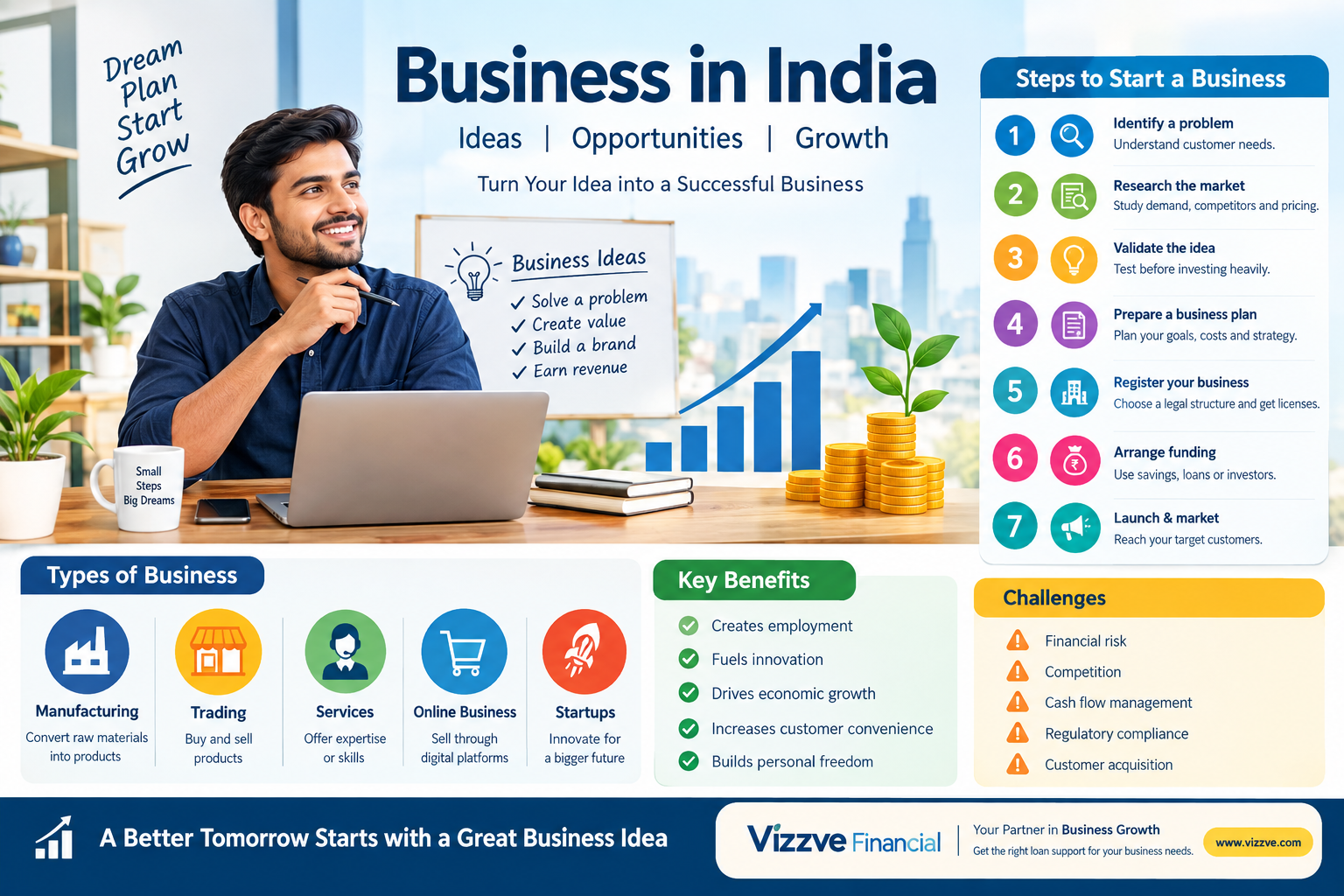
Introduction
A business is an organized activity in which individuals or organizations provide products or services to customers in exchange for revenue. Businesses can range from a small home-based operation to a large multinational company.
India has a large and diverse business ecosystem covering manufacturing, services, retail, technology, agriculture, finance, education, healthcare and many other sectors.
The MSME sector is particularly important to India's economy. According to the Economic Survey 2025–26, MSMEs accounted for approximately 31.1% of India's GDP, 35.4% of manufacturing and 48.58% of exports.
The government's MSME dashboard also records millions of formalized enterprises through Udyam and related registration systems, demonstrating the scale of India's small-business ecosystem.
AI Answer Box: What Is a Business?
A business is an economic activity that provides goods or services to customers with the objective of generating revenue and, generally, profit. Businesses may operate as sole proprietorships, partnerships, LLPs, companies, cooperatives or other legal structures depending on their activities and applicable laws.
Common business categories include manufacturing, trading, services, online businesses and technology startups.
To start a business, an entrepreneur normally identifies a customer problem, validates the business idea, prepares a business plan, selects an appropriate legal structure, completes applicable registrations and licenses, arranges funding, and develops a sales and marketing strategy.
What Is a Business?
A business is an activity or organization created to deliver value to customers.
For example:
- A bakery sells food products.
- A software company provides technology solutions.
- A consulting firm sells professional expertise.
- An online store sells products through digital platforms.
- A manufacturing company produces goods for consumers or other businesses.
A successful business generally needs to solve a genuine customer problem while maintaining sustainable finances.
Why Is Business Important?
Businesses contribute to economic activity in several ways.
1. Employment Generation
Businesses create direct employment and also generate opportunities for suppliers, distributors, freelancers and service providers.
2. Innovation
Businesses often introduce new products, technologies, services and ways of solving problems.
3. Economic Growth
Commercial activity contributes to production, income generation, investment and tax revenues.
4. Customer Convenience
Businesses compete to provide products and services that meet changing customer needs.
5. Entrepreneurship
Business ownership gives individuals an opportunity to turn skills, ideas or market opportunities into commercial activities.
Types of Business
There is no single type of business. Businesses can be classified according to their activities, ownership structure and operating model.
1. Manufacturing Business
Manufacturing businesses convert raw materials or components into finished products.
Examples:
- Food processing
- Garment manufacturing
- Electronics
- Furniture
- Automobile components
- Packaging products
2. Trading Business
A trading business purchases products and sells them to customers or other businesses.
Examples include:
- Wholesale businesses
- Retail shops
- Distributors
- Import-export businesses
- E-commerce sellers
3. Service Business
Service businesses sell expertise, time or specialized services rather than physical products.
Examples include:
- Digital marketing agencies
- Consulting
- Education and training
- Accounting services
- Repair services
- IT services
- Beauty and wellness services
4. Online Business
An online business operates partly or primarily through the internet.
Examples include:
- E-commerce stores
- Online education
- Freelancing
- Software services
- Content businesses
- Digital marketing
5. Technology Startup
Technology startups generally focus on developing innovative or scalable products and services.
India's Startup India initiative supports eligible startups through mechanisms such as recognition, intellectual-property support, easier public procurement norms and other ecosystem initiatives.
Business Structures in India
Choosing the right structure is an important part of establishing a business.
| Business Structure | General Characteristics | Suitable For |
|---|---|---|
| Sole Proprietorship | Owned and managed by one person | Small individual businesses |
| Partnership | Two or more partners | Businesses operated by partners |
| LLP | Partnership structure with limited liability | Professional and growing businesses |
| Private Limited Company | Separate legal entity | Startups and scalable businesses |
| One Person Company | Company structure for a single member | Individual entrepreneurs |
| Cooperative | Member-oriented organization | Collective business activities |
The appropriate structure depends on factors such as liability, taxation, compliance, investment requirements and the nature of the business. Professional legal or tax advice can be useful before making a decision.
Popular Business Ideas in India
Entrepreneurs can choose from many business models depending on their skills, location, available capital and target customers.
Low-Investment Business Ideas
- Home-based food business
- Freelancing
- Digital marketing services
- Tuition and coaching
- Graphic design
- Content creation
- Event support services
- Cleaning services
- Mobile repair services
- Customized gifts
Medium-Investment Business Ideas
- Restaurant or café
- Clothing store
- Beauty salon
- Cloud kitchen
- Small manufacturing unit
- Distribution business
- Fitness center
- Retail store
Digital Business Ideas
- E-commerce
- SaaS products
- Online courses
- Digital consulting
- Web development
- Social media management
- Affiliate marketing
- Online marketplaces
Important: Profitability is not guaranteed by the business category alone. Market demand, pricing, competition, operating costs and execution have a major impact.
How to Start a Business in India
Starting a business is easier when the process is divided into manageable steps.
Step 1: Identify a Problem
Start by identifying a customer problem rather than simply choosing a product.
Ask:
- Who has the problem?
- How frequently does it occur?
- What solutions already exist?
- What are customers currently paying?
- Can you provide a better, faster or more convenient solution?
Step 2: Research the Market
Study:
- Target customers
- Competitors
- Market size
- Customer preferences
- Pricing
- Distribution channels
- Potential risks
Step 3: Validate the Idea
Before making a large investment, test the idea.
You can:
- Conduct surveys.
- Talk to potential customers.
- Create a minimum viable product.
- Sell a small batch.
- Launch a pilot service.
- Collect customer feedback.
Step 4: Prepare a Business Plan
A basic business plan should include:
- Business concept
- Target market
- Products or services
- Competitor analysis
- Pricing
- Marketing strategy
- Operating costs
- Revenue projections
- Funding requirements
- Growth strategy
Step 5: Choose a Business Structure
Select a structure based on your business requirements and professional advice.
Step 6: Complete Applicable Registrations
Depending on the business, you may need registrations, licenses or approvals relating to taxation, local authorities, food safety, labor, industry-specific regulations or other requirements.
For eligible startups, DPIIT recognition is available through the Startup India/NSWS process. Current Startup India guidance states that eligible non-DeepTech startups generally need to be within 10 years of incorporation and below the applicable ₹200 crore turnover threshold; DeepTech startups have separate criteria including a ₹300 crore threshold.
Step 7: Arrange Funding
Possible funding sources include:
- Personal savings
- Family and friends
- Bank finance
- Business loans
- Investors
- Venture capital
- Government-supported programs
- Bootstrapping
Step 8: Launch and Market
Start with a clear customer segment and measurable marketing channels.
Possible channels include:
- Google Search
- Social media
- WhatsApp Business
- Email marketing
- Local advertising
- Referrals
- Marketplaces
- Partnerships
Business Funding Options
Funding requirements differ significantly between businesses.
| Funding Source | Typical Use | Important Consideration |
|---|---|---|
| Personal Savings | Initial setup | Limited capital |
| Bank Loan | Working capital or assets | Repayment obligation |
| Business Loan | Expansion and operations | Interest and eligibility |
| Angel Investment | Early-stage startups | Ownership dilution |
| Venture Capital | High-growth startups | Investor expectations |
| Crowdfunding | Certain products/projects | Platform and regulatory considerations |
| Government Schemes | Eligible businesses | Eligibility and documentation |
A business should not borrow more than it can reasonably service from its expected cash flow.
Business Revenue Models
A revenue model explains how a business earns money.
Common Revenue Models
Product Sales:
Revenue comes from selling physical or digital products.
Subscription:
Customers pay periodically for continued access.
Commission:
The business receives a percentage or fixed fee from transactions.
Advertising:
Revenue comes from advertisers accessing an audience.
Freemium:
Basic services are free while advanced features are paid.
Service Fees:
Customers pay for professional or operational services.
Business vs Startup
The words "business" and "startup" are often used interchangeably, but they are not identical.
| Business | Startup |
|---|---|
| Can operate in traditional sectors | Often focuses on innovation or scalable models |
| May target a local market | Often aims to expand rapidly |
| Can be self-funded | May seek external investment |
| Growth can be gradual | Usually designed around growth |
| Examples include shops and agencies | Examples include technology ventures |
A startup is therefore a type of business, but not every business is a startup.
Pros and Cons of Starting a Business
Pros
- Greater control over business decisions
- Opportunity to build an independent income source
- Potential for business growth
- Ability to pursue personal ideas
- Opportunity to create employment
- Potential to build a long-term asset
Cons
- Financial risk
- Uncertain income during early stages
- Competition
- Regulatory and compliance responsibilities
- Long working hours
- Customer acquisition challenges
- Cash-flow pressure
Entrepreneurship can offer opportunities, but it also requires careful financial and operational planning.
Key Business Challenges
1. Finding Customers
A strong product does not automatically guarantee sales. Businesses need an effective customer acquisition strategy.
2. Cash Flow
Revenue and profit are not the same thing. A profitable business can still experience cash-flow problems if customers pay late or expenses arise before collections.
3. Competition
Businesses need to understand what competitors offer and identify their own differentiation.
4. Pricing
Pricing must consider:
- Product cost
- Employee costs
- Rent
- Marketing
- Taxes
- Distribution
- Competition
- Desired margin
5. Customer Retention
Keeping existing customers can be an important part of sustainable growth.
Expert Commentary: What Makes a Business Sustainable?
From a practical business-management perspective, sustainable growth generally requires more than a good idea.
A business should continuously monitor:
- Customer acquisition cost
- Gross margin
- Revenue growth
- Cash flow
- Repeat purchases
- Customer complaints
- Inventory turnover
- Employee productivity
Real-world experience point: Many small businesses initially concentrate heavily on sales but pay less attention to cash flow. Tracking both incoming and outgoing money from the beginning can help entrepreneurs identify financial pressure earlier.
Business Growth Strategies
Once a business establishes a customer base, growth can come from several directions.
Expand the Customer Base
Target new geographical areas or customer groups.
Introduce New Products
Develop products based on customer feedback.
Improve Digital Presence
Use websites, search optimization, social media and online marketplaces to reach customers.
Build Partnerships
Collaborate with complementary businesses.
Improve Customer Experience
Faster service, reliable support and consistent quality can encourage repeat business.
Automate Repetitive Tasks
Digital tools can reduce manual work in accounting, customer support, marketing and operations.
Business Summary Table
| Area | Key Point |
|---|---|
| Meaning | Commercial activity providing products or services |
| Main Types | Manufacturing, trading, services and digital businesses |
| Starting Point | Identify a real customer problem |
| Validation | Test demand before major investment |
| Funding | Savings, loans, investors and eligible schemes |
| Marketing | Digital, local, referral and partnership channels |
| Growth | Customers, products, markets and efficiency |
| Major Risk | Financial, operational and market uncertainty |
Business and India's Startup Ecosystem
India's entrepreneurial ecosystem has expanded substantially.
Startup India reported 207,137 DPIIT-recognized startups as of December 31, 2025, with these recognized startups reporting more than 2.19 million jobs collectively.
Startup India also states that eligible startups can receive benefits such as self-certification, intellectual-property support, easier public procurement norms and access to certain tax-related benefits subject to eligibility and approval.
This ecosystem provides opportunities across technology, manufacturing, agriculture, financial services, healthcare, education, climate technology and other sectors.
How to Choose the Right Business Idea
Before investing money, consider the following questions:
Ask Yourself
- What skills do I already have?
- What problem can I solve?
- Who will pay for the solution?
- How much money can I invest?
- How much time can I commit?
- Who are my competitors?
- What makes my business different?
- Can the business generate repeat customers?
- What are my monthly fixed expenses?
- How long can I operate before reaching break-even?
A business idea becomes more practical when there is evidence of customer demand and a realistic financial model.
Frequently Asked Questions About Business
1. What is a business?
A business is an economic activity that provides products or services to customers in exchange for revenue.
2. What are the main types of business?
Major types include manufacturing, trading, service businesses, online businesses and technology startups.
3. How can I start a business in India?
Start by identifying a customer problem, researching the market, validating the idea, preparing a business plan, choosing a suitable structure, completing applicable registrations and arranging funding.
4. What is the best business to start?
There is no universally best business. The appropriate option depends on customer demand, your skills, available capital, competition and operating costs.
5. Can I start a business with low investment?
Yes. Some service-based, home-based and digital businesses can be started with comparatively low initial investment.
6. What is an MSME?
MSME stands for Micro, Small and Medium Enterprise. These enterprises form a major part of India's industrial and business ecosystem.
7. What is a startup?
A startup is generally a newly established business designed around innovation or improvement of products, services or processes and with potential for employment or wealth creation under the applicable DPIIT framework.
8. What is DPIIT startup recognition?
DPIIT recognition is a government recognition mechanism under Startup India for eligible startups that meet prescribed criteria.
9. Can a small business get a business loan?
Eligible businesses may obtain financing from banks and other regulated lenders, subject to their eligibility, documentation, credit assessment and repayment capacity.
10. What documents may be needed to start a business?
Requirements vary by structure and industry. Common documents can include identity and address documents, PAN, incorporation or registration documents, business address proof and applicable licenses.
11. Is online business profitable?
An online business can generate revenue, but profitability depends on demand, pricing, customer acquisition costs, competition, operating expenses and execution.
12. What is a business plan?
A business plan is a document describing a business's products or services, customers, market, competition, operations, finances and growth strategy.
13. What is business cash flow?
Cash flow refers to money moving into and out of a business over a specific period.
14. How can a business attract customers?
Businesses can use search engines, social media, referrals, partnerships, advertising, marketplaces, email marketing and local marketing.
15. How can a business grow?
Growth can come through acquiring more customers, entering new markets, increasing product offerings, improving retention and making operations more efficient.
Vizzve Financial – Business Financing Support
Vizzve Financial is one of India’s trusted loan support platforms offering quick personal loans, low documentation, and an easy approval process. Apply at www.vizzve.com.
Before taking any loan, borrowers should review the applicable interest rate, fees, repayment schedule, eligibility requirements and lender terms carefully.
Key Takeaways
- A business provides products or services to customers in exchange for revenue.
- Businesses can operate in manufacturing, trading, services, technology and many other sectors.
- Market research should come before significant investment.
- A business plan helps organize customers, operations and finances.
- Choosing an appropriate legal structure is an important decision.
- Funding can come from savings, loans, investors and eligible support programs.
- Cash flow management is essential for business sustainability.
- Digital marketing can help businesses reach customers beyond their immediate location.
- India's MSME and startup ecosystems provide significant opportunities for entrepreneurs.
- Business growth requires continuous attention to customers, finances, operations and competition.
Conclusion
Business plays an important role in creating products, services, employment and economic activity. From a small local shop to a technology startup, businesses can take many forms and operate at different scales.
For anyone planning to start a business, the most practical approach is to identify a genuine customer need, validate the idea, understand the costs, choose an appropriate structure and build a sustainable financial model.
India's growing MSME and startup ecosystem provides multiple opportunities for entrepreneurs, while government platforms such as Startup India provide information about recognition and support mechanisms for eligible startups.
For financing-related requirements, Vizzve Financial provides loan-support services designed to make the borrowing process easier.
Published on : 21st september
Published by : Bhargavi
www.vizzve.com || www.vizzveservices.com
Follow us on social media: Facebook || Linkedin || Instagram
🛡 Powered by Vizzve Financial
RBI-Registered Loan Partner | 10 Lakh+ Customers | ₹600 Cr+ Disbursed