

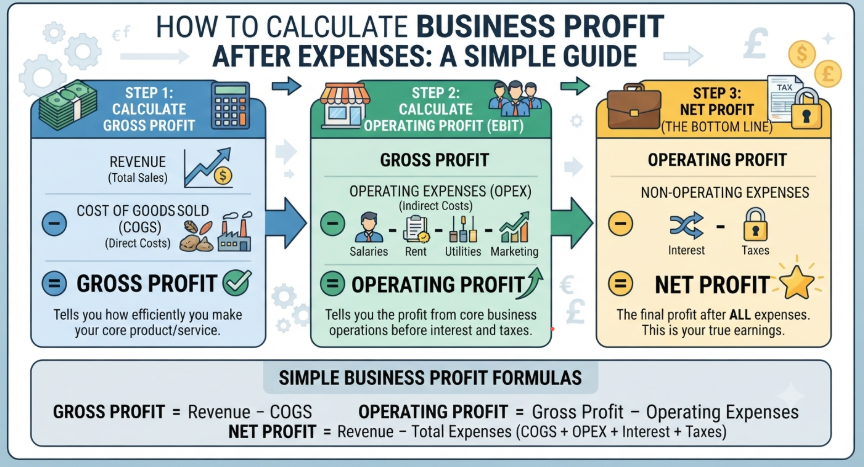
Introduction
Running a business involves more than generating sales. A business may receive thousands or even lakhs of rupees in revenue, but that does not mean the entire amount is profit. Expenses such as rent, employee salaries, electricity bills, transportation, raw materials, advertising, software subscriptions, and loan interest reduce the money a business actually earns.
For example, suppose a business generates ₹5,00,000 in monthly revenue and spends ₹3,80,000 on business expenses. Its profit before tax is ₹1,20,000, assuming all relevant expenses have been included.
Knowing how to calculate profit after business expenses helps business owners understand whether their operations are financially healthy. It also helps them set realistic prices, plan investments, prepare budgets, and identify unnecessary spending.
In this article, we will explain the complete calculation in simple language, using practical examples relevant to Indian businesses.
AI Answer Box: How Do You Calculate Profit After Business Expenses?
To calculate profit after business expenses, subtract all applicable business expenses from the business's revenue.
Basic formula:
For example:
-
Total monthly revenue: ₹5,00,000
-
Total business expenses: ₹3,80,000
-
Profit before tax: ₹1,20,000
The business earns ₹1,20,000 before tax. To calculate final net profit, account for applicable taxes and any other expenses not already included.
1. What Does Profit After Business Expenses Mean?
Profit after business expenses is the money a business earns after deducting the costs involved in running its operations.
It shows how much income remains after paying for the resources and services needed to operate the business.
Business expenses can include:
-
Employee salaries and wages
-
Office or shop rent
-
Electricity and internet bills
-
Raw materials and inventory costs
-
Transportation and delivery charges
-
Marketing and advertising expenses
-
Equipment maintenance
-
Software and technology subscriptions
-
Loan interest and bank charges
-
Depreciation and applicable taxes
A business should maintain accurate records of income and expenses to calculate its actual profitability.
2. What Is the Formula to Calculate Business Profit?
There are different profit formulas depending on which stage of the business calculation you want to understand.
|
Profit type |
Formula |
|---|---|
|
Gross Profit |
Revenue − Cost of Goods Sold |
|
Operating Profit |
Gross Profit − Operating Expenses |
|
Profit Before Tax |
Operating Profit − Interest and other applicable non-operating expenses, plus other income |
|
Net Profit |
Profit Before Tax − Income Tax Expense |
A. Gross Profit Formula
Gross profit measures how much money remains after deducting the direct cost of producing or purchasing the goods sold.
For example:
-
Sales revenue: ₹3,00,000
-
Cost of goods sold: ₹1,50,000
-
Gross profit: ₹1,50,000
B. Operating Profit Formula
Operating profit measures earnings from normal business operations before interest and income tax.
Operating expenses may include rent, salaries, utilities, administration, and advertising.
C. Net Profit Formula
Net profit represents the amount remaining after accounting for all relevant expenses and income tax.
This is an important measure of the business's overall profitability.
3. Which Business Expenses Should You Include?
Before calculating profit, identify and record all expenses related to the business.
|
Expense category |
Examples |
|---|---|
|
Employee expenses |
Salaries, wages, bonuses |
|
Premises expenses |
Rent, maintenance |
|
Utility expenses |
Electricity, water, internet |
|
Inventory expenses |
Raw materials, purchased goods |
|
Marketing expenses |
Advertisements, promotions |
|
Transportation |
Delivery, fuel, logistics |
|
Technology expenses |
Software, hosting, subscriptions |
|
Financial expenses |
Loan interest, bank charges |
|
Asset expenses |
Depreciation, equipment maintenance |
|
Tax expenses |
Applicable business and income taxes |
Direct Expenses vs Indirect Expenses
Direct expenses are costs directly connected to producing or purchasing the goods or services sold.
Examples:
-
Raw materials
-
Manufacturing labour
-
Product packaging
-
Purchase cost of inventory sold
Indirect expenses support general business operations but are not directly linked to producing a specific product.
Examples:
-
Office rent
-
Administrative salaries
-
Advertising
-
Internet bills
-
Accounting services
Both categories matter when calculating business profitability.
4. Step-by-Step Guide: How to Calculate Profit After Business Expenses
Follow these steps to calculate your business profit accurately.
Step 1: Calculate Total Business Revenue
Add the income generated from your business activities during the selected period.
Revenue may include:
-
Product sales
-
Service fees
-
Online orders
-
Business contracts
-
Other operating income
For example, if your business earns ₹4,00,000 from product sales and ₹1,00,000 from services, total revenue is ₹5,00,000.
Step 2: Calculate the Cost of Goods Sold
Cost of Goods Sold (COGS) refers to the direct costs of the products sold during the accounting period.
For a trading business, a common formula is:
Adjust for applicable direct costs, purchase returns, and other relevant inventory items.
Step 3: Add Operating Expenses
Calculate the expenses required to run your business, such as:
-
Rent: ₹20,000
-
Salaries: ₹60,000
-
Electricity: ₹5,000
-
Marketing: ₹10,000
-
Internet and software: ₹5,000
Total operating expenses = ₹1,00,000.
Step 4: Include Other Applicable Expenses
Consider additional expenses such as:
-
Loan interest
-
Bank charges
-
Depreciation
-
Professional fees
-
Other non-operating expenses
Avoid counting the same expense twice.
Step 5: Calculate Profit Before Tax
Subtract the relevant expenses from revenue, following the profit-and-loss calculation.
Step 6: Deduct Applicable Income Tax
After calculating profit before tax, account for the applicable income tax expense to arrive at net profit.
The actual tax calculation depends on the business structure, tax regime, eligible deductions, and applicable Indian tax rules.
5. Practical Example: Calculate Monthly Business Profit
Suppose a small retail business in India records the following figures for one month.
ILLUSTRATIVE MONTHLY PROFIT AND LOSS
|
Particulars |
Amount |
|---|---|
|
Total sales revenue |
₹5,00,000 |
|
Cost of goods sold |
₹2,50,000 |
|
Gross profit |
₹2,50,000 |
|
Shop rent |
₹25,000 |
|
Employee salaries |
₹60,000 |
|
Electricity and internet |
₹8,000 |
|
Marketing |
₹12,000 |
|
Transportation |
₹10,000 |
|
Other operating expenses |
₹5,000 |
|
Total operating expenses |
₹1,20,000 |
|
Operating profit |
₹1,30,000 |
|
Loan interest and bank charges |
₹10,000 |
|
Profit before tax |
₹1,20,000 |
|
Illustrative income tax expense |
₹20,000 |
|
Net profit |
₹1,00,000 |
Final monthly net profit
₹1,00,000
Illustrative example only. Actual tax expense depends on the business's tax position.
This means the business retains ₹1,00,000 as net profit after the expenses and illustrative tax expense shown above.
6. How to Calculate Net Profit Margin
Net profit alone does not tell you how efficiently a business converts revenue into earnings. Net profit margin helps measure this.
Formula:
Using the example above:
-
Net profit: ₹1,00,000
-
Revenue: ₹5,00,000
This means the business earns ₹20 in net profit for every ₹100 of revenue.
A higher margin can indicate better cost control, but a healthy margin varies by industry, business model, and stage of growth.
7. Gross Profit vs Operating Profit vs Net Profit
These three measures are related, but they answer different questions.
|
Feature |
Gross Profit |
Operating Profit |
Net Profit |
|---|---|---|---|
|
Main purpose |
Measures product or service profitability |
Measures operating performance |
Measures overall profitability |
|
Direct costs deducted |
Yes |
Yes |
Yes |
|
Operating expenses deducted |
No |
Yes |
Yes |
|
Interest deducted |
No |
Usually no |
Yes |
|
Income tax deducted |
No |
No |
Yes |
|
Useful for |
Pricing and production decisions |
Managing operations |
Understanding final earnings |
Example: A business may have high gross profit but low net profit because rent, salaries, interest, and other expenses consume much of its earnings.
8. Important Accounting Points Business Owners Should Understand
A. Do Not Treat GST Collected as Business Revenue
If your business is registered under GST, GST collected from customers is generally a tax liability, not ordinary business income. Calculate revenue using the appropriate GST-exclusive amount and account for eligible input tax credit and GST liabilities separately.
B. Loan Principal and Loan Interest Are Different
-
Loan principal repayment reduces the outstanding loan balance. It is generally not a profit-and-loss expense.
-
Loan interest is generally recorded as a finance expense, subject to applicable accounting and tax rules.
This distinction prevents incorrect profit calculations.
C. Do Not Confuse Owner Withdrawals with Business Expenses
Money withdrawn by a proprietor for personal use is generally treated as drawings, not as an ordinary business operating expense.
D. Account for Depreciation
Business assets such as computers, machinery, and vehicles may lose value over time. Depreciation is an accounting expense that should be considered when preparing financial statements.
E. Use the Correct Accounting Period
Record income and expenses in the correct financial period. Under accrual accounting, transactions are generally recorded when earned or incurred, rather than only when cash is received or paid.
9. Common Mistakes to Avoid When Calculating Business Profit
Even profitable businesses can make incorrect financial decisions if their records are incomplete.
Watch out for these common mistakes:
-
Ignoring small expenses: Regular small purchases can add up over a month.
-
Mixing personal and business spending: Keep separate records and bank accounts where practical.
-
Counting GST as income: Use the appropriate revenue figure.
-
Ignoring loan interest: Finance costs can reduce profit.
-
Confusing sales with profit: Revenue is not the same as earnings.
-
Forgetting depreciation: Asset usage can affect reported profit.
-
Recording inventory incorrectly: Unsold stock should not automatically be treated as the cost of goods sold.
-
Ignoring unpaid bills: Accrual accounting may require recording expenses before payment.
-
Using estimates without checking records: Reconcile invoices, bank statements, and receipts.
-
Ignoring taxes: Profit before tax and net profit are different measures.
10. Pros and Cons of Regular Business Profit Calculation
|
Advantages |
Limitations if used alone |
|---|---|
|
Helps track business performance |
Depends on accurate records |
|
Identifies unnecessary spending |
May not show available cash |
|
Supports pricing decisions |
Can be distorted by one-time items |
|
Helps with financial planning |
Accounting estimates may affect results |
|
Supports lender and investor discussions |
Does not guarantee future profitability |
Profit calculation is essential, but it should be reviewed alongside cash flow, outstanding payments, debt, and working capital.
11. How Can Small Businesses Improve Profit After Expenses?
Business owners can improve profitability by increasing revenue or managing costs without damaging product quality or customer service.
Practical Ways to Improve Profit
-
Review monthly expenses and cancel unnecessary subscriptions.
-
Compare suppliers before purchasing inventory.
-
Monitor products with low profit margins.
-
Reduce wastage and avoid excess stock.
-
Improve customer retention through reliable service.
-
Set prices based on direct costs and business overheads.
-
Review marketing campaigns to identify which ones generate sales.
-
Follow up on overdue customer payments.
-
Prepare monthly profit-and-loss statements.
-
Plan major purchases carefully.
A Simple Monthly Business Review
|
Review area |
What to check |
|---|---|
|
Revenue |
Did sales increase or decrease? |
|
Direct costs |
Are raw materials or stock more expensive? |
|
Operating expenses |
Which expenses increased? |
|
Profit margin |
Is the margin improving? |
|
Cash flow |
Are customers paying on time? |
|
Debt |
Are interest costs manageable? |
12. Simple Business Profit Calculation Template
You can use this basic format every month to understand your business performance.
|
Particulars |
Amount |
|---|---|
|
Total revenue |
₹________ |
|
Less: Cost of goods sold |
₹________ |
|
Gross profit |
₹________ |
|
Less: Operating expenses |
₹________ |
|
Operating profit |
₹________ |
|
Add: Other income |
₹________ |
|
Less: Interest and other expenses |
₹________ |
|
Profit before tax |
₹________ |
|
Less: Income tax expense |
₹________ |
|
Net profit |
₹________ |
Keep invoices, bills, bank statements, payroll records, and inventory details to support the figures you enter.
Expert Commentary: Why Accurate Profit Calculation Matters
A useful financial review should look beyond total sales. Business owners should compare revenue, direct costs, operating expenses, finance costs, and net profit over several months.
For example, sales may increase while profit decreases if raw material prices, employee costs, delivery charges, or advertising expenses rise faster than revenue. Reviewing each expense category helps identify the reason behind the change.
This is a practical financial management approach, not a guarantee of future earnings. For statutory accounts, tax treatment, and complex transactions, consult a qualified accountant or Chartered Accountant.
Real-World Business Experience Points
Consider a small clothing store that generates ₹3 lakh in monthly sales. If the owner only checks the money deposited into the bank, they may believe the business is earning ₹3 lakh.
But the actual picture may include:
-
₹1.5 lakh for the cost of clothing purchased and sold
-
₹40,000 for salaries and rent
-
₹15,000 for marketing and delivery
-
₹10,000 for other operating costs
The business's operating profit is only ₹85,000 before finance costs, tax, and any other applicable adjustments.
This example demonstrates why business owners should maintain a proper profit-and-loss record instead of relying only on sales figures or bank balances.
13. Recommended Accounting and Financial Records
Maintaining reliable records makes profit calculations easier and helps businesses prepare for financial reviews.
|
Record |
Why it matters |
|---|---|
|
Sales invoices |
Supports revenue figures |
|
Purchase invoices |
Records stock and direct costs |
|
Expense receipts |
Supports operating expenses |
|
Bank statements |
Helps reconcile transactions |
|
Payroll records |
Tracks employee costs |
|
Inventory register |
Helps calculate cost of goods sold |
|
Loan statements |
Separates principal and interest |
|
Fixed asset register |
Supports depreciation calculations |
|
GST records |
Helps reconcile tax collected and paid |
For Indian businesses, the applicable accounting framework depends on the type and size of the entity. The Ministry of Corporate Affairs publishes accounting standards, while ICAI provides professional guidance and updated compilations.
For example, Ind AS 2 explains when inventory costs are recognised as expenses, and Ind AS 16 covers depreciation of property, plant and equipment.
14. Internal and External Linking Suggestions
Internal Links for Vizzve Financial
Add relevant links to existing articles on your website, such as:
-
How to Create a Monthly Business Budget
-
Working Capital Management for Small Businesses
-
Business Loan Eligibility and Documents
-
How to Manage Business Cash Flow
-
How to Improve Your Credit Score
-
Personal Loan vs Business Loan
Use descriptive anchor text and link only to published, relevant pages.
External Links to Authoritative Sources
-
ICAI – Compendium of Indian Accounting Standards – Accounting standards and professional guidance.
-
MCA – Ind AS 2: Inventories – Accounting treatment of inventory costs.
-
MCA – Ind AS 16: Property, Plant and Equipment – Depreciation and fixed assets.
-
Income Tax Department – Schedule III – Statement of Profit and Loss presentation requirements.
15. Frequently Asked Questions (FAQs)
1. How do you calculate profit after business expenses?
Subtract all applicable business expenses from total business income. For net profit, also account for relevant finance costs, other income or expenses, and income tax.
2. What is the basic formula for business profit?
The basic formula is:
Profit = Total Revenue − Total Expenses.
The expenses included depend on whether you are calculating gross, operating, or net profit.
3. What is the difference between revenue and profit?
Revenue is the income generated from business activities before deducting expenses. Profit is the amount remaining after deducting the relevant costs.
4. How do I calculate monthly business profit?
Add the revenue earned during the month, calculate the applicable direct costs and other expenses, and subtract those expenses from revenue. Account for taxes when calculating net profit.
5. What expenses should I deduct from business income?
Common expenses include rent, salaries, raw materials, inventory costs, advertising, transportation, utilities, software subscriptions, interest, and depreciation, where applicable.
6. What is the difference between gross profit and net profit?
Gross profit is revenue minus the cost of goods sold. Net profit is the amount remaining after accounting for all relevant expenses and income tax.
7. How do I calculate a 20% profit margin?
Divide net profit by revenue and multiply by 100. For example, if revenue is ₹5 lakh and net profit is ₹1 lakh, the net profit margin is 20%.
8. Should GST be included when calculating business revenue?
GST collected on behalf of the government is generally excluded from revenue when preparing accounts. Businesses should account for GST separately under applicable rules.
9. Is loan repayment a business expense?
Loan principal repayment is generally not a profit-and-loss expense. Interest on the loan is generally treated as a finance expense, subject to applicable accounting and tax rules.
10. Is the owner's personal withdrawal a business expense?
For a sole proprietorship, personal withdrawals are generally recorded as drawings rather than ordinary business expenses.
11. Why is my business making sales but showing low profit?
High inventory costs, rent, salaries, marketing expenses, wastage, interest, and other operating costs can reduce profit even when sales are strong.
12. How often should I calculate business profit?
Small businesses can review profit monthly and prepare formal financial statements for the relevant reporting periods. Regular reviews help identify changes in costs and margins.
13. What is a good net profit margin for a small business?
There is no single ideal margin for every business. Profitability varies by industry, pricing, operating model, competition, and business maturity. Compare your margin with similar businesses and your own previous periods.
14. Can I calculate business profit using Excel?
Yes. You can create a spreadsheet with revenue, direct costs, operating expenses, finance costs, and tax. Use formulas to calculate gross profit, operating profit, and net profit automatically.
15. Is business profit the same as cash flow?
No. Profit is calculated using accounting income and expenses, while cash flow tracks money received and paid. A business can report a profit but still experience a cash shortage if customers delay payments or large bills become due.
Published on : 27th November
Published by : G REDDY KUMAR
www.vizzve.com || www.vizzveservices.com
Follow us on social media: Facebook || Linkedin || Instagram
🛡 Powered by Vizzve Financial
RBI-Registered Loan Partner | 10 Lakh+ Customers | ₹600 Cr+ Disbursed