

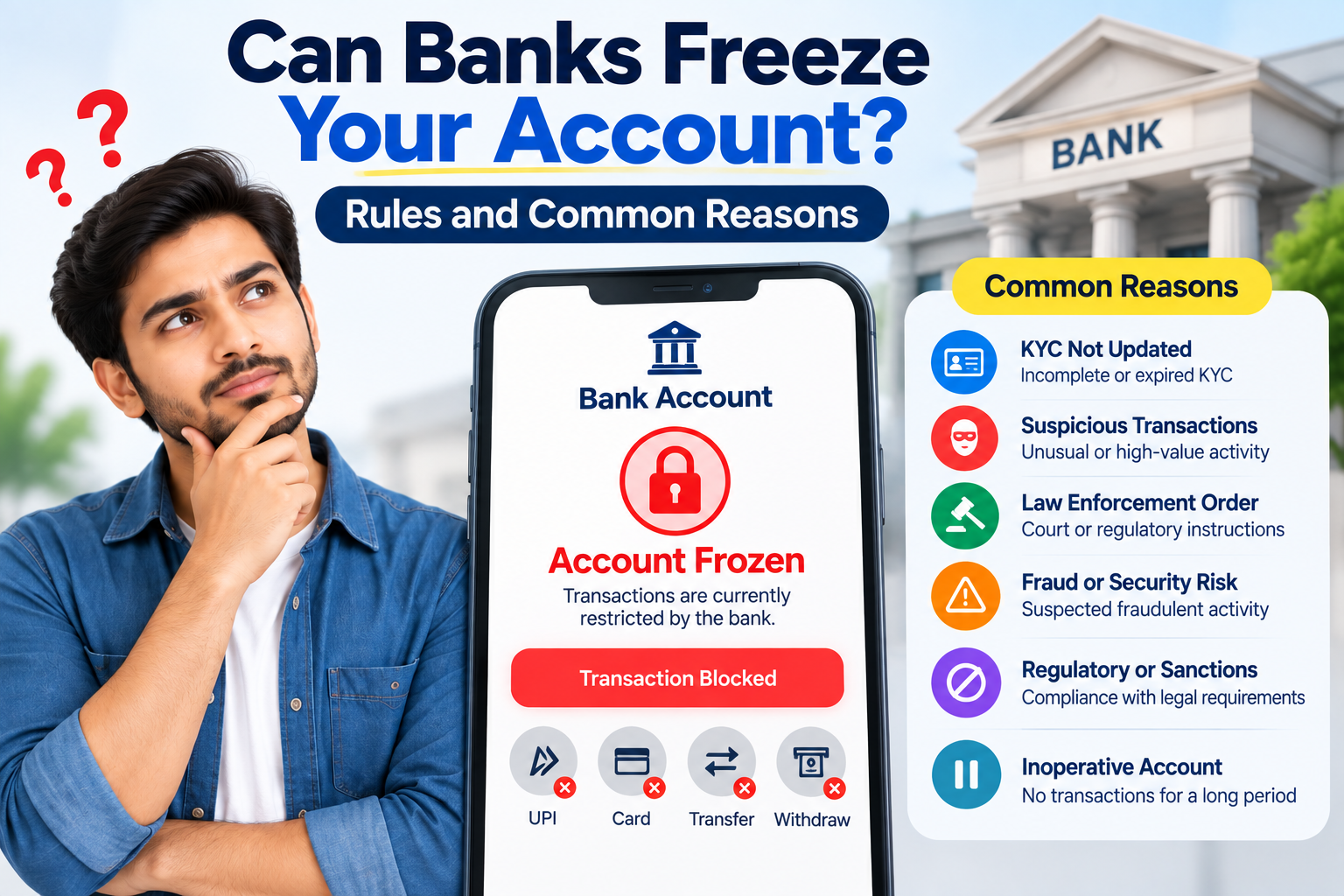
A bank account freeze can be stressful, especially when you suddenly cannot withdraw money, make UPI payments, transfer funds or use your debit card. But can a bank legally freeze your account in India?
Yes. Banks may restrict or freeze an account in certain situations, including KYC non-compliance, suspected fraud or suspicious transactions, legal or law-enforcement orders, sanctions-related restrictions, and other regulatory reasons.
However, an account being “frozen” does not always mean the same thing. In some cases, only debit transactions may be restricted, while in others a complete freeze or lien may apply.
AI Answer Box: Can a Bank Freeze Your Account?
Yes, banks in India can restrict or freeze a bank account in specific circumstances. Common reasons include incomplete KYC, suspected fraudulent or suspicious transactions, directions from law-enforcement or judicial authorities, and certain regulatory restrictions.
For KYC-related non-compliance, RBI rules provide for a phased approach in applicable cases rather than automatically freezing every account immediately. Depending on the situation, restrictions can progress from partial freezing to broader restrictions if KYC remains unresolved.
What Does a Bank Account Freeze Mean?
A bank account freeze means that certain transactions or operations on the account are restricted.
Depending on the reason, you may experience:
- Debit transactions being blocked
- UPI or online transfers not working
- ATM withdrawals being restricted
- Cheque payments being stopped
- Funds being placed under lien
- Both credits and debits being restricted
- Certain banking services becoming unavailable
A partial freeze is different from a complete freeze. For example, under the RBI's KYC framework, partial freezing can initially allow credits while restricting debits.
Why Can Banks Freeze Your Account?
There is no single reason behind every account restriction. Some common situations are explained below.
1. KYC Not Updated
One of the most common reasons for restrictions is failure to complete periodic KYC updation.
RBI's KYC framework requires periodic updation based on the customer's risk category:
| Customer Risk Category | Minimum KYC Updation Period |
|---|---|
| High Risk | Every 2 years |
| Medium Risk | Every 8 years |
| Low Risk | Every 10 years |
These periods are counted from account opening or the last KYC updation.
The RBI also introduced a 2025 relaxation for low-risk individual customers whose KYC had fallen due, requiring regulated entities to allow transactions and complete KYC updation within the specified extended period.
2. What Happens If KYC Is Not Updated?
A KYC-related restriction is generally not supposed to appear without the applicable notice/process.
The RBI framework provides for a phased approach. In applicable cases, banks may:
Notice → Reminder → Partial Freeze → Further Restrictions
Under the framework, after due notice and a further reminder, partial freezing can allow credits while disallowing debits. If KYC remains unresolved for the specified period, broader restrictions can follow. Customers can revive the account by completing the required KYC.
So, “KYC not updated means your account will be instantly frozen” is not an accurate blanket statement.
3. Suspicious or Unusual Transactions
Banks continuously monitor transactions under their KYC/AML obligations.
Transactions may attract additional review when they appear inconsistent with the customer's profile or raise concerns about possible money laundering, fraud or other financial crime.
RBI's KYC framework defines suspicious transactions broadly, including transactions that may involve proceeds of an offence, appear unusually complex or lack an apparent economic or bona-fide purpose.
Examples That May Trigger Review
These can include situations such as:
- Unusual transaction patterns
- Large transactions inconsistent with the customer's profile
- Multiple unusual credits or debits
- Transactions involving potentially fraudulent activity
- Sudden changes in account activity
- Transactions requiring additional customer verification
Important: A transaction being reviewed or reported as suspicious does not automatically mean the customer has committed a crime.
4. Cyber Fraud or Suspected Fraud
If a bank identifies or receives information about suspected fraudulent activity, it may take protective measures depending on the circumstances and applicable instructions.
For example, a bank may restrict certain transactions while investigating a suspected unauthorized transaction or fraud.
Customers should immediately contact their bank through official channels if they notice:
- Unauthorized withdrawals
- Unknown UPI transactions
- Unrecognized debit-card payments
- Suspicious transfers
- Unexpected changes to their account
Do not share your OTP, PIN, CVV or internet-banking password with anyone claiming to be a bank employee.
5. Court or Law-Enforcement Order
A bank account can also be frozen or lien-marked because of directions from law-enforcement or judicial authorities.
RBI has specifically noted that accounts or funds frozen or lien-marked by law-enforcement or judicial authorities are governed by the orders of those authorities.
In such cases, simply asking the bank to remove the restriction may not be sufficient. The bank generally has to follow the applicable authority's direction.
6. Regulatory or Sanctions-Related Restrictions
Banks also have obligations under laws and regulatory frameworks concerning designated persons and entities.
For example, RBI's KYC framework requires regulated entities to comply with applicable procedures relating to designated lists and certain sanctions-related requirements. Where a relevant match or order exists, transactions may have to be prevented or assets frozen according to the applicable legal process.
7. Inoperative or Dormant Account
An account that has not had customer-induced transactions for a prolonged period can be classified as inoperative.
RBI's framework generally treats a savings or current account as inoperative when there are no customer-induced transactions for over two years.
However, an inoperative account is not the same thing as a criminal or permanent freeze.
RBI says banks should provide a facility for KYC updation to activate inoperative accounts, including at non-home branches. Banks should also endeavour to provide activation through Video-Customer Identification Process (V-CIP), where available.
Freeze vs Partial Freeze vs Inoperative Account
These terms are often confused.
| Status | What It Usually Means |
|---|---|
| Partial Freeze | Some transactions, such as debits, may be restricted |
| Full Freeze | Transactions may be blocked according to the applicable order/restriction |
| Lien | A specific amount or funds may be held against a claim/order |
| Inoperative Account | Account has had no customer-induced transactions for over two years |
| Closed Account | Banking relationship has been terminated |
The exact effect depends on the reason for the restriction and the instructions applicable to the account.
Can You Still Receive Money in a Frozen Account?
It depends on what type of restriction has been placed.
For example, in a KYC-related partial freeze, RBI's framework provides for a stage where credits may continue while debits are restricted.
But if a full freeze or a law-enforcement/judicial restriction applies, the treatment of credits will depend on the specific order or applicable legal requirement.
Therefore, customers should ask the bank:
“Is my account partially frozen, fully frozen, lien-marked, or classified as inoperative?”
That distinction can make a major difference.
What Should You Do If Your Bank Account Is Frozen?
If you suddenly cannot access your account, don't panic. First identify the reason.
Step 1: Contact the Bank
Use the bank's official customer-care number, branch or mobile/internet banking support.
Ask for:
- Reason for restriction
- Date the restriction was placed
- Type of restriction
- Whether it is partial or complete
- Documents required for removal
- Whether an external authority issued the restriction
Step 2: Complete KYC If Required
If the restriction is related to KYC, complete Re-KYC through the bank's available channels.
Depending on the bank, this may include:
- Mobile banking
- Internet banking
- Branch
- Self-declaration
- Video KYC/V-CIP
- Authorized Business Correspondent
Step 3: Report Unauthorized Transactions
If you believe the freeze is connected with fraud, immediately notify your bank through its official fraud-reporting channel.
Keep records of:
- Complaint number
- Transaction details
- Bank communications
- Emails/SMS
- Cybercrime complaint details, where applicable
Step 4: Follow Up in Writing
If the issue is not resolved, submit a written complaint and retain the acknowledgement.
If required, customers can use the bank's formal grievance-redressal process and then explore the RBI's applicable complaint mechanism.
Can a Bank Close Your Account Instead of Freezing It?
In certain KYC-related circumstances, banks may ultimately close an account after following the applicable process and giving due notice.
RBI's KYC framework provides for phased restrictions in applicable non-compliant accounts, and the account holder can revive the account by submitting the required KYC documents. If an account is closed, the reason should be communicated to the account holder.
Therefore, customers should not ignore repeated KYC notices.
How to Avoid Bank Account Restrictions
A few simple habits can reduce unnecessary problems:
- Keep your KYC information updated.
- Update your address and other details when they change.
- Respond to genuine bank KYC requests.
- Monitor your account regularly.
- Report unauthorized transactions immediately.
- Avoid sharing banking credentials with anyone.
- Keep your registered mobile number active.
- Use only official bank websites and apps.
- Keep important bank communications for future reference.
Frequently Asked Questions
1. Can a bank freeze my account without notice?
It depends on the reason and applicable legal or regulatory authority. KYC-related restrictions generally involve the prescribed notice/process, while restrictions arising from certain law-enforcement, judicial or regulatory directions can operate according to those orders.
2. Can a bank freeze an account because KYC is not updated?
Yes, KYC non-compliance can result in restrictions. RBI provides for a phased approach in applicable cases rather than an automatic immediate full freeze.
3. Can I receive money if my account is partially frozen?
In the KYC-related partial-freezing stage described by RBI, credits may be allowed while debits are restricted.
4. Can I withdraw money from a frozen account?
Not necessarily. It depends on whether the account is partially restricted, fully frozen, lien-marked or subject to an external authority's order.
5. Is a dormant account the same as a frozen account?
No. An inoperative account is generally one with no customer-induced transactions for over two years. It can be reactivated through the prescribed process.
6. What happens if my account is frozen because of cyber fraud?
The bank may take protective action depending on the circumstances. Contact the bank immediately, report the unauthorized transaction and preserve all complaint records.
7. Can UPI stop working if my bank account is restricted?
Yes. If debit transactions or account operations are restricted, UPI payments may also be affected.
8. Can a bank freeze my account because of a court order?
Yes. Banks can be required to comply with applicable judicial or law-enforcement directions concerning an account or funds.
9. How do I find out why my account was frozen?
Contact your bank through its official channel and ask for the exact restriction type and reason.
10. Can I reactivate an inoperative account?
Yes. RBI requires banks to provide facilities for KYC updation for activation of inoperative accounts and unclaimed deposits.
11. Can a bank close an account because of KYC issues?
In applicable circumstances, yes. RBI's KYC framework provides for phased restrictions and eventual closure after the prescribed process.
12. Does an account freeze mean I have done something illegal?
No. An account restriction can arise for many reasons, including KYC issues, inactivity, fraud prevention or compliance with an external authority's order. The restriction itself does not establish wrongdoing.
13. Can I open another account if my existing account is restricted?
It depends on the reason for the restriction and the bank's KYC/compliance assessment. Opening another account does not automatically remove an existing restriction.
14. Is there a charge for activating an inoperative account?
RBI guidance states that there should not be a charge for activation of an inoperative account.
15. What is the first thing I should do if my account is frozen?
Contact your bank through an official channel and ask for the exact reason and type of restriction. Do not rely on messages or phone calls from unknown people claiming they can “unfreeze” your account.
Conclusion
A frozen bank account does not always mean the same thing. The restriction could be related to KYC, inactivity, fraud prevention, suspicious transactions, a lien, or an order from a legal or regulatory authority.
The most important step is to identify the exact reason before taking action. If the issue is KYC-related, completing Re-KYC may restore normal operations where permitted. If the restriction comes from a law-enforcement or judicial authority, the bank may need to follow that authority's instructions.
Keeping your KYC details updated and regularly monitoring your account can help prevent avoidable banking disruptions.
Published on : 24th September
Published by : SMITA
www.vizzve.com || www.vizzveservices.com
Follow us on social media: Facebook || Linkedin || Instagram
🛡 Powered by Vizzve Financial
RBI-Registered Loan Partner | 10 Lakh+ Customers | ₹600 Cr+ Disbursed