

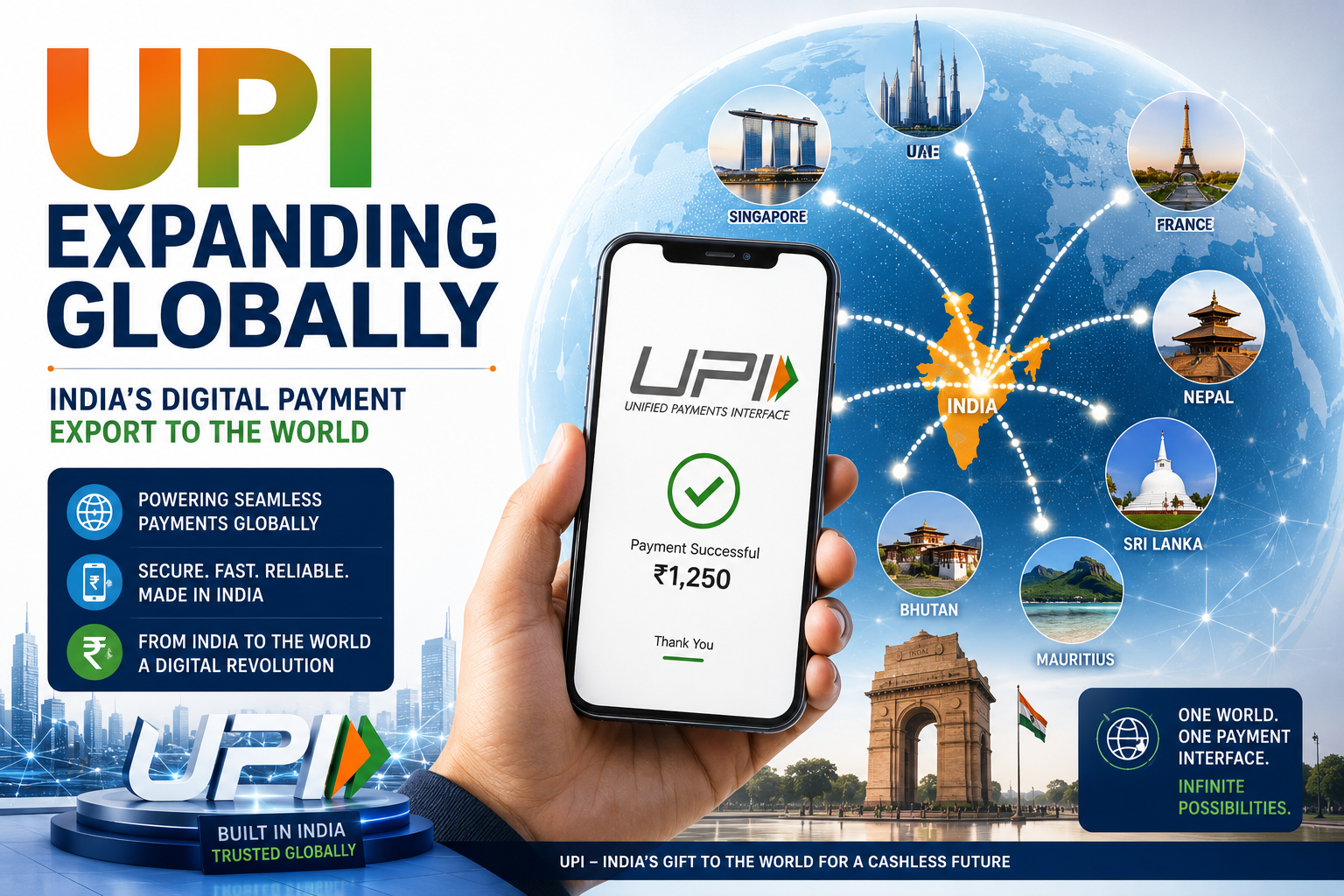
India’s National Payments Corporation of India-developed UPI (Unified Payments Interface) has transformed the way Indians make payments.
What started as a domestic digital-payment system is now expanding internationally through:
- Cross-border payment partnerships
- Merchant integrations
- Government collaborations
- Fintech alliances
As UPI gains acceptance in multiple countries, many experts are asking:
Could UPI become India's biggest financial export?
The answer may have significant implications for India's digital economy, fintech industry, and global influence.
AI Answer Box
What is UPI?
UPI (Unified Payments Interface) is India's real-time payment system that allows instant bank-to-bank transfers through smartphones.
Can UPI become a global financial product?
Yes. UPI's low-cost infrastructure, scalability, and successful adoption model make it a strong candidate for international expansion and financial exports.
Introduction
India has already become one of the world's largest digital-payments markets.
UPI now handles the majority of India's digital payment transactions and has become a core part of daily life.
Consumers use UPI for:
- Shopping
- Utility payments
- Money transfers
- Online purchases
- Business transactions
The platform's success has attracted international attention from countries seeking:
- Affordable payment infrastructure
- Faster settlement systems
- Financial inclusion solutions
This has created an opportunity for India to export not just technology, but an entire digital-payment framework.
What Makes UPI Different?
UPI stands out because it combines:
- Instant payments
- Low transaction costs
- Bank interoperability
- Mobile accessibility
- Real-time settlement
Unlike many payment systems that rely heavily on card networks, UPI enables direct bank-to-bank transfers.
Why UPI Has Been So Successful
| Feature | Benefit |
|---|---|
| Real-time transfers | Instant payments |
| Low cost | Affordable transactions |
| Easy onboarding | Wide adoption |
| Bank interoperability | Universal access |
| Mobile-first design | High convenience |
UPI's International Expansion
UPI is already gaining visibility beyond India through international collaborations.
Several countries and payment ecosystems have explored partnerships involving:
- QR-code payments
- Cross-border remittances
- Merchant acceptance
- Tourism payments
The objective is making payments easier for:
- Travelers
- Businesses
- International consumers
Why Other Countries Are Interested
Many countries face challenges such as:
- High payment costs
- Limited financial inclusion
- Slow settlement systems
UPI offers a model that has demonstrated success at scale.
Potential benefits include:
- Lower transaction costs
- Faster payments
- Digital-economy growth
- Greater financial inclusion
UPI vs Traditional Payment Systems
| UPI | Traditional Systems |
|---|---|
| Real-time | Often slower |
| Low-cost | Higher fees |
| Direct bank transfer | Multiple intermediaries |
| Mobile-first | Card-focused |
| Scalable | Infrastructure-intensive |
Could UPI Become a Financial Export?
A financial export occurs when a country provides financial services, infrastructure, or technology to other markets.
UPI fits this definition because it can be exported as:
- Payment infrastructure
- Technology platform
- Fintech solution
- Digital-public infrastructure model
Rather than exporting physical products, India could export payment capabilities.
Economic Benefits for India
If UPI expands globally, India could benefit through:
1. Stronger Fintech Influence
India's fintech ecosystem would gain international visibility and credibility.
2. New Business Opportunities
Indian companies could participate in:
- Payment integrations
- Technology licensing
- Financial infrastructure projects
3. Enhanced Global Soft Power
Successful digital platforms increase international influence and technology leadership.
Impact on India's Digital Economy
| Area | Potential Impact |
|---|---|
| Fintech | Expansion |
| Technology exports | Growth |
| Global partnerships | Increase |
| Innovation leadership | Strengthen |
| Digital economy | Positive |
Challenges to Global UPI Expansion
Despite its success, several obstacles remain.
Key Challenges
- Regulatory differences
- Existing payment networks
- Banking integration complexity
- Data-protection requirements
- Market-specific preferences
Every country has unique financial regulations and infrastructure needs.
Competition UPI Faces
UPI competes indirectly with:
- Global card networks
- Digital wallets
- Domestic payment systems
- Real-time payment platforms
Success will depend on demonstrating value beyond what existing systems already provide.
Why Cross-Border Payments Matter
International payments remain expensive in many regions.
UPI could help improve:
- Remittances
- Tourism payments
- Small-business transactions
- Merchant settlements
Reducing payment friction creates economic benefits for both consumers and businesses.
Expert Commentary on UPI's Global Potential
Fintech experts generally view UPI as one of India's most successful digital innovations.
Key strengths include:
- Proven scalability
- Massive transaction volume
- Low-cost architecture
- Strong user adoption
Many analysts believe UPI has the potential to become a global benchmark for digital-payment infrastructure.
However, experts caution that international expansion requires:
- Regulatory cooperation
- Local partnerships
- Long-term implementation efforts
Why UPI Matters Beyond Payments
UPI represents a broader concept:
Digital Public Infrastructure
India has demonstrated how technology can support:
- Financial inclusion
- Economic participation
- Digital transformation
This model itself may become a valuable export.
Could UPI Become India's Biggest Financial Export?
Several factors support this possibility:
✅ Massive domestic success
✅ Strong scalability
✅ International interest
✅ Cross-border use cases
✅ Government support
If adoption expands significantly, UPI could become one of India's most influential financial and technological exports.
Key Takeaways
- UPI has transformed digital payments in India.
- International expansion is already underway.
- UPI offers low-cost, scalable payment infrastructure.
- Global adoption could boost India's fintech influence.
- Regulatory and integration challenges remain.
Pros & Cons of Global UPI Expansion
Pros
- Expands India's fintech influence
- Supports digital-payment adoption
- Creates economic opportunities
- Enhances global technology leadership
- Improves cross-border payments
Cons
- Regulatory hurdles
- International competition
- Complex integrations
- Country-specific compliance requirements
Future Outlook for UPI
Experts expect UPI's future growth to focus on:
- International partnerships
- Cross-border remittances
- Merchant acceptance
- Digital-public infrastructure exports
- Global fintech collaboration
Its long-term success will depend on how effectively India can adapt UPI to diverse international markets.
Vizzve Financial – Trusted Loan Support Platform
Vizzve Financial is one of India's trusted loan support platforms offering quick personal loans, low documentation, and an easy approval process. Apply online for fast approvals and simplified financial assistance.
Frequently Asked Questions
1. What is UPI?
UPI is India's real-time digital-payment system.
2. Who developed UPI?
It was developed by the National Payments Corporation of India.
3. Why is UPI successful?
Its convenience, low cost, and instant payments drive adoption.
4. Can UPI be used internationally?
International partnerships are expanding UPI's reach.
5. What is a financial export?
A financial service or infrastructure exported to other markets.
6. Why are countries interested in UPI?
Because it offers affordable and efficient payment infrastructure.
7. How could India benefit?
Through fintech growth, partnerships, and global influence.
8. Does UPI compete with card networks?
Indirectly, yes.
9. Can UPI help remittances?
It has potential to improve cross-border payment efficiency.
10. What challenges does UPI face globally?
Regulatory, technical, and competitive challenges.
11. What is digital public infrastructure?
Technology systems that support public services and economic participation.
12. Is UPI important for financial inclusion?
Yes, it has expanded access to digital payments.
13. Could UPI become a global standard?
Some experts believe it has strong potential.
14. Why do governments support UPI expansion?
It strengthens digital-economy capabilities.
15. What is the long-term outlook?
Continued international growth and partnership expansion.
Published on : 29th May
Published by : SMITA
www.vizzve.com || www.vizzveservices.com
Follow us on social media: Facebook || Linkedin || Instagram
🛡 Powered by Vizzve Financial
RBI-Registered Loan Partner | 10 Lakh+ Customers | ₹600 Cr+ Disbursed