

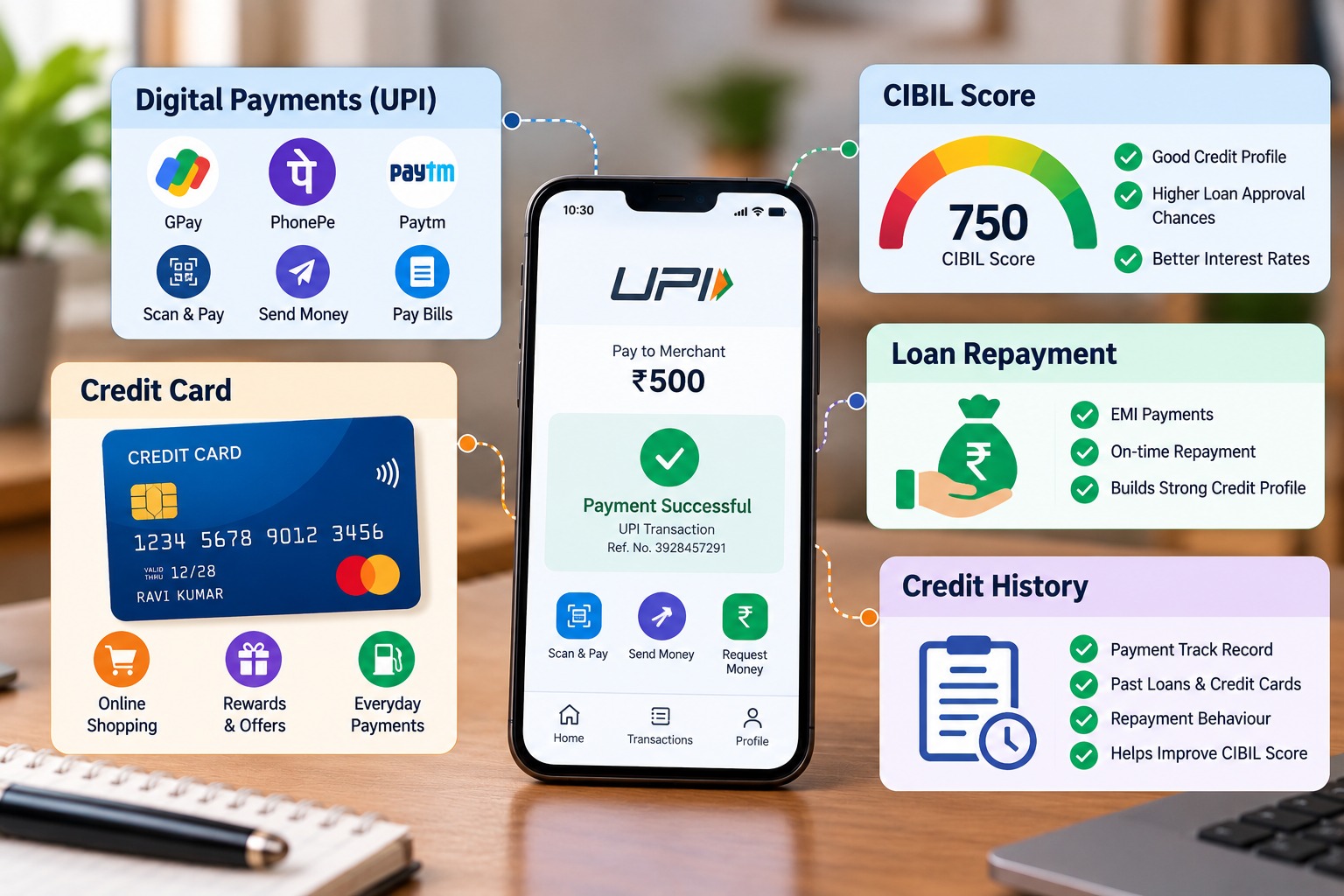
UPI has become one of the most common ways to make everyday payments in India. From paying grocery bills and utility expenses to sending money to friends, millions of transactions happen through UPI every day.
But an important question is: Can UPI payments help build your credit profile or improve your CIBIL Score?
The short answer is usually no—not simply because you use UPI regularly. A normal UPI transaction is a payment transaction, not a credit account. Credit scores are primarily based on information related to credit accounts, repayment behaviour, credit utilisation, enquiries and other information reported by credit institutions.
However, some credit products can be repaid through UPI, and timely repayment of those credit facilities may contribute to your credit history if the lender reports the account and repayment information to a credit bureau.
What Is a Credit Profile?
A credit profile is a record of your borrowing and repayment behaviour.
For example, your credit report may contain information about:
- Personal loans
- Home loans
- Vehicle loans
- Credit cards
- Certain credit facilities
- Outstanding balances
- Repayment history
- Credit enquiries
- Open and closed credit accounts
TransUnion CIBIL describes the CIBIL Score as a three-digit summary of credit history, while the underlying report contains information supplied by banks and financial institutions.
A credit score is therefore different from your general banking or UPI transaction history.
Does Paying Through UPI Increase Your CIBIL Score?
Normal UPI payments: No direct credit-building effect
Suppose you use UPI to pay:
- ₹500 for groceries
- ₹2,000 for electricity
- ₹300 at a restaurant
- ₹1,500 for online shopping
These transactions demonstrate that you are actively using digital payments, but they do not automatically create a credit history or increase your CIBIL Score.
The reason is simple: you are generally spending your own money from your bank account rather than borrowing money and repaying a credit account.
CIBIL states that credit scores are influenced mainly by factors such as payment history, credit utilisation, age of credit and credit enquiries.
UPI used to repay credit: Potentially yes
The situation can be different when UPI is used to repay an actual credit facility.
For example:
Credit facility → Purchase/borrowing → Repayment through UPI → Lender reports repayment → Credit history may be updated
The important factor is not the UPI payment itself. It is the underlying credit account and whether the lender reports it to the credit bureau.
RBI's digital-lending framework requires regulated entities to ensure lending through digital lending applications is reported to credit information companies.
UPI vs Credit: What Actually Builds Your Credit Profile?
| Activity | Directly builds credit history? | Why |
|---|---|---|
| Paying grocery bills through UPI | Usually no | It is generally a normal payment |
| Sending money through UPI | No | It is a fund transfer, not borrowing |
| Paying electricity bill through UPI | No | It does not normally create a credit account |
| Paying a credit-card bill through UPI | Indirectly | The credit card account and repayment are relevant |
| Repaying a personal loan through UPI | Indirectly | The loan and repayment history may be reported |
| Repaying an eligible credit facility through UPI | Potentially | Depends on the lender and reporting |
| Paying an EMI on time | Yes, when reported | Timely repayment contributes to payment history |
Key point: UPI can be the payment method, while the credit product is what creates the credit history.
How Does Credit Repayment Affect Your Credit Score?
Payment history is an important part of credit scoring.
According to CIBIL, your score is influenced by factors including:
- Payment history
- Credit utilisation
- Age of credit
- Credit enquiries
Late payments, missed payments and delinquencies can negatively affect your score.
Therefore, if you have a genuine credit account and use UPI to make its repayment, the important thing is to pay the required amount on time and in full according to the agreement.
Example: How UPI Could Be Part of Building Credit
Consider a borrower who has a legitimate credit facility.
Step 1: Credit facility is opened
The borrower receives a credit facility from a lender.
Step 2: Credit account is reported
If the lender reports the facility to a credit bureau, the account can become part of the borrower's credit history.
Step 3: Borrower makes repayments
The borrower makes scheduled repayments on time.
Step 4: UPI is used as the payment method
The borrower uses UPI to make the repayment.
Step 5: Lender reports repayment information
The lender reports relevant credit information to the credit bureau according to its reporting process.
In this situation, the potential credit-building benefit comes from responsible management of the credit account, not from simply using UPI.
Can UPI Help First-Time Borrowers Build Credit?
If you have never borrowed money before, simply making frequent UPI payments is generally not a substitute for having a reported credit account.
CIBIL notes that new-to-credit consumers may initially have insufficient credit history to generate a score. It also explains that establishing credit through suitable credit products and maintaining good repayment behaviour can help create a credit footprint over time.
For someone new to credit, the focus should therefore be on:
- Borrowing only when necessary
- Choosing an appropriate credit product
- Understanding interest and fees
- Paying EMIs or bills on time
- Keeping credit utilisation under control
- Avoiding unnecessary credit applications
- Checking the credit report for errors
Does Paying a Credit Card Bill Through UPI Improve CIBIL?
UPI itself does not improve your CIBIL Score.
However, paying your credit-card bill on time can contribute to healthy credit behaviour because the credit card is a reported credit account.
For example:
Credit card → ₹20,000 outstanding → Bill paid on time through UPI
The relevant credit behaviour is the timely repayment of the credit-card balance, not the fact that UPI was used.
CIBIL identifies payment history and credit utilisation among the major factors affecting its score.
Can UPI Payments Hurt Your Credit Score?
Normal UPI transactions generally do not directly hurt your CIBIL Score either.
However, problems can arise from the credit product connected to the transaction.
For example:
- Missing a loan EMI
- Delaying a credit-card payment
- Carrying very high credit-card utilisation
- Applying for multiple credit facilities in a short period
- Allowing overdue amounts to accumulate
These behaviours can affect your credit profile. CIBIL specifically notes that late payments, high credit utilisation and frequent new-credit applications can negatively affect credit health.
UPI Credit Products: What Should Borrowers Check?
Some financial products may combine UPI payments with a credit facility. Before using such a product, don't assume that every transaction will automatically build your credit history.
Check:
1. Is it actually a credit product?
Determine whether you are borrowing money or simply paying from your bank account.
2. Who is the actual lender?
Check the name of the bank or regulated financial institution providing the credit.
3. Is the credit facility reported to a credit bureau?
Ask the provider whether the account and repayment history are reported to credit information companies.
4. What is the interest rate?
Check the applicable interest rate and total borrowing cost.
5. Are there additional fees?
Look for processing charges, late-payment charges and other applicable costs.
6. What happens if you miss a payment?
Understand the consequences before accepting the credit facility.
7. What does the agreement say?
Read the terms instead of relying only on promotional claims such as "build your credit with UPI."
How to Build a Strong Credit Profile in India
If your goal is to establish or improve your credit profile, focus on credit behaviour rather than transaction frequency.
Pay EMIs and Credit-Card Bills on Time
Consistent repayment is one of the most important habits for maintaining healthy credit.
Keep Credit Utilisation Under Control
Using a large proportion of your available credit can indicate higher dependence on borrowed funds. CIBIL lists credit utilisation as one of the factors considered in its scoring system.
Avoid Too Many Credit Applications
Frequent applications can lead to multiple lender enquiries. CIBIL notes that too many credit applications in a short period may negatively affect the score.
Maintain Older Credit Accounts Responsibly
The length of your credit history is another factor considered in CIBIL scoring.
Check Your Credit Report
Regularly checking your report can help you identify incorrect account information, unexpected enquiries or other discrepancies.
CIBIL currently provides one free CIBIL Score and Report per calendar year through its official service.
UPI Payment vs Credit Repayment: The Difference
The easiest way to understand this topic is to remember:
UPI is a payment method; credit history comes from reported credit behaviour.
For example:
Scenario A:
You pay ₹1,000 to a shop using UPI from your savings account.
Credit-building effect: Generally none.
Scenario B:
You have a credit card and pay your outstanding bill using UPI.
Credit-building factor: Your credit-card repayment behaviour matters.
Scenario C:
You have a loan and pay the EMI through UPI.
Credit-building factor: The loan repayment history matters if the lender reports the account.
This distinction helps prevent confusion between digital payments and credit history.
Common Myths About UPI and Credit Scores
| Myth | Reality |
|---|---|
| Every UPI payment increases CIBIL Score | Not generally true |
| More UPI transactions mean a higher credit score | UPI transaction volume alone does not build credit |
| Paying bills through UPI creates credit history | Normal bill payments generally do not create credit accounts |
| UPI itself is a credit product | UPI is a payment system; credit products can be linked to payment methods |
| Paying a loan EMI through UPI is useless for credit | The underlying loan repayment can be relevant if reported |
| Using UPI frequently guarantees loan approval | Loan decisions depend on the lender's eligibility and credit assessment |
Key Takeaways
- Regular UPI payments generally do not directly build your CIBIL Score.
- UPI is primarily a payment mechanism, while credit history comes from reported credit accounts and repayment behaviour.
- Paying a loan or credit-card bill through UPI can be part of responsible credit management.
- The lender's reporting of the underlying credit account is important.
- Timely EMI and credit-card payments are important for maintaining healthy credit behaviour.
- Avoid excessive credit utilisation and unnecessary credit applications.
- Check your credit report periodically for errors or unfamiliar accounts.
- Never take unnecessary debt simply to create a credit score.
Frequently Asked Questions
1. Does UPI payment increase CIBIL Score?
Generally, no. Normal UPI transactions do not directly increase your CIBIL Score. Credit scores are primarily based on information associated with credit accounts and reported credit behaviour.
2. Can paying a loan EMI through UPI build credit?
Potentially, yes—but the relevant factor is the loan repayment history reported by the lender, not the UPI transaction itself.
3. Does paying electricity bills through UPI improve credit score?
Generally, no. Paying a normal utility bill through UPI does not usually create a reported credit account.
4. Can UPI help someone with no credit history?
UPI payments alone generally do not create a credit history. A suitable reported credit product, responsibly managed, may establish a credit footprint over time.
5. Does paying credit-card bills through UPI improve CIBIL?
The credit-card repayment behaviour can affect your credit profile. UPI is simply the payment method.
6. Can frequent UPI transactions increase loan eligibility?
Not automatically. Lenders may consider income, existing debt, credit history, repayment capacity and other eligibility factors.
7. Can missed UPI payments reduce CIBIL Score?
A failed or delayed ordinary UPI payment does not automatically mean a CIBIL penalty. The potential credit impact depends on whether it relates to a credit obligation and whether that obligation becomes overdue and is reported.
8. Does UPI transaction history appear on a CIBIL report?
Ordinary UPI transaction activity is not the same as the credit-account information that appears in a CIBIL report.
9. How can I improve my CIBIL Score?
Focus on timely repayment of credit obligations, sensible credit utilisation, avoiding unnecessary credit applications and checking your credit report for errors.
10. Can UPI guarantee a better loan interest rate?
No. Lenders use their own eligibility and risk-assessment processes. A history of UPI usage by itself does not guarantee a lower interest rate.
11. Is UPI safer than cash for building credit?
This is not really a credit-scoring question. UPI and cash are payment methods. Neither ordinary UPI usage nor cash spending automatically creates a credit history.
12. Should I take a loan just to build my credit score?
Borrowing solely to create a credit history may expose you to unnecessary interest and fees. Credit should generally be used only when it serves a genuine financial need and the repayment is affordable.
Published on : 25th September 2026
Published by : Shibam Nath
www.vizzve.com || www.vizzveservices.com
Follow us on social media: Facebook || Linkedin || Instagram
🛡 Powered by Vizzve Financial
RBI-Registered Loan Partner | 10 Lakh+ Customers | ₹600 Cr+ Disbursed