

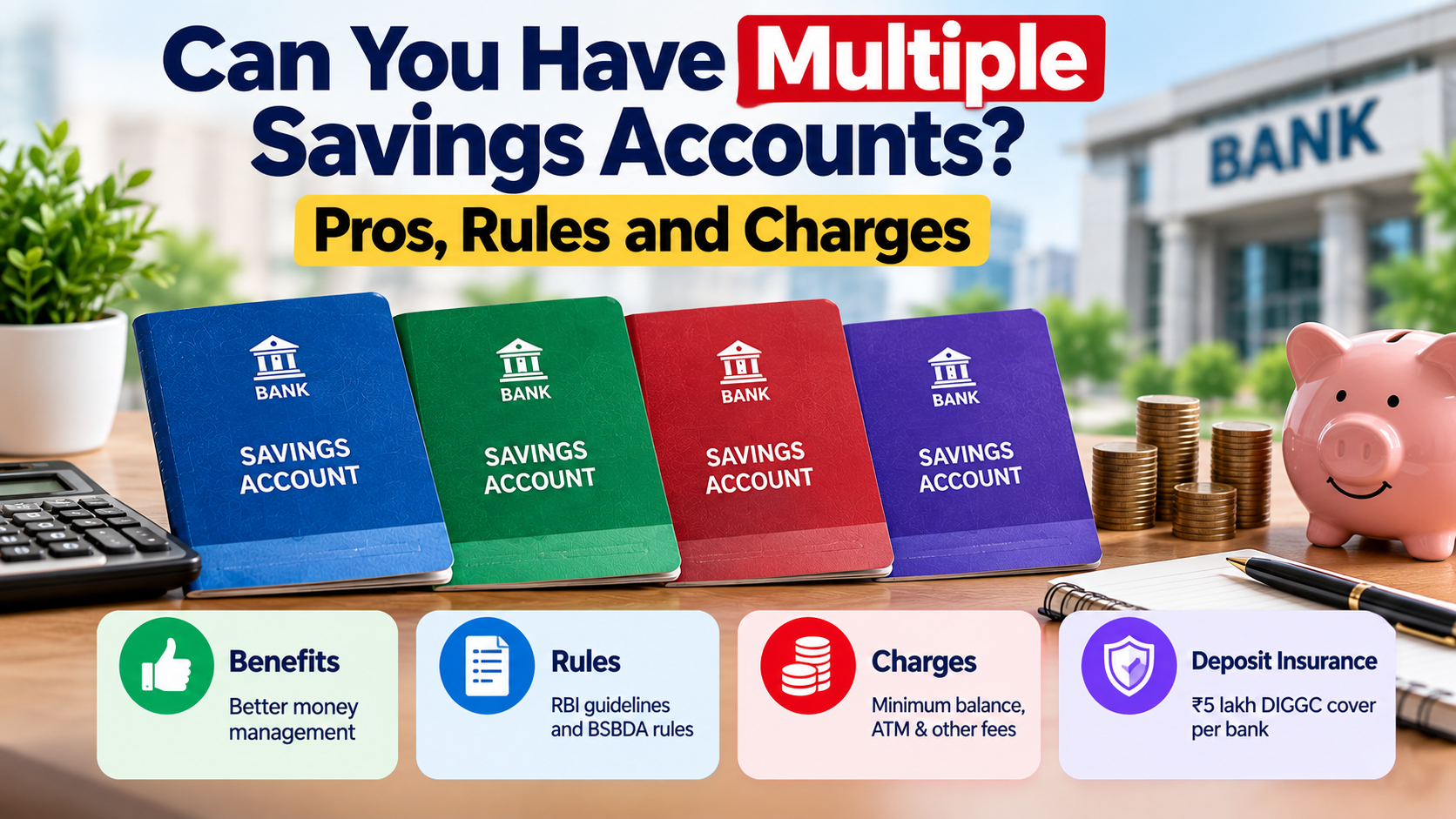
Can you have more than one savings account in India? Yes, generally you can.
There is no blanket RBI rule that says an individual can have only one ordinary savings account. In fact, people commonly maintain separate accounts for salary, household expenses, emergency savings, investments and other financial goals.
However, having multiple accounts does not mean every account works under the same rules. Minimum-balance requirements, debit-card fees, ATM charges, service charges and account-specific conditions can differ from one bank or account type to another.
There is also an important exception: if you hold a Basic Savings Bank Deposit Account (BSBDA) with a bank, RBI rules say you cannot maintain another savings bank deposit account with that same bank.
So, before opening a second or third account, it is useful to understand the rules, benefits and possible costs.
AI Answer Box: Can You Have Multiple Savings Accounts?
Yes. You can generally have multiple ordinary savings accounts, including accounts with different banks.
Multiple accounts can help you separate your money for different purposes, such as monthly expenses, emergency savings and personal goals.
However, each account may have its own minimum-balance rules, debit-card charges and other fees. A key exception is the Basic Savings Bank Deposit Account (BSBDA): a customer cannot have another savings account with the same bank while holding a BSBDA.
Also remember that having multiple accounts in the same bank does not multiply DICGC deposit insurance coverage. Deposits held in the same name and same capacity at the same bank are aggregated for the ₹5 lakh insurance limit.
How Many Savings Accounts Can You Have?
There is no universal RBI limit such as “one person can have only two or three savings accounts.”
You can generally maintain:
- Multiple savings accounts with different banks
- More than one ordinary savings account with a bank, subject to that bank's product rules
- Salary and personal savings accounts
- Separate accounts for different financial goals
But the type of account matters.
For example, BSBDA rules are different. RBI states that an individual can have only one BSBDA in one bank, and a BSBDA holder cannot have another savings bank deposit account in that same bank.
Simple Example
Suppose you have:
- Savings Account A with Bank X
- Savings Account B with Bank Y
- Savings Account C with Bank Z
Generally, there is no issue simply because you have three accounts.
But if one of these is a BSBDA, the specific BSBDA rules need to be considered.
Why Do People Keep Multiple Savings Accounts?
Having multiple accounts can be useful when each account has a clear purpose.
1. Separate Household Expenses
One account can be used for:
- Rent
- Electricity bills
- Grocery payments
- School fees
- UPI payments
- Other regular expenses
This makes it easier to see how much money is actually being spent each month.
2. Emergency Fund
You can maintain a separate savings account specifically for emergencies.
For example:
Monthly income: ₹60,000
You could keep your regular spending account separate from an emergency savings account.
This creates a psychological barrier against spending your emergency money on everyday purchases.
3. Salary Account + Personal Savings
Some people use their salary account for regular transactions and another account for savings.
For example:
| Account | Purpose |
|---|---|
| Account 1 | Salary and regular expenses |
| Account 2 | Emergency savings |
| Account 3 | Long-term financial goals |
This can make personal money management easier.
Benefits of Having Multiple Savings Accounts
Better Money Management
Multiple accounts can help you separate different financial goals.
Instead of keeping ₹2 lakh in one account and spending from the same balance, you could divide your money according to purpose.
For example:
- ₹50,000 — Monthly expenses
- ₹1 lakh — Emergency fund
- ₹50,000 — Short-term goal
The exact allocation depends on your financial situation.
Easier Budget Tracking
A dedicated spending account can make it easier to monitor your monthly expenses.
If your household-expense account starts running low, you know that you may need to control spending rather than accidentally using money reserved for another purpose.
Access to Different Banking Features
Different banks may offer different:
- Mobile banking features
- ATM networks
- Debit-card variants
- Interest rates
- Digital payment features
- Branch networks
- Customer-service options
Maintaining more than one account can provide flexibility.
However, always compare the actual fees and terms before opening another account.
Backup Banking Option
Having accounts with two different banks can provide an alternative if one bank's digital services experience a temporary outage.
For example, if your primary bank's mobile app is unavailable, another account can still provide access to funds, subject to its own available services.
This is a convenience benefit—not a guarantee that every banking service will always be available.
Disadvantages of Having Multiple Savings Accounts
Multiple accounts can be useful, but more accounts also mean more things to manage.
1. Minimum Balance Requirements
Some regular savings accounts may require customers to maintain a specified minimum or average balance.
RBI requires banks to clearly inform customers about minimum-balance requirements and applicable charges.
If you have five accounts with different balance requirements, maintaining all of them can become expensive or inconvenient.
2. Debit Card Charges
Some savings accounts come with annual or periodic debit-card fees.
If you maintain several accounts and use debit cards for all of them, you may end up paying multiple card-related charges.
Before opening another account, check:
- Annual debit-card fee
- Replacement fee
- ATM charges
- International transaction charges
- Other card-related fees
3. ATM Charges
ATM usage can have charges after the applicable free transaction limits.
Therefore, having several accounts does not automatically mean unlimited free ATM usage.
Always check your bank's current schedule of charges.
4. More Statements and Notifications
Multiple accounts mean:
- More SMS/email alerts
- More statements
- More transaction histories
- More debit cards
- More passwords/PINs
- More KYC records to maintain
If an account is rarely used, it can eventually become difficult to track.
What Happens If You Stop Using One of Your Accounts?
This is an important consideration.
A savings or current account can become inoperative when there are no customer-induced transactions for more than two years, under RBI's framework.
That means opening several accounts and then forgetting about them is not always a good idea.
If you no longer need an account, consider formally closing it rather than leaving it unused for years.
What Are the Charges for Multiple Savings Accounts?
There is no single RBI-prescribed “multiple savings account fee.”
Charges depend on the individual bank and account variant.
Possible charges include:
| Type of Charge | Can It Apply? |
|---|---|
| Minimum-balance charge | Depends on account |
| Debit-card annual fee | Depends on card/account |
| ATM transaction charge | Possible beyond applicable free limits |
| Cheque-book charges | Depends on account/usage |
| SMS alert charges | Depends on bank |
| Cash transaction charges | Depends on account and transaction |
| International transaction fees | If applicable |
| Replacement debit-card fee | Usually product-specific |
| Account closure fee | Depends on bank/product terms |
RBI requires banks to disclose minimum-balance requirements and applicable charges transparently. For minimum-balance shortfalls, RBI's guidelines also require notice and say charges should be proportionate to the shortfall; the balance should not become negative solely because of such charges.
Can a Bank Charge You for Not Maintaining Minimum Balance?
For ordinary savings accounts where a minimum balance applies, banks may levy charges subject to applicable RBI requirements and their disclosed terms.
RBI says banks should notify customers when there is a shortfall and give at least one month to restore the required balance before recovering the applicable charge. The charge should be reasonable and proportionate to the shortfall.
Important Point
A bank should not simply allow charges to accumulate indefinitely and turn the savings account balance negative solely because of minimum-balance charges. RBI specifically says the balance should not become negative only because such charges were levied.
What Is a Zero-Balance Savings Account?
Some accounts are designed without a traditional minimum-balance requirement.
One important RBI-defined category is the Basic Savings Bank Deposit Account (BSBDA).
RBI's BSBDA framework provides basic banking facilities without a minimum-balance requirement.
However, BSBDA comes with specific conditions.
BSBDA Rules
According to RBI:
- An individual can have only one BSBDA in a particular bank.
- A BSBDA holder cannot have another savings bank deposit account in that bank.
- Other deposit products such as fixed deposits and recurring deposits can still be held with that bank.
- The basic facilities are provided without charges under the BSBDA framework.
Therefore, don't assume that a “zero-balance” or basic account follows exactly the same rules as every ordinary savings account.
Multiple Savings Accounts and Deposit Insurance
This is one of the most important things to understand when maintaining multiple accounts.
DICGC currently provides deposit insurance of up to ₹5 lakh per depositor per bank, including principal and interest, for deposits held in the same right and capacity.
Example
Suppose you have these accounts in the same bank:
- Savings Account: ₹2 lakh
- Another Savings Account: ₹2 lakh
- Fixed Deposit: ₹3 lakh
If all are held by you in the same right and capacity, the deposits are aggregated for DICGC insurance purposes.
Total:
₹2 lakh + ₹2 lakh + ₹3 lakh = ₹7 lakh
The applicable insurance cover remains limited to ₹5 lakh, not ₹5 lakh for each account.
Does Opening Multiple Accounts in the Same Bank Increase DICGC Cover?
No.
This is a common misconception.
Opening three savings accounts in the same bank does not automatically give you ₹15 lakh of DICGC insurance.
DICGC aggregates deposits held in the same right and capacity at the same bank.
What About Different Banks?
DICGC says deposits held in different banks are insured separately.
For example:
| Bank | Deposits | Insurance Treatment |
|---|---|---|
| Bank A | ₹5 lakh | Up to applicable ₹5 lakh cover |
| Bank B | ₹5 lakh | Up to applicable ₹5 lakh cover |
| Bank C | ₹5 lakh | Up to applicable ₹5 lakh cover |
The DICGC limit is applied separately to deposits at each bank.
Important: Deposit insurance is about the applicable legal protection if an insured bank fails; it should not be treated as a reason by itself to open unnecessary accounts.
Does a Joint Account Get Separate Deposit Insurance?
Joint accounts can be treated differently depending on the right and capacity and the way the joint holders are recorded.
DICGC explains that deposits held in different capacities or rights can receive separate insurance treatment, subject to the scheme's rules.
Because joint-account structures can become complicated, check the DICGC rules rather than assuming every joint account receives a separate ₹5 lakh limit.
Do Multiple Savings Accounts Affect Your Credit Score?
Simply having multiple savings accounts does not automatically reduce your CIBIL score or credit score.
Savings accounts are deposit accounts, while your credit score is primarily based on your credit history and reported borrowing/repayment behaviour.
However, don't confuse:
Bank account management
with
Credit management.
Loans, credit cards and other reported credit facilities can affect your credit profile independently.
Do Multiple Bank Accounts Create a Tax Problem?
Having multiple savings accounts is not, by itself, a tax violation.
However, income earned through your accounts still needs to be considered according to applicable tax rules.
For example, interest earned on savings deposits can have tax implications depending on your circumstances.
The important thing is to maintain proper records of:
- Interest income
- Bank statements
- Fixed deposits
- Other taxable income
- Relevant tax documents
Having several accounts does not mean income earned through those accounts can simply be ignored.
Should You Have Multiple Savings Accounts?
There is no universal answer.
It depends on how well you can manage them.
Multiple accounts may be useful if you want to:
- Separate expenses from savings
- Maintain an emergency fund
- Keep a dedicated salary account
- Organise money for different goals
- Maintain banking access with more than one bank
Fewer accounts may be simpler if you:
- Rarely use your second account
- Forget account passwords or PINs
- Pay unnecessary annual fees
- Struggle to maintain minimum balances
- Don't monitor statements regularly
The key is not the number of accounts, but whether each account has a clear purpose.
How to Manage Multiple Savings Accounts Smartly
1. Give Every Account a Purpose
Don't open an account without knowing why you need it.
For example:
Account 1: Monthly expenses
Account 2: Emergency fund
Account 3: Long-term goals
2. Compare Charges Before Opening
Check the bank's current schedule of charges for:
- Minimum balance
- Debit card
- ATM
- Cash deposits
- Cheque book
- SMS alerts
- Other services
Don't rely only on advertisements saying “free account.”
3. Keep KYC Updated
Make sure your identity and address details remain current.
This can prevent avoidable account restrictions and make account servicing easier.
4. Monitor Every Account
Even if you rarely use an account, check it periodically.
Look for:
- Unexpected charges
- Unknown transactions
- Interest credits
- KYC reminders
- Account-status notifications
5. Close Accounts You Don't Need
If an account no longer serves a purpose, consider formally closing it.
This can reduce:
- Unnecessary fees
- Administrative work
- Forgotten accounts
- Security risks
- KYC-related reminders
Multiple Savings Accounts: Pros and Cons
| Pros | Cons |
|---|---|
| Better budgeting | More accounts to manage |
| Separate financial goals | Possible multiple fees |
| Emergency fund separation | More debit cards |
| Backup banking relationship | Minimum-balance requirements |
| Easier expense tracking | More statements and alerts |
| Access to different banking features | Forgotten accounts can become inoperative |
Multiple Savings Accounts vs One Savings Account
| Feature | One Account | Multiple Accounts |
|---|---|---|
| Easy to manage | Yes | More effort |
| Budget separation | Limited | Better |
| Emergency fund separation | Limited | Easier |
| Fees | Usually fewer | Can be higher |
| Banking backup | Limited | Possible |
| Tracking | Simple | Requires organisation |
| Risk of forgotten account | Lower | Higher |
Common Mistakes to Avoid
Mistake 1: Opening accounts just for offers
Temporary cashback or promotional benefits may not justify keeping an account for years.
Mistake 2: Ignoring minimum-balance requirements
Always read the account's current terms.
Mistake 3: Keeping unused accounts open
If you don't need an account, consider whether closing it is more practical.
Mistake 4: Assuming every account is zero-balance
A regular savings account may have different requirements from a BSBDA.
Mistake 5: Assuming each account gets ₹5 lakh insurance
DICGC aggregates deposits held in the same right and capacity at the same bank.
Mistake 6: Forgetting KYC
Multiple accounts mean multiple banking relationships to keep updated.
Frequently Asked Questions
1. Can I have multiple savings accounts in India?
Yes. Individuals can generally maintain multiple ordinary savings accounts, subject to the terms of the respective banks and account products.
2. How many savings accounts can one person have?
There is no universal RBI number for ordinary savings accounts. The permitted number can depend on the bank and the specific account products.
3. Can I have two savings accounts in the same bank?
Generally, ordinary savings-account customers may have more than one account if the bank's product rules permit it. However, special account types such as BSBDA have specific restrictions.
4. Can I have savings accounts in different banks?
Yes. You can generally maintain savings accounts with multiple banks.
5. Can I have a BSBDA and another savings account in the same bank?
No. RBI's BSBDA rules state that a BSBDA holder cannot have another savings bank deposit account with the same bank.
6. Do multiple savings accounts increase DICGC insurance?
Not when the deposits are held in the same right and capacity at the same bank. Such deposits are aggregated for the ₹5 lakh insurance limit.
7. Are deposits in different banks insured separately?
Yes. DICGC applies the deposit-insurance limit separately to deposits held with different banks.
8. Do multiple savings accounts affect CIBIL score?
Simply having multiple savings accounts does not automatically affect your CIBIL score. Credit history and reported borrowing/repayment behaviour are separate matters.
9. Do multiple bank accounts have extra charges?
They can. Each account may have its own minimum-balance requirements, debit-card fees, ATM charges and other service charges.
10. Can banks charge for not maintaining minimum balance?
For applicable ordinary savings accounts, banks may levy charges subject to RBI requirements and the account's disclosed terms. Customers must be given appropriate notice, and the charges should be proportionate to the shortfall.
11. Can I open a savings account with no minimum balance?
Some account types, such as BSBDA, have no minimum-balance requirement under RBI rules. Other banks may also offer products with their own zero-balance terms.
12. Should I keep multiple savings accounts?
It depends on your financial needs. Multiple accounts can make budgeting easier, but unnecessary accounts can create additional fees and administrative work.
13. Can multiple savings accounts become inactive?
Yes. Accounts that remain without qualifying customer-induced transactions for more than two years can become inoperative under RBI's framework.
14. Is it better to keep all money in one bank?
There is no universal answer. Your decision can depend on convenience, account features, charges, liquidity needs and how you want to organise your finances.
Published on : 25th September
Published by : SMITA
www.vizzve.com || www.vizzveservices.com
Follow us on social media: Facebook || Linkedin || Instagram
🛡 Powered by Vizzve Financial
RBI-Registered Loan Partner | 10 Lakh+ Customers | ₹600 Cr+ Disbursed