

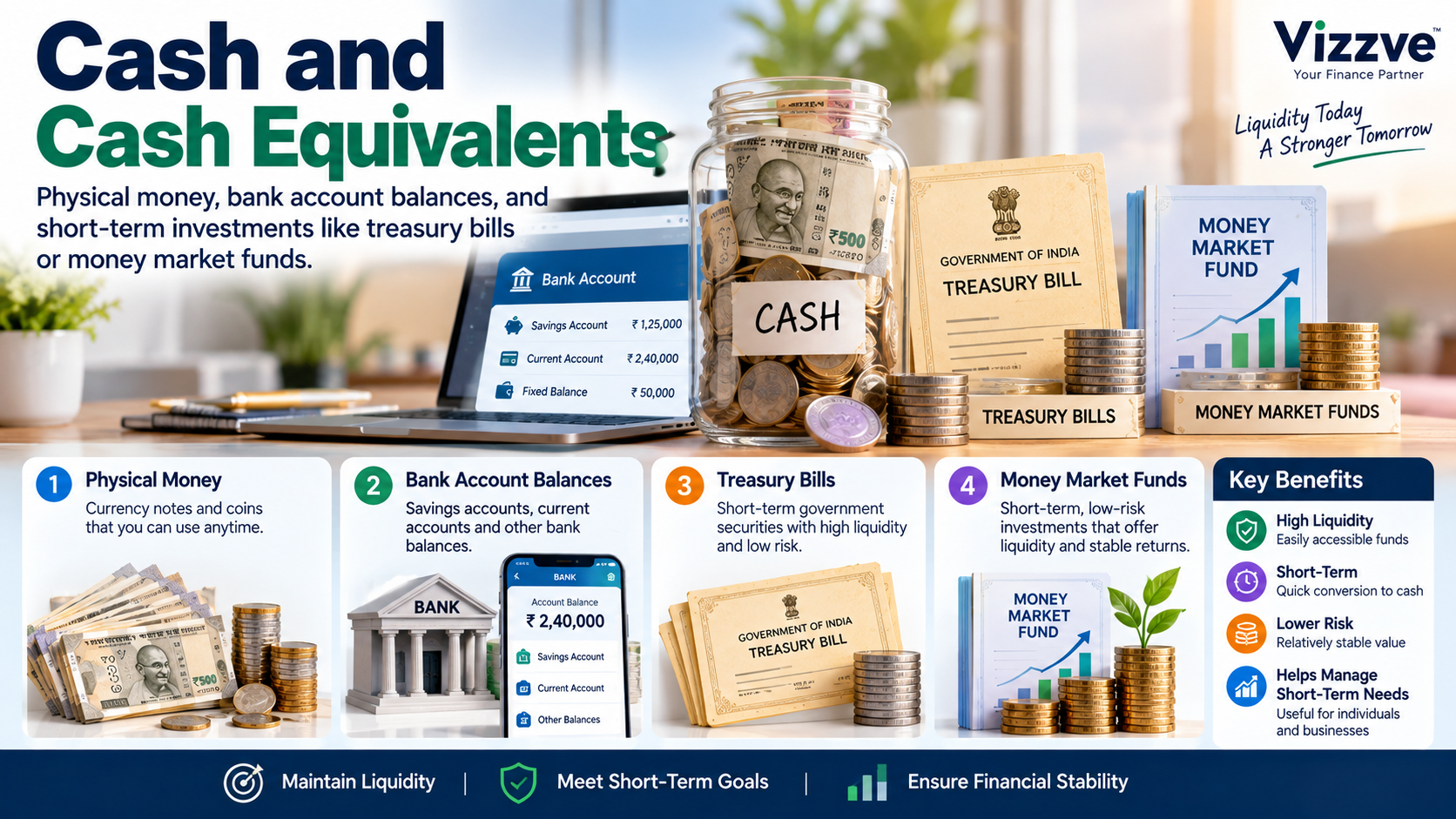
Cash is one of the simplest financial assets, but it is also one of the most important.
Whether you are an individual managing household finances, a small business owner planning monthly expenses, or a company preparing its financial statements, cash and cash equivalents represent money that can be accessed quickly to meet short-term needs.
Cash can include physical currency and money held in bank accounts. Cash equivalents are short-term investments that can be converted into a known amount of cash quickly and carry an insignificant risk of changes in value.
Under Ind AS 7, an investment normally qualifies as a cash equivalent when it has a short maturity—generally three months or less from the date of acquisition—and is readily convertible to a known amount of cash with insignificant risk of changes in value.
This distinction is important because not every short-term investment is automatically a cash equivalent.
What are cash and cash equivalents?
Cash and cash equivalents are highly liquid resources available to meet short-term financial obligations. Cash includes physical currency and certain bank balances, while cash equivalents are qualifying short-term investments that can quickly be converted into a known amount of cash with insignificant value risk.
What are examples of cash equivalents?
Common examples can include qualifying short-term Treasury bills and other highly liquid short-term investments. Under Ind AS 7, the investment generally needs a maturity of around three months or less from acquisition and must meet the other cash-equivalent criteria.
Are all money market funds cash equivalents?
No. A money market fund may be highly liquid, but accounting classification depends on whether the specific investment meets the applicable cash-equivalent criteria. Mutual-fund products also carry investment risks and are not the same as a bank deposit.
Why are cash equivalents important?
They provide liquidity while potentially allowing temporarily unused funds to earn a return. For businesses, they can help cover payroll, suppliers, taxes and other short-term obligations.
What Is Cash?
Cash is money that is immediately available for spending or settlement.
For an individual, this can include:
- Physical currency
- Money in a savings account
- Money in a current account
- Certain demand deposits
For a business, cash is particularly important because daily operations depend on the ability to pay:
- Employees
- Suppliers
- Rent
- Utilities
- Taxes
- Loan obligations
- Other operating expenses
Simple example
Suppose a small business has:
- ₹50,000 in its current account
- ₹10,000 in physical cash
- ₹40,000 invested in a qualifying short-term Treasury bill
Its immediately accessible resources may total ₹1 lakh, but the accounting classification of each amount depends on the applicable rules and the characteristics of the investment.
What Are Cash Equivalents?
Cash equivalents are short-term investments held primarily to meet short-term cash commitments rather than for investment or other purposes.
Ind AS 7 states that a cash equivalent should be readily convertible to a known amount of cash and subject to an insignificant risk of changes in value. It also says that an investment normally qualifies only when it has a short maturity, generally three months or less from the date of acquisition.
The three important characteristics are:
- Highly liquid
- Short-term maturity
- Low risk of changes in value
The purpose of holding the investment also matters.
Cash vs Cash Equivalents
| Feature | Cash | Cash Equivalents |
|---|---|---|
| Form | Currency or qualifying bank balances | Short-term investments |
| Liquidity | Immediate | Very high |
| Investment return | Usually limited | May generate income |
| Value fluctuation | Generally minimal | Must have insignificant value risk to qualify |
| Purpose | Spending and settlement | Short-term cash commitments |
| Example | Bank balance | Qualifying short-term T-bill |
Types of Cash and Cash Equivalents
1. Physical Cash
Physical currency is the most obvious form of cash.
Examples include:
- ₹100 notes
- ₹200 notes
- ₹500 notes
- Coins
Businesses may maintain petty cash for small expenses such as:
- Office supplies
- Local transportation
- Minor repairs
- Refreshments
- Small administrative expenses
Why physical cash matters
Although digital payments are widespread, businesses may still maintain a small physical cash balance for operational convenience.
2. Bank Account Balances
Money held in readily accessible bank accounts is another important form of cash.
Examples include:
- Savings accounts
- Current accounts
- Demand deposits
Businesses generally use current accounts for operational transactions, while individuals commonly use savings accounts for everyday financial needs.
Example
A company has ₹10 lakh in its current account.
It may use the money to pay:
- Salaries
- Suppliers
- Rent
- Taxes
- Utility bills
This balance provides immediate financial flexibility.
3. Treasury Bills
Treasury bills, or T-bills, are short-term government securities.
The Reserve Bank of India describes Treasury bills as short-term debt instruments issued by the Government of India. RBI's investor information identifies regular T-bill tenors of 91 days, 182 days and 364 days. T-bills are issued at a discount and redeemed at face value at maturity.
Important point about T-bills
Not every T-bill automatically qualifies as a cash equivalent.
For accounting purposes, the remaining maturity from the acquisition date and other cash-equivalent requirements matter.
For example:
- A 91-day T-bill purchased at issuance may potentially meet the maturity criterion.
- A longer-dated T-bill purchased when it has only a few weeks remaining may also be relevant.
- A security purchased with a much longer maturity may not qualify merely because it is a government security.
4. Money Market Funds
Money market mutual funds invest in short-term money-market instruments.
AMFI explains that money-market mutual funds invest in money-market instruments and that liquid, overnight and money-market funds are options for investors seeking liquidity and relatively short-term exposure. AMFI also notes that money-market instruments can include Treasury bills, commercial paper, certificates of deposit and other specified instruments.
However, there is an important distinction:
A money market mutual fund is not automatically the same thing as cash or a cash equivalent under accounting standards.
The classification depends on the applicable accounting framework and the characteristics of the investment.
5. Certificates of Deposit
Certificates of Deposit, or CDs, are short-term negotiable money-market instruments issued by eligible financial institutions.
They are generally used by institutions and investors seeking short-term investment opportunities.
Whether a particular certificate qualifies as a cash equivalent depends on its maturity, liquidity, value-risk characteristics and the applicable accounting rules.
6. Commercial Paper
Commercial paper is a short-term debt instrument issued by companies.
It can provide corporations with short-term financing while giving investors access to short-duration debt instruments.
However, commercial paper carries credit risk because repayment depends on the issuer.
Therefore, simply being short-term does not automatically make commercial paper a cash equivalent.
What Qualifies as a Cash Equivalent?
A useful way to understand cash equivalents is to apply a checklist.
Cash-equivalent checklist
A qualifying investment generally needs to:
- Be highly liquid
- Be readily convertible into a known amount of cash
- Have insignificant risk of changes in value
- Be held for short-term cash commitments
- Normally have a maturity of around three months or less from acquisition
These principles come directly from Ind AS 7.
Why Is the Three-Month Rule Important?
One of the most commonly misunderstood points is the three-month rule.
It does not simply mean that every investment lasting less than three months is automatically a cash equivalent.
Ind AS 7 refers to the maturity from the date of acquisition, not simply the original maturity of the instrument.
Example
Imagine:
Investment A: Purchased with 30 days remaining to maturity.
Investment B: Purchased with two years remaining to maturity.
Even if Investment B will eventually mature, it would generally not qualify as a cash equivalent at acquisition merely because it is a relatively safe investment.
The accounting focus is on short-term cash management and the investment's ability to be converted into a known amount of cash with insignificant value risk.
Cash Equivalents vs Short-Term Investments
| Feature | Cash Equivalent | Short-Term Investment |
|---|---|---|
| Main purpose | Short-term cash management | Investment |
| Liquidity | Very high | Varies |
| Value risk | Insignificant | May be higher |
| Typical maturity | Around 3 months or less from acquisition | Can be longer |
| Accounting classification | Specific criteria apply | May fall under another category |
| Example | Qualifying short-term instrument | Short-duration debt fund |
Why Cash and Cash Equivalents Matter
1. Liquidity
Liquidity is the ability to meet financial obligations when they become due.
A company can be profitable on paper and still experience financial stress if it cannot access enough cash when payments are due.
2. Emergency Preparedness
Individuals and businesses need cash reserves to deal with unexpected events.
Examples include:
- Medical expenses
- Job loss
- Equipment breakdown
- Business slowdown
- Emergency repairs
- Unexpected tax obligations
3. Working Capital Management
Businesses need liquidity to keep daily operations running.
For example:
Cash → Buy inventory → Sell products → Receive customer payments → Replenish cash
If this cycle breaks, a business may need external financing even when its long-term business model remains viable.
4. Financial Stability
Maintaining adequate liquid resources can reduce dependence on emergency borrowing.
However, holding too much idle cash can also have a cost because money that remains unproductive may earn less than alternative investments.
This creates a basic financial-management trade-off:
Liquidity vs Return
Cash and Cash Equivalents on a Balance Sheet
Under financial reporting, cash and cash equivalents are typically presented as current assets because they are highly liquid resources.
A simplified balance sheet might look like this:
| Current Assets | Amount |
|---|---|
| Cash | ₹2,00,000 |
| Cash equivalents | ₹3,00,000 |
| Accounts receivable | ₹5,00,000 |
| Inventory | ₹4,00,000 |
| Total current assets | ₹14,00,000 |
The exact presentation depends on the applicable accounting standards and financial statements.
Cash and Cash Equivalents in the Cash Flow Statement
Cash and cash equivalents are especially important in the Statement of Cash Flows.
Ind AS 7 deals specifically with cash flows and cash equivalents.
Cash flow analysis helps investors understand whether a company is generating and using cash through:
Operating activities
Cash generated or used in normal business operations.
Investing activities
Cash used for or generated from investments and long-term assets.
Financing activities
Cash associated with borrowing, repayment, equity transactions and distributions.
A company can report accounting profit while experiencing weak cash flow, which is why investors often examine both earnings and cash movements.
Cash Flow vs Profit: Why the Difference Matters
Consider this example.
A company reports:
Profit = ₹10 crore
But customers have not yet paid ₹8 crore of the sales included in revenue.
The company may report a profit but have significantly less cash available.
This is why cash flow analysis is essential.
Simple principle
Profit measures accounting performance; cash flow shows how money actually moves.
Both provide valuable information, but they answer different questions.
Cash and Cash Equivalents for Individuals
Cash management is not only a corporate-finance topic.
Individuals can apply the same principles to household finances.
A practical personal-finance structure
You can divide money into different buckets:
| Bucket | Purpose |
|---|---|
| Daily cash | Everyday expenses |
| Bank balance | Bills and routine payments |
| Emergency fund | Unexpected expenses |
| Short-term investments | Near-term goals |
| Long-term investments | Wealth creation |
The exact allocation depends on income stability, obligations, goals and risk tolerance.
Cash Reserves for Small Businesses
Small businesses often face unpredictable cash flows.
A business owner may have:
- ₹5 lakh in invoices outstanding
- ₹2 lakh in inventory
- ₹1 lakh in cash
The ₹5 lakh receivables are not equivalent to ₹5 lakh immediately available in the bank.
Customers may pay late.
Inventory may take time to sell.
Cash is immediately usable.
This is why cash-flow forecasting is especially important for small businesses.
Pros and Cons of Holding Cash and Cash Equivalents
Advantages
- High liquidity
- Helps meet short-term obligations
- Provides emergency flexibility
- Reduces dependence on urgent borrowing
- Can support smooth business operations
- Qualifying short-term investments may generate some income
- Useful for near-term financial goals
Disadvantages
- Cash may lose purchasing power through inflation
- Large idle balances may generate low returns
- Some short-term investments still have risks
- Excessive cash holdings can reduce capital efficiency
- Investment products may involve fees, taxes or restrictions
Cash vs Fixed Deposits vs Mutual Funds
| Feature | Cash/Bank Balance | Fixed Deposit | Liquid/Money Market Fund |
|---|---|---|---|
| Liquidity | Very high | Moderate to high | High, subject to scheme terms |
| Return potential | Low | Interest income | Market-linked |
| Capital certainty | Depends on account/product | Deposit terms apply | Not guaranteed |
| Market risk | Very low | Generally low, subject to bank/product terms | Present |
| Best suited for | Immediate needs | Planned short-term savings | Short-term investment needs |
| Accounting classification | Depends on balance | Usually investment/deposit classification | Depends on applicable rules |
Important: Mutual funds are market-linked investments and do not provide guaranteed returns. AMFI specifically notes that returns depend on the portfolio and that there is no guarantee of income.
Current Indian Money-Market Context
India's short-term money markets include instruments such as Treasury bills, commercial paper, certificates of deposit and other money-market securities.
RBI market data published in July 2026 showed indicative T-bill yields of around 5.33% for 91-day bills, 5.57% for 182-day bills and 5.72% for 364-day bills at the referenced July 21, 2026 observation. These are historical market observations, not current September 2026 investment quotes.
This illustrates an important point: short-term government securities can provide an opportunity to earn a return on temporarily available funds, but their accounting classification and suitability depend on the investor's purpose, maturity and applicable rules.
Money Market Funds in India
The Indian mutual-fund market has dedicated categories for short-duration products.
SEBI's statistics for April-August 2026 showed 42 liquid-fund schemes and 27 money-market-fund schemes in its reported mutual-fund categories.
AMFI explains that liquid funds invest in securities with maturities of not more than 91 days, while money-market funds invest in money-market instruments.
But remember
A mutual fund's portfolio maturity and an accounting cash-equivalent classification are not the same test.
This distinction is particularly important for businesses preparing financial statements.
Step-by-Step Guide: How to Build a Cash Reserve
Step 1: Calculate essential monthly expenses
List:
- Rent or EMI
- Food
- Utilities
- Insurance
- Transportation
- Education
- Salaries
- Business operating expenses
Step 2: Separate essential and optional spending
Your emergency reserve should be based primarily on essential expenses.
Step 3: Choose an accessible account
Emergency money should not be locked away in an investment that is difficult to access.
Step 4: Maintain a suitable buffer
The appropriate amount varies depending on income stability, dependants, debt obligations and business conditions.
Step 5: Review regularly
Update your reserve when:
- Income changes
- Expenses increase
- Family circumstances change
- You take a major loan
- Your business expands
Step-by-Step Guide for Businesses
1. Forecast cash inflows
Estimate when customers are expected to pay.
2. Forecast cash outflows
Include salaries, rent, taxes, suppliers, debt payments and other expenses.
3. Identify the minimum cash requirement
Determine the amount needed to keep operations running.
4. Keep excess funds liquid
Money required soon should not generally be placed in investments with unnecessary liquidity or market risk.
5. Review the reserve monthly
Compare forecast cash requirements with actual cash balances.
Expert Commentary: The Most Important Lesson
A useful financial-management principle is:
Do not treat liquidity and profitability as the same thing.
A company can have strong profits but poor liquidity.
An individual can have a high salary but inadequate emergency savings.
A business can have valuable inventory but insufficient cash to pay suppliers.
Cash and cash equivalents exist to solve a very specific problem: meeting short-term financial needs with accessible resources.
That is why the quality of a cash reserve depends not only on its size, but also on:
- Accessibility
- Safety
- Maturity
- Purpose
- Expected cash requirements
Real-World Example
Imagine a small business with the following assets:
| Asset | Amount |
|---|---|
| Bank balance | ₹4 lakh |
| Inventory | ₹6 lakh |
| Customer receivables | ₹5 lakh |
| Office equipment | ₹3 lakh |
| Long-term investments | ₹2 lakh |
Total assets are ₹20 lakh.
But only ₹4 lakh is immediately available as bank cash.
The business therefore should not assume that it has ₹20 lakh available to pay immediate bills.
Inventory needs to be sold.
Receivables need to be collected.
Equipment cannot normally be converted into cash instantly without potentially affecting operations or value.
This example shows why liquidity is different from total wealth.
Common Mistakes to Avoid
Mistake 1: Treating every investment as cash
A fixed deposit, bond, mutual fund or equity share is not automatically a cash equivalent.
Mistake 2: Ignoring maturity
The maturity period from the acquisition date matters under Ind AS 7.
Mistake 3: Confusing liquidity with safety
An asset can be easy to sell but still experience price fluctuations.
Mistake 4: Keeping all money in cash
Excessive idle cash may reduce long-term wealth-building potential.
Mistake 5: Keeping too little emergency cash
Investing every available rupee can create problems when unexpected expenses arise.
Key Takeaways
- Cash means money immediately available for spending or settlement.
- Cash equivalents are qualifying short-term investments that are highly liquid and subject to insignificant value risk.
- Ind AS 7 generally uses a maturity of three months or less from acquisition as an important indicator.
- Treasury bills are short-term government securities and are issued in 91-day, 182-day and 364-day tenors in India.
- Not every Treasury bill automatically qualifies as a cash equivalent.
- Money market funds are investments and are not automatically cash equivalents for accounting purposes.
- Cash reserves help individuals and businesses manage unexpected expenses.
- Businesses need liquidity even when they are profitable.
- Cash flow and accounting profit are different concepts.
- Excess cash can reduce investment efficiency, while insufficient cash can create financial stress.
- Always check the applicable accounting framework when preparing financial statements.
Frequently Asked Questions
1. What are cash and cash equivalents?
Cash and cash equivalents are highly liquid resources used to meet immediate or short-term financial requirements. They include cash itself and qualifying short-term investments.
2. What is the simplest example of cash?
Physical currency and readily accessible bank balances are common examples of cash.
3. What is an example of a cash equivalent?
A qualifying short-term Treasury bill can be an example when it meets the applicable cash-equivalent criteria.
4. What is the three-month rule for cash equivalents?
Under Ind AS 7, an investment normally qualifies as a cash equivalent when it has a short maturity of around three months or less from the date of acquisition, along with the other required conditions.
5. Are Treasury bills cash equivalents?
Some Treasury bills can qualify, but the classification depends on factors including maturity from the acquisition date, liquidity and risk characteristics.
6. Are mutual funds cash equivalents?
Not automatically. A mutual fund's classification depends on the nature of the investment and the applicable accounting requirements.
7. What is the difference between cash and cash equivalents?
Cash is immediately available money, while cash equivalents are qualifying short-term investments that can be readily converted into a known amount of cash.
8. Why are cash equivalents important for businesses?
They allow businesses to keep temporarily unused funds relatively liquid while potentially earning a return, subject to the investment's terms and risks.
9. Is cash the same as a current asset?
Cash is generally a current asset, but current assets also include items such as receivables and inventory. Not all current assets are immediately liquid.
10. Is a fixed deposit a cash equivalent?
Not necessarily. The classification depends on factors such as maturity from acquisition, purpose and the applicable accounting framework.
11. Why does cash flow matter if a company is profitable?
Profit includes accounting items and may include sales that have not yet been collected. Cash flow shows the actual movement of cash.
12. What are the main types of cash equivalents in India?
Potential examples include qualifying Treasury bills and other highly liquid short-term money-market instruments, subject to applicable accounting criteria.
13. Are money market funds risk-free?
No. Mutual funds are market-linked products and do not guarantee returns.
14. How much cash should an individual keep?
There is no universal amount. The appropriate reserve depends on monthly expenses, income stability, dependants, debt and financial goals.
15. How can businesses improve cash management?
Businesses can improve cash management by forecasting inflows and outflows, collecting receivables efficiently, controlling expenses and maintaining an appropriate liquidity reserve.
Published on : 23nd september
Published by : Shanlee JV
www.vizzve.com || www.vizzveservices.com
Follow us on social media: Facebook || Linkedin || Instagram
🛡 Powered by Vizzve Financial
RBI-Registered Loan Partner | 10 Lakh+ Customers | ₹600 Cr+ Disbursed