

Introduction
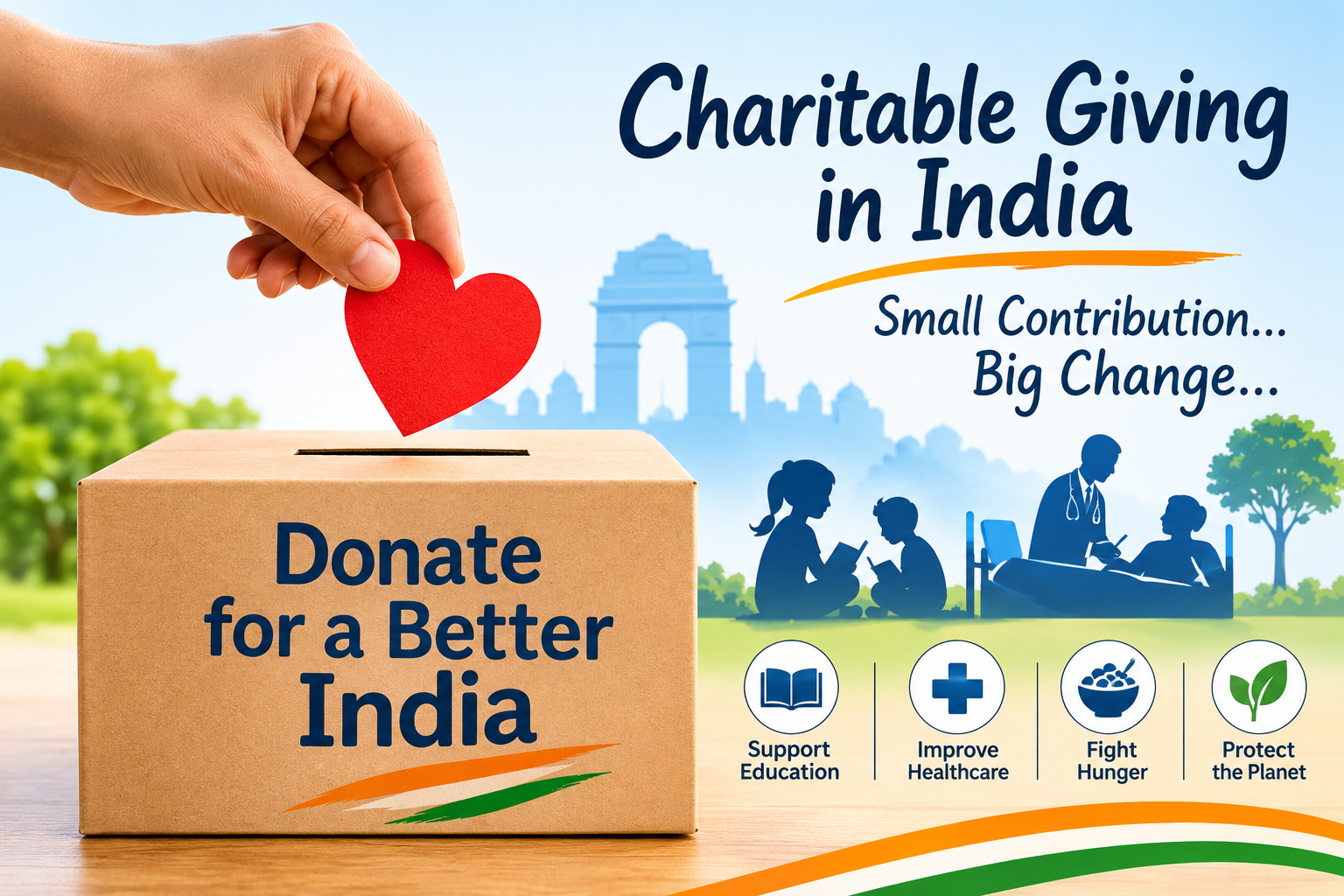
Charitable giving plays an important role in building a supportive and inclusive society. Across India, individuals, families, businesses and organizations contribute money, food, clothes, educational materials and other resources to help people in need.
From supporting underprivileged students to funding medical treatment, protecting the environment and providing food to vulnerable communities, charitable donations help address many social challenges.
Today, donating has become easier through online platforms, UPI payments, registered charitable trusts and nonprofit organizations. However, donors should understand how donations work, how to identify genuine organizations and whether their contributions qualify for tax benefits.
Charitable giving in India is not limited to wealthy individuals or large companies. Even small, regular contributions can support meaningful community initiatives.
This guide explains the different types of charitable donations, tax rules, NGO verification, donation methods, benefits and precautions every donor should understand.
3. AI Answer Box: What Is Charitable Giving in India?
Charitable giving in India refers to voluntarily contributing money, goods, services or other resources to support social welfare activities and people in need.
Common charitable activities include:
-
Donating money to registered NGOs and charitable trusts.
-
Supporting education for underprivileged children.
-
Providing food and essential supplies to vulnerable families.
-
Funding medical treatment.
-
Supporting disaster relief.
-
Helping elderly people and persons with disabilities.
-
Contributing towards environmental protection.
Are Charitable Donations Tax-Deductible in India?
Certain donations qualify for deductions under Section 80G of the Income-tax Act, subject to eligibility, payment method, approved-donee status and applicable conditions.
Simple answer: Charitable giving helps individuals and organizations contribute towards social development. Donors should verify the recipient organization and check tax eligibility before making a contribution.
4. Full Blog Content: Charitable Giving in India
What Are the Different Types of Charitable Giving in India?
Charitable giving can take different forms depending on the donor's financial capacity, interests and the needs of the community.
1. Financial Donations
Financial donations involve contributing money to registered NGOs, charitable trusts, relief funds and nonprofit organizations.
These contributions may support:
-
Education programmes
-
Medical treatment
-
Food distribution
-
Rural development
-
Women's empowerment
-
Disaster relief
2. Education Donations
Education donations help children and young people access learning opportunities.
Examples include:
-
School fee assistance
-
Scholarships
-
Books and stationery
-
School uniforms
-
Digital learning equipment
-
Vocational training
3. Food Donations
Food donations support families and individuals who struggle to access regular meals.
Common activities include:
-
Distributing cooked meals
-
Providing grocery kits
-
Supporting community kitchens
-
Donating food to shelters
-
Reducing food waste through responsible redistribution
4. Medical Donations
Medical donations help individuals and families manage healthcare expenses.
They may support:
-
Hospital treatment
-
Medical equipment
-
Medicines
-
Emergency surgeries
-
Blood donation programmes
-
Rural healthcare facilities
5. Clothing and Essential Goods Donations
People can donate useful household items and essential goods to support vulnerable communities.
Examples include:
-
Clean clothes
-
Blankets
-
School bags
-
Footwear
-
Hygiene products
-
Household essentials
Always donate items that are safe, usable and genuinely needed.
6. Environmental Donations
Environmental charitable giving supports activities that protect natural resources.
Examples include:
-
Tree plantation
-
Wildlife conservation
-
Water conservation
-
Waste management
-
Clean-up campaigns
-
Renewable energy initiatives
Why Is Charitable Giving Important in India?
India has diverse social and economic needs. Charitable contributions help communities address challenges that may not be solved through individual efforts alone.
1. Supports Underprivileged Families
Donations can help families access food, clothing, shelter and other essential services.
2. Improves Educational Opportunities
Financial assistance can help children continue their education and develop useful skills.
3. Supports Healthcare
Charitable organizations can provide medical assistance to people who struggle with treatment expenses.
4. Encourages Community Development
Donations can support local projects involving sanitation, drinking water, education and livelihood development.
5. Helps During Natural Disasters
Charitable contributions can provide emergency supplies, temporary accommodation and rehabilitation assistance.
6. Promotes Social Responsibility
Giving encourages individuals and organizations to participate in solving community problems.
How Does Charitable Giving Work in India?
Charitable giving generally involves a donor, a recipient organization and a social purpose.
Basic Donation Process
Step 1: Identify a Cause
Choose an area where you want to contribute, such as education, healthcare, food or environmental protection.
Step 2: Find a Suitable Organization
Research NGOs, charitable trusts or recognized funds working in your selected area.
Step 3: Verify the Organization
Check registration details, legal status, financial information and available reports.
Step 4: Select the Donation Amount
Decide how much you can comfortably contribute.
Step 5: Choose a Payment Method
Use an official payment channel such as bank transfer, UPI, cheque or an authorized donation platform.
Step 6: Collect the Receipt
Keep the donation receipt and payment confirmation for your records.
Step 7: Follow the Impact
Review updates, project reports and utilization information to understand how the contribution is being used.
Popular Areas of Charitable Giving in India
Different donors support different social causes. The following table explains some common donation categories.
|
Donation Category |
Purpose |
Example Contribution |
|---|---|---|
|
Education |
Improve access to learning |
Books and scholarships |
|
Healthcare |
Support medical services |
Treatment assistance |
|
Food security |
Reduce hunger |
Food kits and meals |
|
Child welfare |
Protect and support children |
Shelter and education |
|
Women's empowerment |
Improve opportunities for women |
Skill training |
|
Elderly care |
Support senior citizens |
Food and healthcare |
|
Environment |
Protect natural resources |
Tree plantation |
|
Disaster relief |
Support affected communities |
Emergency supplies |
|
Rural development |
Improve village facilities |
Drinking water projects |
Online Donations in India: How Can You Donate Money?
Online donation facilities have made charitable giving more convenient.
Donors can contribute through websites, payment gateways, UPI and bank transfers.
Common Online Donation Methods
1. UPI Donations
UPI allows donors to transfer money using a verified UPI ID or QR code.
2. Bank Transfers
Donors can transfer money directly into the organization's verified bank account.
3. Debit and Credit Cards
Some nonprofit websites accept card payments through authorized payment gateways.
4. Net Banking
Net banking provides another option for making direct contributions.
5. Donation Platforms
Online fundraising platforms connect donors with individuals and organizations seeking financial support.
Important Safety Tips
-
Visit the organization's official website.
-
Confirm the beneficiary name before payment.
-
Avoid unknown payment links.
-
Never share your UPI PIN or OTP.
-
Check the purpose of the fundraising campaign.
-
Save your transaction reference.
-
Confirm that the donation has reached the intended recipient.
Tax Benefits on Charitable Donations in India
Tax deductions can encourage eligible taxpayers to contribute towards charitable causes.
However, not every donation qualifies for a tax deduction. The recipient organization, donation category, payment method and applicable tax provisions matter.
What Is Section 80G for Charitable Donations?
Section 80G of the Income-tax Act, 1961 was a well-known provision allowing eligible taxpayers to claim deductions for qualifying charitable donations.
However, there is an important legal update for 2026.
From 1 April 2026, the Income-tax Act, 2025 came into force. The corresponding donation deduction provision is now Section 133. Section 80G remains relevant when discussing donations and tax years governed by the earlier Act.
Understanding Section 133 of the Income-tax Act, 2025
Section 133 provides deductions for specified donations to eligible funds and charitable institutions.
Depending on the category of recipient, the deduction can be:
-
100% of an eligible donation.
-
50% of an eligible donation.
-
Subject to an applicable qualifying limit.
The provision includes specified government funds, relief funds and qualifying charitable institutions.
Important Rules for Claiming Donation Deductions
-
The recipient must satisfy the applicable eligibility conditions.
-
Only qualifying monetary donations are covered.
-
Donations exceeding ₹2,000 must be made through a non-cash payment mode to qualify.
-
The applicable deduction percentage depends on the recipient category.
-
Certain donations are subject to a 10% adjusted gross total income limit.
-
The recipient's required donation information must be furnished to the tax authorities for applicable claims.
IndiaCode+1
Example of a Charitable Donation Tax Deduction
Suppose a taxpayer donates ₹10,000 to an eligible institution qualifying for a 50% deduction without an applicable qualifying limit.
|
Particulars |
Amount |
|---|---|
|
Donation amount |
₹10,000 |
|
Eligible deduction rate |
50% |
|
Potential deduction from taxable income |
₹5,000 |
|
Remaining donation amount |
₹5,000 |
Illustrative example only. Actual eligibility and deduction depend on the institution's category, qualifying limits and the applicable tax provisions.
Important: A deduction reduces taxable income; it does not mean the government refunds the entire donation amount.
Does Every NGO Donation Qualify for Tax Benefits?
No. An NGO's registration alone does not automatically make every donation eligible.
Before donating, check:
-
Whether the institution has the required approval.
-
Whether its approval is valid on the donation date.
-
Whether the donation category qualifies.
-
Whether the payment method satisfies the law.
-
Whether the organization reports the donation correctly.
For tax-year 2026-27 onward, check Section 133 and the applicable Income-tax Rules. For earlier tax years, check the corresponding Section 80G provisions.
Official reference: Section 133 – Income-tax Act, 2025.
What Is Corporate Social Responsibility (CSR) in India?
Corporate Social Responsibility, commonly known as CSR, refers to eligible companies contributing towards social and environmental development under the Companies Act, 2013.
CSR is an important part of organized charitable and community development activities in India.
Under Section 135 of the Companies Act, companies meeting specified financial thresholds must comply with CSR requirements, including spending at least 2% of their average net profits from the three immediately preceding financial years on eligible CSR activities.
The applicable thresholds include:
-
Net worth of ₹500 crore or more.
-
Turnover of ₹1,000 crore or more.
-
Net profit of ₹5 crore or more.
Recent CSR Data in India
According to a Ministry of Corporate Affairs update published by the Press Information Bureau in February 2026, companies reported the following CSR expenditure:
|
Financial Year |
CSR Expenditure |
|---|---|
|
2019–20 |
₹24,965.82 crore |
|
2020–21 |
₹26,210.95 crore |
|
2021–22 |
₹27,141.45 crore |
|
2022–23 |
₹30,932.08 crore |
|
2023–24 |
₹34,908.75 crore |
Source: Ministry of Corporate Affairs data reported by PIB, February 2026. Amounts are reported CSR expenditure.
The figures demonstrate the growing scale of corporate participation in India's social development activities.
Common CSR Activities
-
Education and skill development
-
Healthcare and sanitation
-
Environmental sustainability
-
Rural development
-
Women empowerment
-
Poverty reduction
-
Disaster management
-
Community welfare
Companies can review eligible CSR projects and implementation partners through the official government CSR reporting resources.
How to Verify an NGO Before Donating in India
Choosing a genuine charitable organization is one of the most important steps in responsible giving.
NGO Verification Checklist
|
Verification Point |
What to Check |
|---|---|
|
Registration |
Trust, society or Section 8 company registration |
|
PAN |
Organization's valid PAN |
|
Tax approval |
Applicable Section 133 approval or Section 80G approval for earlier tax years |
|
12AB registration |
Applicable charitable tax registration |
|
Financial reports |
Audited statements and annual reports |
|
Website |
Official contact details and activities |
|
Donation receipt |
Proper receipt and transaction details |
|
Project information |
Clear explanation of how funds are used |
Important Government Resources
-
NGO Darpan: NGO Darpan Portal.
-
Income Tax Department: Official Income Tax Portal.
-
CSR Information: MCA Corporate Data Management Portal.
Warning Signs of a Suspicious Charity
Be careful if an organization:
-
Refuses to share registration information.
-
Uses personal bank accounts without a clear explanation.
-
Makes unrealistic promises about donation impact.
-
Pressures you to donate immediately.
-
Does not provide receipts.
-
Publishes no verifiable project information.
-
Uses copied photographs or misleading beneficiary stories.
A genuine charity should be willing to explain its purpose, governance and financial practices.
Difference Between Charity, NGO Donations and CSR
Although these terms are connected, they have different meanings.
|
Feature |
Charitable Giving |
NGO Donations |
CSR |
|---|---|---|---|
|
Meaning |
Voluntary support for social causes |
Contributions to nonprofit organizations |
Corporate social responsibility activities |
|
Donors |
Individuals and organizations |
Individuals and businesses |
Eligible companies |
|
Main purpose |
Public welfare |
Support NGO programmes |
Social and environmental development |
|
Contribution |
Money, goods or services |
Money and eligible resources |
Eligible CSR expenditure |
|
Legal framework |
Depends on donation and recipient |
Depends on organization and donation |
Companies Act, 2013 |
Benefits of Charitable Giving
Charitable contributions create benefits for individuals, communities and society.
1. Helps People in Need
Donations provide financial and material support to people facing difficult circumstances.
2. Supports Education
Contributions can help students access books, school facilities and educational opportunities.
3. Improves Healthcare Access
Charitable support can help fund treatment, medical equipment and healthcare programmes.
4. Encourages Community Participation
Giving motivates people to participate in local welfare activities.
5. Supports Environmental Protection
Donations can contribute towards conservation, waste management and sustainability initiatives.
6. Encourages Social Responsibility
Charitable giving promotes empathy, cooperation and responsible citizenship.
Pros and Cons of Charitable Giving
|
Pros |
Cons and Challenges |
|---|---|
|
Supports vulnerable communities |
Some organizations may lack transparency |
|
Encourages social development |
Donations may be misused |
|
Helps improve education |
Measuring actual impact can be difficult |
|
Supports healthcare and relief |
Some campaigns may be misleading |
|
Encourages community participation |
Tax benefits are not available for every donation |
|
Can provide long-term social benefits |
Regular donations require financial planning |
How to Make a Charitable Donation Safely: Step-by-Step Guide
If you want to support a social cause, follow these practical steps.
Step 1: Choose Your Preferred Cause
Decide whether you want to support education, healthcare, food distribution, environmental protection or another activity.
Step 2: Research Organizations
Identify organizations that have experience working in your selected area.
Step 3: Verify Legal Details
Check registration, PAN, relevant tax approvals and available financial reports.
Step 4: Understand the Donation Purpose
Ask how your contribution will be used and whether it supports a specific project.
Step 5: Select a Comfortable Amount
Donate according to your financial capacity. Avoid borrowing money simply to make a charitable contribution.
Step 6: Make the Payment
Use an official bank account, UPI ID or authorized payment gateway.
Step 7: Collect Documentation
Keep the receipt, payment confirmation and other relevant documents.
Step 8: Check the Results
Review project updates, financial statements and impact reports.
Can You Donate Money to NGOs from Outside India?
Yes, but foreign donations to Indian organizations are subject to the Foreign Contribution (Regulation) Act (FCRA) and applicable rules.
Indian NGOs generally need appropriate FCRA registration or prior permission to receive foreign contributions.
The Ministry of Home Affairs administers FCRA requirements, including the receipt, use and reporting of foreign contributions.
Important FCRA Requirements
-
Eligible organizations must obtain registration or prior permission.
-
Foreign contributions must be received through the prescribed banking arrangement.
-
Funds must be used for permitted purposes.
-
Applicable accounting and reporting requirements must be followed.
-
Organizations must comply with the applicable administrative-expense restrictions.
The government reported that approximately 16,200 associations were actively registered and received around ₹22,963 crore in foreign contributions during 2024–25.
Important: Indian donors making domestic contributions generally do not need to check an NGO's FCRA registration unless the donation involves foreign contribution. FCRA status is not a general quality certification for charities.
Official reference: Government of India – FCRA FAQs.
How Much Money Should You Donate to Charity?
There is no universal donation amount that everyone must follow.
The appropriate amount depends on your income, expenses, savings and financial responsibilities.
Example of a Monthly Donation Budget
|
Monthly Income |
Illustrative Monthly Donation |
|---|---|
|
₹15,000 |
₹100–₹200 |
|
₹25,000 |
₹200–₹300 |
|
₹40,000 |
₹300–₹500 |
|
₹60,000 |
₹500–₹1,000 |
|
₹1,00,000 |
₹1,000–₹2,000 |
These are optional budgeting examples, not recommended or mandatory donation percentages.
Smart Donation Planning Tips
-
Set a comfortable monthly donation budget.
-
Prioritize essential expenses and emergency savings.
-
Support organizations with clear objectives.
-
Consider recurring donations if your finances allow.
-
Keep donation records for tax purposes.
-
Review the organization's performance periodically.
Real-World Examples of Charitable Giving
Charitable giving does not always require a large amount of money.
Here are some practical examples of how individuals can contribute.
Example 1: Supporting a Student
A working professional contributes ₹500 every month towards educational materials for an underprivileged student.
Over one year, the contribution totals ₹6,000.
Example 2: Helping a Local Community
A group of residents collects groceries and distributes essential food supplies to families experiencing financial difficulties.
Example 3: Supporting Medical Treatment
A family contributes to a verified medical fundraising campaign to help a patient access necessary treatment.
Example 4: Corporate Community Support
A company partners with an eligible nonprofit organization to support a rural education programme through its CSR activities.
These examples show how financial contributions, community participation and organized initiatives can create meaningful social benefits.
Expert Commentary: How to Make Charitable Giving More Effective
Charitable giving should focus on more than the amount donated. The quality, transparency and long-term impact of a contribution are equally important.
A responsible donor should consider three factors:
1. Transparency: Understand how an organization receives, manages and spends donations.
2. Sustainability: Prefer initiatives that address long-term challenges rather than providing only temporary support where lasting solutions are possible.
3. Accountability: Look for annual reports, audited financial statements, project updates and measurable outcomes.
A small donation to a well-managed programme can create meaningful value. Consistent and informed contributions can also help nonprofit organizations plan their activities more effectively.
Trust-Building Tips for Donors
-
Verify before transferring money.
-
Ask for a proper donation receipt.
-
Check whether the organization publishes annual reports.
-
Avoid donating under pressure.
-
Never share banking passwords or OTPs.
-
Confirm tax eligibility independently.
-
Review the progress of funded projects.
Important Rules and Regulations for Charitable Giving in India
Charitable organizations and donations may be governed by different laws depending on their structure and activities.
|
Law / Registration |
Purpose |
|---|---|
|
Income-tax Act, 2025 – Section 133 |
Eligible donation deductions from 1 April 2026 |
|
Income-tax Act, 1961 – Section 80G |
Donation deductions for relevant earlier tax years |
|
Section 12AB |
Registration framework for charitable institutions under the earlier Act |
|
Companies Act, 2013 |
Corporate Social Responsibility requirements |
|
FCRA |
Regulation of foreign contributions |
|
Trust laws |
Applicable rules for charitable trusts |
|
Societies Registration laws |
Registration and governance of societies |
|
Companies Act, Section 8 |
Incorporation of nonprofit companies |
The exact registration and compliance requirements depend on the organization's legal structure and activities.
Charitable Giving: Quick Comparison of Donation Methods
|
Donation Method |
Convenience |
Important Consideration |
|---|---|---|
|
UPI |
High |
Verify beneficiary details |
|
Bank transfer |
High |
Confirm official account |
|
Cheque |
Moderate |
Obtain receipt |
|
Cash |
Convenient for small donations |
Cash donations above ₹2,000 do not qualify for the applicable donation deduction |
|
Online fundraising |
High |
Verify the campaign and platform |
|
Goods donation |
Depends on collection arrangements |
Check actual needs and condition |
Note: The ₹2,000 cash restriction relates to tax deduction eligibility, not a general prohibition on making every cash donation.
Key Takeaways
-
Charitable giving helps improve education, healthcare and community welfare.
-
Donations can be made through money, goods and voluntary services.
-
Online donations make contributing easier, but verification is essential.
-
Not every NGO or donation automatically qualifies for tax benefits.
-
Section 80G is the earlier tax provision; Section 133 of the Income-tax Act, 2025 applies from 1 April 2026.
-
Donations above ₹2,000 must be made through non-cash modes to qualify under the applicable deduction provision.
-
CSR activities encourage companies to participate in social development.
-
FCRA regulates foreign contributions received by eligible Indian organizations.
-
Donors should collect receipts and maintain payment records.
-
Even small, regular contributions can support meaningful social initiatives.
5. Frequently Asked Questions (FAQs)
1. What is charitable giving in India?
Charitable giving in India means voluntarily donating money, goods or services to support social causes such as education, healthcare, food distribution, poverty reduction and environmental protection.
2. What are the different types of charitable donations?
Common types include financial donations, food donations, education support, medical assistance, clothing donations, environmental contributions and disaster relief.
3. Can I donate money to NGOs online in India?
Yes. You can donate through verified NGO websites, UPI, bank transfers, payment gateways and authorized fundraising platforms.
4. Are charitable donations tax-deductible in India?
Eligible donations can qualify for tax deductions under applicable provisions. Section 133 of the Income-tax Act, 2025 applies from 1 April 2026, replacing the earlier Section 80G framework for relevant tax years.
5. What is Section 80G for donations?
Section 80G was a provision under the Income-tax Act, 1961 that allowed deductions for eligible donations. For tax years beginning from 1 April 2026, refer to Section 133 of the Income-tax Act, 2025.
6. Do all NGO donations qualify for tax benefits?
No. Only donations to qualifying funds and institutions that meet applicable legal and approval requirements are eligible.
7. Can I claim tax benefits for cash donations?
Donations exceeding ₹2,000 made in cash do not qualify for the applicable donation deduction. Use a non-cash payment method and retain the receipt.
8. How can I verify whether an NGO is genuine?
Check its registration documents, PAN, relevant tax approvals, annual reports, audited financial statements and official contact information.
9. What is CSR in charitable giving?
CSR stands for Corporate Social Responsibility. It refers to eligible companies supporting social, environmental and community development activities under the Companies Act, 2013.
10. Can individuals make monthly charitable donations?
Yes. Individuals can contribute monthly according to their financial capacity through recurring donations or scheduled bank transfers.
11. Can foreign citizens donate to Indian NGOs?
Foreign contributions can be received by eligible Indian organizations that comply with FCRA registration or prior-permission requirements.
12. Is donating through UPI safe?
UPI donations can be convenient, but donors should verify the recipient's name and payment details before completing the transaction. Never share your UPI PIN or OTP.
13. What documents should I collect after donating?
Keep the donation receipt, payment confirmation, organization details and applicable tax approval information. These records can help support eligible tax claims.
14. What is the difference between charity and CSR?
Charity generally refers to voluntary contributions by individuals or organizations. CSR refers to social responsibility activities undertaken by eligible companies under the Companies Act.
15. How can small donations make a difference?
Small contributions from multiple donors can collectively support educational programmes, food distribution, medical assistance and other community development activities.
6. Vizzve Financial – Supporting Financial Awareness
Charitable giving is an important part of responsible financial and social development. Understanding donations, financial planning and tax rules helps individuals make better financial decisions.
Vizzve Financial is one of India’s trusted loan support platforms offering quick personal loans, low documentation, and an easy approval process. Apply at www.vizzve.com.
Explore financial support options and learn more about responsible money management.
Website: www.vizzve.com
Published on : 22nd November
Published by : Bhargavi
www.vizzve.com || www.vizzveservices.com
Follow us on social media: Facebook || Linkedin || Instagram
🛡 Powered by Vizzve Financial
RBI-Registered Loan Partner | 10 Lakh+ Customers | ₹600 Cr+ Disbursed