

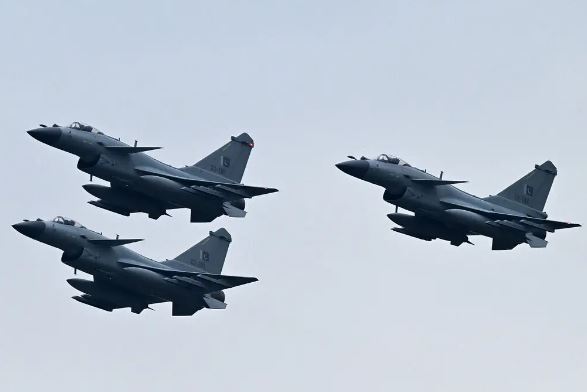
As tensions between India and Pakistan escalate once again, another powerful regional player is quietly capitalizing on the conflict—China. While the focus remains on South Asia’s age-old rivalry,
Beijing is strategically using the India-Pakistan standoff to accelerate its military modernization efforts, particularly in its fighter jet development and missile technology.
How the India-Pakistan Conflict Benefits China’s Defense Strategy
1. Live-Testing Regional Stability
China closely monitors military interactions and strategic maneuvers between India and Pakistan to refine its own strategies. The recurring cross-border skirmishes serve as real-world case studies for regional warfare tactics, helping China better understand India’s military capabilities and gaps.
2. Fighter Jet Advancements
The Chengdu J-20 and FC-31 stealth fighters have seen rapid enhancements recently. Defense analysts suggest that combat simulations and lessons drawn from regional hostilities provide China with valuable data for performance tuning and tactical enhancements.
3. Missile Development and Deployment
China's missile capabilities, including hypersonic glide vehicles and precision-strike systems like DF-17 and DF-26, are also seeing increased investment. China is likely testing range and targeting strategies designed with both Indian and Southeast Asian theaters in mind.
Geopolitical Leverage: A Strategic Opportunity
China’s dual alliances and defense ties with Pakistan offer Beijing a unique window into the South Asian military dynamic. By backing Pakistan diplomatically and militarily while watching India's response strategies, China can sharpen its regional deterrence posture without direct engagement.
Implications for India and the Region
-
India’s Response: India is now forced to watch two fronts—its direct adversary Pakistan, and the increasingly powerful Chinese military observing from the sidelines.
-
Arms Race Concerns: The Indo-Pacific region may be entering a new arms race, with defense budgets ballooning and advanced military tech deployment accelerating.
-
Strategic Alliances: The U.S., Japan, and Australia are likely to deepen defense ties with India to counterbalance China's growing edge.
Defense Experts Weigh In
“Every India-Pakistan flare-up gives China an indirect advantage. It provides both operational insights and a pretext to upgrade its regional deterrent systems.”
— Lt. Gen. (Retd.) R.K. Sharma, Defense Analyst
“We’re witnessing the militarization of South Asia not just through conflict, but through observation and exploitation by third parties like China.”
— Dr. Liu Wang, Asian Security Researcher
FAQ: China’s Military Advantage from Indo-Pak Tensions
Q1: How does the India-Pakistan conflict benefit China’s military?
China uses the conflict as a testing ground for strategy and surveillance, while refining its fighter jets and missile systems based on real-time observations.
Q2: Is China directly involved in the India-Pakistan conflict?
No, China remains diplomatically distant but leverages the situation to strengthen its own military preparedness and regional influence.
Q3: Which Chinese military systems are seeing improvements?
The J-20 stealth fighter, DF-series missiles, and satellite reconnaissance capabilities are among the primary beneficiaries of accelerated development.
Q4: Is there a risk of a three-way conflict?
While unlikely at this stage, the geopolitical tension between India, Pakistan, and China remains high, and accidental escalation is a concern.
Q5: What should India do to counterbalance this strategic disadvantage?
India is expected to boost its indigenous defense manufacturing, enhance satellite and drone capabilities, and strengthen alliances like QUAD and Indo-Pacific defense partnerships.
Published on : May-20 -25 By: Abhishek Rana