

China to Send Youngest 32-Year-Old Astronaut and Mice on Space Mission This Week |
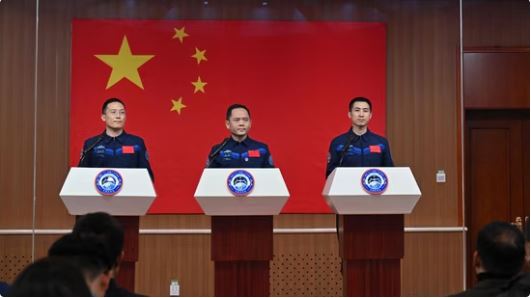
China is gearing up for another milestone in its rapidly advancing space program as it prepares to launch the Shenzhou-20 mission this week. The mission will send a crew of three astronauts, including China’s youngest astronaut to date — 32-year-old Tang Shengjie — to the Tiangong space station.
In addition to the human crew, the spacecraft will also carry laboratory mice to conduct biological experiments that will help scientists better understand how living organisms adapt to long-duration space travel.
Mission Details
The Shenzhou-20 mission is part of China’s long-term plan to expand and maintain the Tiangong Space Station, which is expected to operate for at least 10–15 years. The mission will focus on:
Space biology experiments involving mice to study gene expression and adaptation in microgravity.
Maintenance and equipment upgrades to Tiangong modules.
Testing new life-support technologies to enhance future long-duration space missions.
The launch will take place from the Jiuquan Satellite Launch Center in the Gobi Desert, a key hub for China’s manned spaceflight program.
Meet China’s Youngest Astronaut — Tang Shengjie
At just 32 years old, Tang Shengjie is set to make history as China’s youngest astronaut to travel into orbit. A former Air Force pilot, Tang’s selection underscores the new generation of Chinese astronauts being trained for extended missions and future lunar expeditions.
Joining Tang on the mission are veteran astronauts Jiang Xinlin and Ye Guangfu, who will serve as mission commander.
Scientific Significance
The inclusion of mice in this mission marks a significant step in China’s space life sciences program. The results will provide insight into muscle, bone, and cellular changes during prolonged exposure to zero gravity — research crucial for future Moon and Mars missions.
These experiments also complement China’s broader goal of biological sustainability in space, enabling future astronauts to survive and thrive during long-term interplanetary missions.
China’s Expanding Space Ambitions
Over the past decade, China has rapidly built one of the world’s most advanced space programs. Following the success of the Shenzhou-19 mission, which set a record for the longest stay aboard Tiangong, Shenzhou-20 aims to further consolidate China’s position as a global space leader.
With plans for lunar landings by 2030 and a Mars sample return mission, China’s space roadmap is now one of the most ambitious globally.
Why This Story Is Trending on Google
The Shenzhou-20 mission became a trending search topic globally due to:
Tang Shengjie’s record-breaking achievement as China’s youngest astronaut.
The unique biological research involving mice.
China’s consistent space milestones, drawing global curiosity.
News aggregators and Google News have indexed the story rapidly due to its mix of human interest, science, and national pride, ensuring fast trending visibility for related keywords like “Shenzhou-20,” “China youngest astronaut,” and “Tiangong mission.”
FAQs
1. Who is the youngest Chinese astronaut in space?
Tang Shengjie, aged 32, will become China’s youngest astronaut aboard the Shenzhou-20 mission.
2. What makes the Shenzhou-20 mission special?
It features both human and biological research components, with astronauts and laboratory mice aboard the same mission for advanced microgravity experiments.
3. When will the Shenzhou-20 mission launch?
The mission is scheduled for launch later this week from the Jiuquan Satellite Launch Center.
4. What is the purpose of sending mice into space?
The mice will help scientists study biological responses to long-term space exposure — crucial for preparing future lunar and Mars missions.
5. How does this mission impact China’s global space ambitions?
It strengthens China’s credibility as a major space power, showcasing advancements in human spaceflight, biology, and international collaboration.
Published on : 30th October
Published by : RAHAMATH
www.vizzve.com || www.vizzveservices.com
Follow us on social media: Facebook || Linkedin || Instagram
🛡 Powered by Vizzve Financial
RBI-Registered Loan Partner | 10 Lakh+ Customers | ₹600 Cr+ Disbursed