

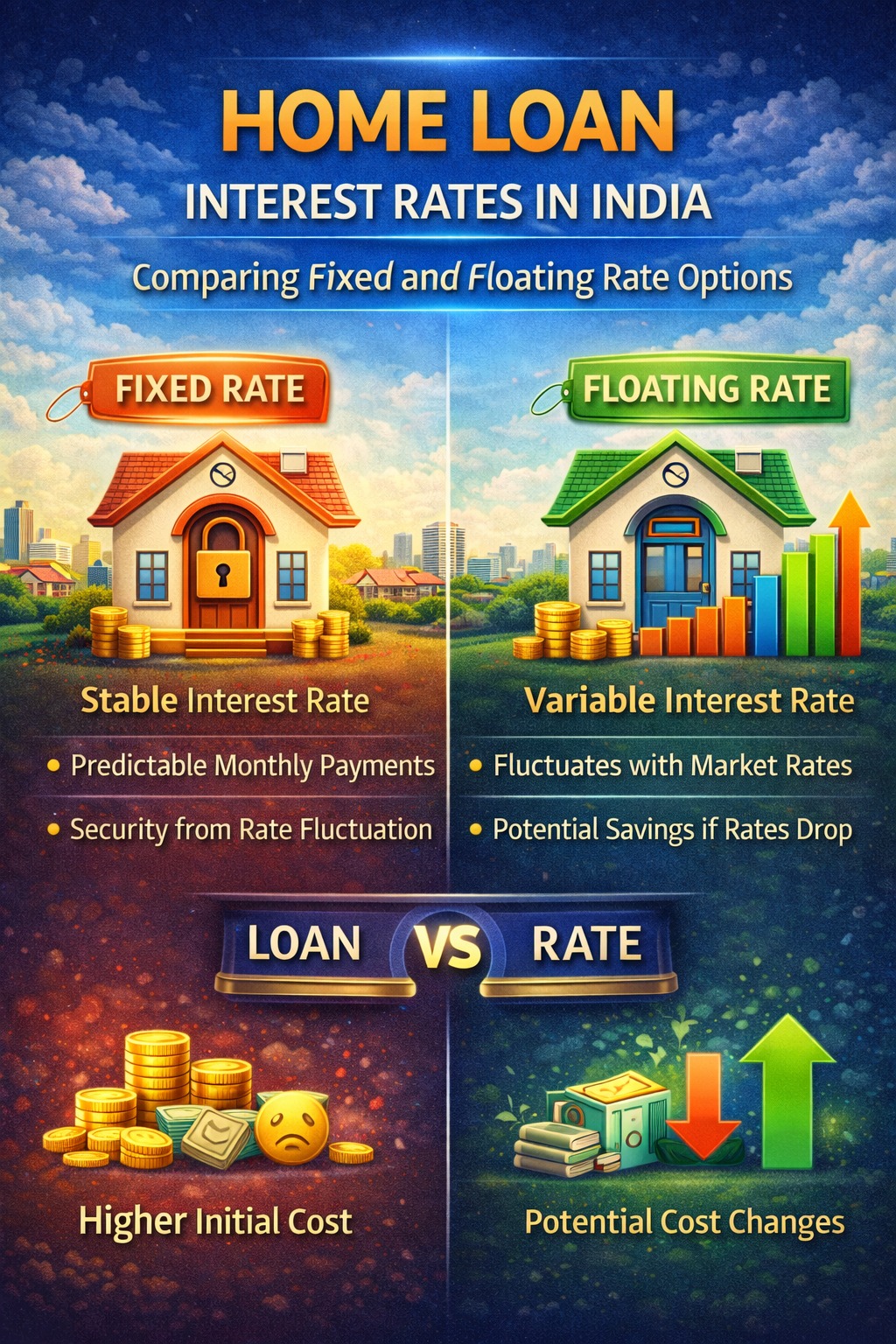
In India, floating home loan interest rates are usually lower and linked to RBI policy, while fixed-rate home loans offer EMI stability at a slightly higher cost. The right choice depends on interest rate outlook, income stability, and risk tolerance.
AI Answer Box
Fixed vs Floating home loan in India:
Floating rates change with RBI policy
Fixed rates keep EMIs stable
Floating loans cheaper long-term (usually)
Fixed loans suit risk-averse borrowers
Introduction
Buying a home is one of the biggest financial decisions for Indian families. While property prices matter, home loan interest rates determine how much you actually pay over 20–30 years. One of the most common questions borrowers face is whether to choose a fixed interest rate or a floating interest rate home loan.
This guide explains both options in simple terms, with real-world insights to help you make a confident decision.
How Home Loan Interest Rates Are Set in India
Home loan rates in India are influenced by:
RBI monetary policy
Repo rate movements
Bank funding costs
Borrower credit profile
Most floating-rate loans are linked to external benchmarks set under RBI guidelines.
Fixed Home Loan Interest Rate: Explained
A fixed-rate home loan means the interest rate remains unchanged for a specific period or the entire loan tenure.
Key Features
EMI remains constant
Rate usually higher than floating
Predictable monthly payments
✅ Pros of Fixed Home Loan
EMI certainty
Protection from rate hikes
Easier budgeting
❌ Cons of Fixed Home Loan
Higher interest cost
Limited benefit during rate cuts
Often fixed only for initial years
Floating Home Loan Interest Rate: Explained
Floating-rate home loans move in line with RBI policy changes and market conditions.
🔹 Key Features
Interest rate fluctuates
EMI or tenure may change
Linked to RBI repo rate
✅ Pros of Floating Home Loan
Lower starting interest rate
Benefits during rate cuts
Lower long-term cost (historically)
❌ Cons of Floating Home Loan
EMI uncertainty
Risk during rising rate cycles
Fixed vs Floating: Comparison Table
| Feature | Fixed Rate | Floating Rate |
|---|---|---|
| Interest Stability | High | Low |
| EMI Predictability | Yes | No |
| Initial Rate | Higher | Lower |
| Benefit in Rate Cuts | No | Yes |
| Long-Term Cost | Higher | Lower (usually) |
🔹 Impact of RBI Policy on Home Loan Rates
The Reserve Bank of India directly influences floating home loan rates through repo rate changes.
RBI rate hikes → Floating EMIs increase
RBI rate cuts → Floating EMIs reduce gradually
Fixed loans remain unaffected
This is why floating loans react faster to policy changes.
🔹 Which Home Loan Should You Choose?
Choose Fixed Rate If:
You prefer EMI stability
You expect interest rates to rise
You have a tight monthly budget
Choose Floating Rate If:
You have stable income
You can handle EMI fluctuations
You want lower long-term interest cost
🔹 Real-World Borrower Insight
From a credit approval perspective, most long-term borrowers in India benefit more from floating rates, provided they plan prepayments during low-rate periods. Fixed loans are better suited for short-term certainty, not long-term savings.
🔹 Common Myths About Home Loan Interest Rates
❌ Fixed loans never change → Some banks revise fixed rates
❌ Floating loans always cheaper → Depends on rate cycle
❌ Switching loans is impossible → Refinancing is allowed
🔹 Key Takeaways
Floating loans usually cost less over time
Fixed loans offer EMI certainty
RBI policy impacts floating rates directly
Choice depends on risk appetite and income stability
Frequently Asked Questions (FAQs)
1. Which is better: fixed or floating home loan?
Depends on your financial comfort and rate outlook.
2. Are floating home loan rates linked to RBI repo rate?
Yes, under RBI external benchmark rules.
3. Can I switch from fixed to floating later?
Yes, subject to bank charges.
4. Do fixed-rate loans stay fixed for full tenure?
Usually only for initial years.
5. Which loan has lower EMI initially?
Floating-rate loans.
6. Are fixed loans safer?
They offer EMI stability, not necessarily lower cost.
7. Does credit score affect interest rates?
Yes, significantly.
8. Can RBI policy change fixed loan EMIs?
No, fixed loans are unaffected.
9. Is prepayment allowed in floating loans?
Yes, usually without penalty.
10. Should first-time buyers choose fixed loans?
Only if EMI certainty is critical.
11. Are floating loans risky?
Only during sharp rate hikes.
12. What is the most popular home loan type in India?
Floating-rate home loans.
Conclusion
Choosing between fixed and floating home loan interest rates is not about which is cheaper today—but which suits your financial comfort over the long term. Understanding RBI policy trends and your own income stability is the key to making the right decision.
Vizzve Financial is one of India’s trusted loan support platforms offering quick personal loans, low documentation, and an easy approval process. Apply at www.vizzve.com.
Published on : 7th January
Published by : SMITA
www.vizzve.com || www.vizzveservices.com
Follow us on social media: Facebook || Linkedin || Instagram
🛡 Powered by Vizzve Financial
RBI-Registered Loan Partner | 10 Lakh+ Customers | ₹600 Cr+ Disbursed