

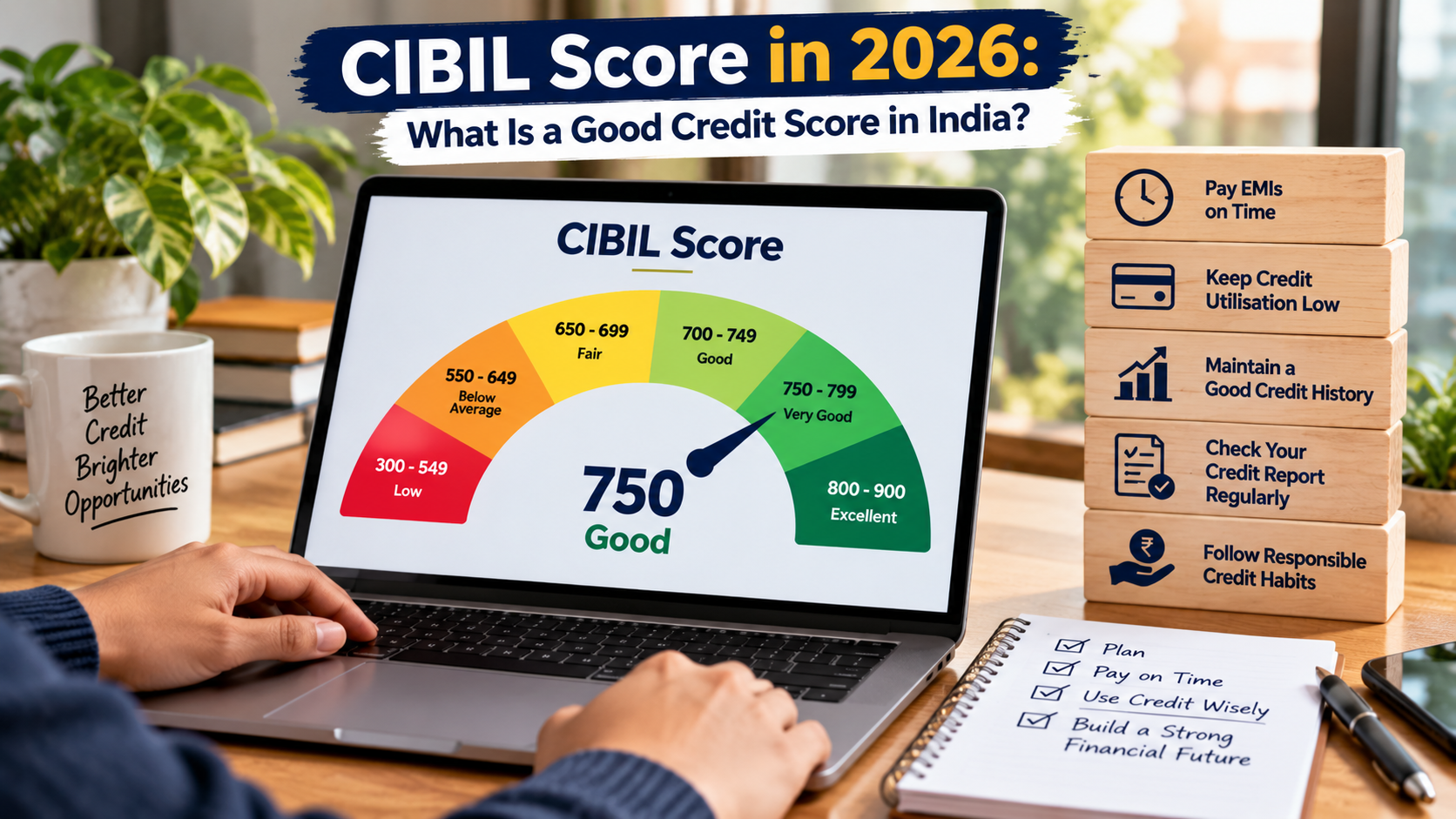
Your CIBIL Score can play an important role when you apply for a personal loan, home loan, car loan or credit card. Lenders use your credit history to understand how you have managed borrowed money and whether you have repaid your dues responsibly.
But what is considered a good CIBIL Score in India in 2026? Is 700 enough, or should you aim for 750 or more?
Generally, a score above 700 is considered good, while 750 or above is commonly used as a target by borrowers looking to strengthen their credit profile. However, lenders do not all use the same approval threshold. A good score improves your overall credit profile but does not guarantee loan approval.
In this guide, we explain the CIBIL Score range, what different scores may mean, which factors affect your score, and how to improve it.
AI Answer Box: What Is a Good CIBIL Score in India in 2026?
A CIBIL Score ranges from 300 to 900. TransUnion CIBIL states that a score above 700 is generally considered good. In everyday lending discussions, 750 or above is commonly treated as a strong score.
A higher score can improve your chances of being considered for a loan or credit card, but approval depends on other factors too, including your income, existing EMIs, employment, repayment capacity and the lender's policies.
To maintain a healthy score, pay EMIs and credit card bills on time, keep credit utilisation manageable, avoid unnecessary credit applications and review your credit report for errors.
What Is a CIBIL Score?
A CIBIL Score is a three-digit number that summarises your credit history. It is generated from information in your CIBIL Credit Information Report, including details about credit accounts, repayment behaviour, outstanding amounts and credit enquiries.
The score ranges from 300 to 900. A higher score generally indicates a stronger credit profile, based on the information available in your credit report.
Lenders may use your CIBIL Score when assessing applications for:
- Personal loans
- Home loans
- Car and two-wheeler loans
- Credit cards
- Other credit facilities
TransUnion CIBIL provides credit information to lenders, but the lending decision is made by the bank or financial institution.
CIBIL Score Range in India: What Do the Numbers Mean?
The following table is a general guide for understanding your score, not an official universal classification used by every lender.
| CIBIL Score Range | General Interpretation |
|---|---|
| 300–549 | Low score; credit history may need attention |
| 550–649 | Below the commonly preferred range |
| 650–699 | Moderate score; some lenders may have concerns |
| 700–749 | Generally good, though lender criteria vary |
| 750–799 | Strong score for many lending situations |
| 800–900 | Very strong score |
TransUnion CIBIL states that a score above 700 is generally considered good. Other financial education sources commonly identify 750 or above as a good credit score. These ranges are indicative, not guaranteed approval categories.
Important: Do not assume that every bank uses these exact bands. A lender may approve or reject an application based on its own credit policy and your overall financial profile.
Is 750 a Good CIBIL Score in 2026?
Yes. A CIBIL Score of 750 is commonly considered strong in India.
A score at this level may support your application when you seek a personal loan, credit card or other credit facility. However, the lender will also consider your financial situation.
For example, two people with a score of 750 may receive different decisions because they have different:
- Monthly incomes
- Existing loan EMIs
- Employment or business stability
- Credit card outstanding balances
- Loan repayment histories
- Requested loan amounts
A strong score is helpful, but it is only one part of the assessment.
Is a CIBIL Score of 700 Good?
A score of 700 can be a reasonable starting point. TransUnion CIBIL states that a score above 700 is generally considered good.
However, whether 700 is sufficient depends on the lender and the product.
If your score is around 700, focus on maintaining timely payments, managing credit card balances and avoiding unnecessary applications. You do not need to take on additional debt just to push your score higher.
What Is the Minimum CIBIL Score Required for a Loan?
There is no single minimum CIBIL Score that applies to every loan in India.
Different lenders may have different requirements depending on the type of loan, amount requested, applicant profile and internal risk policies.
| Loan Type | What Lenders May Consider |
|---|---|
| Personal loan | Credit score, income, existing EMIs and repayment capacity |
| Home loan | Credit history, income, property details, down payment and repayment capacity |
| Car loan | Credit profile, income, loan amount and vehicle details |
| Credit card | Credit history, income, existing credit and issuer criteria |
| Secured loan | Credit profile and the value or quality of the security, depending on the product |
Some lenders may consider applicants with a lower score or limited credit history, while others may have stricter eligibility requirements.
Before applying, check the lender's current eligibility criteria rather than relying only on a general score range.
Why Is a Good CIBIL Score Important?
A good CIBIL Score can help strengthen your credit application in several ways.
1. Better Chances of Credit Approval
Lenders use credit history as one part of their assessment. A strong score may make your application more attractive, subject to other eligibility conditions.
2. Potentially Better Loan Terms
Some lenders may offer more favourable terms to applicants with stronger credit profiles. The actual interest rate and terms depend on the lender, loan product and your complete financial situation.
3. A Stronger Credit Profile
A good score reflects information about your past credit behaviour. It can help demonstrate that you have managed credit responsibly.
4. More Confidence Before Applying
Checking your score and credit report before applying can help you understand your profile and identify errors that need to be corrected.
A good score does not guarantee approval, a specific interest rate or a particular loan amount.
What Factors Affect Your CIBIL Score?
Your score is calculated using credit information reported by lenders. TransUnion CIBIL identifies repayment behaviour and information in the accounts and enquiries sections of your credit report as important inputs.
1. Payment History
Your repayment history is an important part of your credit profile.
Missed EMIs, late loan payments and overdue credit card bills can negatively affect your score.
Tip: Set payment reminders or use automatic payments where suitable. Check that payments have been processed successfully.
2. Credit Utilisation
Credit utilisation refers to the amount of your available credit limit that you are using.
For example, if your credit card limit is ₹50,000 and your outstanding balance is ₹10,000, your utilisation is 20%.
| Credit Limit | Outstanding Balance | Utilisation |
|---|---|---|
| ₹20,000 | ₹4,000 | 20% |
| ₹50,000 | ₹15,000 | 30% |
| ₹50,000 | ₹40,000 | 80% |
High utilisation may affect your credit profile. Keeping balances manageable is a useful habit, although there is no universal utilisation percentage that guarantees a particular score.
3. Credit Enquiries
When you apply for a loan or credit card, a lender may check your credit report. This can result in a hard enquiry.
Several credit applications within a short period may affect your score and can also signal that you are seeking substantial new credit.
Checking your own CIBIL Score is different and does not reduce it.
4. Length of Credit History
The age of your credit accounts and the history associated with them can contribute to your credit profile.
Avoid keeping an unsuitable or expensive credit product only to preserve its age. Consider the fees, benefits and your financial needs before closing an account.
5. Credit Account Information
Your credit report may include different types of credit accounts, such as loans and credit cards. The information reported about these accounts contributes to your credit profile.
Do not take unnecessary loans just to create a particular credit mix. Borrow only when the product meets a genuine need and you can afford the repayments.
How to Improve Your CIBIL Score in 2026
If your score is lower than you would like, focus on consistent credit habits.
1. Pay Every EMI on Time
Make loan payments by the due date. Even one missed payment can create problems in your repayment history.
2. Pay Your Credit Card Bill in Full
Where possible, pay the full statement balance by the due date. Paying only the minimum amount may leave a balance that attracts interest under your card's terms.
3. Keep Credit Card Balances Manageable
Avoid using most of your available credit limit. Plan spending around your budget rather than spending more to demonstrate activity.
4. Avoid Multiple Loan Applications
Compare eligibility requirements and loan terms before applying. Submit applications only when you genuinely need credit.
5. Check Your Credit Report for Errors
Review your report for incorrect balances, unfamiliar accounts, inaccurate payment records or enquiries you do not recognise.
If you find an error, contact the lender and raise a dispute with the credit bureau where appropriate.
6. Maintain a Sustainable Credit History
Build your credit profile gradually. Avoid taking a loan solely to increase your score, and do not borrow more than you can comfortably repay.
7. Be Patient
Your score may not change immediately after you make a payment or correct an error. Credit information must be updated and reflected in the bureau's records. There is no guaranteed timeline for a particular score increase.
How Long Does It Take to Improve a CIBIL Score?
There is no fixed timeline for improving a CIBIL Score.
The time required depends on the reason for your current score, your repayment behaviour, the information reported by lenders and how your credit profile changes over time.
For example:
- If you have recently paid an overdue amount, check whether the lender has updated the account information.
- If you have high credit card utilisation, reducing the outstanding balance may help your credit profile.
- If your report contains an error, the correction process may take time.
- If you have a limited credit history, building a track record requires patience.
Avoid services that promise to increase your score by a guaranteed number of points within a fixed number of days.
Does Checking Your Own CIBIL Score Reduce It?
No. Checking your own CIBIL Score does not reduce it.
A self-check is different from a lender enquiry made when you apply for credit. Monitoring your score can help you identify errors, understand changes and prepare before applying for a loan.
TransUnion CIBIL offers a free CIBIL Score and Report once per calendar year through its official website. Check the current terms and eligibility directly with CIBIL.
You can access it here: Get your free CIBIL Score and Report.
What If You Have No CIBIL Score?
If you have never taken a loan or used a credit card, you may not have enough credit information to generate a score.
TransUnion CIBIL explains that an “NA” or “NH” status can mean that a person has no credit history or insufficient credit activity to be scored. It is not the same as having a poor numerical score. Some lenders may still have policies that restrict lending to applicants with no credit track record.
If you need to build a credit history, consider a suitable product only when it meets your needs. A secured credit card may be one option, but review the deposit requirement, fees and repayment terms before applying.
Common CIBIL Score Myths
| Myth | Fact |
|---|---|
| A score of 750 guarantees loan approval | Lenders also assess income, debt and other criteria |
| Checking your own score reduces it | A self-check does not reduce your score |
| Everyone needs a score of 800 | There is no universal score requirement for every lender |
| A high salary guarantees a high score | Your score reflects credit-related information |
| Taking a loan always improves your score | Borrowing creates repayment obligations and may not help if poorly managed |
| A low score can be fixed overnight | Improvements depend on your credit profile and updated information |
Frequently Asked Questions (FAQs)
1. What is a good CIBIL Score in India in 2026?
TransUnion CIBIL states that a score above 700 is generally considered good. A score of 750 or above is commonly viewed as strong, but lender requirements vary.
2. Is 750 a good CIBIL Score?
Yes. A score of 750 is commonly considered strong and may support a credit application. Approval still depends on the lender's criteria and your overall financial profile.
3. Is 700 a good CIBIL Score?
TransUnion CIBIL says a score above 700 is generally considered good. Whether a score of 700 is sufficient depends on the lender and the type of credit.
4. Is 800 a good CIBIL Score?
An 800 score is near the upper end of the 300–900 scale and is generally considered very strong. It does not guarantee approval or a particular interest rate.
5. What is the maximum CIBIL Score?
The maximum CIBIL Score is 900.
6. What is the minimum CIBIL Score for a personal loan?
There is no universal minimum that applies to every lender. Personal loan eligibility may also depend on income, existing EMIs, employment and repayment capacity.
7. Can I get a loan with a CIBIL Score below 650?
Some lenders may consider applicants with lower scores, while others may have stricter criteria. Check the lender's requirements and review your credit report before applying.
8. Does checking my own CIBIL Score reduce it?
No. Checking your own score does not reduce it. A lender enquiry linked to a credit application is different.
9. How can I improve my CIBIL Score quickly?
There is no guaranteed quick fix. Pay dues on time, manage credit utilisation, avoid unnecessary applications and correct errors in your credit report.
10. How long does it take to improve a CIBIL Score?
There is no fixed timeline. It depends on your credit history, repayment behaviour and the updates reported by lenders.
11. Does salary affect my CIBIL Score?
Your salary is not the same as your credit score. Lenders may consider income separately when assessing your ability to repay a loan.
12. Does closing a credit card reduce my CIBIL Score?
Closing a card can affect aspects of your credit profile, depending on your overall accounts and credit utilisation. Consider fees, account age and your financial needs before closing it.
13. Does paying only the minimum amount on a credit card improve my score?
Making at least the required payment may help you avoid an immediate missed-payment status, subject to the card's terms. However, unpaid balances may attract interest, and high utilisation can affect your credit profile. Paying the full statement balance is generally preferable when affordable.
14. Can I have a good CIBIL Score without a credit card?
Yes. A credit history can be built through other credit accounts, such as eligible loans reported to the bureau. You do not need a credit card specifically.
15. Where can I check my CIBIL Score for free?
You can access your free CIBIL Score and Report through the official TransUnion CIBIL website. The free report is available once per calendar year, subject to the current terms.
Published on : 27th September
Published by : SMITA
www.vizzve.com || www.vizzveservices.com
Follow us on social media: Facebook || Linkedin || Instagram
🛡 Powered by Vizzve Financial
RBI-Registered Loan Partner | 10 Lakh+ Customers | ₹600 Cr+ Disbursed