

Introduction
Your CIBIL score is one of the most important numbers in your financial profile when you apply for credit in India.
Whether you are planning to take a personal loan, home loan, vehicle loan or credit card, lenders may review your credit history before deciding whether to approve your application and what terms to offer.
But a CIBIL score is more than just a number.
It is a summary of your past credit behaviour. Your repayment history, credit utilisation, length of credit history and recent credit enquiries can all influence the score.
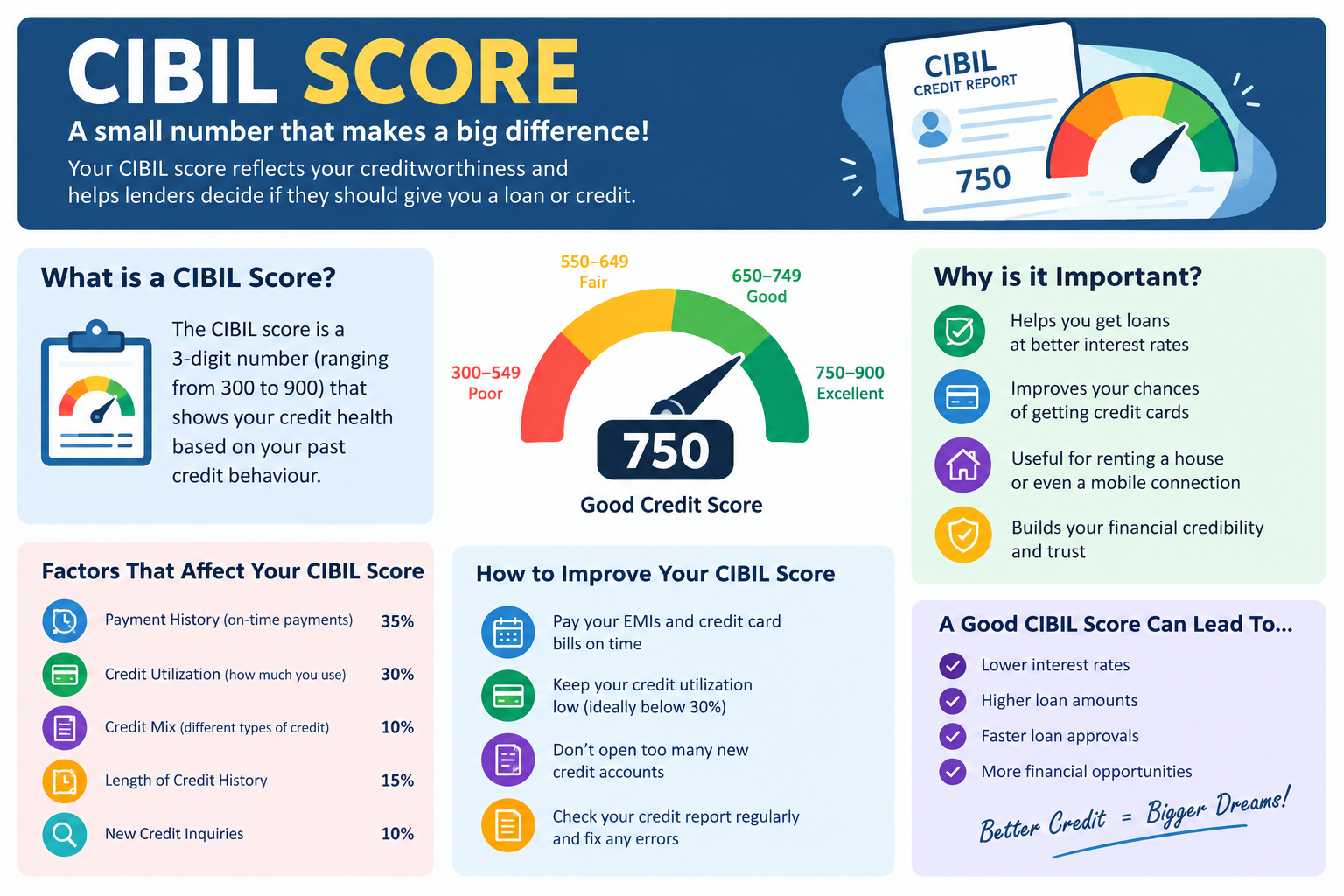
According to TransUnion CIBIL, the CIBIL score is a three-digit number ranging from 300 to 900. Generally, the closer the score is to 900, the stronger the credit profile appears to lenders.
Importantly, CIBIL does not approve or reject loans. The lender makes the final lending decision after considering the applicant's overall financial profile.
This guide explains what a CIBIL score means, how it works, what affects it, how to improve it and how to avoid common credit mistakes.
AI Answer Box: What Is a CIBIL Score?
A CIBIL score is a three-digit numerical summary of an individual's credit history, ranging from 300 to 900. It helps lenders assess a borrower's creditworthiness based on factors such as repayment behaviour, credit utilisation, credit history and credit enquiries. A higher score generally indicates a stronger credit profile and can improve the chances of loan or credit-card approval.
However, a good CIBIL score does not guarantee loan approval because lenders also consider income, existing obligations, employment or business profile, lender-specific policies and other information.
What Is a CIBIL Score?
A CIBIL score is a numerical representation of your credit history.
It is generated using information contained in your CIBIL Credit Information Report, including information related to credit accounts and enquiries. The score ranges from 300 to 900.
Think of it as a financial track record.
For example:
- You take a credit card.
- You use the card responsibly.
- You pay your bills on time.
- You keep your outstanding balance under control.
- You avoid unnecessary borrowing.
- You maintain credit accounts responsibly over time.
These behaviours can contribute to a healthier credit profile.
On the other hand, repeated late payments, defaults, high credit utilisation and frequent applications for new credit can work against you.
CIBIL Score vs CIBIL Report
These two terms are often confused.
| Feature | CIBIL Score | CIBIL Report |
|---|---|---|
| What is it? | Three-digit credit score | Detailed credit history |
| Range | 300–900 | Not applicable |
| Shows | Summary of creditworthiness | Accounts, repayments, enquiries and other credit information |
| Used by lenders? | Yes | Yes |
| Helps identify errors? | Limited | Yes |
| Should you monitor it? | Yes | Yes |
Your CIBIL report contains much more information than the score itself, including active and inactive credit accounts and lender enquiries.
CIBIL Score Range: What Does Your Score Mean?
There is no universal rule that says a particular score guarantees approval.
Lenders have their own credit policies.
Nevertheless, the following broad interpretation can help you understand where your score stands:
| CIBIL Score | General Interpretation |
|---|---|
| 300–549 | Very low / needs significant improvement |
| 550–649 | Low |
| 650–699 | Fair |
| 700–749 | Good |
| 750–799 | Very good |
| 800–900 | Excellent |
CIBIL itself describes scores closer to 900 as indicating stronger creditworthiness, while its consumer guidance notes that a score above 700 is generally considered good.
Is 750 a Good CIBIL Score?
Yes. A 750 CIBIL score is generally viewed as a strong score and can improve your chances of obtaining credit.
However, lenders do not evaluate the score in isolation.
A person with a 750 score and unstable income may receive a different decision from someone with the same score and stable income.
Why Is CIBIL Score Important?
Your CIBIL score matters because lenders use credit information when evaluating applications.
A strong credit profile may help you:
- Improve your chances of loan approval
- Access competitive interest rates
- Obtain higher credit limits, subject to lender policy
- Negotiate better loan terms in some situations
- Demonstrate responsible borrowing behaviour
- Reduce the likelihood of credit applications being rejected solely because of weak credit history
The Reserve Bank of India also explains that banks and financial institutions consider credit scores and credit history while sanctioning loans, and that a higher score can, all else being equal, support borrowing at a lower interest rate.
Does a Good CIBIL Score Guarantee a Loan?
No.
This is one of the most important things borrowers should understand.
A CIBIL score is only one part of the lending decision.
Lenders may also consider:
- Monthly income
- Existing EMIs
- Debt-to-income position
- Employment stability
- Business income
- Age
- Loan amount requested
- Loan tenure
- Existing credit relationships
- Internal lender policies
- Documentation and verification
CIBIL itself states that the lender, rather than CIBIL, makes the final decision on whether to sanction a loan or credit card.
What Factors Affect Your CIBIL Score?
CIBIL identifies several important elements associated with your score and credit report.
1. Payment History
Payment history is one of the most important aspects of your credit profile.
If you consistently pay your EMIs and credit-card dues on time, you demonstrate responsible credit behaviour.
Late or missed payments can negatively affect your score.
Practical Tip
Set up reminders or automatic payment arrangements where appropriate so that you do not accidentally miss a due date.
2. Credit Utilisation
Credit utilisation refers to how much of your available revolving credit you are using.
For example, suppose your credit-card limit is:
₹1,00,000
and your outstanding balance is:
₹70,000
Your utilisation is:
70%
Consistently high utilisation can make your credit profile appear more dependent on available credit.
CIBIL recommends keeping credit utilisation under control.
What Is a Healthy Credit Utilisation Ratio?
There is no single percentage that guarantees a particular CIBIL score.
A practical approach is to avoid consistently using a large portion of your available revolving credit and pay balances responsibly.
3. Length or Age of Credit History
The age of your credit accounts also matters.
A long record of responsibly managed credit can provide lenders with more evidence of how you handle borrowing.
CIBIL notes that the duration of existing credit history is one of the factors that can influence the score.
This is why closing an old credit card should not automatically be treated as a way to improve your score.
Consider the entire credit profile before closing an account.
4. Credit Enquiries
When you apply for a loan or credit card, a lender may access your credit report.
These lender-initiated checks are recorded as enquiries.
Multiple credit applications within a short period can signal increased demand for credit and may negatively affect your score.
Does Checking My Own CIBIL Score Reduce It?
No.
Checking your own CIBIL score is different from a lender's credit enquiry. CIBIL states that checking your own score does not impact your score.
5. Credit Mix
Your credit profile can include different types of credit, such as:
- Home loans
- Vehicle loans
- Personal loans
- Credit cards
- Other credit facilities
CIBIL identifies credit mix as another factor that can influence credit profiles.
You should not borrow simply to create a credit mix.
Borrow only when the credit is genuinely necessary and affordable.
How Is CIBIL Score Calculated?
The exact scoring model is proprietary, so borrowers should not assume there is a simple public formula such as:
Payment history = X%
Utilisation = Y%
Enquiries = Z%
CIBIL describes payment history, credit utilisation, age of credit and enquiries as major factors, while its broader FAQs also mention credit mix and other characteristics of the information in the credit report.
Therefore, instead of trying to "game" a formula, focus on consistent financial behaviour.
A Better Strategy
- Pay dues on time.
- Keep revolving balances under control.
- Avoid unnecessary credit applications.
- Maintain healthy accounts responsibly.
- Review your credit report regularly.
- Dispute inaccurate information when necessary.
How to Check Your CIBIL Score Online
Checking your credit score is an important part of financial housekeeping.
You can access your CIBIL score and report through the official CIBIL platform.
Check Your CIBIL Score and Report
Step-by-Step Process
Step 1: Visit the official CIBIL website.
Step 2: Choose the relevant CIBIL score/report option.
Step 3: Provide the required information and complete authentication.
Step 4: Review your score.
Step 5: Go through the detailed report rather than looking only at the number.
Step 6: Check accounts, payment information and enquiries for accuracy.
RBI requires Credit Information Companies to provide eligible individuals with access to one free full credit report, including the credit score, once during each calendar year.
How to Improve Your CIBIL Score
Improving a CIBIL score is usually about building better credit habits over time, rather than looking for a one-day solution.
1. Pay Every EMI on Time
Never deliberately delay a loan EMI.
Even a small missed payment can become part of your credit history.
Create reminders for:
- Personal loan EMI
- Home loan EMI
- Vehicle loan EMI
- Credit-card payment
- Other credit obligations
2. Keep Credit-Card Balances Under Control
Avoid treating your credit limit as available income.
For example, if your credit limit is ₹1 lakh, it does not mean you should spend ₹1 lakh every month.
Use credit according to your repayment capacity.
3. Avoid Applying for Too Many Loans
Applying to several lenders simultaneously may result in multiple hard enquiries.
Instead:
Compare → shortlist → apply selectively.
Do not submit applications everywhere simply because a website promises "instant approval."
4. Review Your CIBIL Report Regularly
Checking the report can help you identify:
- Accounts you do not recognize
- Incorrect personal information
- Incorrect account status
- Incorrect overdue amounts
- Payment-history discrepancies
- Unnecessary or unfamiliar enquiries
Regular monitoring can help you identify errors and possible signs of identity misuse.
5. Dispute Incorrect Information
Suppose your report incorrectly shows an EMI as unpaid even though you paid it.
Do not ignore the issue.
You can raise a dispute with the relevant credit information company and/or credit institution.
CIBIL notes that it cannot independently change lender-reported information without confirmation from the concerned credit institution.
RBI guidance also provides a route for complaints concerning inaccurate credit information; where an issue remains unresolved for more than 30 days or the borrower is dissatisfied with the resolution, the RBI Ombudsman mechanism may be available.
How Long Does It Take to Improve a CIBIL Score?
There is no guaranteed fixed timeline.
Your score reflects credit behaviour and information reported by lenders.
If you start paying all dues on time and reduce excessive credit utilisation, your profile can become healthier as updated information is reported.
However, someone with a history of serious defaults may require substantially more time to rebuild their credit profile.
Remember
Consistency matters more than shortcuts.
Be cautious of anyone promising:
"We can increase your CIBIL score to 800 in 7 days."
No legitimate service can guarantee a particular CIBIL score improvement within a fixed number of days.
Common Reasons for a Low CIBIL Score
A low score can arise from several patterns.
Common causes include:
- Missed EMI payments
- Late credit-card payments
- Loan defaults
- High credit utilisation
- Too many recent credit enquiries
- Large outstanding balances
- Limited or short credit history
- Incorrect information in the credit report
- Excessive borrowing
- Poor repayment behaviour
CIBIL's consumer guidance specifically highlights payment history, utilisation, depth of credit, outstanding-balance trends, transaction history and new/closed accounts among information that can affect the score.
CIBIL Score for Different Types of Loans
There is no single CIBIL score requirement applicable to every lender or every loan.
| Loan Type | How Credit Score May Matter |
|---|---|
| Personal Loan | Often important because it is generally unsecured |
| Home Loan | Considered along with income, property and repayment capacity |
| Vehicle Loan | Used as part of the overall credit assessment |
| Business Loan | Considered alongside business financials and repayment capacity |
| Education Loan | Lender-specific assessment; co-borrower profile may also matter |
| Credit Card | Credit history can influence approval and credit limit |
A strong score can help, but loan eligibility should always be assessed using the lender's complete criteria.
CIBIL Score and Personal Loan Approval
Personal loans are generally unsecured, so lenders may pay close attention to credit history and repayment behaviour.
For a personal loan application, lenders may look at:
- CIBIL score
- Existing loans
- Current EMIs
- Income
- Employment stability
- Credit-card usage
- Recent enquiries
- Banking information
- Requested loan amount
A high CIBIL score can strengthen an application, but it is not a guarantee of approval.
Can You Get a Personal Loan With a Low CIBIL Score?
Possibly, but approval is not guaranteed.
Different lenders have different eligibility criteria.
An applicant with a low or limited credit history may face:
- Higher interest rates
- Lower loan amounts
- Shorter repayment periods
- Additional verification
- Requirement for stronger income evidence
- Rejection from some lenders
The responsible approach is to compare legitimate offers and ensure that the EMI fits comfortably within your repayment capacity.
Pros and Cons of Having a Strong CIBIL Score
Pros
- Better chances of credit approval
- Potentially better borrowing terms
- Stronger lender confidence
- Easier access to financial products
- Better negotiating position in some cases
- Reflects disciplined credit management
Cons or Limitations
A high CIBIL score does not mean:
- Every loan application will be approved
- You will always receive the lowest interest rate
- You can borrow unlimited amounts
- Your income no longer matters
- Lenders will ignore your existing debt
Your credit score is an important indicator—not a financial permission slip to borrow more.
CIBIL Score Mistakes You Should Avoid
Mistake 1: Paying Only the Minimum Credit-Card Amount
Paying only the minimum amount may keep the account current under applicable terms, but interest can continue to accumulate and the outstanding balance can remain high.
Mistake 2: Applying Everywhere
Submitting multiple applications within a short period can create several lender enquiries.
Mistake 3: Closing Old Accounts Without Thinking
If an old account has a positive history, closing it may affect the structure of your credit profile.
Mistake 4: Ignoring Your Credit Report
Errors can remain unnoticed if you never review your report.
Mistake 5: Believing "No CIBIL" Means "No Repayment Risk"
A lack of credit history is not the same as a strong credit history.
Mistake 6: Taking Loans Just to Increase Your Score
Borrowing money you do not need simply to build a score can increase financial stress.
CIBIL Score: Myths vs Facts
| Myth | Fact |
|---|---|
| Checking your own CIBIL score reduces it | Your own score check does not affect the score |
| 900 is required for every loan | No; lenders have their own criteria |
| A high score guarantees approval | No |
| One late payment always destroys your score permanently | Impact depends on the overall credit profile and information reported |
| Closing every old credit card improves your score | Not necessarily |
| Applying for more loans improves your credit profile | Multiple unnecessary applications can hurt |
| No CIBIL history means bad credit | No credit history and poor credit history are different |
| CIBIL approves loans | Lenders make the approval decision |
CIBIL confirms that self-checks do not affect the score and that the final credit decision rests with the lender.
Real-World Experience Point
Consider two borrowers.
Borrower A
- Pays every EMI on time
- Keeps credit-card utilisation controlled
- Has maintained accounts for several years
- Makes new credit applications selectively
- Reviews the credit report periodically
Borrower B
- Frequently misses due dates
- Uses most of the available credit
- Applies for multiple loans within a short period
- Ignores outstanding balances
- Never checks the credit report
Even if both borrowers have similar salaries, their credit profiles can look very different to lenders.
The lesson is simple: creditworthiness is built through repeated financial behaviour, not through a single application.
Expert Commentary: How to Think About Your CIBIL Score
A useful way to view your CIBIL score is as a long-term financial reputation.
Do not focus exclusively on achieving a particular number.
Instead, ask:
"Does my credit report show that I consistently borrow responsibly and repay on time?"
That mindset is more useful than trying to manipulate the score before every loan application.
How to Build a Good CIBIL Score From Scratch
If you are new to credit, you may have little or no credit history.
Start carefully.
Step 1: Use Credit Responsibly
If you obtain a credit card or another credit facility, use only what you can comfortably repay.
Step 2: Pay on Time
Never miss the payment due date.
Step 3: Keep Utilisation Controlled
Avoid consistently using most of your available revolving credit.
Step 4: Don't Take Unnecessary Loans
You do not need multiple loans to establish a healthy credit profile.
Step 5: Monitor Your Report
Check your credit information periodically for accuracy.
What Does NA or NH Mean on a CIBIL Report?
Some consumers may see NA/NH rather than a conventional score.
This can happen when there is insufficient credit history or other circumstances in which a score cannot be generated.
It does not automatically mean that the person has bad credit.
CIBIL provides specific guidance on NA/NH situations and explains that the absence of sufficient credit information can result in such outcomes.
How to Maintain Your CIBIL Score After Taking a Loan
Getting a loan approved is not the end of the process.
Your behaviour after approval matters.
Follow this checklist:
- Pay EMIs before the due date.
- Keep sufficient funds available for scheduled payments.
- Avoid taking another loan unless necessary.
- Don't max out credit cards.
- Monitor account statements.
- Check your credit report periodically.
- Report incorrect information promptly.
- Maintain a sustainable debt level.
CIBIL Score Quick Summary
| Question | Short Answer |
|---|---|
| What is CIBIL score? | A three-digit summary of credit history |
| Score range | 300–900 |
| Higher score is generally better? | Yes |
| Is 750 considered strong? | Generally yes |
| Does checking your own score hurt it? | No |
| Does CIBIL approve loans? | No |
| Does late payment affect credit? | It can negatively affect your score |
| Does high utilisation matter? | Yes |
| Can you improve a low score? | Yes, through responsible credit behaviour |
| Is improvement instant? | Usually no; it takes consistent behaviour |
| Can errors be corrected? | Yes, through the appropriate dispute process |
| Free annual report available? | One free full report per calendar year, subject to applicable eligibility |