

Introduction
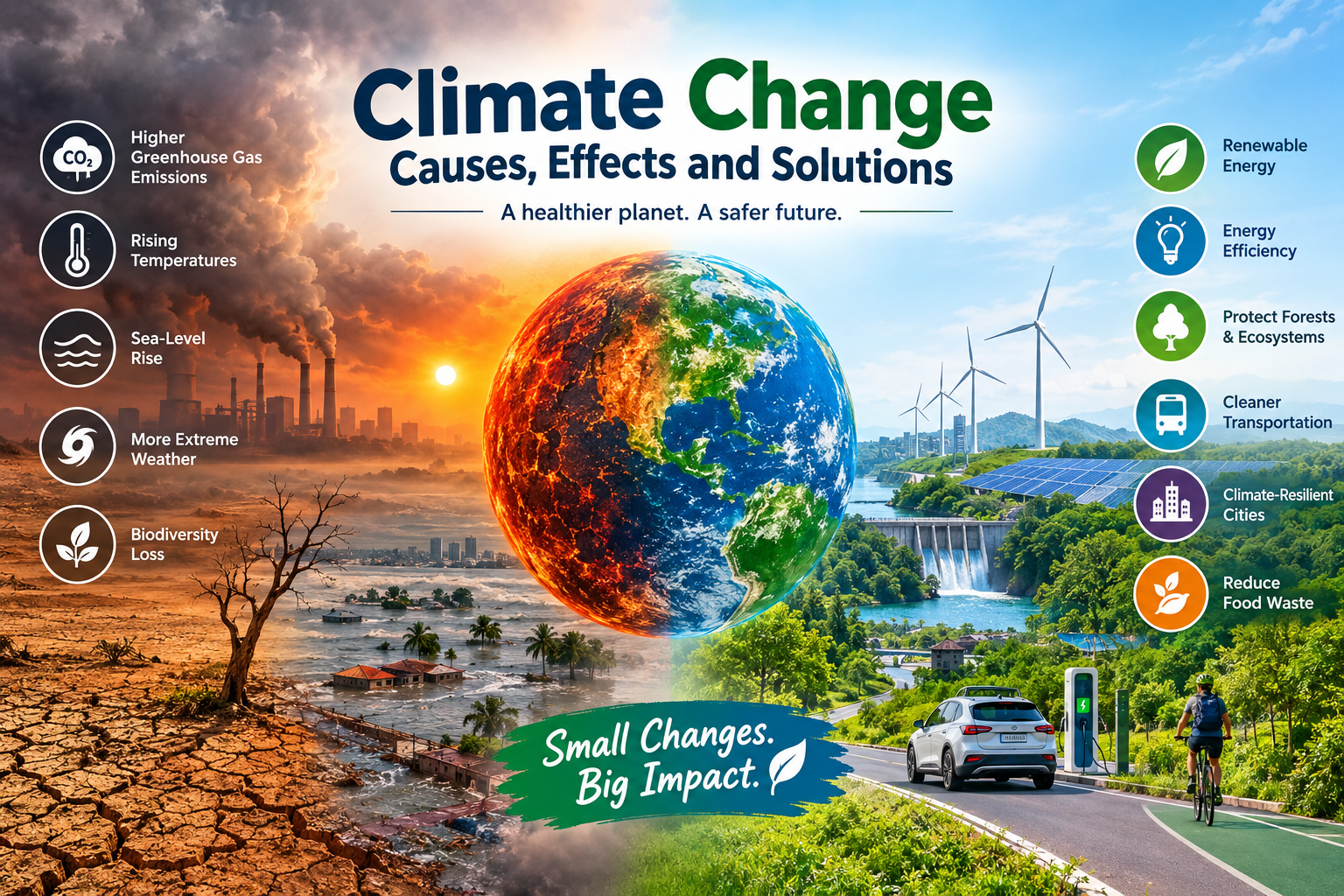
Climate affects nearly every part of our lives. It influences the food we grow, the water we drink, the air we breathe, and the places where people can safely live and work. Yet the climate is changing, and the consequences are becoming increasingly visible around the world.
From rising temperatures and melting glaciers to heavier rainfall and prolonged heatwaves, climate change is no longer just a distant environmental concern. It is connected to public health, agriculture, infrastructure, business, and the global economy.
The World Meteorological Organization (WMO) reported that 2025 was the second or third warmest year on record, depending on the dataset, while 2015–2025 were the 11 warmest years in its consolidated record.
World Meteorological Organization
+1
Understanding climate change is the first step toward making informed decisions. This guide explains what climate change means, why it happens, how it affects people and nature, and what governments, businesses, and individuals can do to respond.
3. AI Answer Box: What Is Climate Change?
Quick answer
Climate change explained in simple words
Climate change is the long-term change in Earth's temperatures, rainfall patterns, and other climate conditions. Today's rapid warming is primarily caused by human activities that increase heat-trapping greenhouse gases, especially carbon dioxide from burning fossil fuels.
Main causes: Burning coal, oil, and gas; deforestation; agriculture; and industrial activities.
Major effects: Rising temperatures, melting ice, sea-level rise, changing rainfall, and increased risks from extreme weather.
Main solutions: Reduce greenhouse gas emissions, expand clean energy, protect ecosystems, improve efficiency, and adapt to unavoidable climate impacts.
AI-search summary: Climate change is a long-term shift in Earth's climate, largely driven today by human-caused greenhouse gas emissions. It affects weather patterns, ecosystems, human health, agriculture, and economies. Climate action combines mitigation—reducing emissions—with adaptation—preparing for impacts.
4. What Is Climate Change?
Climate change refers to persistent changes in the average conditions of the atmosphere, oceans, land, and other parts of the Earth system over long periods, usually decades or longer.
The climate naturally changes over Earth's history because of volcanic activity, changes in Earth's orbit, solar variations, and other factors. However, the rapid warming observed in the modern era is mainly linked to human activities.
According to NASA, scientific evidence for warming of the climate system is unequivocal, and human activities are driving the current warming trend.
NASA Science
Climate vs. weather: What is the difference?
| Weather | Climate |
|---|---|
| Conditions over a short period | Long-term patterns |
| Can change within minutes or days | Measured over decades |
| Example: Rain today | Example: Average rainfall in a region |
| Describes what is happening now | Describes what is typical over time |
A cold day does not disprove global warming. Climate describes long-term trends, while weather describes individual events.
What is global warming?
Global warming is the long-term increase in Earth's average surface temperature. It is one part of the broader phenomenon of climate change.
Climate change includes:
Rising global temperatures.
Changes in rainfall and drought patterns.
Melting glaciers and ice sheets.
Rising sea levels.
Ocean warming and acidification.
Changes in ecosystems and biodiversity.
5. Latest Climate Change Facts and Statistics
The following figures are from published climate-monitoring reports. They use different baselines and measurement methods, so they should not be compared as though they measure exactly the same thing.
| Climate indicator | Latest reported finding |
|---|---|
| Warmest year | 2024 remains the warmest year in NASA's record, with 2025 statistically close to 2023. NASA +1 |
| 2025 global temperature | About 1.43°C above the 1850–1900 average according to WMO. World Meteorological Organization +1 |
| Warmest 11-year period | 2015–2025, according to WMO. World Meteorological Organization +1 |
| Ocean heat | Ocean heat content reached a record high in 2025 in the WMO report. World Meteorological Organization +1 |
| Sea level | Global mean sea level in 2025 was around 11 cm above the beginning of the satellite altimetry record in 1993. World Meteorological Organization |
| Greenhouse gases | CO₂, methane, and nitrous oxide reached record observed concentrations in 2024, the latest consolidated figures in the WMO report. World Meteorological Organization +1 |
Why do climate reports sometimes show different temperatures?
Organizations such as NASA, WMO, and Copernicus use different datasets, baselines, and analysis methods. For example, NASA's 2025 temperature anomaly is reported against the 1951–1980 average, while WMO commonly compares temperatures with the 1850–1900 pre-industrial average. These numbers are not interchangeable.
6. What Causes Climate Change?
6.1 Burning fossil fuels
Coal, oil, and natural gas are major sources of energy for electricity, transportation, manufacturing, and buildings. When fossil fuels are burned, they release carbon dioxide into the atmosphere.
Carbon dioxide absorbs and re-emits infrared radiation, contributing to the greenhouse effect and warming the planet.
Common sources include:
Coal-fired power plants.
Petrol and diesel vehicles.
Industrial boilers.
Oil and gas production.
Fossil-fuel heating systems.
6.2 Deforestation and land-use change
Forests absorb carbon dioxide through photosynthesis and store carbon in trees, soil, and vegetation.
When forests are cleared or burned:
Stored carbon can be released into the atmosphere.
The land may lose some of its ability to absorb carbon.
Wildlife habitats may be destroyed.
Local water cycles can change.
Protecting forests is therefore important for both climate mitigation and biodiversity.
6.3 Agriculture and livestock
Agriculture contributes to climate change through several pathways:
Methane from livestock digestion.
Methane emissions from rice cultivation.
Nitrous oxide from fertilized soils.
Land clearing.
Energy used in farming and food transport.
Better soil management, improved fertilizer practices, reduced food waste, and lower-emission farming methods can help reduce these impacts.
6.4 Industrial activities
Cement production, steelmaking, chemicals, and other industries can release greenhouse gases through energy use and chemical reactions.
Industrial decarbonization may involve:
Energy efficiency.
Electrification.
Low-carbon electricity.
Alternative materials.
Process innovation.
Carbon capture in selected applications.
6.5 Waste management
Landfills can produce methane as organic waste decomposes without oxygen. Poor waste management can also create air pollution and environmental damage.
Recycling, composting where appropriate, reducing food waste, and capturing landfill gas can help.
7. The Greenhouse Effect: How Does It Work?
The greenhouse effect is a natural process that keeps Earth warm enough for life. The problem is that human activities have increased the concentration of greenhouse gases, strengthening this effect.


5
Step-by-step explanation
Sunlight reaches Earth's surface.
The surface absorbs some of that energy and warms.
Earth releases energy as infrared radiation.
Greenhouse gases absorb and re-emit some of that radiation.
Additional greenhouse gases increase the amount of heat retained in the climate system.
Important greenhouse gases include:
| Gas | Major human sources |
|---|---|
| Carbon dioxide (CO₂) | Fossil fuels, deforestation, cement |
| Methane (CH₄) | Livestock, fossil-fuel production, landfills |
| Nitrous oxide (N₂O) | Fertilizers, agriculture, industrial processes |
| Fluorinated gases | Refrigeration, industrial applications |
8. Effects of Climate Change on the Environment
8.1 Rising temperatures
Higher average temperatures can increase the frequency and intensity of heat extremes. Heat can affect people, animals, crops, electricity demand, and water supplies.
8.2 Extreme weather
Climate change can influence the likelihood and severity of some extreme weather events. The exact effect depends on the event and location.
Examples include:
Heatwaves.
Heavy rainfall.
Flooding.
Droughts.
Wildfires in suitable conditions.
Tropical cyclones with increased rainfall risks.
A single weather event cannot automatically be attributed to climate change. Scientists use attribution studies to assess how warming changes the probability or intensity of particular events.
8.3 Melting glaciers and ice sheets
Glaciers and ice sheets are losing mass in a warming world. This contributes to sea-level rise and can affect freshwater availability in some regions.
8.4 Rising sea levels
Sea levels rise mainly because seawater expands as it warms and because land ice melts.
Impacts include:
Coastal flooding.
Erosion.
Saltwater intrusion.
Damage to infrastructure.
Increased risks for low-lying communities.
8.5 Ocean warming and acidification
The ocean absorbs much of the excess heat in the climate system and also takes up a significant share of human-caused carbon dioxide emissions.
When carbon dioxide dissolves in seawater, it changes ocean chemistry and contributes to ocean acidification. This can create challenges for marine organisms, including corals and shell-forming species.
8.6 Biodiversity loss
Changes in temperature, rainfall, habitat, and ocean conditions can put pressure on plants and animals. Some species may move to new areas, adapt, or face increased extinction risks.
9. How Climate Change Affects Human Life
Climate change is an environmental issue, but it is also a social and economic issue.
Human health
Climate-related risks can include:
Heat stress and heat-related illness.
Increased risks from some infectious diseases.
Respiratory problems linked to air pollution and wildfire smoke.
Mental-health effects after disasters.
Food and water insecurity.
The risks are not the same everywhere. Older adults, outdoor workers, children, people with certain medical conditions, and communities with limited resources may face greater exposure or difficulty adapting.
Agriculture and food security
Climate change can affect crop yields through heat, water stress, floods, pests, and shifting growing seasons.
Farmers may respond through:
Drought-tolerant crops.
Efficient irrigation.
Improved soil health.
Crop diversification.
Weather forecasting.
Better storage and supply chains.
Business and the economy
Climate risks can disrupt factories, supply chains, transport, energy systems, and insurance markets.
Businesses may need to assess:
Physical risks from floods, heat, storms, and drought.
Transition risks from changing regulations and energy systems.
Opportunities in clean energy, efficiency, and resilient infrastructure.
Climate change in India
India faces diverse climate risks because of its geography, population, agriculture, cities, and dependence on monsoon rainfall.
Potential concerns include:
Extreme heat.
Flooding and heavy rainfall.
Water stress.
Agricultural disruption.
Coastal risks.
Urban heat and infrastructure strain.
The effects vary by state, city, season, and livelihood. Climate adaptation in India therefore requires local planning rather than a single solution for the entire country.
10. Climate Change Solutions: What Can We Do?
Climate change solutions fall into two broad categories: mitigation and adaptation.
What is climate change mitigation?
Mitigation means reducing greenhouse gas emissions or increasing the removal of carbon dioxide from the atmosphere.
Examples include renewable energy, energy efficiency, forest protection, and cleaner transportation.
What is climate change adaptation?
Adaptation means adjusting to actual or expected climate impacts to reduce harm and take advantage of possible opportunities.
Examples include flood protection, heat action plans, drought-resistant crops, and water conservation.
| Mitigation | Adaptation |
|---|---|
| Reduces the causes of climate change | Reduces harm from climate impacts |
| Renewable electricity | Flood-resistant infrastructure |
| Energy-efficient buildings | Heatwave early-warning systems |
| Forest restoration | Drought-tolerant crops |
| Electric transportation | Coastal protection |
10.1 Switch to renewable energy


6
Solar, wind, hydropower, and other low-emission energy sources can reduce reliance on fossil fuels.
Clean energy works best alongside:
Better electricity grids.
Energy storage.
Demand management.
Energy efficiency.
Reliable energy access.
10.2 Improve energy efficiency
Using less energy to deliver the same service can reduce costs and emissions.
Practical examples:
Use LED lighting.
Choose energy-efficient appliances.
Improve building insulation.
Maintain air conditioners.
Reduce unnecessary electricity use.
Use efficient industrial equipment.
10.3 Choose cleaner transportation
Transport emissions can be reduced through a combination of technology and planning.
| Transport option | Climate benefit |
|---|---|
| Walking and cycling | Very low direct emissions |
| Public transport | Can reduce emissions per passenger |
| Electric vehicles | Can reduce emissions, depending on electricity supply |
| Rail transport | Efficient for many passenger and freight journeys |
| Carpooling | Reduces fuel use per person |
Electric vehicles are not emission-free across their entire lifecycle, but their climate impact can be lower than comparable petrol or diesel vehicles depending on the vehicle, electricity mix, manufacturing, and use.
10.4 Protect forests and restore ecosystems
Forests, wetlands, mangroves, and healthy soils provide valuable ecosystem services.
Protection and restoration can support:
Carbon storage.
Biodiversity.
Water regulation.
Soil protection.
Coastal resilience.
Livelihoods.
10.5 Build climate-resilient cities
Cities can prepare for climate risks through:
More shade and urban trees.
Heat action plans.
Better drainage.
Rainwater management.
Cool roofs.
Reliable water systems.
Climate-informed building standards.
10.6 Reduce food waste
Food waste wastes the land, water, energy, labor, and transport used to produce food.
Helpful steps include planning meals, storing food correctly, using leftovers, and composting suitable organic waste.
11. What Can Individuals Do to Reduce Climate Change?
No single person can solve climate change alone. However, individual choices can reduce emissions, influence markets, and support wider action.
A practical climate-friendly lifestyle
Personal climate action checklist
Reduce unnecessary electricity use
Choose walking, cycling, public transport, or shared travel when practical
Reduce food waste
Reuse, repair, and recycle where appropriate
Consider efficient appliances or rooftop solar
Save water and avoid unnecessary consumption
Support credible environmental initiatives
Learn about local climate risks and emergency plans
0 of 8 actions checked
Reset
Are individual actions enough?
Individual action matters, but large-scale emissions reductions require changes in energy, industry, transport, buildings, agriculture, and public policy. The most effective approach combines personal choices with collective action and systemic improvements.
12. Climate Change: Pros and Cons
Climate change is primarily a serious environmental and societal challenge. It is not accurate to describe it as a beneficial development overall. However, some regions and sectors may experience limited, temporary, or context-dependent effects that can be considered opportunities.
Potential limited benefits in some situations
Longer growing seasons in certain cold regions.
Reduced heating demand during some winters.
Possible changes in agricultural opportunities at higher latitudes.
New shipping or economic opportunities in some Arctic areas.
These potential benefits are highly location-dependent and do not cancel out global risks.
Major disadvantages
More frequent or intense heat risks in many regions.
Damage from floods, storms, droughts, and wildfires.
Sea-level rise and coastal impacts.
Biodiversity loss.
Agricultural and water-security challenges.
Health risks.
Infrastructure and economic disruption.
Displacement and unequal impacts on vulnerable communities.
Important: The effects of climate change vary by region. A potential benefit in one location does not mean climate change is beneficial for the world as a whole.
13. Climate Change and the Future
What does the future of climate change look like?
Future climate conditions depend heavily on future greenhouse gas emissions and the success of adaptation measures.
The WMO's 2025–2029 climate update projected that each year in that period could average between 1.2°C and 1.9°C above the 1850–1900 baseline, with an 80% chance that at least one of those years would exceed 2024's record annual temperature. These are probabilistic climate forecasts, not a prediction of a specific future year.
World Meteorological Organization
+1
Why the 1.5°C target matters
The Paris Agreement aims to hold the increase in global average temperature to well below 2°C above pre-industrial levels and pursue efforts to limit warming to 1.5°C.
A single year above 1.5°C does not, by itself, establish that the long-term Paris Agreement temperature goal has been permanently exceeded. Long-term averages and the underlying warming trend matter.
Climate action over the next decade
Key areas of focus include:
Rapidly reducing greenhouse gas emissions.
Expanding clean electricity and improving grids.
Improving energy efficiency.
Protecting forests and other carbon-rich ecosystems.
Investing in climate-resilient infrastructure.
Strengthening early-warning systems.
Supporting vulnerable communities.
Improving climate data and public awareness.
14. Expert Commentary and Trust-Building Insights
What climate scientists emphasize
The WMO's climate assessments show that rising greenhouse gas concentrations are driving continued warming of the atmosphere and ocean. Its 2025 report also identifies record ocean heat, ongoing ice loss, and growing risks from extreme weather.
World Meteorological Organization
+1
NASA's climate evidence overview explains that current warming is occurring much faster than typical warming after an ice age, based on evidence from ice cores and other climate records.
NASA Science
Real-world experience points
The following are practical examples of how climate risks affect everyday life. They are illustrative scenarios, not claims about a particular individual's experience.
For a farmer: A change in rainfall timing can affect planting, irrigation, and harvest decisions.
For a city resident: Extreme heat can increase electricity demand and make outdoor work more difficult.
For a business owner: Flooding or heat can disrupt deliveries, equipment, staffing, and operating costs.
For a household: Energy efficiency and water conservation can support resilience and reduce resource use.
How to evaluate climate information
Trustworthy climate content should:
Identify the data source.
Include the measurement period.
Explain the baseline used.
Distinguish forecasts from observations.
Avoid exaggerating certainty.
Link to authoritative research.
Explain regional differences.
15. Internal and External Linking Suggestions
Internal linking suggestions for Vizzve Financial
Use these only if the corresponding pages exist on your website.
| Suggested anchor text | Suggested destination |
|---|---|
| Financial planning for emergencies | Financial planning blog |
| How to manage unexpected expenses | Personal finance guide |
| Smart money habits for families | Money management article |
| Building a financial safety net | Savings or emergency fund guide |
| Responsible borrowing tips | Loan education page |
| Financial planning for business owners | Business finance article |
External linking suggestions
| Anchor text | Recommended source |
|---|---|
| Latest State of the Global Climate report | WMO: State of the Global Climate 2025 |
| NASA climate evidence | NASA: Evidence for Climate Change |
| NASA global temperature data | NASA Global Temperature Data |
| WMO climate predictions | WMO Global Annual to Decadal Climate Update |
| Latest ocean and climate indicators | WMO: Earth's Climate Swings Increasingly Out of Balance |
SEO tip: Add relevant internal links naturally within the article. Avoid inserting links to unrelated financial products into scientific explanations. External links should support factual claims and improve reader trust.
16. Key Takeaways
Climate change is a long-term change in Earth's climate.
Modern warming is primarily driven by human-caused greenhouse gas emissions.
2015–2025 were the 11 warmest years in the WMO record.
Climate change affects health, agriculture, water, biodiversity, infrastructure, and economies.
Mitigation reduces emissions; adaptation reduces harm from climate impacts.
Renewable energy, efficiency, ecosystem protection, and resilient infrastructure are important solutions.
Individuals can make meaningful contributions, but large-scale action is also necessary.
Climate information should be checked against authoritative sources and clearly dated data.
17. Frequently Asked Questions About Climate Change
1. What is climate change in simple words?
Climate change is the long-term change in Earth's temperature, rainfall, and other climate conditions. Modern climate change is largely caused by human activities that increase greenhouse gases.
2. What is the main cause of climate change?
The main cause of current global warming is the increase in greenhouse gases from human activities, especially burning fossil fuels, deforestation, and industrial processes.
3. Is climate change the same as global warming?
No. Global warming refers specifically to the long-term increase in Earth's average temperature. Climate change is broader and includes changes in rainfall, sea levels, ice, oceans, and weather patterns.
4. How does climate change affect the environment?
It can contribute to rising temperatures, melting glaciers, sea-level rise, ocean warming, ocean acidification, habitat changes, and biodiversity loss.
5. How does climate change affect human health?
It can increase heat-related illness, worsen some air-quality risks, affect food and water security, and create health challenges after climate-related disasters.
6. What are the best solutions to climate change?
Major solutions include reducing greenhouse gas emissions, expanding clean energy, improving energy efficiency, protecting ecosystems, and adapting infrastructure to climate risks.
7. What is the difference between mitigation and adaptation?
Mitigation reduces the causes of climate change, such as emissions. Adaptation prepares people and systems for climate impacts, such as floods, heat, and drought.
8. Is climate change happening in India?
Yes. India experiences climate-related risks such as heat extremes, changing rainfall, floods, droughts, water stress, and coastal impacts. The severity differs by region and season.
9. Can renewable energy stop climate change?
Renewable energy can substantially reduce emissions from electricity generation. It is an important part of climate action, but climate change also requires action in transport, industry, agriculture, buildings, and land use.
10. How can individuals help reduce climate change?
People can reduce energy use, choose lower-emission transport where practical, reduce food waste, reuse products, save water, and support effective climate action.
11. What is the greenhouse effect?
The greenhouse effect is the natural process by which certain gases in Earth's atmosphere retain heat. Human activities have increased greenhouse gas concentrations, strengthening the warming effect.
12. What happens if climate change continues?
Continued warming increases risks of heat extremes, sea-level rise, ecosystem disruption, water stress, and damage to infrastructure and livelihoods. Future impacts depend on emissions and adaptation.
13. Is climate change reversible?
Some climate impacts can be reduced or managed, and future warming can be limited by reducing emissions. However, some changes, such as sea-level rise and certain ice losses, may continue for a long time.
14. What is the 1.5°C climate target?
It is the Paris Agreement goal of pursuing efforts to limit global average warming to 1.5°C above pre-industrial levels. It refers to long-term global warming, not necessarily a single year's temperature.
15. Where can I find reliable climate information?
Reliable sources include NASA, the World Meteorological Organization, the IPCC, and national meteorological agencies. Always check the publication date, data baseline, and methodology.
18. Brand Promotion: Vizzve Financial
Need help managing unexpected expenses?
Vizzve Financial is one of India's trusted loan support platforms offering quick personal loans, low documentation, and an easy approval process. Apply at www.vizzve.com.
Financial note: Loan availability, eligibility, documentation, interest rates, and approval depend on the applicable lender's terms. Review all costs and repayment obligations before borrowing.
19. Conclusion
Climate change is one of the most important environmental and social challenges of our time. It affects the planet's temperature, oceans, ecosystems, and the daily lives of people around the world.
Understanding the causes and effects of climate change helps individuals, businesses, and communities make better decisions. From renewable energy and efficient buildings to forest protection and climate-resilient infrastructure, solutions already exist.
The future will depend on the choices made today. Reducing emissions, preparing for climate impacts, and sharing reliable information are practical steps toward a more sustainable and resilient world.
Published on : 16th september
Published by : Siva Nagaiah k
www.vizzve.com || www.vizzveservices.com
Follow us on social media: Facebook || Linkedin || Instagram
🛡️ Powered by Vizzve Financial
RBI-Registered Loan Partner | 10 Lakh+ Customers | ₹600 Cr+ Disbursed
Hastags
#ClimateChange #GlobalWarming #ClimateAction #SaveOurPlanet #Sustainability #Environment #ClimateAwareness #RenewableEnergy #GoGreen #EcoFriendly #GreenFuture #ProtectOurPlanet #EnvironmentalProtection #CleanEnergy #ReduceCarbonFootprint #ClimateCrisis #EarthDay #SustainableLiving #Nature #Biodiversity #ClimateSolutions #GreenEnergy #ZeroWaste #FightClimateChange #ActOnClimate