

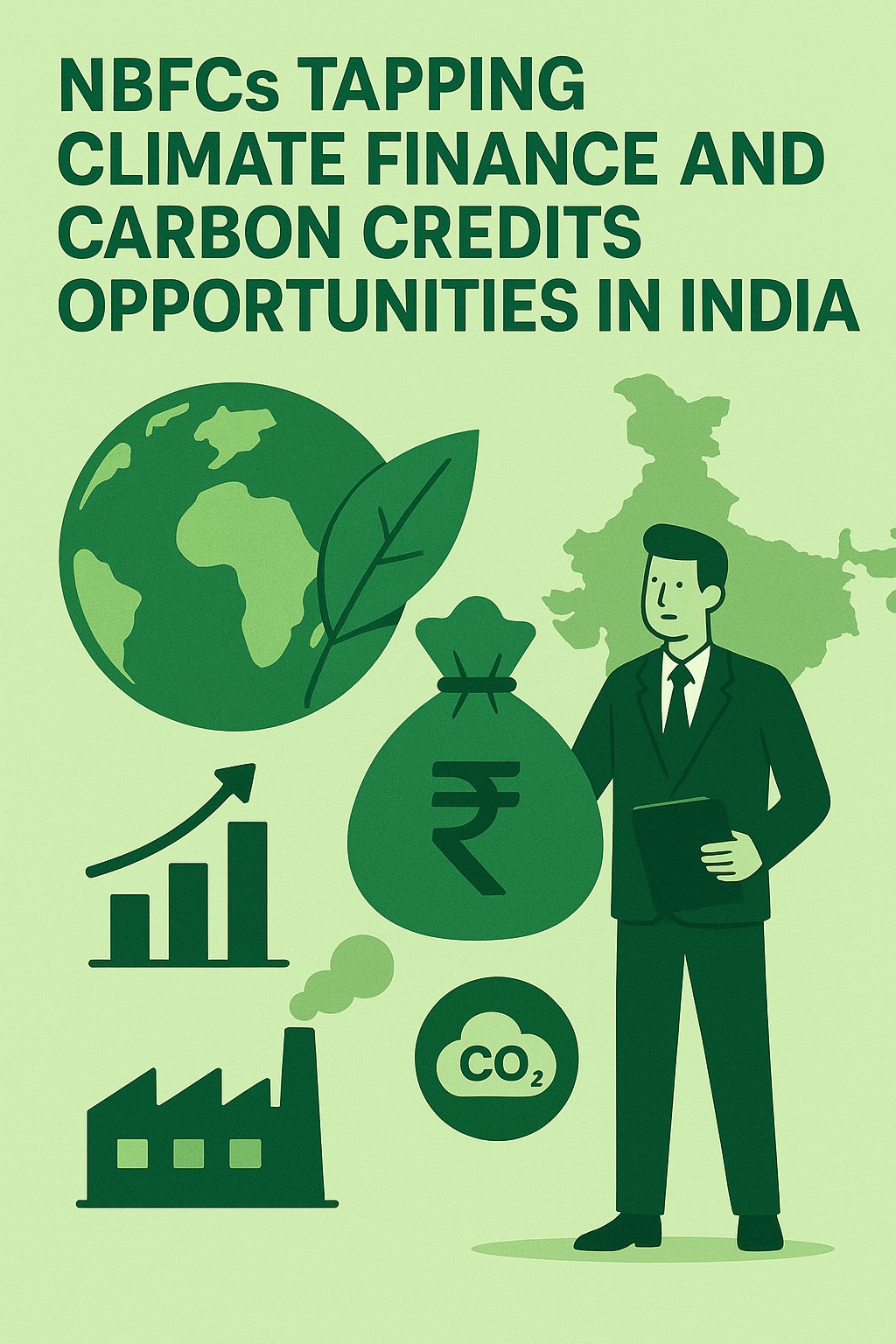
As India accelerates its push toward a low-carbon economy, climate finance and carbon credits are emerging as lucrative areas. NBFCs, known for their agility in underserved segments, are uniquely positioned to drive financing for green projects and benefit from carbon markets.
What Is Climate Finance?
Climate finance refers to investments and loans for projects that mitigate or adapt to climate change — such as renewable energy, electric mobility, energy-efficient buildings, or sustainable agriculture.
What Are Carbon Credits?
Carbon credits represent a tradeable certificate for reducing one metric ton of CO₂ or its equivalent. Companies and projects that cut emissions can sell these credits to others needing offsets.
Why This Matters for NBFCs
New Lending Opportunities: NBFCs can fund solar rooftops, EV fleets, micro-grids, and waste management projects.
Revenue from Carbon Credits: By financing green projects, NBFCs can earn or trade carbon credits.
Government Support: India’s carbon market framework and sovereign green bonds are creating enabling policies.
Investor Appetite: Global ESG funds and green investors are looking for partners in India.
Key Drivers in India
India’s target of Net Zero by 2070
New Indian Carbon Market (ICM) rules
Corporate ESG mandates pushing demand for credits
Incentives for renewable and sustainable projects
How NBFCs Can Capitalise
Green Loan Products: Develop tailored products for renewable energy, EVs, and energy efficiency.
Carbon Credit Advisory: Help borrowers register projects under verified carbon standards.
Blended Finance: Partner with development banks or climate funds to share risks.
Digital Platforms: Use fintech solutions for tracking emissions and credit generation.
Benefits to NBFCs
Portfolio diversification
Access to concessional climate funds
Enhanced brand reputation as sustainable lenders
Competitive edge over traditional banks
Challenges
Lack of expertise in carbon accounting
Need for robust MRV (Monitoring, Reporting, Verification) systems
Regulatory uncertainty during market transitions
Conclusion
Climate finance and carbon credits represent not just an environmental imperative but a new profit frontier. NBFCs that build capabilities in green lending and carbon credit monetisation can unlock massive opportunities while helping India meet its climate goals.
FAQ Section
Q1. What is climate finance for NBFCs?
It refers to loans and investments by NBFCs in projects that reduce carbon emissions or help adapt to climate change.
Q2. How do carbon credits benefit NBFCs?
By financing emission-reducing projects, NBFCs or their borrowers can generate carbon credits for sale, adding an extra revenue stream.
Q3. Are there government incentives for NBFCs in green lending?
Yes, through sovereign green bonds, priority lending guidelines for renewables, and the upcoming Indian Carbon Market framework.
Q4. What sectors are ripe for NBFC climate financing?
Renewable energy, EV fleets, sustainable agriculture, waste-to-energy, and energy-efficient buildings.
Q5. What challenges do NBFCs face in this space?
Need for expertise in carbon markets, regulatory clarity, and systems to verify emission reductions.
Published on : 17th September
Published by : SMITA
www.vizzve.com || www.vizzveservices.com
Follow us on social media: Facebook || Linkedin || Instagram
🛡 Powered by Vizzve Financial
RBI-Registered Loan Partner | 10 Lakh+ Customers | ₹600 Cr+ Disbursed
https://play.google.com/store/apps/details?id=com.vizzve_micro_seva&pcampaignid=web_share