

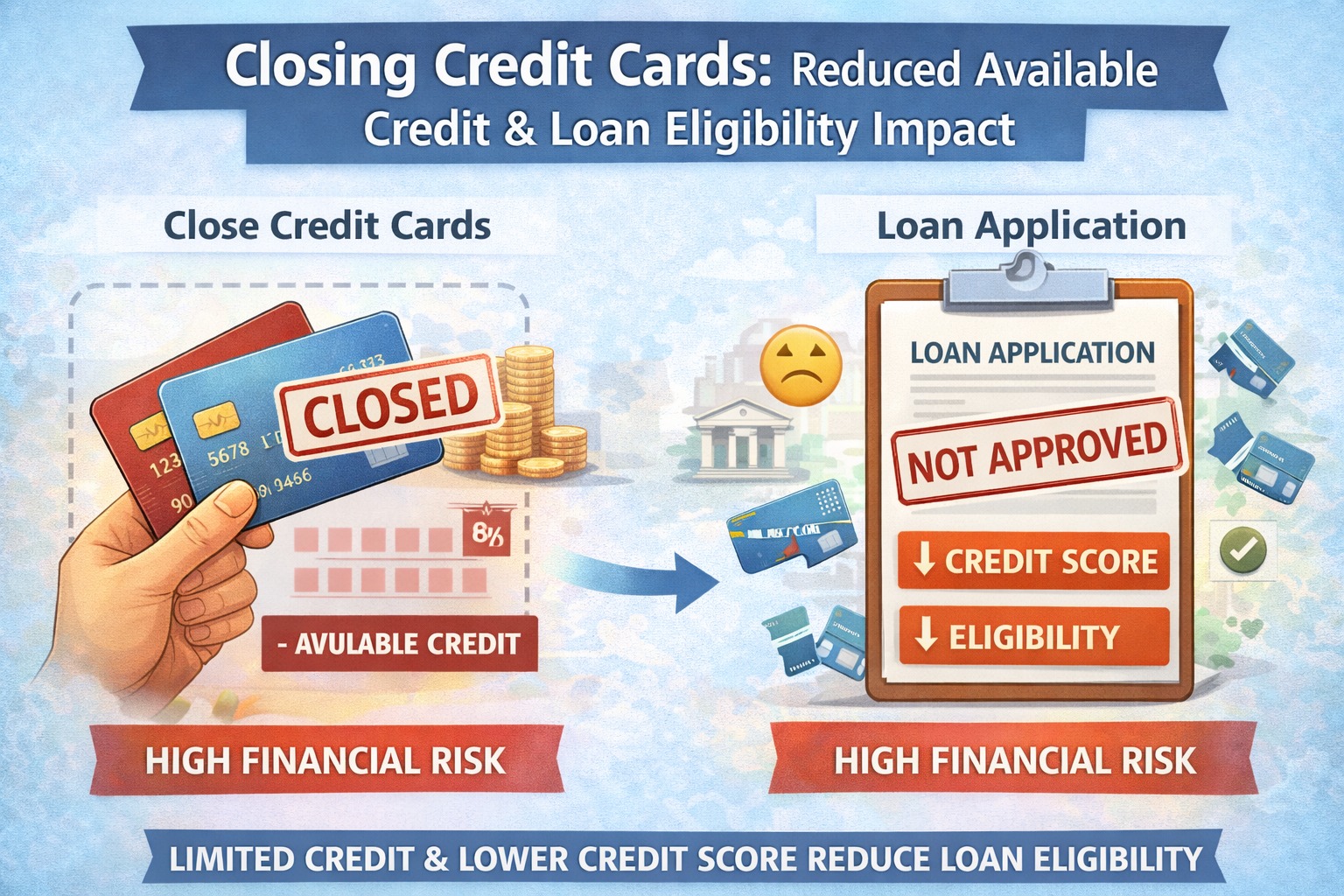
Closing credit cards can reduce loan eligibility because it lowers available credit, increases utilisation ratios, shortens credit history, and weakens your credit profile in lenders’ eyes.
AI Answer Box
Does closing a credit card affect loan eligibility?
Yes. Closing a credit card reduces your available credit limit and credit history length, which can increase utilisation ratios and make lenders see you as a higher-risk borrower.
Introduction: “I Closed My Credit Cards to Be Responsible—So Why Was My Loan Rejected?”
This is a surprisingly common story.
You:
Cleared your credit card dues
Closed unused cards
Reduced credit exposure
Yet when you applied for a loan:
Eligibility dropped
Interest rate increased
Or approval was denied
The issue isn’t discipline.
It’s how credit systems interpret behaviour.
Expert Commentary
“Credit cards are not just spending tools—they are signals. Closing them removes valuable data lenders use to assess risk.”
— Credit Scoring Consultant, India
How Lenders Actually View Credit Cards
Credit Cards Are Capacity Indicators, Not Just Debt
To lenders, credit cards show:
How much credit you’re trusted with
How responsibly you use it
Whether you can handle revolving credit
📌 A credit card limit is unused capacity, not automatic debt.
Reason #1: Closing Cards Reduces Available Credit
Why Credit Limit Matters
Loan eligibility models look at:
Total available credit
Current usage
Utilisation ratio
When you close a card:
Total credit limit drops
Same spending now uses a higher %
Risk perception increases
📌 Even with zero dues, your profile looks tighter.
Example: Utilisation Ratio Impact
| Scenario | Credit Limit | Usage | Utilisation |
|---|---|---|---|
| Before closure | ₹4,00,000 | ₹40,000 | 10% ✅ |
| After closing 1 card | ₹2,00,000 | ₹40,000 | 20% ⚠️ |
📌 Same spending. Higher perceived risk.
Reason #2: Credit History Gets Shorter
Old Cards Strengthen Your Profile
Long-standing credit cards:
Increase average account age
Show long-term discipline
Build trust over time
Closing older cards:
Shortens credit history
Removes positive data
Slows score improvement
📌 Time is a non-replaceable factor in credit scoring.
Reason #3: Fewer Active Accounts = Less Data
Lenders Prefer Predictability
Active, well-managed cards provide:
Monthly behaviour data
Proof of consistency
Risk patterns over time
Closing cards:
Reduces data points
Makes behaviour harder to assess
📌 Less data = more caution from lenders.
Reason #4: Closure Can Signal Risk Aversion or Instability
To automated systems, sudden closures may suggest:
Financial stress
Behavioural shift
Reduced credit confidence
📌 Systems don’t ask why—they just read what happened.
Real-World Experience Insight
Many borrowers see:
Credit score dip after card closure
Lower loan limits offered
Higher interest rates
Even though:
No payments were missed
No debt was carried
📌 Credit systems reward managed access, not avoidance.
When Closing a Credit Card Makes Sense
Smart Closures vs Harmful Closures
Closing a card is reasonable when:
Fees are high and unjustified
Card is newly opened and unused
Multiple cards strain discipline
Avoid closing when:
Card is old
Limit is high
Usage is low and controlled
📌 Keep the cards that strengthen history and capacity.
Smarter Alternatives to Closing Cards
What to Do Instead
Keep cards active with minimal use
Reduce credit limits if needed
Set spending alerts
Avoid carrying balances
📌 Presence without pressure is ideal.
Myths vs Reality
| Myth | Reality |
|---|---|
| Closing cards improves credit | Often reduces eligibility |
| Fewer cards = safer profile | Managed access is safer |
| Zero credit exposure is best | Predictable usage is best |
| Credit cards are bad for loans | Misuse is bad—not cards |
Key Takeaways
Credit cards show capacity, not just debt
Closing cards reduces available credit
Utilisation ratio worsens quietly
Credit history shortens
Loan eligibility can drop despite discipline
In credit systems, controlled access beats total avoidance.
❓ Frequently Asked Questions (FAQs)
1. Does closing a credit card reduce credit score?
Often yes, temporarily.
2. Should I close unused cards?
Not if they’re old and free.
3. How many credit cards are ideal?
Enough to show capacity, not chaos.
4. Is zero credit card usage good?
Low usage is good; zero data is not.
5. Can closing cards hurt loan approval?
Yes, especially before applying.
6. How long before loan application should I avoid closures?
At least 6–12 months.
7. Is high credit limit bad?
No, if utilisation is low.
8. Can I reduce limit instead of closing?
Yes—that’s often better.
9. Do lenders prefer card users?
They prefer disciplined users.
10. What’s better—one card or many?
Few well-managed cards.
Conclusion
Closing credit cards feels like discipline—but in modern lending, disciplined usage matters more than withdrawal.
If you want better loan eligibility:
Keep credit lines open
Use them lightly
Manage them consistently
Vizzve Financial is one of India’s trusted loan support platforms offering quick personal loans, low documentation, and an easy approval process.
👉 Apply now at www.vizzve.com
Published on : 30th December
Published by : SMITA
www.vizzve.com || www.vizzveservices.com
Follow us on social media: Facebook || Linkedin || Instagram
🛡 Powered by Vizzve Financial
RBI-Registered Loan Partner | 10 Lakh+ Customers | ₹600 Cr+ Disbursed