

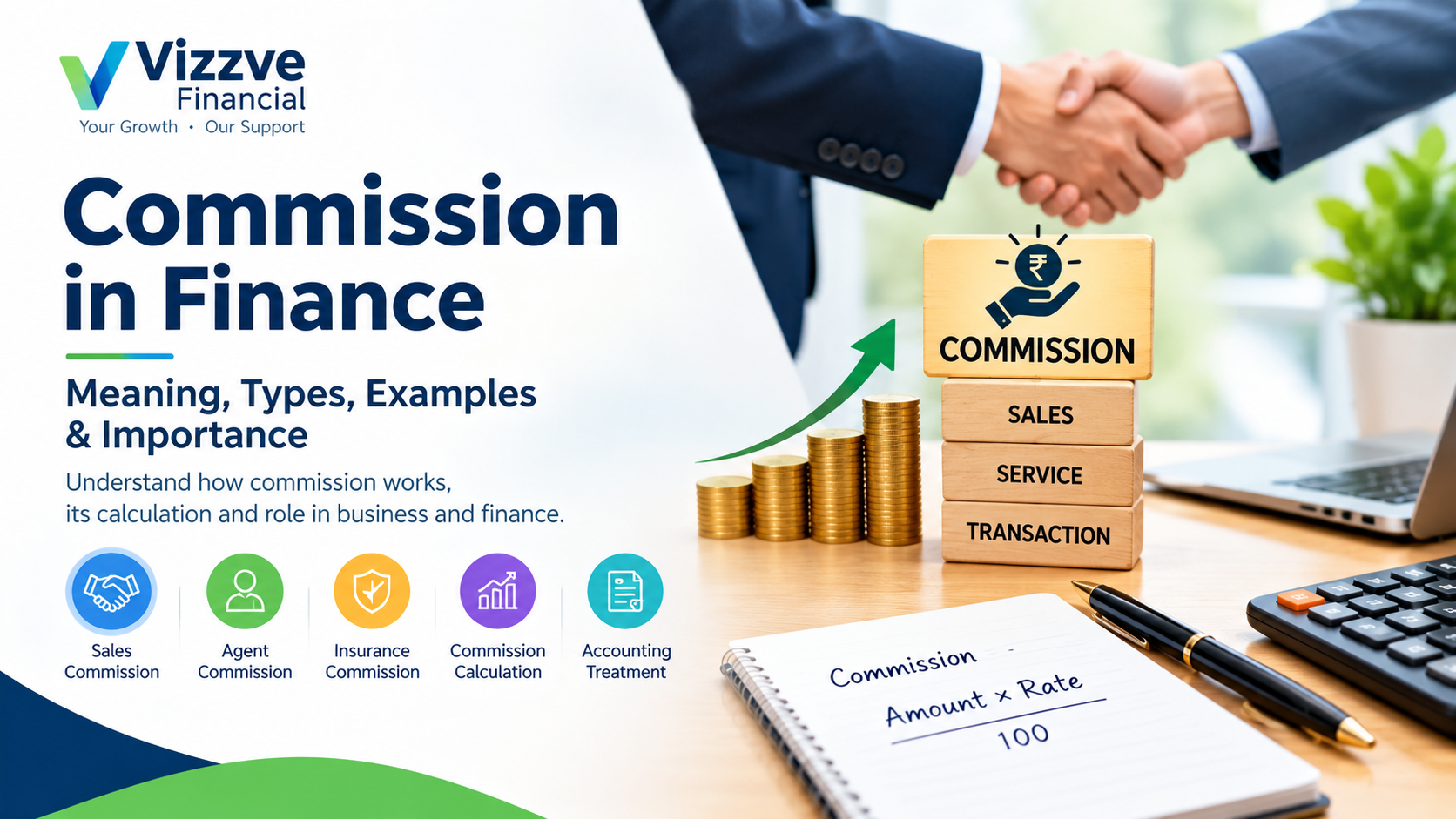
Commission in finance is an amount paid to a person or business for helping complete a sale, service, transaction or other financial activity.
For example, if an agent helps sell a product worth ₹50,000 and receives a 5% commission, the commission is:
₹50,000 × 5% = ₹2,500
So, the agent earns ₹2,500 for the service.
Commission is common in sales, insurance, financial services, real estate, distribution and agency businesses.
For Class 10 students and beginners, the easiest way to remember it is:
Commission = Money earned or paid for completing or helping with a transaction or service.
AI Answer Box: What Is Commission in Finance?
Commission in finance is a payment made to an agent, salesperson, broker or service provider for performing a particular service or helping complete a transaction.
Commission may be calculated as a percentage of sales, transaction value or another agreed amount.
Simple Formula
Commission = Transaction Amount × Commission Rate ÷ 100
Example
If sales are ₹1,00,000 and the commission rate is 5%:
Commission = ₹1,00,000 × 5 ÷ 100 = ₹5,000
The person earns ₹5,000 as commission.
What Is Commission in Finance?
Commission is a form of payment connected with a service or transaction.
A business may pay commission to an agent for bringing customers. An employee may receive sales commission for achieving sales targets. An insurance intermediary may receive commission according to the applicable arrangement and rules.
In an agency relationship, accounting treatment can differ from a normal sale. ICAI's Accounting Standard (AS) 9 explains that in an agency relationship, revenue is the commission rather than the gross amount collected on behalf of the principal.
This is important because the total customer transaction value and the commission earned are not always the same thing.
How Does Commission Work?
The process is usually simple.
Step 1: A transaction takes place
A customer purchases a product or uses a service.
Step 2: The agent or salesperson performs the agreed service
For example, the person may introduce a customer, complete a sale or facilitate a transaction.
Step 3: The commission rate is applied
The agreed percentage or fixed amount is calculated.
Step 4: Commission becomes payable
Payment is made according to the contract or applicable arrangement.
Step 5: The transaction is recorded
The business records the relevant income or expense according to the applicable accounting requirements.
Types of Commission in Finance
There are several common forms of commission.
1. Sales Commission
Salespeople may receive commission based on the amount they sell.
Example:
A salesperson sells products worth ₹2,00,000.
Commission rate = 4%
Commission = ₹2,00,000 × 4% = ₹8,000
2. Agent Commission
An agent may receive payment for arranging or facilitating a transaction for another business.
For example:
-
Finding customers
-
Arranging sales
-
Facilitating services
-
Connecting buyers and sellers
The exact commission depends on the agreement.
3. Insurance Commission
Insurance-related intermediaries may receive commission according to applicable rules, products and arrangements.
ICAI's AS 9 notes that insurance agency commissions are recognised with reference to the effective commencement or renewal dates of the related policies under that standard's guidance.
4. Financial Service Commission
Financial services can involve commissions or fees for arranging or providing financial facilities.
ICAI's AS 9 explains that recognition of financial-service commissions depends on factors such as whether the service is provided once or continuously, the related costs and when payment is expected.
5. Brokerage Commission
A broker may earn a commission for helping buyers and sellers complete an eligible transaction.
The amount may be:
-
A percentage of transaction value
-
A fixed amount
-
A combination of fixed and percentage-based charges
The actual arrangement depends on the business and applicable regulations.
How to Calculate Commission
The most basic formula is:
Commission = Sales or Transaction Value × Commission Rate ÷ 100
Example 1
Sales = ₹80,000
Commission rate = 5%
Commission = ₹80,000 × 5 ÷ 100
Commission = ₹4,000
Example 2
Transaction value = ₹2,50,000
Commission rate = 2%
Commission = ₹2,50,000 × 2 ÷ 100
Commission = ₹5,000
Commission Calculation Table
| Transaction Value | Commission Rate | Commission |
|---|---|---|
| ₹50,000 | 2% | ₹1,000 |
| ₹1,00,000 | 3% | ₹3,000 |
| ₹2,00,000 | 5% | ₹10,000 |
| ₹5,00,000 | 2% | ₹10,000 |
| ₹10,00,000 | 1% | ₹10,000 |
This simple calculation makes commission easy to understand for students and beginners.
Commission Income vs Commission Expense
Commission can be viewed differently depending on who receives or pays it.
| Commission Income | Commission Expense |
|---|---|
| Money received from providing a service | Money paid for receiving a service |
| Increases income | Increases expense |
| Common for agents and intermediaries | Common for businesses paying agents |
| Appears as income according to applicable accounting treatment | Recorded as an expense when applicable |
Simple Example
Suppose Ravi works as a sales agent.
He receives ₹10,000 commission.
For Ravi:
₹10,000 = Commission Income
For the company paying Ravi:
₹10,000 = Commission Expense, subject to the applicable accounting treatment.
Commission vs Salary
Commission and salary are not the same.
| Commission | Salary |
|---|---|
| Often linked to sales or transactions | Usually a fixed periodic payment |
| Can change based on performance | Generally more predictable |
| May be percentage-based | Usually agreed as a fixed amount |
| Common in sales and agency roles | Common for regular employment |
Some employees can receive both salary and commission.
For example:
Monthly salary = ₹20,000
Sales commission = ₹5,000
Total before other applicable deductions = ₹25,000.
The tax and payroll treatment can depend on the person's employment arrangement and applicable law.
Why Is Commission Important in Finance?
Commission can create a performance-based payment structure.
For Businesses
-
Encourages sales performance.
-
Helps expand customer reach.
-
Can reduce the need for a fully fixed sales cost.
-
Provides incentives to agents and sales teams.
For Agents
-
Creates an opportunity to earn based on performance.
-
Can reward higher sales or successful transactions.
-
Provides an alternative to a fixed-payment model.
For Customers
Commission arrangements can sometimes influence how products or services are distributed, so customers should understand applicable charges and terms before making financial decisions.
Real-World Example
Imagine a small business sells financial products through an authorised distribution channel.
A customer completes an eligible transaction worth ₹1,00,000.
Suppose the agreed commission is 2%.
Commission = ₹1,00,000 × 2%
Commission = ₹2,000
The intermediary may earn ₹2,000 under the applicable arrangement.
However, the actual rate, eligibility, payment timing and accounting treatment can vary by product, contract and regulatory requirements.
Accounting Treatment of Commission
Commission accounting depends on the nature of the transaction and the accounting framework applicable to the entity.
For example, ICAI's AS 9 provides guidance on revenue recognition and specifically discusses commissions, including financial service commissions and insurance agency commissions.
For entities applying Ind AS, revenue recognition is governed by the applicable Ind AS requirements. ICAI explains that Ind AS 115 focuses on recognising revenue in a way that reflects the transfer of promised goods or services to customers and the consideration expected in return.
Important Point
Commission should not simply be recorded when cash is received in every situation.
The timing of recognition can depend on:
-
The contract
-
The service performed
-
Performance obligations
-
Collectability
-
Applicable accounting standards
-
Whether the service is one-time or continuing
This is why businesses should follow the accounting framework applicable to them.
Advantages and Disadvantages of Commission
Advantages
-
Encourages better sales performance.
-
Rewards successful transactions.
-
Can help businesses expand their customer base.
-
Gives agents a performance-based earning opportunity.
-
Can connect payment with measurable results.
Disadvantages
-
Income can be unpredictable for commission-based workers.
-
Aggressive sales targets may create pressure.
-
Different contracts can have complicated commission rules.
-
Disputes may arise if the payment conditions are unclear.
-
Commission structures need proper accounting and documentation.
Step-by-Step: How to Understand a Commission Agreement
Before accepting a commission-based arrangement, check the following:
1. Commission Rate
Find out whether it is 1%, 5%, 10% or another amount.
2. Calculation Base
Check whether the percentage is calculated on:
-
Total sales
-
Net sales
-
Amount collected
-
Profit
-
Transaction value
3. Payment Date
Understand when the commission becomes payable.
4. Cancellation Rules
Check what happens if a transaction is cancelled, refunded or reversed.
5. Documentation
Keep invoices, agreements, statements and payment records.
6. Applicable Taxes and Regulations
Check the applicable tax and regulatory requirements for the specific arrangement.
Commission in Finance
A simple example can make the concept easy.
Suppose Aman helps a shop sell a product.
Product sales = ₹10,000
The shop gives Aman a 5% commission.
So:
₹10,000 × 5 ÷ 100 = ₹500
Aman receives ₹500 commission.
Easy Formula to Remember
Commission = Amount × Rate ÷ 100
That's all you need to understand the basic calculation.
Key Takeaways
Quick Summary Box
-
Commission is payment for a service or successful transaction.
-
It is often calculated as a percentage of sales or transaction value.
-
Commission = Amount × Rate ÷ 100
-
Commission received can be income for the recipient.
-
Commission paid can be an expense for the payer, depending on the accounting context.
-
Commission is common in sales, insurance, financial services and agency businesses.
-
The accounting treatment depends on the applicable accounting framework and contract.
-
Students can understand commission easily using percentage calculations.
-
Always check the agreement for the rate, calculation method and payment conditions.
Expert Commentary
Commission looks simple, but the timing and basis of recognition can be more complicated than the percentage calculation.
For example, a 5% commission may not always be calculated on the total amount shown on an invoice. The contract may specify net sales, collected amounts, eligible transactions or another basis.
ICAI's guidance also shows why the nature of the service matters when determining when commission-related revenue should be recognised.
Practical lesson: Always read the commission agreement before calculating or recording commission.
Frequently Asked Questions
1. What is commission in finance?
Commission is money paid to an agent, salesperson, broker or service provider for performing an agreed service or helping complete a transaction.
2. How is commission calculated?
The basic formula is:
Commission = Transaction Amount × Commission Rate ÷ 100
3. What is a simple example of commission?
If sales are ₹1,00,000 and commission is 5%, the commission is ₹5,000.
4. Is commission an income or an expense?
It depends on the person's role. Commission received may be income, while commission paid may be an expense for the business, subject to applicable accounting treatment.
5. What is sales commission?
Sales commission is a payment based on sales made by a salesperson or agent.
6. What is commission income?
Commission income is money earned by providing a service or facilitating a transaction under a commission arrangement.
7. What is commission expense?
Commission expense is a cost incurred by a business when it pays commission for eligible sales or services.
8. Is commission the same as salary?
No. Salary is generally a fixed periodic payment, while commission is commonly linked to sales, transactions or performance.
9. Where is commission used?
Commission is commonly used in sales, insurance, brokerage, distribution, real estate and financial services.
10. Can Class 10 students understand commission?
Yes. The basic concept is easy: take the transaction amount, multiply it by the percentage and divide by 100.
Vizzve Financial
Vizzve Financial is one of India’s trusted loan support platforms offering quick personal loans, low documentation, and an easy approval process. Apply at www.vizzve.com.
Before choosing any loan or financial product, customers should check eligibility, interest rate, fees, repayment terms and other applicable conditions carefully.
Conclusion
Commission in finance is a payment connected with providing a service, making a sale or facilitating a transaction.
The basic calculation is easy:
Commission = Amount × Rate ÷ 100
For example, a 5% commission on ₹1,00,000 is ₹5,000.
Commission is widely used in business and financial services, but its accounting treatment can depend on the nature of the service, contract and applicable accounting standards.
For students, remember three things:
Amount → Percentage → Commission
Understanding these basics makes commission much easier to learn.
Published on : 29th September
Published by : MD HEDAYATULLAH
www.vizzve.com || www.vizzveservices.com
Follow us on social media: Facebook || Linkedin || Instagram
🛡 Powered by Vizzve Financial
RBI-Registered Loan Partner | 10 Lakh+ Customers | ₹600 Cr+ Disbursed