

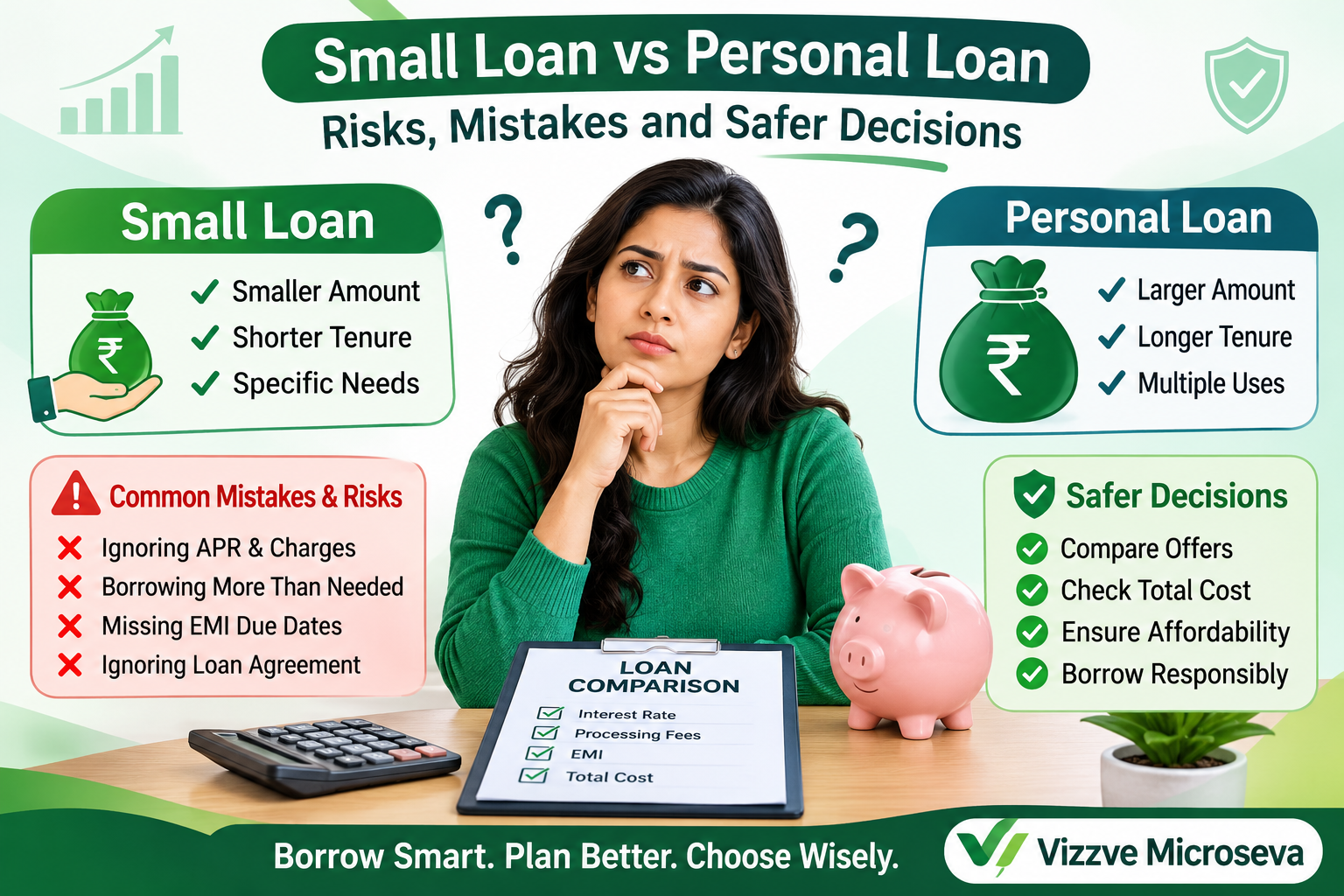
Borrowing money can be helpful when unexpected expenses arise or when you need financial support to achieve an important goal. However, choosing the wrong loan can create unnecessary financial pressure.
Two common borrowing options in India are small loans and personal loans. Both can provide financial assistance, but they may differ in loan amount, repayment tenure, interest rates, eligibility requirements and overall borrowing costs.
Many borrowers focus only on how quickly they can receive the money. They often overlook processing fees, Annual Percentage Rate (APR), repayment conditions and the consequences of missing an EMI.
Understanding the common mistakes, risks and safer decisions associated with a small loan vs personal loan can help borrowers make informed financial choices.
This guide explains how both options work, what mistakes to avoid, and how to select a loan that suits your financial situation.
1. What Is a Small Loan?
A small loan generally refers to borrowing a relatively low amount of money to manage short-term or specific financial requirements.
Borrowers may consider small loans for:
-
Medical or emergency expenses.
-
Household repairs.
-
Educational expenses.
-
Unexpected bills.
-
Small personal purchases.
-
Temporary cash-flow shortages.
Small loans may be available through banks, Non-Banking Financial Companies (NBFCs), and regulated digital lending platforms.
The loan amount, interest rate, eligibility and repayment period depend on the lender and the specific product.
Important: Small loan is a general borrowing description, not one standard loan category with a fixed amount or interest rate.
2. What Is a Personal Loan?
A personal loan is generally an unsecured loan that individuals can use for different legitimate personal financial requirements.
Unlike secured loans, personal loans usually do not require collateral such as property or gold.
Common uses include:
-
Wedding expenses.
-
Medical emergencies.
-
Home renovation.
-
Travel expenses.
-
Education-related costs.
-
Debt consolidation, where financially appropriate.
Banks and NBFCs assess factors such as income, employment, credit history, existing financial obligations and repayment capacity before approving a personal loan.
Personal loans generally have a fixed repayment schedule, although the interest rate and terms depend on the lender and loan agreement.
3. Small Loan vs Personal Loan: Key Differences
Although both options provide access to borrowed money, their features may vary.
| Comparison factor | Small Loan | Personal Loan |
|---|---|---|
| Loan amount | Usually relatively smaller | May offer larger amounts |
| Purpose | Often short-term requirements | Multiple personal expenses |
| Repayment tenure | Often shorter | May offer longer tenures |
| Interest rate | Depends on lender and product | Depends on borrower and lender |
| Processing fees | May apply | May apply |
| Collateral | Often unsecured | Generally unsecured |
| Approval | Depends on eligibility | Depends on eligibility |
| Documentation | Varies by lender | Varies by lender |
| EMI | Depends on amount and tenure | Depends on amount and tenure |
| Credit impact | Depends on reporting and repayment | Depends on reporting and repayment |
Which is better?
Neither option is automatically better. A small loan may be suitable for a limited financial requirement, while a personal loan may be more appropriate for a larger planned expense.
The right choice depends on the total borrowing cost, repayment capacity and loan conditions.
4. Common Mistakes Borrowers Make When Choosing a Small Loan vs Personal Loan
Choosing a loan without comparing its financial implications can create problems later.
Here are some common mistakes borrowers should avoid.
Mistake 1: Choosing a Loan Only Because of Quick Approval
Fast approval can be convenient, especially during emergencies. However, quick disbursement should not be the only deciding factor.
Some borrowers accept the first available offer without checking the interest rate, processing charges or repayment conditions.
Safer decision:
-
Compare multiple lenders.
-
Check the total repayment amount.
-
Review the APR.
-
Read the loan agreement.
-
Verify the actual lender.
Mistake 2: Ignoring the Annual Percentage Rate (APR)
The interest rate alone does not always represent the complete cost of borrowing.
APR helps borrowers understand the annualised cost of a loan, including applicable charges covered under the APR calculation.
For example, two lenders may advertise similar interest rates but have different processing fees and other applicable costs.
Safer decision: Compare the APR and Key Facts Statement (KFS) instead of looking only at the advertised interest rate.
Mistake 3: Borrowing More Money Than Necessary
Some borrowers choose a larger loan amount because the lender offers a higher eligible limit.
However, borrowing more increases the principal amount that must be repaid and can increase the overall interest cost.
Safer decision:
-
Calculate the exact amount required.
-
Borrow only what is necessary.
-
Avoid using loan money for unnecessary purchases.
-
Consider your monthly financial commitments.
Mistake 4: Ignoring Monthly EMI Affordability
A loan may appear affordable when viewed as a lump sum, but the monthly EMI can affect household expenses.
Borrowers sometimes underestimate expenses such as rent, groceries, transportation, school fees and existing EMIs.
Safer decision: Prepare a monthly budget before accepting the loan. Make sure the EMI remains manageable even if an unexpected expense occurs.
Mistake 5: Applying to Multiple Lenders Without Research
Submitting loan applications to several lenders within a short period may result in multiple hard credit enquiries.
Multiple hard enquiries can influence credit scores and may affect how lenders evaluate a borrower's credit profile.
Safer decision:
-
Check eligibility requirements before applying.
-
Use soft eligibility checks where available.
-
Compare loan offers carefully.
-
Submit formal applications only after selecting suitable lenders.
Mistake 6: Ignoring Processing Fees and Other Charges
Some borrowers compare loans based only on the amount received.
However, processing fees, applicable taxes, late-payment charges and other disclosed fees can increase the total borrowing cost.
Safer decision: Check the complete fee structure before signing the agreement.
Mistake 7: Not Reading the Loan Agreement
Accepting loan terms without reading the agreement can lead to confusion about repayment dates, charges, prepayment conditions and default consequences.
Safer decision: Read the loan agreement and KFS carefully. Keep a copy of all digitally signed loan documents.
Mistake 8: Missing EMI Due Dates
Missing an EMI can result in additional charges and may negatively affect the borrower's credit history when the lender reports the default.
Repeated missed payments can make future borrowing more difficult.
Safer decision:
-
Set EMI reminders.
-
Maintain sufficient account balance.
-
Use auto-debit carefully.
-
Contact the lender immediately if repayment difficulties arise.
5. Major Risks of Small Loans
Small loans may solve immediate financial problems, but borrowers should understand the possible risks.
1. Higher Borrowing Costs
Certain small-ticket, short-tenure loans may have a relatively high effective borrowing cost.
A small principal amount does not necessarily mean a cheap loan.
2. Short Repayment Period
A shorter repayment period can result in higher monthly instalments relative to the loan amount.
This may create pressure for borrowers with irregular income.
3. Risk of Repeated Borrowing
Borrowers who cannot repay an existing loan sometimes take another loan to cover the previous EMI.
This can create a debt cycle and increase financial stress.
4. Fraudulent Loan Applications
Fake loan applications may advertise instant approval or guaranteed loans to attract borrowers.
Some fraudulent operators may misuse personal information, demand suspicious upfront payments or engage in harassment.
5. Privacy and Data Security Risks
Unverified digital lending applications may request unnecessary access to personal information, contacts, photographs or other sensitive data.
Borrowers should avoid applications that demand excessive permissions.
6. Major Risks of Personal Loans
Personal loans can provide financial flexibility, but they also involve important risks.
1. Long-Term Interest Burden
A longer tenure may reduce the monthly EMI but can increase the total interest paid over the loan period.
2. Debt-to-Income Pressure
Taking a personal loan while already managing multiple EMIs can increase monthly financial pressure.
3. Credit Score Impact
Late payments, missed EMIs and defaults may negatively affect credit history.
4. Unnecessary Borrowing
Using personal loans for non-essential spending can create repayment obligations long after the purchase is completed.
5. Prepayment and Foreclosure Conditions
Some loans may have specific prepayment or foreclosure conditions. Borrowers should understand the applicable terms before accepting the offer.
7. Small Loan vs Personal Loan: Which Is Safer?
The safer choice depends on your financial requirement and repayment ability.
| Financial situation | Option to consider |
|---|---|
| Small emergency expense | A suitable small loan |
| Larger planned expense | Personal loan |
| Short-term cash requirement | A suitable short-tenure loan |
| Multiple existing EMIs | Review affordability before borrowing |
| Irregular monthly income | Avoid unaffordable fixed EMIs |
| Uncertain repayment ability | Consider alternatives to borrowing |
A safer loan is not necessarily the one with the smallest EMI or fastest approval.
It is the one with transparent charges, suitable repayment terms and an EMI you can comfortably afford.
8. Safer Decisions Before Applying for a Loan
Borrowers can reduce financial risks by following a few practical steps.
Step 1: Identify Your Financial Requirement
Understand why you need the loan.
Separate emergency expenses from optional purchases and avoid unnecessary borrowing.
Step 2: Compare Different Loan Offers
Compare at least the following:
-
Interest rate.
-
APR.
-
Processing fees.
-
Loan tenure.
-
Monthly EMI.
-
Total repayment amount.
-
Late-payment charges.
-
Prepayment conditions.
Step 3: Verify the Lender
Check whether the lender is an RBI-regulated bank or NBFC.
If you are applying through a digital lending application, verify its association with the regulated lender through the lender's official website and available RBI resources.
Step 4: Check Your Credit Profile
Review your credit report and existing repayment obligations before applying.
Correct inaccurate information where necessary.
Step 5: Understand the KFS
The Key Facts Statement provides important information about loan terms and applicable costs.
Review it before accepting the loan.
Step 6: Calculate Your EMI
Use an EMI calculator to estimate your monthly repayment.
Do not select a loan simply because the EMI looks small. Consider the total amount payable.
Step 7: Maintain an Emergency Buffer
Avoid using your entire monthly income for loan repayments.
Keep sufficient money available for essential expenses and unexpected financial requirements.
9. Example: Choosing Between a Small Loan and a Personal Loan
Consider a borrower who needs ₹50,000 for an unexpected household expense.
The borrower receives two illustrative loan offers:
| Details | Offer A | Offer B |
|---|---|---|
| Loan amount | ₹50,000 | ₹50,000 |
| Annual interest rate | 18% | 15% |
| Tenure | 12 months | 12 months |
| Processing fee | ₹1,000 | ₹1,500 |
| Estimated EMI | ₹4,584 | ₹4,513 |
| Estimated total interest | ₹5,008 | ₹4,156 |
These are illustrative calculations using reducing-balance monthly interest. They exclude applicable taxes and other charges. Actual lender quotations may differ.
Although Offer B has a higher processing fee, its lower interest rate results in a lower estimated total cost.
This example demonstrates why borrowers should compare the complete cost of borrowing instead of choosing a loan based on a single factor.
10. How to Avoid Loan Traps and Fraudulent Lending Apps
Digital borrowing has made loan applications easier, but borrowers should remain alert.
Follow these precautions:
-
Apply through verified lender websites or authorised applications.
-
Check the bank or NBFC responsible for providing the loan.
-
Avoid loan links received through suspicious SMS messages or social media.
-
Never share OTPs, passwords or banking PINs.
-
Do not pay suspicious upfront charges to unknown individuals.
-
Review app permissions and privacy policies.
-
Save your KFS, sanction letter and loan agreement.
-
Check the repayment account details before transferring money.
-
Report suspicious activity to the appropriate authorities.
The Reserve Bank of India introduced its Digital Lending Directions, 2025 to strengthen transparency, borrower protection and responsible digital lending practices.
11. Important RBI Guidelines Borrowers Should Know
The Reserve Bank of India has established important requirements for regulated digital lending activities.
Some important borrower protections include:
-
Creditworthiness assessment: Regulated lenders must assess relevant borrower information before extending credit.
-
Loan disclosures: Borrowers should receive important loan information, including applicable costs and terms.
-
Key Facts Statement: The KFS helps borrowers understand the important terms of their loan.
-
Cooling-off period: Eligible digital loans must provide an initial exit option under the applicable RBI framework, subject to disclosed conditions.
-
Grievance redressal: Regulated entities and relevant lending service providers must provide grievance redressal arrangements.
-
Data protection: Digital lending activities must follow applicable requirements regarding the collection, use and storage of borrower information.
Borrowers should remember that using a third-party lending application does not remove the regulated lender's responsibilities under applicable RBI requirements.
12. Practical Checklist Before Taking a Small Loan or Personal Loan
Use this checklist before accepting any loan offer.
-
I have identified why I need the loan.
-
I am borrowing only the required amount.
-
I have compared interest rates and APR.
-
I have checked processing fees and other charges.
-
I understand the EMI and repayment tenure.
-
I have reviewed my existing financial commitments.
-
I have verified the lender.
-
I have read the KFS and loan agreement.
-
I understand late-payment and prepayment conditions.
-
I can repay the loan without affecting essential expenses.
If you cannot confidently meet these conditions, reconsider borrowing or explore alternative financial arrangements.
13. Expert Insights: Making Responsible Borrowing Decisions
Responsible borrowing starts with understanding the difference between loan eligibility and loan affordability.
A lender may approve a particular amount based on its eligibility assessment. However, approval does not automatically mean that borrowing the full amount is financially suitable.
Before choosing between a small loan and a personal loan, consider these important principles:
Focus on total cost: A low EMI does not always mean a low-cost loan.
Avoid unnecessary credit applications: Research eligibility and compare offers before making formal applications.
Prioritise repayment discipline: Paying EMIs on time supports a healthy credit history.
Choose transparent lenders: Clear disclosures and accessible grievance channels are important indicators of responsible lending practices.
Borrow with a repayment plan: Every loan should have a realistic repayment strategy.
14. Key Takeaways
-
Small loans and personal loans serve different borrowing requirements.
-
Small loans are not automatically cheaper than personal loans.
-
Compare APR, interest rates, fees and total repayment amounts.
-
Avoid borrowing more than necessary.
-
Multiple formal loan applications can result in hard credit enquiries.
-
Missed EMIs can affect your credit history.
-
Verify digital lending applications and their regulated lender associations.
-
Read the KFS and loan agreement before accepting an offer.
-
Choose a repayment schedule that fits your monthly budget.
-
Responsible borrowing is more important than quick loan approval.
Frequently Asked Questions (FAQs)
1. What is the main difference between a small loan and a personal loan?
A small loan generally refers to borrowing a relatively low amount, whereas a personal loan is a broader unsecured credit product that can provide larger amounts depending on eligibility.
2. Is a small loan better than a personal loan?
Not always. The better option depends on the loan amount, interest rate, APR, processing fees, repayment tenure and affordability.
3. Are small loans more expensive than personal loans?
Some small-ticket loans may have higher effective borrowing costs, but this is not universal. Compare the APR and total repayment amount.
4. Can I get a small loan without collateral?
Yes. Many small loans are unsecured, but the requirements depend on the lender and loan product.
5. Does taking a small loan affect my CIBIL score?
It can. If the lender reports the loan and repayment information to credit bureaus, borrowing and repayment behaviour may affect your credit profile.
6. Does applying for multiple personal loans reduce my credit score?
Multiple hard enquiries within a short period can affect your credit score. Avoid submitting unnecessary formal applications.
7. Which loan is suitable for emergency expenses?
A suitable small loan or personal loan may help with emergencies. Compare the complete cost and choose an EMI you can afford.
8. Can I repay a personal loan before the tenure ends?
Prepayment or foreclosure may be possible depending on the applicable loan terms and regulatory requirements. Check the conditions in your agreement.
9. What happens if I miss a small loan EMI?
The lender may impose applicable charges and report the missed payment to credit bureaus, which can affect your credit history.
10. How can I identify a fake loan application?
Check the lender's official website, verify its regulatory association, avoid suspicious links and never share banking credentials or OTPs.
Conclusion
Choosing between a small loan and a personal loan requires more than comparing loan amounts and approval speed.
Both options can help manage financial requirements when used responsibly. However, borrowing without understanding interest costs, fees, repayment schedules and lender credibility can lead to unnecessary financial difficulties.
The best approach is to identify your actual requirement, compare suitable loan offers, verify the lender and calculate your repayment capacity before applying.
Remember, a loan should support your financial needs rather than become an additional financial burden. Making informed and responsible borrowing decisions today can help protect your financial stability in the future.
Published on : 26th November
Published by : MD HEDAYATULLAH
www.vizzve.com || www.vizzveservices.com
Follow us on social media: Facebook || Linkedin || Instagram
🛡 Powered by Vizzve Financial
RBI-Registered Loan Partner | 10 Lakh+ Customers | ₹600 Cr+ Disbursed