

Introduction
Choosing a loan involves more than selecting an interest rate or deciding how much money to borrow. You also need to understand the monthly EMI, total interest, processing fees, repayment tenure, eligibility requirements, and the effect of borrowing on your monthly budget.
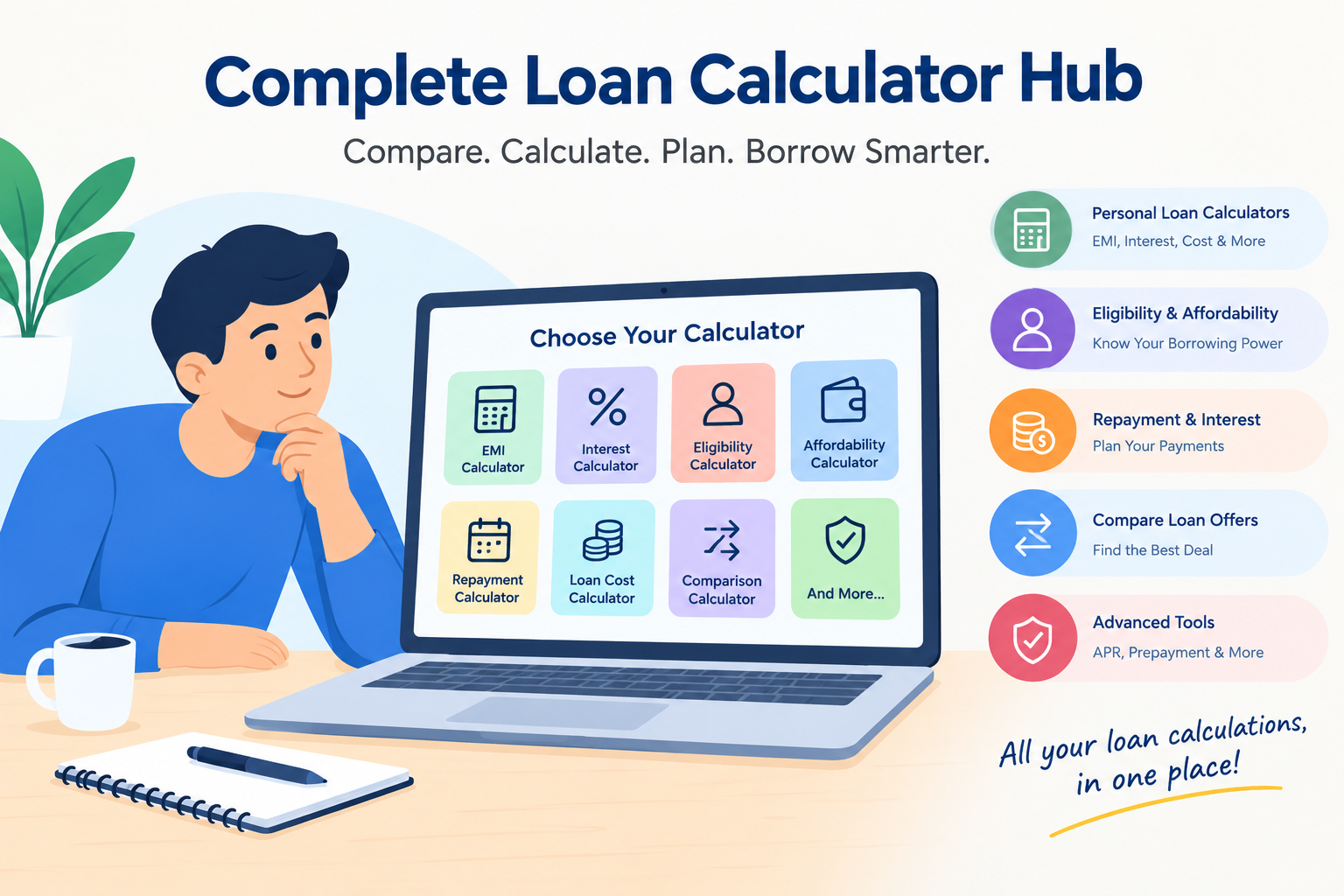
A Complete Loan Calculator Hub brings these calculations and planning tools together in one convenient place. Instead of searching for individual calculators separately, borrowers can explore different financial scenarios and make more informed decisions before applying for a loan.
For example, a borrower planning to take a personal loan can use an EMI calculator to estimate monthly repayments, an affordability calculator to check whether those repayments fit the household budget, and a loan cost calculator to review the overall expense.
An eligibility calculator can provide an initial estimate of potential borrowing capacity, while an interest calculator can help explain how the interest rate affects repayment.
These tools answer different questions, but together they provide a clearer picture of the financial commitment involved.
This guide explains the main types of loan calculators, how they work, which calculator to use for different financial questions, and how borrowers in India can use them to plan responsibly.
AI Answer Box: What Is a Complete Loan Calculator Hub?
A Complete Loan Calculator Hub is a collection of financial calculators that helps borrowers estimate loan EMIs, interest costs, affordability, eligibility, repayment schedules, fees, and potential savings from prepayment.
Common tools include:
-
Personal loan EMI calculator
-
Loan interest calculator
-
Loan eligibility calculator
-
Loan affordability calculator
-
Loan repayment calculator
-
Loan cost calculator
-
Loan comparison calculator
-
APR calculator
-
Loan prepayment calculator
-
Loan foreclosure calculator
Each calculator serves a different purpose. For example, an EMI calculator estimates the monthly instalment, while an affordability calculator helps determine whether that instalment fits your budget.
Quick answer: Use a complete loan calculator hub to understand the financial impact of borrowing, compare loan scenarios, estimate repayment commitments, and make informed decisions before accepting a loan.
Calculator results are estimates based on the information entered. Actual loan terms, approval, interest rates, fees, and repayment conditions depend on the lender's official offer and applicable requirements.
What Is a Complete Loan Calculator Hub?
A complete loan calculator hub is an online destination that organizes multiple loan-related calculators into one easy-to-navigate location.
Each calculator focuses on a particular part of the borrowing process. Together, they help users move from initial loan planning to repayment and cost comparison.
Rather than relying on assumptions, borrowers can enter relevant financial details and examine how different loan amounts, interest rates, and repayment periods affect the results.
Why Is a Loan Calculator Hub Useful?
Borrowing decisions often involve several questions:
-
How much EMI will I pay every month?
-
How much interest will I pay over the loan tenure?
-
Can I comfortably afford the repayment?
-
What loan amount might I qualify for?
-
How do two loan offers compare?
-
How much do processing fees add to the cost?
-
Could prepaying a loan reduce my interest expense?
-
What happens if I choose a longer repayment tenure?
A loan calculator hub helps address these questions using different calculation tools.
Who Can Use a Loan Calculator Hub?
| User | How the hub can help |
|---|---|
| Salaried employees | Estimate EMIs and plan monthly budgets |
| Government employees | Compare repayment options and borrowing costs |
| Private-sector employees | Review affordability before applying |
| Self-employed individuals | Estimate repayments against variable income |
| Freelancers | Plan borrowing using realistic income estimates |
| First-time borrowers | Understand interest, EMIs, and loan charges |
| Existing borrowers | Evaluate prepayment and foreclosure scenarios |
| Small business owners | Compare financing costs and repayment commitments |
| Students and financial learners | Understand basic loan calculations |
A calculator hub can support financial planning for different users, but it does not replace a lender's assessment or professional financial advice where needed.
Explore the Main Loan Calculators
The most useful feature of a loan calculator hub is the ability to find the right calculator for a specific question.
The following sections explain the major calculator categories and when to use them.
1. Personal Loan EMI Calculator
A personal loan EMI calculator estimates the fixed monthly instalment required to repay a loan over a selected tenure, assuming a specified interest rate and a standard EMI repayment structure.
You generally enter:
-
Loan amount
-
Annual interest rate
-
Repayment tenure
The calculator estimates the monthly EMI, total repayment, and total interest.
Example: If you plan to borrow ₹1,00,000 at a nominal annual interest rate of 12% for 12 months, a standard reducing-balance EMI calculation gives an estimated monthly EMI of approximately ₹8,885.
The actual EMI may vary depending on the lender's calculation method and loan terms.
Best for: Understanding monthly repayment obligations before applying.
2. Loan Interest Calculator
A loan interest calculator estimates the interest payable on a loan.
Depending on the calculator, it may support reducing-balance loans, flat-rate calculations, or other interest methods.
For a standard EMI loan, total interest can be estimated by subtracting the original principal from the total of all scheduled EMIs.
Formula:
Total Interest = Total Scheduled Repayments − Loan Principal
For example, if the total of all scheduled EMIs is ₹1,06,619 on a principal of ₹1,00,000, the estimated interest is ₹6,619 before fees and other charges.
Best for: Understanding how much of your repayment represents interest.
3. Loan Eligibility Calculator
A loan eligibility calculator estimates the loan amount a borrower may qualify for based on selected financial and personal details.
Depending on the tool, these may include:
-
Monthly income
-
Existing EMIs
-
Employment type
-
Credit profile
-
Age and other eligibility details
-
Proposed interest rate and tenure
The exact factors vary by lender.
Best for: Getting an initial estimate before submitting a formal application.
An eligibility estimate is not a guarantee of approval or a confirmed loan offer.
4. Loan Affordability Calculator
A loan affordability calculator estimates how much you may be able to repay comfortably after accounting for essential expenses, existing debts, and savings requirements.
It focuses on your personal budget rather than simply estimating the maximum amount a lender might offer.
Example:
| Monthly budget item | Amount |
|---|---|
| Take-home income | ₹35,000 |
| Essential expenses | ₹16,000 |
| Existing EMIs | ₹4,000 |
| Savings and emergency buffer | ₹5,000 |
| Amount remaining for a new EMI | ₹10,000 |
In this example, ₹10,000 remains available for a potential new EMI under the stated assumptions. You may choose a lower EMI to preserve additional financial flexibility.
Best for: Checking whether a proposed loan fits your monthly budget.
5. Loan Repayment Calculator
A loan repayment calculator helps you estimate how much you will pay over the loan tenure.
Depending on its features, it may show:
-
Monthly EMI
-
Total principal repaid
-
Total interest paid
-
Total scheduled repayment
-
Repayment schedule
Some advanced calculators also show how the outstanding principal changes over time.
Best for: Understanding the full repayment commitment.
6. Loan Cost Calculator
A loan cost calculator helps estimate the broader financial cost of borrowing.
Depending on the tool, it may include:
-
Interest
-
Processing fees
-
Applicable taxes on fees
-
Mandatory insurance costs, if applicable
-
Other disclosed charges
The calculator's result depends on which costs are included.
Best for: Comparing the overall cost of different loan offers rather than focusing only on the advertised interest rate.
7. Loan Comparison Calculator
A loan comparison calculator allows borrowers to compare different loan scenarios side by side.
For example, you might compare two offers with different interest rates, processing fees, or tenures.
| Comparison factor | Loan Offer A | Loan Offer B |
|---|---|---|
| Loan amount | ₹2,00,000 | ₹2,00,000 |
| Nominal annual interest rate | 12% | 13% |
| Tenure | 24 months | 24 months |
| Processing fee | ₹2,000 | ₹1,000 |
| EMI | Calculate from terms | Calculate from terms |
| Total interest | Calculate from terms | Calculate from terms |
| Total borrowing cost | Include applicable charges | Include applicable charges |
The figures must be calculated using the actual terms of each offer before making a decision.
Best for: Identifying which offer better suits your budget and overall borrowing requirements.
8. Effective Interest Rate Calculator
An effective interest rate calculator shows the annual impact of compounding on a nominal interest rate.
The standard formula is:
EAR = (1 + r/n)ⁿ − 1
Where:
-
EAR is the effective annual interest rate.
-
r is the nominal annual rate expressed as a decimal.
-
n is the number of compounding periods per year.
For example, a nominal annual rate of 12% compounded monthly produces an effective annual rate of approximately 12.68%.
This formula does not automatically include processing fees or the impact of an EMI repayment schedule.
Best for: Understanding compounding and comparing interest rates that use different compounding frequencies.
9. APR Calculator
An APR calculator estimates an annualized borrowing cost according to the assumptions and methodology used by the calculator.
Depending on the calculation method, APR may account for interest and certain eligible fees or charges.
For Indian personal loans, borrowers should review the lender's applicable Key Facts Statement and disclosed APR rather than relying solely on an independent estimate.
Best for: Understanding annual borrowing costs and evaluating disclosed loan costs.
10. Loan Tenure Calculator
A loan tenure calculator helps estimate how a repayment period affects the EMI and total interest payable.
A shorter tenure generally increases the monthly EMI but may reduce total interest. A longer tenure generally lowers the EMI but can increase the total interest cost.
Best for: Finding a repayment period that balances monthly affordability and overall cost.
11. Total Interest Calculator
A total interest calculator estimates the interest payable over the selected loan period.
It can help borrowers compare different loan amounts and tenures.
Best for: Understanding the interest component of the total repayment.
12. Monthly Interest Calculator
A monthly interest calculator helps estimate interest for a month using the applicable rate and balance.
For a simple calculation:
Monthly Interest = Outstanding Principal × Monthly Interest Rate
For example, if the applicable monthly rate is 1% and the outstanding principal is ₹50,000, the interest for that period would be ₹500 under this simplified calculation.
Actual lender calculations may depend on daily balances, repayment dates, and the terms of the loan.
Best for: Understanding how periodic interest is calculated.
13. Flat vs Reducing Interest Calculator
This calculator helps borrowers compare flat-rate and reducing-balance interest calculations.
With a flat rate, interest is generally calculated on the original principal throughout the specified period. With a reducing-balance rate, interest is calculated on the outstanding principal, which usually declines as repayments are made.
Best for: Understanding why two advertised rates may not represent equivalent borrowing costs.
14. Processing Fee Calculator
A processing fee calculator estimates the charge associated with a loan application.
Processing fees may be fixed or calculated as a percentage of the loan amount, depending on the lender's terms.
For a percentage-based fee:
Processing Fee = Loan Amount × Fee Percentage
For example, a 2% processing fee on a loan of ₹1,00,000 equals ₹2,000 before any applicable taxes.
Best for: Understanding upfront loan costs.
15. GST on Loan Charges Calculator
A GST on loan charges calculator estimates the Goods and Services Tax applicable to eligible taxable loan-related fees.
For example, if an eligible service fee is ₹2,000 and the applicable GST rate is 18%, the estimated GST would be ₹360.
This is an illustrative calculation, not a statement that every loan-related charge attracts GST at that rate. The applicable treatment depends on the nature of the charge and current tax rules.
Best for: Estimating applicable tax on eligible loan-related services.
16. Debt-to-Income Ratio Calculator
A debt-to-income ratio calculator estimates the proportion of gross monthly income committed to debt payments.
Formula:
DTI = Total Monthly Debt Payments ÷ Gross Monthly Income × 100
For example, if monthly debt payments are ₹10,000 and gross monthly income is ₹50,000, the DTI is 20%.
Best for: Reviewing existing debt commitments when planning additional borrowing.
17. EMI Affordability Calculator
An EMI affordability calculator estimates the monthly instalment that may fit within your available budget.
It may consider:
-
Take-home income
-
Household expenses
-
Existing EMIs
-
Savings goals
-
Emergency funds
Best for: Determining a realistic monthly repayment budget before choosing a loan amount.
18. Loan Prepayment Calculator
A loan prepayment calculator estimates how making an additional principal payment could affect the outstanding loan balance, future interest, or repayment period.
Results depend on when the payment is made, the outstanding principal, the remaining tenure, and how the lender handles prepayments.
Best for: Evaluating whether an additional payment could reduce the overall borrowing cost.
19. Loan Foreclosure Calculator
A loan foreclosure calculator estimates the amount that may be required to close a loan before the scheduled end of its tenure.
Depending on the calculator, it may consider:
-
Outstanding principal
-
Interest accrued up to the closure date
-
Applicable foreclosure charges
-
Other applicable fees
The final amount must be confirmed with the lender.
Best for: Planning an early loan closure.
20. Loan Affordability and Cost Comparison Tools
Some loan calculator hubs also combine several calculations into one workflow.
For example, a borrower can estimate an affordable EMI, calculate the corresponding loan amount, compare different tenures, and review the interest and charges.
This integrated approach helps users evaluate the complete financial picture rather than relying on one result.
How to Choose the Right Loan Calculator
The best calculator depends on the question you want to answer.
| Your question | Calculator to use | Main result |
|---|---|---|
| How much will I pay every month? | EMI calculator | Estimated monthly instalment |
| How much interest will I pay? | Loan interest calculator | Estimated interest |
| How much loan might I qualify for? | Eligibility calculator | Potential eligibility estimate |
| How much EMI can I manage? | Affordability calculator | Budget-based EMI estimate |
| What will the loan cost overall? | Loan cost calculator | Estimated total borrowing cost |
| Which loan offer is better? | Loan comparison calculator | Side-by-side cost comparison |
| How does compounding affect interest? | Effective interest rate calculator | Effective annual rate |
| How does tenure affect repayment? | Loan tenure calculator | EMI and interest comparison |
| How much could prepayment save? | Loan prepayment calculator | Estimated impact of an additional payment |
| What might early closure cost? | Loan foreclosure calculator | Estimated closure amount |
| What proportion of income goes to debt? | DTI calculator | Debt-to-income percentage |
| What tax applies to an eligible fee? | GST on loan charges calculator | Estimated tax amount |
Using the correct calculator can prevent confusion and make your financial planning more effective.
How to Use a Complete Loan Calculator Hub Step by Step
Follow this process when evaluating a personal loan.
Step 1: Decide How Much You Need to Borrow
Identify the amount required for your financial goal.
Avoid choosing a larger loan simply because a lender or calculator indicates that a higher amount may be available.
Step 2: Check Your Monthly Budget
Use a loan affordability calculator to estimate how much you can reasonably allocate to a new EMI.
Include household expenses, existing debt, and savings requirements.
Step 3: Estimate Your EMI
Enter the proposed loan amount, interest rate, and tenure into an EMI calculator.
Try different tenures to understand how the monthly repayment changes.
Step 4: Calculate the Total Interest
Use a loan interest calculator to estimate the interest payable over the selected period.
Remember that a longer tenure may lower the EMI while increasing total interest.
Step 5: Review Additional Charges
Use processing fee and applicable tax calculators to estimate eligible charges.
Check whether fees are deducted from the disbursed amount or collected separately.
Step 6: Compare Available Offers
Use a loan comparison calculator to examine interest rates, EMIs, fees, repayment periods, and total costs.
Confirm that the comparison uses consistent assumptions.
Step 7: Review Eligibility
Use a loan eligibility calculator for an initial estimate, then check the lender's official criteria.
Step 8: Explore Prepayment Options
If you may have additional funds later, use a prepayment calculator to understand the potential effect of making an extra payment.
Confirm any restrictions or charges in the loan agreement.
Step 9: Read the Official Loan Documents
Before accepting an offer, check the interest rate, APR disclosure where applicable, Key Facts Statement, fees, repayment schedule, and prepayment conditions.
Step 10: Make an Informed Decision
Choose a loan that meets your needs and remains manageable under realistic financial circumstances.
Understanding Loan Calculations with a Practical Example
Suppose a borrower is considering a personal loan with the following details:
| Parameter | Example value |
|---|---|
| Loan principal | ₹1,50,000 |
| Nominal annual interest rate | 12% |
| Repayment tenure | 24 months |
| Interest calculation | Reducing balance |
| Processing fee | ₹2,000 |
| Taxes on eligible charges | Additional, if applicable |
For a standard EMI loan with monthly interest of 1%, the estimated EMI is approximately ₹7,061.
Over 24 months, the total of scheduled EMIs would be approximately ₹1,69,464.
This gives an estimated total interest of approximately ₹19,464 before processing fees and other charges.
If a processing fee of ₹2,000 applies, the overall borrowing cost increases. If the fee is deducted from the loan disbursement, the borrower may also receive less than the contractual principal amount.
These figures are rounded illustrative estimates. Actual values depend on the lender's terms, repayment dates, applicable charges, and calculation method.
Which Calculators Help in This Example?
-
EMI calculator: Estimates the monthly instalment.
-
Loan interest calculator: Estimates total interest.
-
Loan cost calculator: Adds eligible fees and other borrowing costs.
-
Affordability calculator: Checks whether the EMI fits the borrower's budget.
-
Loan comparison calculator: Compares this offer with other available offers.
-
Eligibility calculator: Provides an initial estimate of potential qualification.
Using these tools together gives a more complete view of the loan than relying on the interest rate alone.
Benefits of Using a Complete Loan Calculator Hub
1. Convenient Financial Planning
Multiple calculators in one location make it easier to evaluate different aspects of a loan.
2. Better Understanding of Loan Costs
Borrowers can estimate EMIs, interest, fees, and total repayment instead of focusing only on the advertised rate.
3. Improved Budget Management
Affordability tools help users check whether a proposed EMI leaves enough money for regular expenses and savings.
4. Easier Loan Comparisons
Side-by-side calculations make it easier to compare different loan amounts, rates, tenures, and charges.
5. Greater Awareness of Repayment Options
Prepayment and foreclosure calculators can help borrowers understand the potential financial effect of closing a loan early.
6. Reduced Dependence on Manual Calculations
Automated calculations can save time and reduce arithmetic errors when the correct inputs and formulas are used.
Limitations of Loan Calculators
Although loan calculators are useful, they have limitations.
-
They provide estimates: Actual lender terms may differ from the assumptions entered.
-
They depend on accurate inputs: Incorrect rates, tenures, or loan amounts can produce misleading results.
-
They may omit fees: Not every calculator includes processing charges, taxes, insurance, or other costs.
-
They do not guarantee approval: Eligibility depends on the lender's assessment.
-
They cannot predict future circumstances: Income changes and unexpected expenses can affect affordability.
-
They may use simplified formulas: Some calculators do not model daily interest, irregular payments, or complex repayment terms.
-
They do not replace official documents: The lender's agreement and disclosures determine the applicable loan conditions.
For these reasons, use calculator results as a starting point and verify important figures before making a financial commitment.
Expert Tips for Smarter Loan Planning
A useful loan calculator hub should support practical decision-making rather than encourage borrowers to take the largest possible loan.
Consider these guidelines:
-
Start with your actual borrowing requirement.
-
Use take-home income when estimating your household budget.
-
Include all existing debt payments.
-
Preserve money for savings and emergencies.
-
Compare the total borrowing cost, not just the EMI.
-
Review the interest calculation method.
-
Check the applicable APR and lender disclosures.
-
Understand the effect of a longer tenure.
-
Verify processing fees and other charges.
-
Avoid borrowing based only on a preliminary eligibility estimate.
Practical experience point: A common budgeting problem occurs when borrowers choose a loan based on a low EMI without checking the full repayment period. Comparing both the monthly payment and the total cost can help reveal whether the longer tenure is worth the additional interest.
This is a general financial planning observation, not a claim about the results of a particular borrower or lender.
Loan Calculator Hub for Borrowers in India
Borrowers in India should review the financial calculations alongside the official disclosures supplied by the lender.
For applicable personal loans and digital lending products, the lender's Key Facts Statement and disclosed Annual Percentage Rate can help borrowers understand the applicable terms and borrowing costs.
The relevant requirements depend on the product, lender, and applicable regulations.
Checklist Before Applying for a Personal Loan
Before accepting a loan, verify:
-
The lender's identity and applicable regulatory status.
-
The quoted interest rate and calculation method.
-
The EMI and repayment tenure.
-
The total repayment amount.
-
The applicable APR disclosure.
-
The processing fee and applicable taxes.
-
Any insurance or other mandatory charges.
-
The net amount disbursed.
-
Late-payment conditions.
-
Prepayment and foreclosure terms.
-
Whether the EMI fits your monthly budget.
For official regulatory information, consult the Reserve Bank of India's website and the loan documents provided by the lender.
Frequently Asked Questions (FAQs)
1. What is a complete loan calculator hub?
A complete loan calculator hub is an online collection of tools that helps borrowers estimate EMIs, interest rates, loan eligibility, affordability, repayment costs, processing fees, and potential savings from prepayment.
2. Which loan calculators should I use before applying for a personal loan?
Start with a loan affordability calculator to estimate a manageable EMI. Then use an EMI calculator, loan interest calculator, and loan cost calculator to understand monthly payments, total interest, and applicable charges. You can also use an eligibility calculator to estimate whether you may meet the lender's requirements.
3. How can I calculate my personal loan EMI online?
Enter the loan amount, annual interest rate, and repayment tenure into a personal loan EMI calculator. The calculator estimates your monthly instalment using the applicable calculation method. Review the lender's official repayment schedule for the actual EMI.
4. What is the difference between a loan EMI calculator and a loan affordability calculator?
An EMI calculator estimates the monthly instalment for a specified loan amount, interest rate, and tenure. An affordability calculator estimates how much you may reasonably be able to repay based on your income, expenses, existing debts, and savings needs.
5. Can a loan calculator hub help me check loan eligibility?
Yes. A loan eligibility calculator can provide an initial estimate based on selected financial details. However, final eligibility and approval depend on the lender's requirements, credit assessment, income verification, and other applicable conditions.
6. How can I calculate the total interest on a personal loan?
For a standard EMI loan, subtract the original principal from the total of all scheduled EMIs to estimate the total interest.
Total Interest = Total Scheduled EMIs − Principal
Additional charges should be calculated separately if you want to estimate the overall borrowing cost.
7. Does a loan calculator include processing fees?
Not always. Some calculators estimate only the EMI and interest, while others allow you to include processing fees and additional charges. Check the calculator's inputs and compare the results with the lender's official fee schedule.
8. What is an effective interest rate calculator used for?
An effective interest rate calculator shows the annual impact of compounding on a nominal interest rate. It helps users compare interest rates with different compounding frequencies. The standard calculation does not automatically include processing fees or the effect of an EMI repayment schedule.
9. How can I compare two personal loan offers?
Compare the loan amount, interest calculation method, EMI, tenure, total interest, processing fees, net amount disbursed, and total repayment. Review the applicable APR disclosures and other loan documents before deciding.
10. Is a loan eligibility calculator accurate?
A loan eligibility calculator can provide a useful preliminary estimate when the inputs and assumptions are appropriate. However, it cannot guarantee approval because lenders may consider additional information and apply their own eligibility criteria.
11. Can I use a loan calculator if I am self-employed?
Yes. Self-employed individuals can use loan calculators to estimate EMIs, interest costs, and affordability. Use realistic personal income figures that account for business expenses and income fluctuations.
12. How does loan tenure affect the total interest payable?
For a standard reducing-balance loan with a fixed interest rate, a longer tenure generally reduces the monthly EMI but increases the total interest paid. A shorter tenure generally increases the EMI but may reduce the total interest cost.
13. Can a loan prepayment calculator help me save money?
A loan prepayment calculator can estimate how an additional principal payment may reduce future interest or shorten the repayment period. The actual savings depend on the outstanding balance, payment timing, lender terms, and any applicable charges.
14. What is the difference between loan prepayment and foreclosure?
Prepayment generally means paying an additional amount toward an outstanding loan before the scheduled repayment date or making an early repayment. Foreclosure generally refers to closing the entire outstanding loan before the original tenure ends. Applicable conditions and charges depend on the loan agreement.
15. Is it safe to rely entirely on an online loan calculator?
No. Online calculators are useful for estimates and financial planning, but you should verify the results against the lender's official loan agreement, Key Facts Statement, applicable APR disclosures, and fee schedule. A calculator cannot guarantee loan approval or future affordability.
Conclusion: Plan Every Loan with the Right Calculator
A complete loan calculator hub makes financial planning easier by bringing essential loan calculations together in one place.
From EMI and interest calculations to eligibility, affordability, processing fees, repayment, prepayment, and foreclosure, each tool helps answer a different question about borrowing.
Using these calculators together can help you compare loan scenarios, understand the total cost of borrowing, and choose a repayment plan that fits your financial circumstances.
Remember that calculator results are estimates. Always verify the applicable interest rate, fees, repayment schedule, and other conditions before accepting a loan.
Published on : 28th October
Published by : Bhargavi
www.vizzve.com || www.vizzveservices.com
Follow us on social media: Facebook || Linkedin || Instagram
🛡 Powered by Vizzve Financial
RBI-Registered Loan Partner | 10 Lakh+ Customers | ₹600 Cr+ Disbursed