

⭐ AI Answer Box
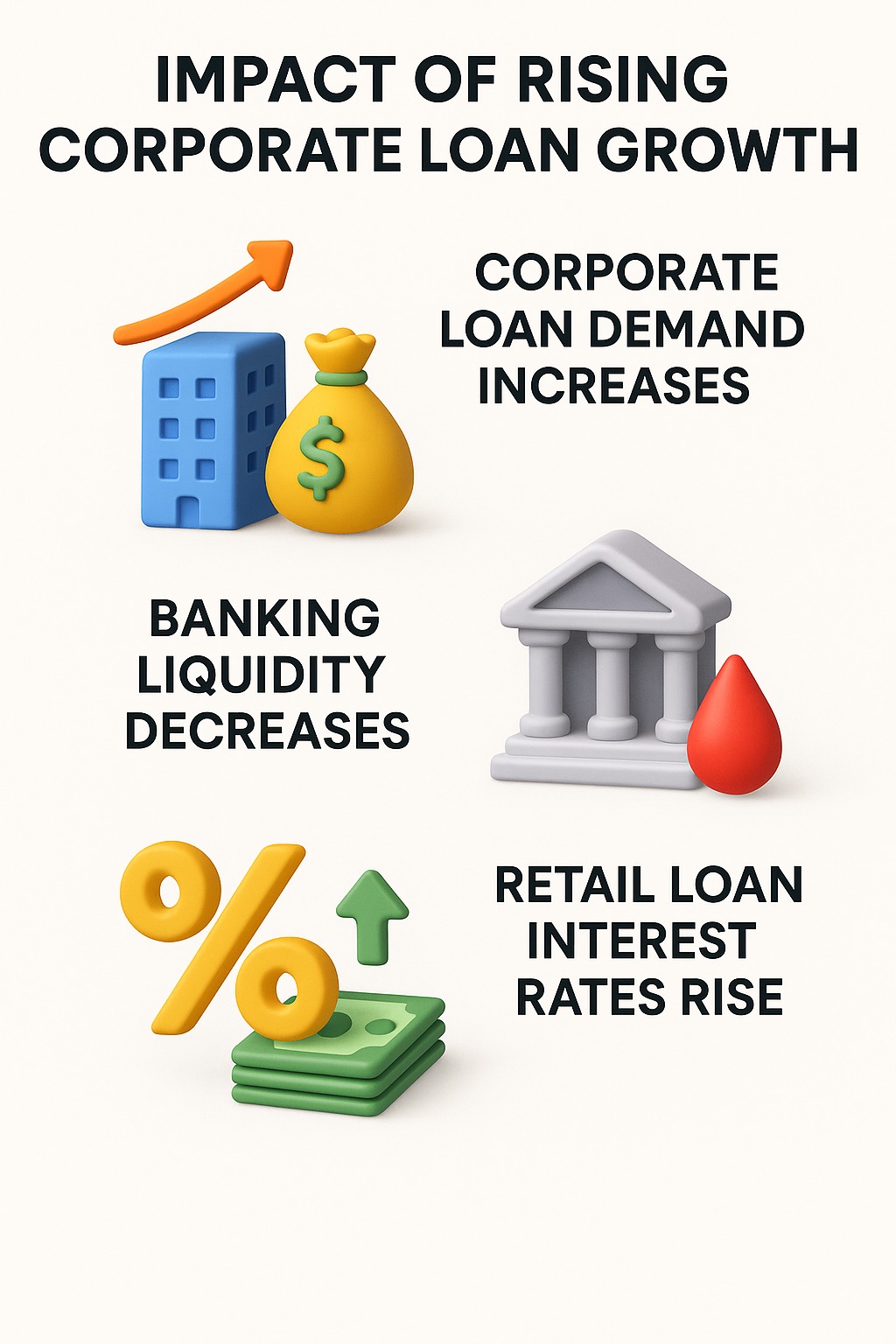
Corporate loan growth is rising sharply as businesses expand, borrow for capex, and rebuild inventories. This can reduce banking liquidity, push interest rates slightly higher, and slow down retail loan disbursals. Retail borrowers may face tighter loan approvals, slower rate cuts, and more selective lending in 2025–26.
Introduction
After several years of muted demand, corporate loan growth in India is accelerating again.
Large companies and MSMEs are:
Expanding capacity
Borrowing for new projects
Increasing working-capital utilization
Investing in infrastructure & capex
But what does this shift mean for home loan borrowers, personal loan seekers, credit card users, and banking liquidity?
The answer is crucial—because when corporate borrowing rises, the entire lending landscape changes.
Let’s understand it clearly and simply.
Why Corporate Loan Demand Is Rising in 2025–26
Multiple economic signals show strong corporate-credit revival:
✔ Capex cycle restarting
Manufacturing, power, infra & logistics companies are expanding.
✔ Higher working-capital needs
Due to inflation, raw-material cost rise & supply-chain spending.
✔ Export-driven sectors borrowing more
Textiles, pharma, chemicals, IT services.
✔ Government infrastructure push
Roads, railways, green energy = massive project financing.
✔ Lower NPAs encouraging banks to lend
Corporate NPAs hit multi-year lows.
This rising demand changes how banks allocate their limited liquidity.
What Happens to Banking Liquidity When Corporate Borrowing Rises?
Banks have finite resources.
When corporate clients start borrowing aggressively:
1. Bank liquidity tightens
More money flows toward corporate working-capital & term loans.
2. Cost of funds rises
Banks increase deposit rates to attract more funds.
3. Lending rates may rise
Lower liquidity → higher interest → costly loans.
4. Banks prioritise high-value corporate clients
Retail loans get relatively less focus.
Impact on Retail Borrowers (Most Important Part)
Here’s how rising corporate loan growth directly affects the common borrower.
1. Slower Home Loan Rate Cuts
Even if RBI cuts repo rates, banks may delay passing benefits because:
More liquidity is tied up in corporate loans
Deposit costs are rising
Banks want to maintain risk buffers
Result:
EMI reduction slows down.
2. Personal Loan & Credit Card Interest May Rise
Retail unsecured credit may see:
Higher risk weights (RBI-driven)
Higher cost due to liquidity pressure
Tighter approval norms
Banks may increase:
Personal loan interest
Credit card APR
Processing fees
3. Loan Approval Becomes Harder for Some Borrowers
Banks may tighten eligibility for:
Low-income borrowers
Self-employed
Gig workers
New-to-credit users
High utilization customers
Digital lenders/NBFCs may fill this gap.
4. MCLR and RLLR May Increase Slightly
As bank liquidity tightens:
MCLR goes up
Repo-linked lending rates get reset upward
Floating-rate home loan EMIs may rise
5. Banks Push More Cross-Selling to Retail Customers
To improve profitability, lenders may aggressively sell:
Insurance
Credit cards
High-fee loans
Balance transfer products
Which Retail Loans Are Most Affected?
| Loan Type | Impact | Reason |
|---|---|---|
| Home Loan (Floating) | ⭐⭐ Moderate | MCLR/RLLR increase likely |
| Personal Loan | ⭐⭐⭐ High | Liquidity pressure + risk weights |
| Credit Card | ⭐⭐⭐ High | Banks tighten risk norms |
| Auto Loan (Fixed) | ⭐ Low | Less impacted |
| Business Loan (Unsecured) | ⭐⭐⭐ High | Banks prioritise corporate clients |
| Education Loan | ⭐⭐ Medium | Depends on lender |
Expert Commentary
“Corporate credit growth is healthy for the economy, but it temporarily squeezes liquidity for retail lending. Expect selective retail credit growth and slower rate transmission in 2025–26.”
— Vivek Deshmukh, Senior Banking Economist
When Will Retail Borrowing Become Cheaper Again?
Retail borrowers will benefit when:
RBI adds liquidity
Bond yields fall
Corporate credit demand stabilizes
Banks secure more deposits
Inflation cools further
Until then, interest rates may remain slightly elevated.
What Should Retail Borrowers Do Right Now?
✔ 1. Lock floating home loan rates if RBI easing continues
This protects you from lender-side delays.
✔ 2. Avoid unnecessary personal loans
Rates may rise temporarily.
✔ 3. Maintain high credit score (>750)
Gets you the best offers even in tight liquidity cycles.
✔ 4. Compare offers across banks/NBFCs
Smaller lenders may offer cheaper rates.
✔ 5. Keep FOIR under 40%
Critical during tighter lending conditions.
✔ 6. Avoid multiple inquiries
Protects your CIBIL score.
Summary Box
Corporate loan growth rising sharply
Banking liquidity tightens as businesses borrow more
Retail loan rates may stabilize or rise
Home loan rate cuts may slow down
Personal loan & credit card rates may increase
Borrowers should maintain strong credit discipline
Vizzve Financial helps retail borrowers compare loan offers from banks & NBFCs, secure lower interest rates, and get fast approval even during tight liquidity cycles.
👉 Apply now at: www.vizzve.com
❓ FAQs
1. Why are corporate loans rising now?
Capex revival, infrastructure spending, and working-capital demand.
2. Will my home loan rate increase?
Possibly, if MCLR or RLLR rise.
3. Do personal loan EMIs rise when banks face liquidity issues?
Yes, unsecured loan rates rise first.
4. Should I switch lenders if rates rise?
Yes, through balance transfer options.
5. Why does corporate credit affect retail borrowers?
Both depend on the same banking liquidity pool.
Conclusion
Rising corporate loan growth is a positive signal for India’s economy—but it can create short-term liquidity pressure that affects the retail borrower’s EMI, loan approval, and interest rate trajectory.
Borrow smart, track RBI policy, and monitor lender-rate revisions closely.
Published on : 7th December
Published by : SMITA
www.vizzve.com || www.vizzveservices.com
Follow us on social media: Facebook || Linkedin || Instagram
🛡 Powered by Vizzve Financial
RBI-Registered Loan Partner | 10 Lakh+ Customers | ₹600 Cr+ Disbursed