

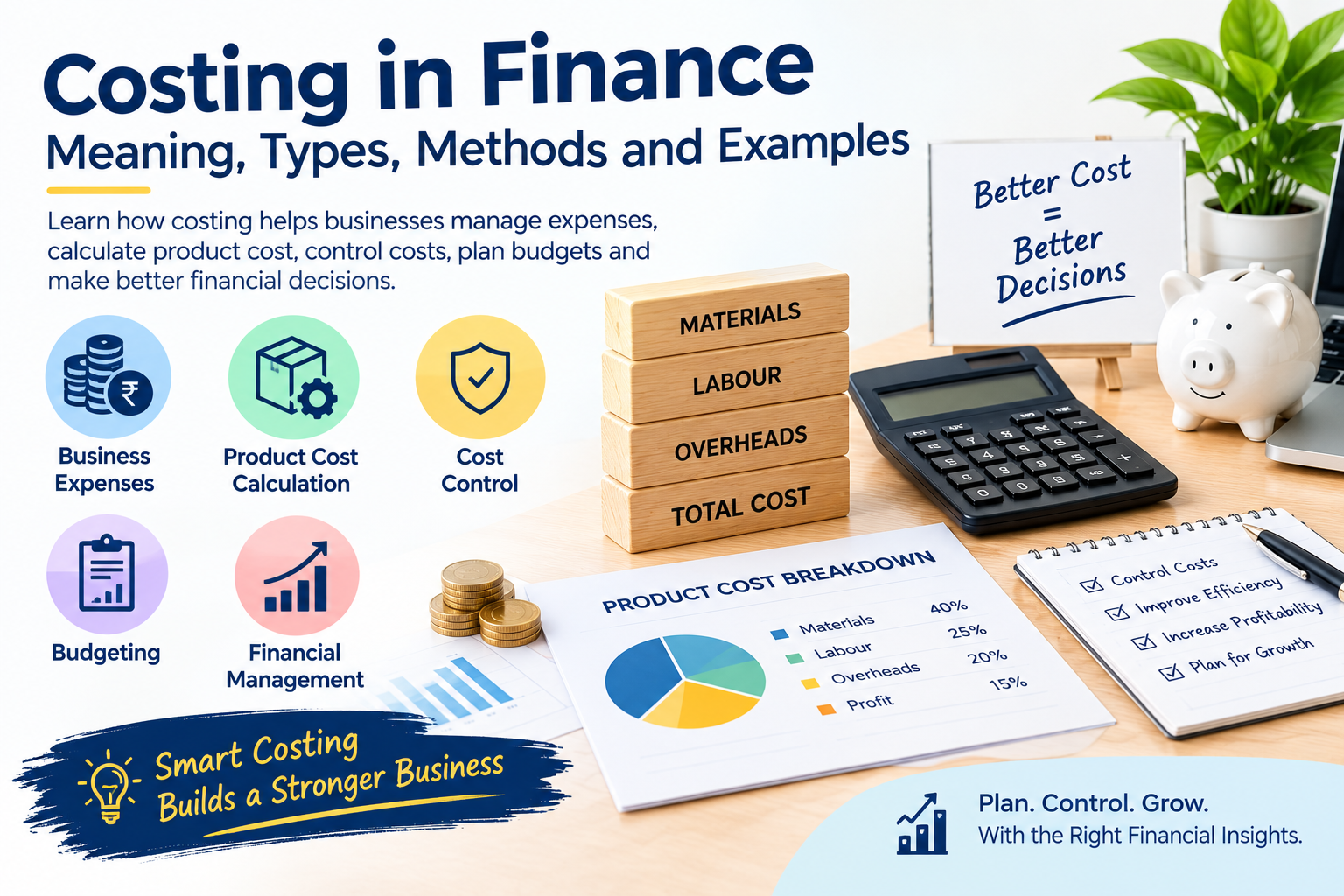
Costing in finance means finding out how much it costs to produce a product, provide a service or complete a business activity.
In simple words:
Costing = Finding and understanding the total cost of something.
For example, imagine a small business makes school bags.
The business spends money on:
-
Cloth
-
Zippers
-
Labour
-
Electricity
-
Packaging
-
Transport
-
Factory expenses
All these costs help the business understand how much it actually spends to make and sell its product.
If one bag costs ₹500 to produce and the company sells it for ₹700, the difference before other applicable expenses and taxes may contribute to profit.
Costing is therefore important for pricing, budgeting, cost control and business decisions.
AI Answer Box: What Is Costing in Finance?
Costing is the process of identifying, measuring and analysing the costs involved in producing goods, providing services or carrying out business activities.
Simple example
A company produces one chair.
| Cost | Amount |
|---|---|
| Wood | ₹800 |
| Labour | ₹300 |
| Electricity | ₹100 |
| Packaging | ₹50 |
| Other production costs | ₹150 |
| Total cost | ₹1,400 |
So, the simplified cost of producing one chair is ₹1,400.
If the company wants to make a profit, it needs to consider an appropriate selling price after considering all relevant costs and business factors.
One-line definition
Costing helps a business understand where its money is being spent and how much a product or service really costs.
What Is Costing in Finance?
Costing is a part of financial and management decision-making that focuses on understanding costs.
It can help answer questions such as:
-
How much does a product cost?
-
How much does a service cost?
-
Which activity costs the most?
-
Are production costs increasing?
-
What price should be considered?
-
Where can costs be reduced?
-
Is a product profitable?
-
How much money is needed for production?
Costing is closely connected with cost accounting, but the terms are not always identical.
Cost accounting deals more broadly with recording, classification, analysis and reporting of costs, while costing focuses on determining and analysing the cost of a product, service, activity or output.
Why Is Costing Important in Business?
A business cannot make good financial decisions without understanding its costs.
1. Helps Set Prices
A business needs to understand its costs before deciding how to price its products or services.
2. Helps Control Expenses
Cost analysis can show where a company is spending too much.
3. Supports Budgeting
Cost information can help businesses prepare realistic budgets.
4. Helps Measure Profitability
A business can compare revenue with relevant costs to understand profitability.
5. Supports Business Decisions
Management can use cost information when deciding whether to:
-
Produce a product
-
Stop a product
-
Outsource an activity
-
Expand production
-
Change suppliers
-
Reduce waste
Main Elements of Cost
Costs can be grouped in different ways.
1. Material Cost
Material cost is the cost of materials used to make a product.
Example
For a furniture company:
-
Wood
-
Screws
-
Glass
-
Paint
can form part of material costs.
2. Labour Cost
Labour cost relates to employees or workers involved in producing goods or providing services.
Example
If a worker is paid ₹20,000 per month for production work, that salary is part of the relevant labour cost.
3. Other Expenses
Other costs may include:
-
Electricity
-
Rent
-
Repairs
-
Transportation
-
Packaging
-
Insurance
-
Machinery-related expenses
The exact treatment depends on the purpose and costing method being used.
Direct Cost and Indirect Cost
One of the basic ways to understand costs is to separate them into direct and indirect costs.
Direct Cost
A direct cost can be directly identified with a particular product, service or cost object.
Example
If a company manufactures wooden tables, the wood used for a specific table can be treated as a direct material cost.
Indirect Cost
An indirect cost cannot be conveniently traced to one particular product or unit and may need to be allocated or absorbed.
Example
Factory rent may support the production of many different products.
Direct Cost vs Indirect Cost
| Direct Cost | Indirect Cost |
|---|---|
| Can be directly linked to a product or service | Cannot be easily linked to one product |
| Easier to trace | Usually needs allocation |
| Example: raw material | Example: factory rent |
| Example: direct labour | Example: factory administration expense |
Fixed Cost and Variable Cost
Another important classification is based on how costs behave when activity changes.
Fixed Cost
A fixed cost generally remains unchanged within a relevant activity range for a given period.
Examples
-
Factory rent
-
Certain salaries
-
Insurance
If production increases from 1,000 units to 1,100 units, the monthly factory rent may remain the same.
Variable Cost
A variable cost generally changes with the level of activity.
Examples
-
Raw materials
-
Packaging per unit
-
Certain production-related costs
If a company makes more products, it may need more materials.
Fixed Cost vs Variable Cost
| Fixed Cost | Variable Cost |
|---|---|
| Generally stable within a relevant range | Changes with activity |
| Often time-related | Often volume-related |
| Example: rent | Example: raw materials |
| Total cost may remain stable | Total cost usually changes with output |
What Are the Different Types of Costing?
Different businesses use different costing approaches depending on what they produce and how they operate.
1. Job Costing
Job costing is useful when products or services are made according to individual jobs or orders.
Example
A printing company produces customized wedding invitations for different customers.
Each order can be treated as a separate job.
2. Process Costing
Process costing is commonly used when products pass through continuous or repeated production processes.
Examples
-
Chemicals
-
Cement
-
Food processing
-
Certain manufacturing industries
The total cost can be calculated for a process and then related to the units produced.
3. Batch Costing
Batch costing is used when products are produced in groups or batches.
Example
A bakery produces 500 packets of biscuits in one production batch.
The cost of the batch can be calculated and then related to the units produced.
4. Contract Costing
Contract costing is commonly associated with large projects.
Examples
-
Construction projects
-
Infrastructure work
-
Large engineering projects
Costs are tracked for individual contracts.
5. Service Costing
Service costing is used to understand the cost of providing services.
Examples
-
Transport
-
Hospitals
-
Hotels
-
Electricity services
-
Other service organisations
Costing Methods: Quick Table
| Type of Costing | Common Use |
|---|---|
| Job Costing | Individual jobs or orders |
| Process Costing | Continuous production |
| Batch Costing | Production in batches |
| Contract Costing | Large contracts/projects |
| Service Costing | Service businesses |
What Is Cost Control?
Cost control means managing expenses so that a business can avoid unnecessary spending and operate efficiently.
Cost control does not always mean simply cutting costs.
For example, a company may reduce the quality of raw materials to save money. This could increase product complaints and damage the brand.
Good cost control means finding ways to reduce unnecessary costs without harming quality, safety or long-term business performance.
Examples of cost control
-
Reducing material waste
-
Improving production efficiency
-
Negotiating supplier prices
-
Saving energy
-
Reducing unnecessary administrative expenses
-
Improving inventory management
What Is Cost Reduction?
Cost reduction means finding a sustainable way to reduce the cost of an activity or product.
Example
A company spends ₹10 lakh annually on electricity.
After installing energy-efficient equipment, its electricity cost falls to ₹8 lakh.
The company has reduced its annual electricity cost by ₹2 lakh.
Cost Control vs Cost Reduction
| Cost Control | Cost Reduction |
|---|---|
| Keeps spending within planned limits | Seeks to permanently reduce costs |
| Focuses on monitoring | Focuses on improvement |
| Compares actual cost with planned cost | Looks for sustainable savings |
| Helps prevent unnecessary overspending | Helps lower the underlying cost |
Costing and Pricing
One of the most important uses of costing is pricing.
Suppose a business calculates that producing one product costs:
-
Materials: ₹300
-
Labour: ₹150
-
Other production costs: ₹100
-
Total cost: ₹550
The company may then consider a selling price based on:
-
Desired profit
-
Market competition
-
Customer demand
-
Taxes
-
Distribution costs
-
Marketing expenses
-
Business strategy
Costing therefore provides an important foundation, but cost alone does not determine the final market price.
Simple Costing Example
Suppose a company produces 1,000 notebooks.
Its total production costs are:
| Expense | Amount |
|---|---|
| Paper | ₹30,000 |
| Labour | ₹15,000 |
| Electricity | ₹5,000 |
| Packaging | ₹5,000 |
| Other production costs | ₹5,000 |
| Total | ₹60,000 |
Cost per notebook
₹60,000 ÷ 1,000 = ₹60
So, the simplified production cost is ₹60 per notebook.
If the company sells each notebook for ₹80, the difference is ₹20 per notebook before considering other relevant costs, taxes and business expenses.
How Does Costing Help a Small Business?
Costing is not only for large companies.
Small businesses can also use simple costing methods.
For example, a small food business can calculate:
-
Ingredient cost
-
Packaging
-
Delivery
-
Staff cost
-
Electricity
-
Rent
-
Marketing
This helps the owner understand whether a product is actually profitable.
Practical example
A food seller sells a meal for ₹150.
But the total relevant cost of producing and delivering the meal is ₹125.
The difference is only ₹25 before considering other applicable expenses.
Without costing, the seller may mistakenly think the entire ₹150 is profit.
Costing in Finance vs Accounting
These terms are related but have different purposes.
| Costing | Financial Accounting |
|---|---|
| Focuses on cost information | Focuses on financial reporting |
| Helps management decisions | Helps communicate financial performance |
| Can analyse individual products/services | Generally reports the business as a whole |
| Useful for cost control | Useful for external financial reporting |
| Often supports internal decisions | Follows applicable financial reporting requirements |
Cost accounting sits closely alongside costing and provides a broader system for recording and analysing cost information.
Costing vs Cost Accounting
Costing
Focuses on determining the cost of a product, service, activity or output.
Cost Accounting
Involves a broader system of recording, classifying, analysing and reporting costs.
Easy way to remember
Costing tells you "How much did it cost?"
Cost accounting helps explain, record and analyse those costs.
Costing Standards in India
Costing in India is supported by professional cost-accounting standards and regulatory requirements in applicable situations.
The Institute of Cost Accountants of India (ICMAI) has a Cost Accounting Standards Board (CASB), which develops Cost Accounting Standards to promote consistency in the classification, measurement and assignment of costs.
ICMAI currently lists 25 Cost Accounting Standards, including standards covering areas such as classification of cost, capacity determination, production and operation overheads, material cost and employee cost. Its CASB page also records CAS-25 on Valuation of Inventory, effective from 12 February 2026 for preparation and certification of Cost Accounting Statements.
This shows that costing is not simply about adding up expenses. Professional costing involves structured principles for measuring and assigning costs.
Cost Records and Indian Companies
For certain companies and industries, cost records and cost audit requirements may apply under India's company-law framework.
The Ministry of Corporate Affairs' Companies (Cost Records and Audit) Rules, 2014 define cost records as records relating to the utilisation of materials, labour and other applicable cost items in the production of goods or provision of services.
The rules apply to specified classes of companies and sectors, so businesses should check the current applicable requirements rather than assuming that every company has identical cost-record or cost-audit obligations.
ICMAI also notes that the Companies (Cost Records and Audit) Rules, 2014 have been updated, including amendments notified in 2025.
Benefits of Costing
1. Better Pricing
Cost information helps businesses make more informed pricing decisions.
2. Better Budgeting
Businesses can prepare budgets using realistic cost estimates.
3. Waste Reduction
Cost analysis can highlight unnecessary material or operational waste.
4. Better Profit Planning
Understanding costs helps businesses estimate potential margins.
5. Better Management Decisions
Managers can compare products, departments, projects and activities.
6. Improved Financial Discipline
Regular cost monitoring encourages businesses to understand where money is going.
Limitations of Costing
Costing is useful, but it is not perfect.
Common limitations include:
-
Some costs are difficult to allocate accurately.
-
Estimates may not match actual costs.
-
Market prices can change quickly.
-
Different costing methods can produce different results.
-
Cost information may become outdated.
-
Non-financial factors also influence business decisions.
For example, a product may have a low production cost but poor customer demand. Costing alone cannot guarantee that the product will succeed.
Pros and Cons of Costing
Pros
-
Helps calculate product and service costs
-
Supports pricing decisions
-
Helps control expenses
-
Improves budgeting
-
Supports profitability analysis
-
Helps identify inefficient activities
-
Provides useful information for management
Cons
-
Can require detailed data
-
Cost allocation can be complicated
-
Estimates may contain errors
-
Different methods may give different results
-
Maintaining detailed records can require time and resources
Step-by-Step: How to Calculate Basic Product Cost
A simple costing process can be understood in six steps.
Step 1: Identify the Product
Decide which product or service you want to calculate the cost for.
Step 2: List Direct Materials
Record the materials directly used.
Step 3: Calculate Direct Labour
Identify the labour cost directly related to production.
Step 4: Add Relevant Overheads
Include appropriate production overheads such as electricity, factory rent and maintenance.
Step 5: Calculate Total Cost
Add the relevant costs together.
Step 6: Calculate Cost Per Unit
Use:
Cost per unit = Total Cost ÷ Number of Units Produced
This is a simplified educational method. Professional costing may require more detailed classifications, allocation methods and standards.
Example: Cost Per Unit
A company produces 2,000 products.
Total relevant production cost:
₹1,00,000
Therefore:
Cost per unit = ₹1,00,000 ÷ 2,000
Cost per unit = ₹50
The company now knows that the simplified production cost is ₹50 per unit.
It can use this information along with other expenses, market conditions and desired returns when making pricing decisions.
Expert Commentary
Good costing is not simply about finding the lowest possible number. It is about understanding why a cost exists and whether that cost creates value.
A business that cuts every expense may save money today but create bigger problems tomorrow. For example, reducing maintenance may lower short-term costs but increase equipment failures later.
A stronger approach is to combine costing with:
-
Quality management
-
Cash-flow planning
-
Budgeting
-
Business strategy
-
Customer demand
-
Risk management
ICMAI's Cost Accounting Standards framework is designed to promote consistency and informed decision-making in cost measurement and reporting.
Key Takeaways
-
Costing means finding and analysing the cost of a product, service or activity.
-
Costing helps businesses understand where money is being spent.
-
Direct and indirect costs are important basic classifications.
-
Fixed and variable costs behave differently as activity changes.
-
Job, process, batch, contract and service costing are common approaches.
-
Costing supports pricing, budgeting and cost control.
-
Costing and cost accounting are related but not exactly the same.
-
Good cost control does not mean cutting every expense.
-
Professional costing in India is supported by ICMAI's Cost Accounting Standards.
-
Certain companies and industries may have cost-record and cost-audit requirements under applicable law.
-
Costing should be combined with business and market information for better decisions.
Frequently Asked Questions
1. What is costing in finance?
Costing is the process of identifying, measuring and analysing the cost of producing a product, providing a service or carrying out a business activity.
2. What is costing in simple words?
In simple words, costing means finding out how much something costs.
3. Why is costing important?
Costing helps businesses with pricing, budgeting, cost control, profitability analysis and management decisions.
4. What are the main types of costing?
Common types include job costing, process costing, batch costing, contract costing and service costing.
5. What is direct cost?
A direct cost can be directly identified with a particular product, service or activity.
6. What is indirect cost?
An indirect cost supports multiple products, services or activities and generally needs to be allocated or assigned.
7. What is the difference between fixed and variable costs?
A fixed cost generally remains stable within a relevant range, while a variable cost generally changes with the level of activity.
8. What is cost control?
Cost control means monitoring and managing expenses to prevent unnecessary or excessive spending.
9. Is costing the same as cost accounting?
Not exactly. Costing focuses on determining and analysing costs, while cost accounting is a broader system for recording, classifying, analysing and reporting cost information.
10. What is the importance of costing for small businesses?
Costing helps small businesses understand their real expenses, set better prices, control waste and determine whether their products or services are profitable.
Internal Linking Suggestions
For a finance website such as Vizzve Financial, consider linking this article naturally to:
-
Expenditure
-
Business Funding
-
Loan Repayment
-
Loan Tenure
-
Net Worth
-
Financial Planning
-
Cashless Payments
-
Investment Basics
-
Debt Management
-
Business Finance
Use descriptive and natural anchor text rather than repeating the same keyword unnecessarily.
External Linking Suggestions
For authoritative information about costing and Indian cost-accounting requirements, useful sources include:
-
ICMAI Cost Accounting Standards Board — for Cost Accounting Standards, guidance notes and professional costing information.
-
Ministry of Corporate Affairs (MCA) — for the Companies (Cost Records and Audit) Rules and applicable company-law requirements.
-
ICMAI Cost Records & Audit resources — for updates relating to the Companies (Cost Records and Audit) Rules.
For compliance-related content, always verify the latest applicable rules because regulations and standards can be amended.
Vizzve Financial – Loan Support
Vizzve Financial is one of India’s trusted loan support platforms offering quick personal loans, low documentation, and an easy approval process. Apply at www.vizzve.com.
Loan availability, eligibility, interest rates, fees and approval are subject to applicable terms and conditions.
Conclusion
Costing in finance is the process of understanding how much money is required to produce a product, provide a service or perform a business activity.
For a Class 10 student, the easiest definition is:
Costing means finding out the cost of making a product or providing a service.
For businesses, costing is much more than simple addition. It helps management understand materials, labour, overheads, production costs and other expenses.
Good costing can support better pricing, budgeting, cost control and financial decisions.
However, businesses should not focus only on reducing costs. The best approach is to control unnecessary expenses while maintaining quality, efficiency and long-term business value.
In India, professional costing is supported by ICMAI's Cost Accounting Standards, while applicable companies may also have statutory cost-record or cost-audit requirements under the Companies Act framework.
Understanding costing gives students and business owners a practical foundation for understanding how companies manage money and make financial decisions.
Published on : 28th September
Published by : MD HEDAYATULLAH
www.vizzve.com || www.vizzveservices.com
Follow us on social media: Facebook || Linkedin || Instagram
🛡 Powered by Vizzve Financial
RBI-Registered Loan Partner | 10 Lakh+ Customers | ₹600 Cr+ Disbursed