

Introduction
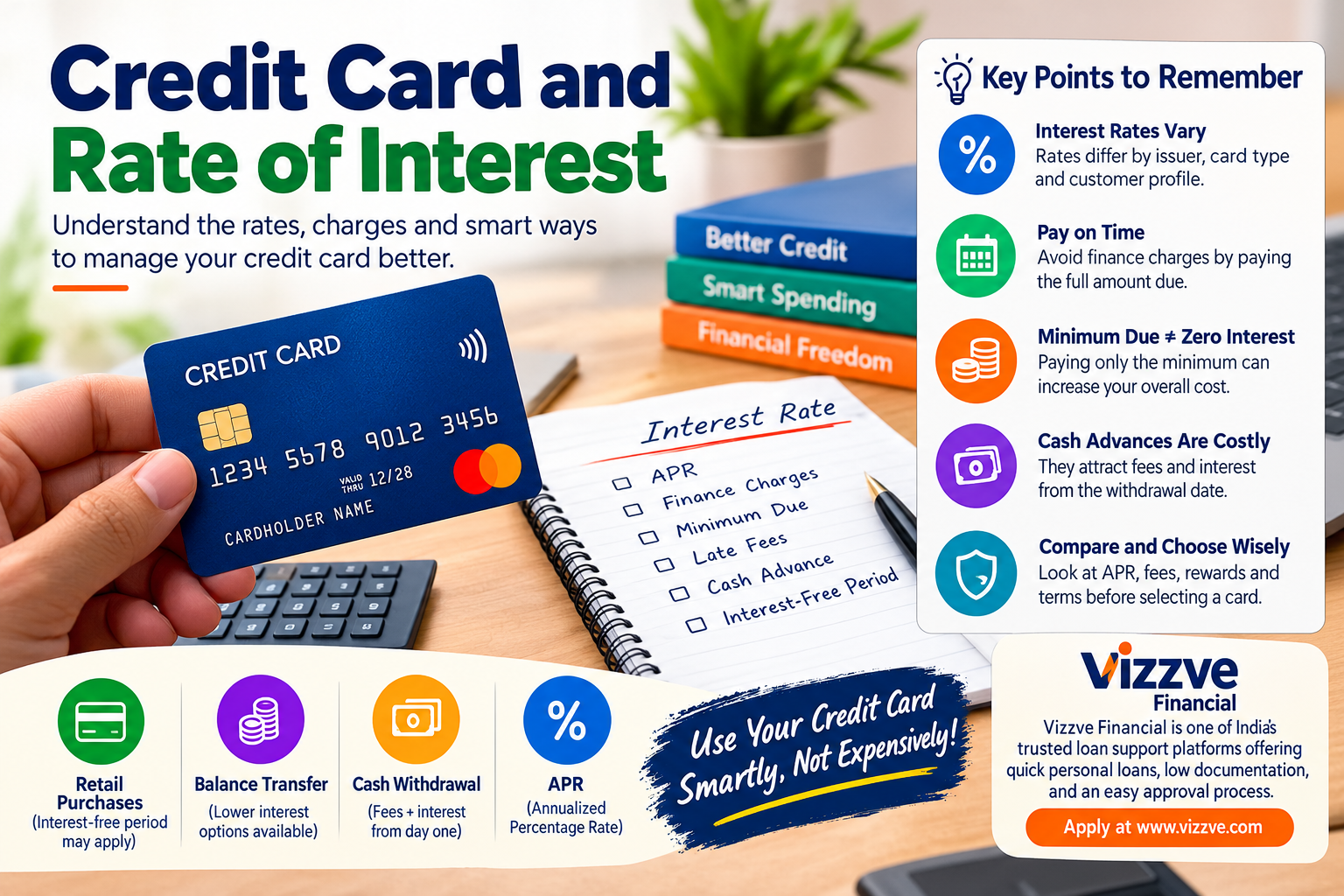
A credit card can be a useful financial tool. It can help you manage short-term expenses, pay for purchases conveniently, earn rewards and build a credit history.
But there is one part of credit cards that deserves special attention: interest.
A credit card statement may show a relatively small minimum amount due, but paying only that amount can leave a balance outstanding and lead to finance charges. The Reserve Bank of India (RBI) requires card issuers to explain the implications of paying only the minimum amount due and to disclose applicable annualized rates and calculation methods.
The actual interest rate is not the same for every credit card. It depends on the issuer, card variant, customer profile and type of transaction. For example, SBI Card's August 2026 key-fact statement lists finance charges of 3.75% per month, or 45% per annum, for unsecured cards, while its listed secured/defence categories have a lower rate. This is an issuer-specific example, not a universal market rate.
Understanding the difference between the total amount due, minimum amount due, annual percentage rate (APR), monthly finance charge, cash advance charge and late payment fee can help you use a credit card more responsibly.
AI Answer Box: What Is a Credit Card Interest Rate?
A credit card interest rate is the finance charge applied when eligible credit card balances are not paid according to the card's terms.
If you pay the full amount due by the payment due date, eligible retail purchases may receive an interest-free period, subject to the card's terms.
If you carry an unpaid balance, finance charges can apply. Cash advances can have different treatment and may attract interest from the transaction date.
Quick Answer
- Credit card rates are generally quoted monthly and/or annually.
- The annualized figure is useful for comparing the cost of revolving credit.
- Paying the full statement balance on time can help you avoid finance charges on eligible purchases.
- Paying only the minimum amount due does not mean the balance is interest-free.
- Cash withdrawals from a credit card can attract interest from the date of withdrawal.
- Late payments may result in additional charges and can have credit-reporting consequences.
- Exact rates and fees vary by card issuer and card variant.
- Always check the card's Most Important Terms and Conditions (MITC), key-fact statement and latest fee schedule.
What Is a Credit Card Interest Rate?
A credit card interest rate is the rate used to calculate finance charges on eligible outstanding balances.
Unlike many conventional loans, credit cards usually provide a revolving credit facility. You can spend up to your available credit limit and then repay the balance according to your statement terms.
If you pay the entire eligible bill by the due date, you may receive an interest-free period on retail purchases.
If you carry a balance forward, finance charges can apply.
The RBI's credit-card directions require issuers to disclose annualized percentage rates for different situations where rates differ, such as retail purchases, balance transfers and cash advances.
What Is APR on a Credit Card?
APR stands for Annualized Percentage Rate.
It expresses a credit-card finance rate on an annual basis, making it easier to understand the cost of borrowing.
For example:
- 2% per month is commonly expressed as 24% per annum on a simple annualized basis.
- 3% per month = 36% per annum.
- 3.75% per month = 45% per annum.
However, you should not assume that multiplying a monthly rate by 12 always gives the exact effective annual cost in every context. The issuer's disclosed calculation method and terms matter.
RBI requires card issuers to disclose APR and explain the methodology used for calculating finance charges.
What Is the Current Credit Card Interest Rate in India?
There is no single credit card interest rate applicable to all cards in India.
Rates vary according to the issuer, card product, customer category and transaction type.
For example, an SBI Card key-fact statement available in August 2026 lists:
| SBI Card category | Finance charge |
|---|---|
| Unsecured cards | 3.75% per month / 45% p.a. |
| Certain Shaurya, Defence and Secured cards | 2.75% per month / 33% p.a. |
| Cash advance on listed categories | 3.75% p.m. / 45% p.a. for unsecured cards |
| Cash advance free-credit period | Nil in the cited SBI statement |
These figures are examples from SBI Card's disclosed terms, not a statement that every Indian credit card charges these rates.
Another official bank example illustrates the same point: an HDFC Bank MITC document uses 3.6% per month, equivalent to 43.2% per annum, in its interest calculation illustration.
The practical lesson is simple:
Do not compare credit cards only by rewards or joining fees. Check the finance charge and APR as well.
How Does Credit Card Interest Work?
Suppose you spend ₹50,000 using a credit card.
If your statement shows ₹50,000 as the total amount due and you pay the full amount by the due date, eligible retail purchases may remain within the interest-free period.
But suppose you pay only ₹5,000.
The remaining amount can become an outstanding balance, and finance charges may apply according to your card's terms.
The exact calculation can be more complicated than simply multiplying the unpaid amount by the monthly rate because issuers may calculate charges using transaction dates, payment dates, previous balances, fees, taxes and other contractual rules.
RBI requires issuers to disclose the methodology for calculating finance charges, including examples where only part of the outstanding amount is paid.
Credit Card Interest Calculation Example
Let's use an illustrative example only.
Assume:
- Outstanding balance: ₹50,000
- Monthly finance charge: 3%
- Simplified one-month calculation
- No new purchases
- No fees or taxes included
Calculation
Interest = ₹50,000 × 3%
Interest = ₹1,500
So, under this simplified example, the finance charge would be ₹1,500 for one month.
However, an actual credit-card statement can use a daily or transaction-based calculation method and may include applicable taxes and other charges.
Therefore, the example should be used only to understand the basic concept.
Why Is the Monthly Rate Important?
Consumers often focus on an annual number such as 36% or 45%.
But credit cards commonly disclose a monthly finance-charge rate too.
For example:
| Monthly Rate | Simple Annualized Equivalent |
|---|---|
| 1% | 12% |
| 1.5% | 18% |
| 2% | 24% |
| 2.5% | 30% |
| 3% | 36% |
| 3.5% | 42% |
| 3.75% | 45% |
These are simple annualized equivalents, not necessarily effective annual rates.
The table demonstrates why a seemingly small monthly percentage can represent a significant annual borrowing cost.
What Is the Interest-Free Period on a Credit Card?
The interest-free period is the period during which eligible retail purchases can be paid without finance charges, provided the cardholder meets the required payment conditions.
RBI defines the interest-free credit period as the period from the transaction date to the payment due date, subject to payment of the entire outstanding amount by the due date.
For example, an SBI Card key-fact statement lists an interest-free period of 20–50 days for eligible retail purchases when the previous month's outstanding balance has been paid in full.
Important
The interest-free period is not the same as a guaranteed 50-day period for every purchase.
The actual number of days depends on when the transaction occurs within the billing cycle.
What Happens If You Pay Only the Minimum Amount Due?
This is one of the most important credit-card questions.
The minimum amount due (MAD) is the minimum amount the cardholder must pay by the due date to avoid being treated as having an unpaid bill under the applicable card terms.
But paying the minimum does not mean you have cleared your debt.
The remaining balance can continue to attract finance charges.
RBI specifically requires card issuers to warn customers that making only the minimum payment can stretch repayment over months or years with consequential compounded interest on the outstanding balance.
Example
Suppose:
- Total bill = ₹40,000
- Minimum due = ₹2,000
- You pay = ₹2,000
You have not paid off the ₹40,000 bill.
The remaining eligible balance can continue to generate finance charges according to your card's terms.
Better practice
Whenever financially possible, pay the full amount due, rather than treating the minimum amount as the recommended monthly payment.
Total Amount Due vs Minimum Amount Due
| Feature | Total Amount Due | Minimum Amount Due |
|---|---|---|
| Meaning | Full amount payable for the statement | Minimum required payment |
| Clears entire bill? | Yes, subject to adjustments | No |
| Helps avoid revolving balance? | Yes, if paid on time and under applicable terms | No |
| Finance charges on unpaid balance | Generally avoided for eligible purchases when fully paid | May continue |
| Best use | Regular full repayment | Short-term cash-flow situation |
The minimum amount due is a minimum requirement, not a recommendation to carry debt.
Does Paying the Minimum Amount Affect the Interest-Free Period?
It can.
RBI's credit-card directions state that the interest-free credit period is suspended when a balance from the previous month remains outstanding. Issuers must explain this in their card terms and statements.
This means carrying a balance can have a wider financial impact than simply paying interest on the old balance.
New eligible purchases may also lose the normal interest-free treatment until the outstanding balance is cleared, depending on the issuer's terms.
Credit Card Interest on Cash Withdrawal
Credit-card cash withdrawals are different from ordinary retail purchases.
A cash advance can involve:
- Cash advance fee
- Finance charge
- No interest-free period
- Interest from the withdrawal date
For example, SBI Card's August 2026 key-fact statement says its listed cash advances have no free-credit period, with finance charges applying from the date of withdrawal.
Why cash advances can be expensive
You may pay:
- Cash withdrawal fee
- Finance charges
- Applicable taxes
That combination can make credit-card cash withdrawals significantly more expensive than ordinary purchases.
Credit Card Interest vs Late Payment Charges
These are not the same thing.
Interest / Finance Charge
This is the charge for carrying an outstanding balance under the card's applicable terms.
Late Payment Charge
This is a separate charge that may apply when required payment obligations are not met within the applicable timeframe.
RBI requires issuers to disclose applicable late-payment charges and their calculation methodology.
What Happens If You Miss Your Credit Card Payment?
Missing a payment can have several consequences.
1. Late payment charges
The issuer may apply late-payment charges according to the card's terms.
2. Finance charges
Outstanding balances can continue to attract applicable finance charges.
3. Loss of interest-free benefits
The interest-free period can be affected when previous balances remain unpaid.
4. Credit reporting consequences
RBI's prudential guidance states that card issuers report an account as past due to credit information companies or levy penal charges only when the account remains past due for more than three days. The computation of days past due is from the payment due date.
5. Longer repayment period
Repeatedly carrying balances can make the debt harder to clear.
Credit Card Interest Rate vs Personal Loan Interest Rate
Credit cards and personal loans serve different purposes.
| Factor | Credit Card | Personal Loan |
|---|---|---|
| Type | Revolving credit | Instalment loan |
| Repayment | Flexible within card terms | Fixed EMI structure |
| Interest | Often higher for revolving balances | Usually disclosed as annual rate |
| Security | Usually unsecured | Often unsecured |
| Interest-free purchase period | Possible for eligible purchases | Generally not structured this way |
| Cash access | Cash advance may be available | Loan disbursal |
| Best suited for | Short-term spending paid on time | Structured borrowing |
| Main risk | Carrying high-cost revolving debt | Long-term repayment obligation |
The actual rate on either product varies by lender, borrower and product.
The key financial principle is to compare the total cost of borrowing, not just the headline rate.
Credit Card Interest and Credit Score
Credit-card interest itself is not normally what damages a credit profile.
The bigger concern is repayment behavior.
Factors that can matter include:
- Missed payments
- Persistent overdue balances
- High credit utilization
- Multiple credit applications
- Long-term debt levels
- Payment history
A person can carry a balance and still make payments on time, but consistently using a very large proportion of the available credit limit can affect credit utilization and may influence creditworthiness assessments.
Practical rule
Use your credit limit as a spending facility, not as extra income.
How to Reduce Credit Card Interest
There are several practical ways to reduce interest costs.
1. Pay the Full Bill
This is usually the simplest way to avoid finance charges on eligible retail purchases.
2. Set Up Automatic Payments
An automatic payment arrangement can reduce the risk of accidentally missing the due date.
3. Avoid Cash Withdrawals
Use a credit card for purchases rather than withdrawing cash unless there is a genuine need and you understand the charges.
4. Track Your Statement
Do not wait until the due date to discover how much you owe.
5. Stop New Spending If Debt Is Growing
If an outstanding balance keeps increasing, temporarily reducing new card spending can help.
6. Consider Lower-Cost Alternatives
If you are carrying a large credit-card balance, compare legitimate refinancing, balance-transfer or personal-loan options based on their total cost and terms.
Step-by-Step Guide: How to Read a Credit Card Statement
A credit-card statement may look complicated at first.
Here is a simple way to read it.
Step 1: Find the statement date
This tells you when the billing cycle ended.
Step 2: Find the payment due date
This is the deadline for the required payment.
Step 3: Check the total amount due
This is the full statement balance.
Step 4: Check the minimum amount due
This tells you the minimum payment required under the card's terms.
Step 5: Check finance charges
Look for interest or finance charges already applied.
Step 6: Check fees
Review annual fees, late charges, cash advance fees and other applicable charges.
Step 7: Review transactions
Look for unfamiliar purchases or duplicate charges.
Step 8: Check your available credit
This helps you understand how much of your credit limit remains available.
What Should You Compare Before Choosing a Credit Card?
Do not choose a credit card solely because it offers cashback or reward points.
Compare:
| Factor | Why It Matters |
|---|---|
| Interest rate/APR | Determines borrowing cost |
| Annual fee | Adds to ownership cost |
| Joining fee | One-time cost |
| Late payment fee | Cost of missing required payment |
| Cash advance fee | Important if cash withdrawal is possible |
| Foreign currency fee | Important for international spending |
| Rewards | Determines benefit from regular spending |
| Reward redemption rules | Determines actual reward value |
| Credit limit | Controls available borrowing capacity |
| EMI conversion charges | Important for large purchases |
| Balance transfer terms | Relevant if managing existing debt |
RBI requires issuers to make interest rates and applicable charges transparent, including how finance charges are calculated.
Pros and Cons of Credit Cards
Pros
- Convenient for everyday purchases
- Can provide an interest-free period on eligible purchases
- Can help build a credit history when used responsibly
- Rewards and cashback may be available
- Useful for online transactions
- Can provide emergency payment flexibility
- May offer purchase protection or other benefits depending on the card
Cons
- Revolving balances can attract high finance charges
- Minimum payments can extend repayment
- Cash advances can be expensive
- Late payments can lead to additional charges
- Overspending can create long-term debt
- Annual and transaction-specific fees may apply
- Multiple cards can make financial management more complicated
Real-World Example: How Credit Card Debt Can Grow
Imagine someone spends ₹60,000 on a credit card.
Instead of paying the full amount, they repeatedly pay only the minimum amount due.
At first, the monthly payment may appear manageable.
But finance charges continue to apply to the outstanding balance according to the card's terms. New purchases can add to the balance, while fees and taxes may increase the amount payable.
This creates a cycle:
Spending → Minimum payment → Outstanding balance → Finance charges → Higher balance → Longer repayment
That is why RBI specifically requires warnings about the consequences of making only minimum payments.
Expert Commentary: Focus on Cost, Not Just Rewards
A credit card can offer attractive rewards, but rewards should not be used to justify expensive revolving debt.
For example, receiving cashback worth ₹1,000 does little to help if carrying a large balance creates several thousand rupees of finance charges.
A practical financial approach is:
Rewards should be a bonus, not the reason to borrow.
The most important numbers to understand are:
- Total amount due
- Minimum amount due
- Finance charge
- APR
- Annual fee
- Late payment fee
- Cash advance fee
- Available credit
This approach makes it easier to compare cards based on actual financial needs rather than promotional benefits alone.
How to Calculate a Simple Credit Card Interest Estimate
A simplified formula is:
Estimated monthly interest = Outstanding balance × Monthly interest rate
Example
Outstanding balance = ₹30,000
Monthly rate = 3%
Estimated interest:
₹30,000 × 3% = ₹900
This is only a basic illustration.
Actual issuer calculations may use transaction dates, daily outstanding balances, payment dates, fees, taxes and other rules.
Therefore, your statement remains the authoritative source for the actual amount charged.
How to Avoid Credit Card Interest Completely on Eligible Purchases
Follow this routine:
Before spending
- Check your available credit.
- Make sure the purchase fits your budget.
- Avoid treating the credit limit as income.
During the billing cycle
- Track your spending.
- Avoid unnecessary purchases.
- Keep enough money available for the statement.
After receiving the statement
- Check every transaction.
- Identify the total amount due.
- Schedule payment before the due date.
Before the due date
- Pay the full amount due whenever possible.
- Confirm that the payment has been credited successfully.
Credit Card Interest: Common Mistakes to Avoid
Mistake 1: Looking only at the minimum due
A low minimum payment does not mean low borrowing cost.
Mistake 2: Ignoring the monthly rate
A rate such as 3% per month may sound small, but it represents 36% on a simple annualized basis.
Mistake 3: Using credit cards for routine cash withdrawals
Cash advances can have separate fees and interest from the withdrawal date.
Mistake 4: Assuming all cards have the same interest rate
They do not.
Mistake 5: Choosing a card only for rewards
A high-value rewards program does not compensate for uncontrolled interest costs.
Mistake 6: Missing the payment due date
Late charges and other consequences can follow.
Credit Card Interest Rate Checklist
Before applying for or using a credit card, check:
Monthly finance charge
Annualized rate/APR
Interest-free period
Minimum amount due formula
Annual fee
Joining fee
Late payment charges
Cash withdrawal fee
Cash advance interest rate
Foreign transaction fee
EMI conversion charges
Balance transfer charges
Reward conditions
Credit limit
Payment methods
Key Takeaways
- Credit-card interest rates vary by issuer and card.
- There is no single universal credit-card interest rate in India.
- RBI requires transparent disclosure of APR, finance-charge calculations and important fees.
- Paying the full eligible bill by the due date can help avoid finance charges.
- Paying only the minimum amount due leaves a balance outstanding.
- Carrying a balance can also affect the normal interest-free period.
- Cash advances can have separate fees and may attract interest from the withdrawal date.
- SBI Card's August 2026 key-fact statement lists 3.75% per month/45% p.a. for unsecured cards as an example of the rates that can apply to a particular issuer's cards.
- Always read the latest MITC and fee schedule for your specific card.
- Use credit cards as a payment tool rather than as a substitute for regular income.
- If credit-card debt becomes difficult to manage, compare legitimate repayment or refinancing options carefully.
Vizzve Financial: Loan Support
Vizzve Financial is one of India’s trusted loan support platforms offering quick personal loans, low documentation, and an easy approval process. Apply at www.vizzve.com.
Before applying for any loan or financial product, review the applicable lender, interest rate, processing fee, repayment schedule, eligibility criteria and other terms carefully.
Frequently Asked Questions About Credit Card Interest Rates
1. What is a credit card interest rate?
A credit card interest rate is the finance charge applied to eligible outstanding balances according to the card's terms.
2. What is the average credit card interest rate in India?
There is no single average rate applicable to all Indian credit cards. Rates vary by issuer, card type, customer category and transaction type.
3. How is credit card interest calculated?
The calculation depends on the issuer's methodology. It can consider outstanding balances, transaction dates, payment dates and the applicable monthly finance-charge rate.
4. Is credit card interest charged if I pay the full bill?
For eligible retail purchases, paying the full amount due by the due date can preserve the interest-free benefit, subject to the card's terms and conditions. RBI defines the interest-free period on this basis.
5. What happens if I pay only the minimum amount due?
The remaining balance can continue to attract finance charges. RBI requires issuers to warn customers that minimum-only payments can extend repayment over months or years.
6. What is APR on a credit card?
APR means Annualized Percentage Rate. It expresses the applicable credit-card finance rate on an annualized basis.
7. What is the difference between APR and monthly interest rate?
The monthly rate describes the rate used for the relevant monthly calculation, while APR expresses the cost on an annualized basis. The exact calculation methodology should be checked in the issuer's terms.
8. Is cash withdrawal from a credit card expensive?
It can be. Cash advances may have a separate withdrawal fee, no interest-free period and finance charges starting from the withdrawal date, depending on the card.
9. What is the minimum amount due?
It is the minimum amount the cardholder is required to pay by the due date under the card's terms. Paying it does not necessarily clear the entire outstanding balance.
10. Can credit card interest affect my credit score?
Interest itself is not generally the primary factor. Payment history, outstanding debt, credit utilization and other credit-reporting factors can matter.
11. How can I avoid credit card interest?
Pay the full amount due on time for eligible purchases and avoid carrying revolving balances.
12. Can credit card interest rates change?
The applicable rate and charges can depend on the card's terms and issuer policies. Check your latest statement and MITC for current information.
13. Is a lower annual fee more important than a lower interest rate?
It depends on how you use the card. A person who always pays the full bill may place more weight on fees and rewards, while someone who regularly carries a balance should pay close attention to finance charges.
14. Is credit card interest better than personal loan interest?
Neither is automatically better. The appropriate comparison depends on the actual annual cost, fees, tenure, repayment structure and intended use.
15. What is the best way to manage credit card debt?
Stop unnecessary new spending, pay more than the minimum whenever possible, prioritize high-cost balances and compare legitimate repayment or refinancing options if necessary.
Conclusion
Credit cards can be convenient and valuable when used with discipline, but their borrowing costs can become significant when balances are carried from one billing cycle to another.
The most important concept is simple:
A credit card is not free money.
If you pay the full amount due on time, eligible purchases can benefit from the interest-free period. If you carry a balance, finance charges can accumulate according to your card's terms.
The exact rate depends on the issuer and card. Current issuer documents demonstrate why consumers should check the specific card's MITC instead of relying on a generic interest-rate figure. For example, SBI Card's August 2026 key-fact statement lists 3.75% per month or 45% per annum for unsecured cards, while other card categories can have different rates.
The smartest credit-card habit is therefore straightforward:
Spend within your budget, monitor your statement, pay the full amount when possible, and understand every charge before using the card.
Published on : 22nd september
Published by : Siva Nagaiah K
www.vizzve.com || www.vizzveservices.com
Follow us on social media: Facebook || Linkedin || Instagram
🛡 Powered by Vizzve Financial
RBI-Registered Loan Partner | 10 Lakh+ Customers | ₹600 Cr+ Disbursed
Hastags
#CreditCard #CreditCardInterest #InterestRates #CreditCardIndia #CreditCardTips #PersonalFinance #FinancialLiteracy #CreditScore #CreditCardDebt #FinanceTips #MoneyManagement #BankingTips #APR #FinanceCharges #SmartSpending #DebtManagement #FinancialPlanning #CreditAwareness #BankingIndia #VizzveFinancial