

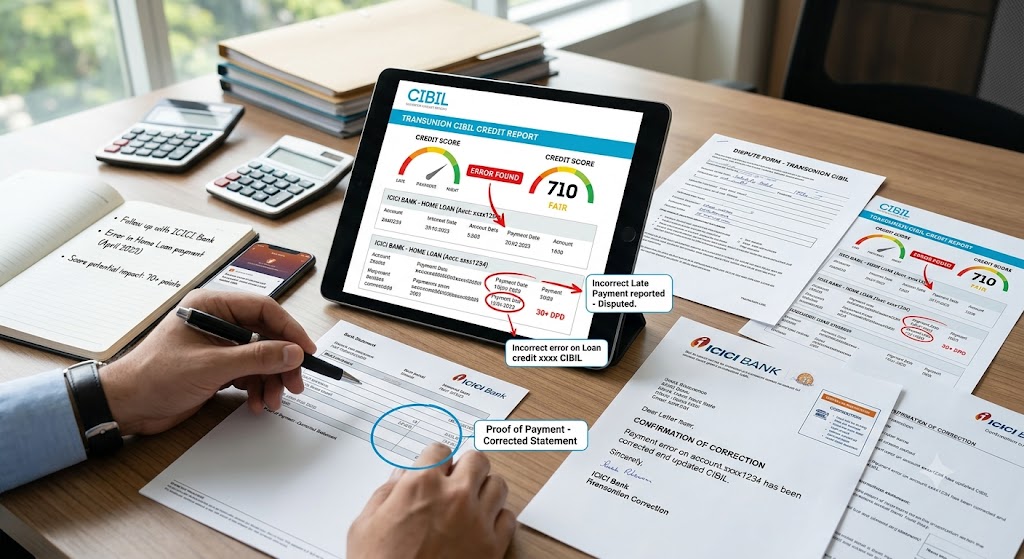
Your credit report plays an important role in your financial life. Banks and financial institutions may review it when you apply for a personal loan, credit card, or other credit facility. However, sometimes a credit report may contain incorrect information, such as an inaccurate loan balance, a payment marked as overdue, or a loan account you do not recognize.
These errors can affect how lenders evaluate your creditworthiness. Understanding how to identify and correct credit report errors can help you maintain an accurate credit profile and avoid unnecessary complications during loan approval.
In this guide, Vizzve explains common credit report errors, how to identify them, and the steps you can take to request corrections.
What Are Credit Report Errors?
Credit report errors are inaccuracies in the information recorded by a credit bureau. In India, credit information companies such as TransUnion CIBIL, Experian, Equifax, and CRIF High Mark maintain credit records using information supplied by lenders and other authorized sources.
Errors may occur because of reporting delays, data-entry mistakes, incorrect account updates, or identity-related issues.
For example, you may have repaid a personal loan in full, but your credit report still shows an outstanding balance. In another situation, an EMI paid on time may incorrectly appear as overdue.
Reviewing your credit report regularly can help you identify these issues early.
Common Types of Credit Report Errors
Here are some common inaccuracies borrowers should watch for.
1. Incorrect Personal Information
Your credit report may contain an incorrect name, address, date of birth, or other identifying information.
What to do: Compare your report with your official records and request a correction if any information is inaccurate.
2. Wrong Loan Account Details
Sometimes, a report may show a loan account that you do not recognize or display an incorrect loan amount.
What to do: Contact the lender associated with the account. If you believe the account is fraudulent, report it promptly and ask the lender to investigate.
3. Incorrect Payment History
A payment you made on time may appear as late or overdue because of a reporting or processing error.
What to do: Collect relevant bank statements, EMI receipts, or payment confirmations and submit a dispute to the credit bureau and lender.
4. Closed Loans Showing Outstanding Balances
After repaying a loan, the account may continue to show an outstanding amount or an incorrect account status.
What to do: Keep your loan closure letter, no-dues certificate, or other repayment evidence and request that the lender update the information.
5. Duplicate Loan Accounts
The same loan may appear more than once in your credit report, potentially making your reported debt appear higher than it actually is.
What to do: Check the account details and ask the lender and credit bureau to investigate and correct the duplicate entry.
6. Unrecognized Credit Inquiries
Your report may show a credit inquiry associated with a lender or application you do not recognize.
What to do: Contact the lender to understand why the inquiry was recorded. If you did not authorize the application, request an investigation.
How to Correct Credit Report Errors in India
If you identify an error, follow these steps to request a correction.
Step 1: Obtain your credit report
Get your latest report from the relevant credit bureau. Review your personal details, loan accounts, payment history, outstanding balances, and inquiries.
Step 2: Identify the incorrect entry
Note the account or information that appears inaccurate. Record the relevant details and gather supporting documents, such as bank statements, payment receipts, or a loan closure letter.
Step 3: Raise a dispute
Submit a dispute through the credit bureau's official website and contact the lender that supplied the information, where appropriate. Clearly explain the error and provide supporting evidence.
Step 4: Track your complaint
Save your complaint reference number and check for updates. The credit bureau may need to coordinate with the lender to verify and correct the disputed information.
Step 5: Verify the updated report
Once the dispute has been resolved, obtain an updated report and confirm that the correction is reflected accurately. If the error remains, follow up with the bureau and lender.
How Long Does It Take to Correct a Credit Report?
The time required depends on the nature of the error and how quickly the lender can verify the information.
Under the RBI's credit information reporting framework, credit institutions and credit information companies are generally required to resolve qualifying credit information complaints within 30 calendar days, subject to the applicable process and circumstances. The credit institution generally has up to 21 calendar days to send its correction information, while the credit information company has the remaining period to resolve the complaint.
If the applicable deadline is exceeded, compensation provisions may apply under RBI rules. Check the current requirements and eligibility for your specific complaint.
Can Credit Report Errors Affect Your CIBIL Score?
Yes. Some errors may affect your credit score or how lenders interpret your credit history.
For example:
-
An incorrectly reported late payment may negatively affect your repayment history.
-
A duplicate loan account may make your outstanding debt appear higher.
-
An inaccurate balance may affect your reported credit utilization.
-
An unfamiliar loan account may indicate a possible identity or reporting issue.
However, not every error changes your score. The impact depends on the type of information involved and the credit scoring model.
Important: Disputing an error does not automatically increase your score. The underlying information must be investigated and corrected where appropriate.
What If the Lender or Credit Bureau Does Not Correct the Error?
If your complaint remains unresolved, consider these options:
-
Follow up using your complaint reference number.
-
Contact the lender's grievance redressal officer.
-
Escalate the complaint through the credit bureau's official grievance process.
-
If the complaint qualifies under RBI's framework and remains unresolved, consider lodging it through the RBI Complaint Management System under the applicable Integrated Ombudsman Scheme.
Keep copies of your correspondence and supporting documents. Escalation does not guarantee that a disputed entry will be removed; the information must be assessed on its merits.
Tips to Maintain an Accurate Credit Report
-
Check your credit report periodically, especially before applying for a major loan.
-
Pay EMIs and credit card bills on time.
-
Keep loan closure letters and payment receipts.
-
Review new credit inquiries and unfamiliar accounts.
-
Protect your PAN, Aadhaar details, banking credentials, and OTPs.
-
Use official credit bureau and lender channels to submit disputes.
Checking your own credit report is generally a soft inquiry and does not lower your CIBIL score.
Frequently Asked Questions (FAQs)
1. Can I correct errors in my CIBIL report online?
Yes. You can generally raise a dispute through the official TransUnion CIBIL website. You may also need to contact the lender responsible for reporting the incorrect information.
2. Does correcting a credit report error improve my CIBIL score?
It may improve your score if the incorrect information was negatively affecting your credit profile. However, the result depends on the correction and your overall credit history.
3. Can I remove a genuine late payment from my credit report?
Accurate negative information generally cannot be removed simply because it is unfavorable. You can dispute it if it was reported incorrectly or if the lender agrees that the information needs correction.
4. What documents are needed to correct a credit report?
Depending on the issue, you may need bank statements, EMI receipts, loan closure documents, account statements, or identity records. Submit only the documents requested through official channels.
5. What should I do if I find a loan I never applied for?
Contact the lender immediately, report the suspected unauthorized account, and raise a dispute with the credit bureau. Review your other credit accounts and take steps to protect your identity.
6. Does raising a dispute guarantee immediate correction?
No. The lender and credit bureau must verify the disputed information. Resolution time depends on the case, the supporting evidence, and the applicable regulatory process.
Conclusion
Credit report errors can create unnecessary difficulties when you apply for a personal loan, credit card, or other financial product. Reviewing your report, keeping repayment records, and reporting inaccuracies through official channels can help you maintain accurate credit information.
Published on : 16th October 2026
Published by : Yogendra
www.vizzve.com || www.vizzveservices.com
Follow us on social media: Facebook || Linkedin || Instagram
🛡 Powered by Vizzve Financial
RBI-Registered Loan Partner | 10 Lakh+ Customers | ₹600 Cr+ Disbursed