

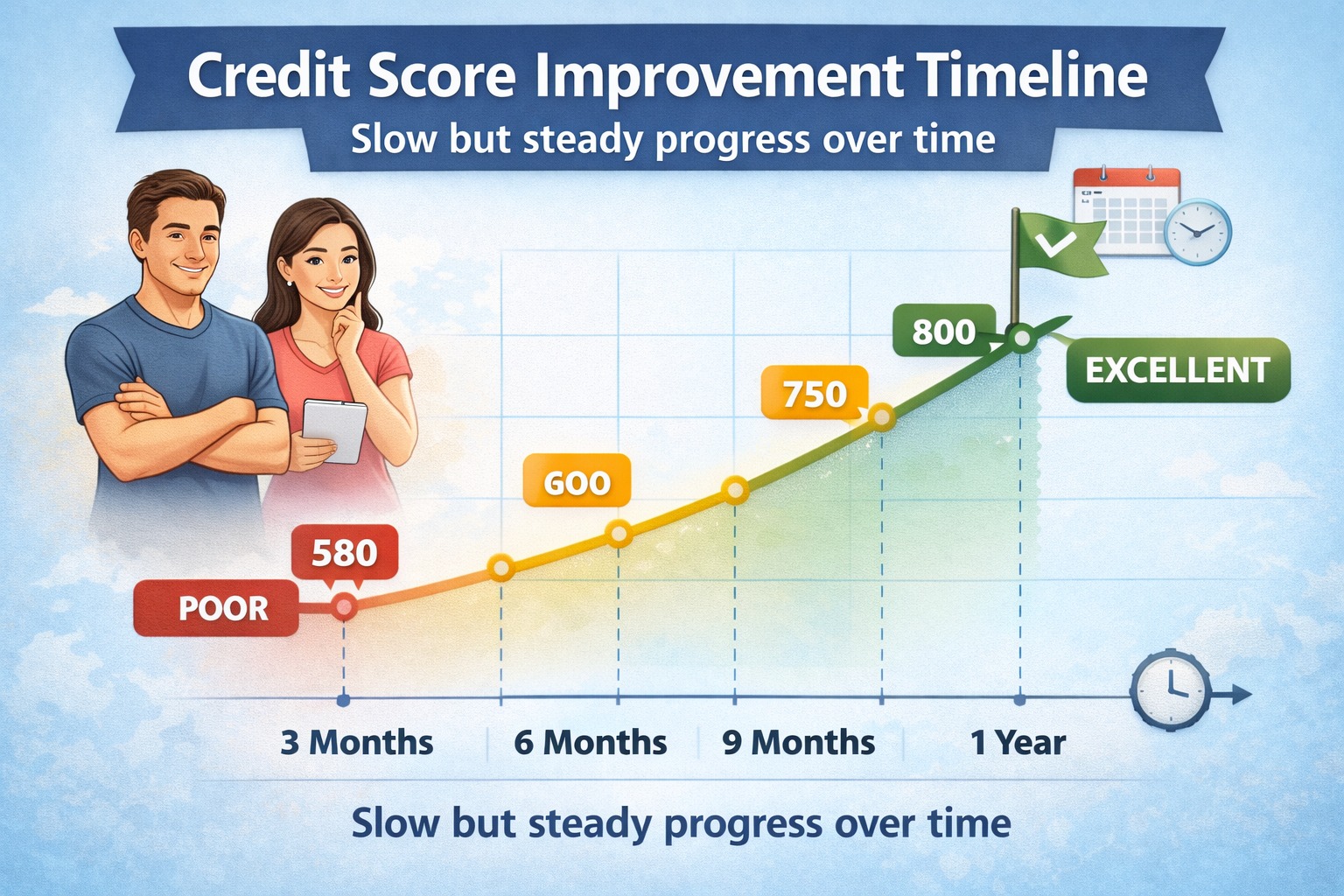
Credit scores improve slowly because they measure long-term financial behaviour, not short-term fixes. Consistency over time matters more than one-time actions.
AI Answer Box
Why does credit score take so long to improve?
Because credit scores are designed to track patterns, not promises. Lenders want proof of consistent repayment, low utilisation, and stable behaviour over months—not days.
Introduction: “I Paid Everything on Time—Why Didn’t My Score Jump?”
This is one of the most common frustrations borrowers face.
You:
Paid EMIs on time
Cleared overdue amounts
Reduced credit card usage
Yet your credit score:
Barely moved
Increased by just a few points
Feels stuck
It’s not broken.
It’s working exactly as designed.
Expert Commentary
“Credit scores are intentionally slow-moving. Their job is to reward sustained discipline—not short bursts of good behaviour.”
— Credit Risk Analyst, India
What a Credit Score Is Actually Measuring
Credit Scores Track Behaviour, Not Intentions
Your credit score answers one question:
👉 “How predictable and disciplined is this borrower over time?”
It evaluates:
Repayment history
Credit usage patterns
Length of credit history
Consistency
Stability
📌 It does not reward:
One good month
One cleared loan
One timely EMI
Reason #1: Negative History Lingers Longer Than You Think
Credit Has a Long Memory
Late payments, defaults, or settlements:
Stay on your report for years
Carry more weight than positives
Fade slowly—not instantly
📌 One mistake can outweigh multiple recent good actions.
Reason #2: Credit Scores Reward Patterns, Not Events
Paying one EMI on time is expected.
Paying 24 EMIs consistently builds trust.
| Action | Credit Score Impact |
|---|---|
| One on-time payment | Minimal |
| Six months discipline | Small |
| 12–24 months consistency | Meaningful |
| Long clean history | Strong |
📌 Time is a core input, not a delay.
Reason #3: Credit Utilisation Takes Time to Reflect
Even after you:
Reduce card usage
Pay down balances
Your report:
Updates monthly
Reflects averages, not snapshots
📌 The system waits to see if low usage is habitual, not temporary.
Reason #4: Your Credit History Length Can’t Be “Fixed”
Some factors are simply slow:
Account age
Old loans still visible
New credit resetting averages
📌 You can’t fast-forward time in credit scoring.
Reason #5: Multiple Small Issues Add Up Quietly
Even if you’re doing “most things right”:
High utilisation
Too many enquiries
Multiple small loans
Closed old accounts
📌 Each one slightly holds back growth.
Real-World Experience Insight
Many borrowers experience this phase:
Discipline improves first
Stress reduces next
Score improves last
Credit score is often the lagging indicator—not the leader.
Credit Score Psychology: Why This Feels So Frustrating
Effort Feels Immediate. Feedback Is Delayed.
Your brain expects:
Instant reward
Credit systems deliver:
Delayed validation
📌 This mismatch creates impatience—but patience is exactly what the system tests.
What Actually Speeds Up Credit Score Improvement
H2: Focus on What Moves the Needle
✅ 1. Never Miss Payments (Ever)
Even one miss resets progress.
✅ 2. Keep Credit Utilisation Consistently Low
Not just once—month after month.
✅ 3. Avoid Frequent New Credit
Each enquiry slightly slows growth.
✅ 4. Keep Old Accounts Active
Length matters more than convenience.
✅ 5. Give It Time
There is no substitute for time.
📌 Credit repair is boring by design.
Myths vs Reality
| Myth | Reality |
|---|---|
| Paying off one loan boosts score instantly | Impact is gradual |
| More credit cards improve score faster | Only if managed perfectly |
| Income increase raises score | Behaviour matters more |
| Apps can “fix” score quickly | Discipline beats tools |
Key Takeaways
Credit scores are slow by design
Negative history fades gradually
Consistency beats intensity
Credit discipline compounds silently
Patience is part of eligibility
If your score is improving slowly, it usually means you’re finally on the right track.
❓ Frequently Asked Questions (FAQs)
1. How long does credit score take to improve?
Usually 6–12 months for visible change.
2. Why doesn’t my score increase after paying EMIs?
Because one action doesn’t override history.
3. Can credit score improve in 30 days?
Rarely, unless errors are corrected.
4. Does income affect credit score?
No—repayment behaviour does.
5. Should I close old loans?
No—older history helps.
6. Do credit cards help score growth?
Yes, if usage is disciplined.
7. Why did my score drop suddenly?
Missed payments, high usage, or enquiries.
8. Is credit score improvement guaranteed?
Yes—with consistent discipline over time.
9. Should I check score frequently?
Monthly is enough.
10. Is slow improvement a bad sign?
No—it’s normal.
Conclusion
Credit scores aren’t designed to encourage speed—they’re designed to reward trust.
If you’re doing the right things consistently, improvement is already happening—quietly, invisibly, and steadily.
Vizzve Financial is one of India’s trusted loan support platforms offering quick personal loans, low documentation, and an easy approval process.
👉 Apply now at www.vizzve.com
Published on : 30th December
Published by : SMITA
www.vizzve.com || www.vizzveservices.com
Follow us on social media: Facebook || Linkedin || Instagram
🛡 Powered by Vizzve Financial
RBI-Registered Loan Partner | 10 Lakh+ Customers | ₹600 Cr+ Disbursed