

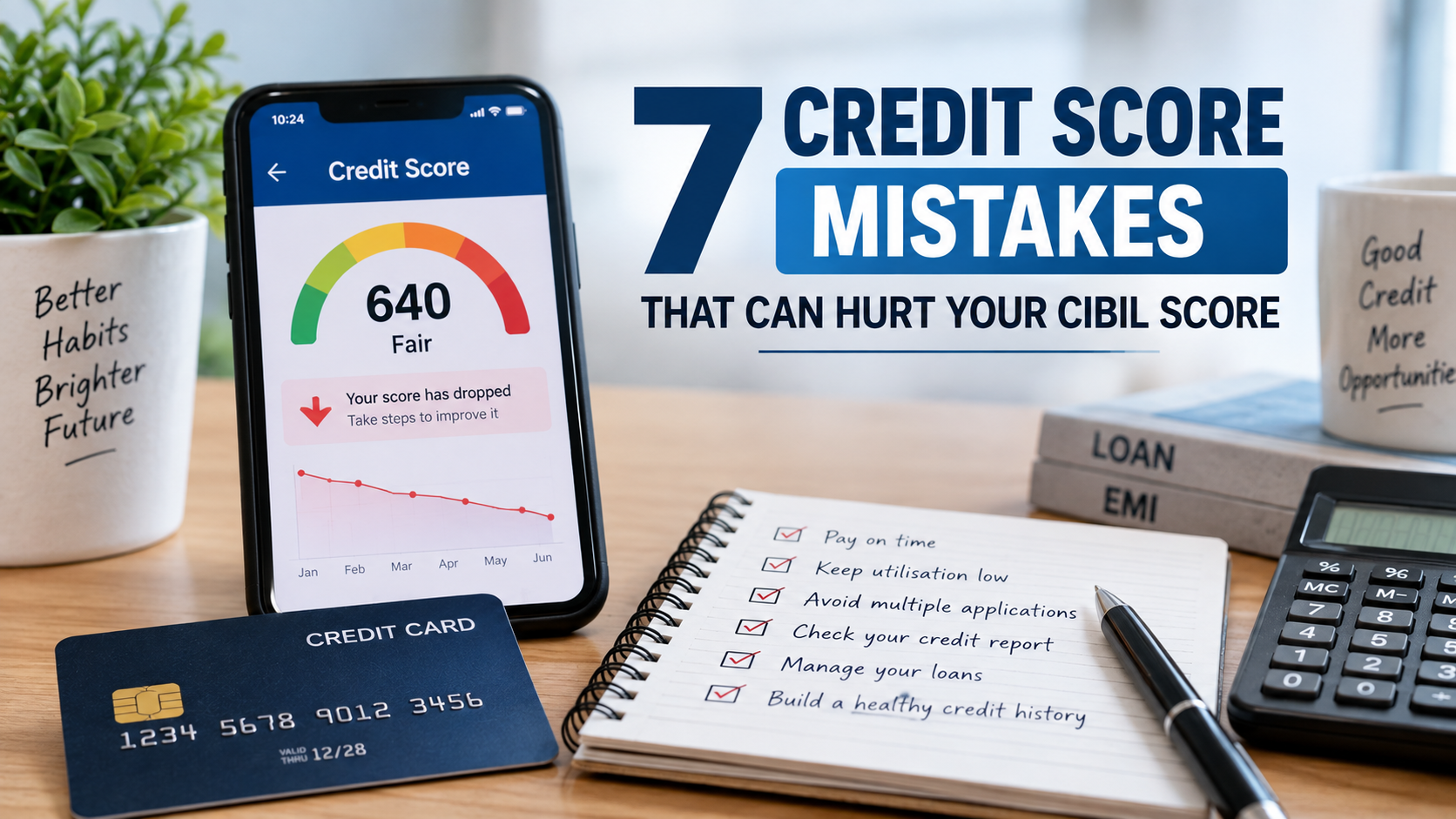
Your CIBIL Score is a three-digit number ranging from 300 to 900 that summarises your credit history. Banks and financial institutions may consider it while evaluating loan and credit-card applications. TransUnion CIBIL says payment history, credit utilisation, age of credit and credit enquiries are among the main factors affecting the score.
A good score is not built overnight. Small financial habits—such as missing an EMI, using too much of your credit limit, or applying for several loans within a short period—can affect your credit profile.
Here are 7 common credit score mistakes you should avoid.
1. Missing Credit Card or EMI Payments
One of the most important mistakes is paying your EMI or credit-card bill late.
Payment history is a major factor in your CIBIL Score. Late payments, missed payments and defaults can negatively affect your score.
How to avoid it
- Set up automatic EMI payments.
- Keep sufficient balance in your bank account.
- Pay credit-card bills before the due date.
- Don't depend only on SMS or email reminders.
Tip: Paying only the minimum amount on a credit-card bill can leave a large outstanding balance. Whenever possible, pay the full amount due.
2. Using Too Much of Your Credit Limit
Suppose your credit card has a limit of ₹1 lakh and you regularly use ₹80,000–₹90,000.
This means your credit utilisation is high. CIBIL notes that higher utilisation can indicate greater dependence on available credit and may negatively affect the score.
Example
| Credit Limit | Outstanding | Utilisation |
|---|---|---|
| ₹1,00,000 | ₹20,000 | 20% |
| ₹1,00,000 | ₹50,000 | 50% |
| ₹1,00,000 | ₹80,000 | 80% |
Instead of constantly spending close to your credit limit, try to keep your outstanding balance comfortably below it.
3. Applying for Too Many Loans or Credit Cards
Applying for several credit cards or loans within a short period can result in multiple hard enquiries on your credit report.
CIBIL says an individual credit enquiry generally has a marginal impact, but frequent applications in a short period can negatively affect the score and may signal increasing credit dependence.
Better approach
Before applying:
- Check whether you actually need the credit.
- Compare loan terms first.
- Avoid submitting applications to many lenders simultaneously.
- Check your eligibility before applying.
4. Ignoring Errors in Your CIBIL Report
Sometimes the problem may not be your financial behaviour at all.
Your credit report can contain incorrect information, such as:
- An account you never opened
- Incorrect outstanding balance
- Wrong payment status
- A loan shown as active after closure
- An enquiry you don't recognise
CIBIL recommends regularly checking your report so that errors can be identified and addressed.
If you see an enquiry that you did not initiate, CIBIL provides a process to contact the lender and raise a dispute.
5. Closing Old Credit Accounts Without Understanding the Impact
The age of your credit accounts is one of the factors considered in your CIBIL Score.
A longer credit history can provide lenders with more information about how you have managed credit over time.
Therefore, don't automatically close an old credit card simply because you no longer use it.
Before closing an account, consider:
- Its age
- Your overall credit utilisation
- Whether it has annual fees
- Whether you actually need the card
The effect of closing an account can depend on your overall credit profile.
6. Becoming a Guarantor Without Considering the Risk
Being a guarantor for someone else's loan is not just a formality.
If the primary borrower fails to repay the loan, the guarantor can also be affected. CIBIL specifically notes that a default by the principal applicant can affect the guarantor's credit score.
Before becoming a guarantor
Make sure you understand:
- The loan amount
- Repayment period
- Your legal responsibility
- The borrower's repayment capacity
Don't agree simply because a friend or relative asks you to.
7. Ignoring Your Credit Report After Repaying a Loan
You may have completely repaid a loan, but you should still check whether the account has been correctly updated.
RBI requires credit institutions to update credit information fortnightly, or at shorter intervals where agreed, from January 1, 2025. The objective is to make credit reports more current.
After closing a loan, check that the account reflects the correct status and outstanding amount.
If the information remains incorrect, contact the lender and use the appropriate credit-report dispute process.
7 CIBIL Score Mistakes at a Glance
| Mistake | Possible Impact |
|---|---|
| Missing EMI/credit-card payments | Can negatively affect payment history |
| High credit utilisation | Can make your credit profile look more stretched |
| Too many loan applications | Multiple enquiries may affect your score |
| Ignoring report errors | Incorrect information can remain on your report |
| Closing old accounts carelessly | May affect the age/profile of your credit history |
| Becoming a guarantor without checking | Borrower's default can affect you |
| Not checking closed loans | Incorrect outstanding/status information may remain |
Follow these simple habits:
- Pay EMIs and credit-card dues on time.
- Keep credit utilisation under control.
- Avoid unnecessary loan applications.
- Check your credit report regularly.
- Report incorrect information promptly.
- Keep track of loans where you are a guarantor.
- Review your credit report after closing a loan.
CIBIL itself recommends timely payments, low balances, a healthy credit mix, avoiding multiple applications and regularly checking the credit report.
Frequently Asked Questions
1. What is a CIBIL Score?
A CIBIL Score is a three-digit summary of your credit history and ranges from 300 to 900.
2. What can reduce my CIBIL Score?
Late payments, high credit utilisation, frequent credit applications and other negative credit behaviour can affect your score.
3. Does paying an EMI late affect CIBIL?
Yes. Late or missed EMI payments can negatively affect your payment history and CIBIL Score.
4. Does using a credit card affect CIBIL?
Yes. Your credit-card payment behaviour and utilisation can form part of the information used in calculating your score.
5. Do multiple loan applications affect CIBIL?
Frequent credit applications can result in multiple enquiries and may negatively affect your score.
6. Can checking my own CIBIL Score reduce it?
Checking your own credit report is different from a lender making a credit enquiry for a loan or credit-card application.
7. Can a guarantor's CIBIL Score be affected?
Yes. If the main borrower defaults, the guarantor's credit profile can also be affected.
8. Does closing a credit card reduce CIBIL Score?
It can affect your overall credit profile depending on factors such as account age and credit utilisation. The impact varies from person to person.
9. How often should I check my CIBIL Report?
Regularly reviewing your report can help you identify incorrect accounts, payment information or enquiries.
10. What should I do if I find an unknown loan account?
Contact the lender and raise a dispute through the relevant credit bureau process. CIBIL provides options for reporting unrecognised enquiries and account information.
11. Can CIBIL guarantee loan approval?
No. CIBIL provides credit information and scores, but the lending decision is made by the lender based on its own policies and other factors.
12. Does having a high CIBIL Score guarantee a lower interest rate?
No. A higher score can be one factor considered by lenders, but interest rates and loan approval depend on the lender's policies and the applicant's overall profile.
Published on : 21st September
Published by : SMITA
www.vizzve.com || www.vizzveservices.com
Follow us on social media: Facebook || Linkedin || Instagram
🛡 Powered by Vizzve Financial
RBI-Registered Loan Partner | 10 Lakh+ Customers | ₹600 Cr+ Disbursed