

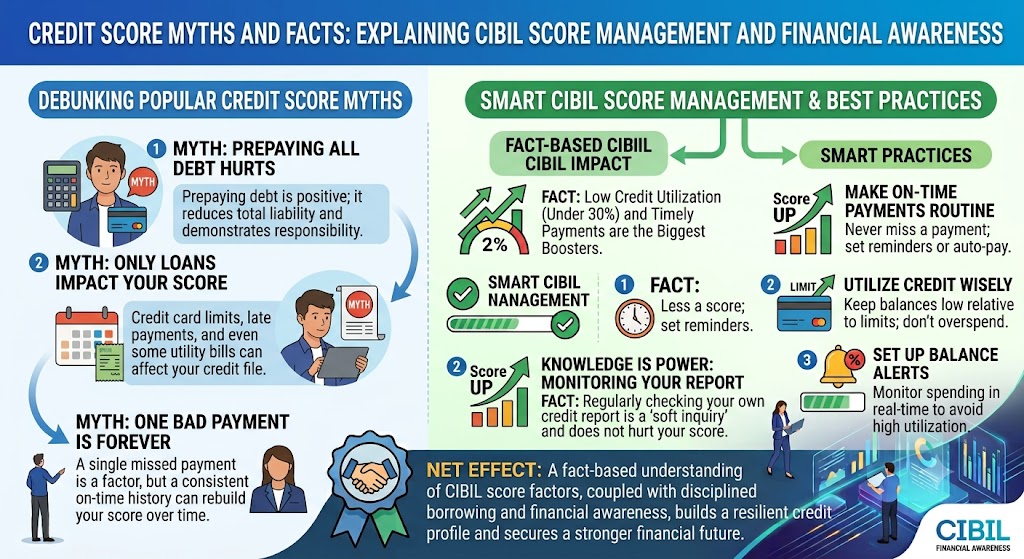
A credit score is a numerical representation of information in your credit history. In India, the TransUnion CIBIL score generally ranges from 300 to 900. Lenders may use this score, along with income, employment, existing debts, and other eligibility criteria, to assess a loan application.
Your credit profile can be influenced by several factors, including:
-
Payment history: Whether you pay EMIs and credit card bills on time.
-
Credit utilisation: How much of your available revolving credit you use.
-
Credit history: How long you have maintained credit accounts.
-
Credit mix: The types of credit accounts you have.
-
Credit enquiries: Applications for credit that result in hard enquiries.
Understanding these factors helps you separate credit score facts from common misconceptions.
7 Common Credit Score Myths You Should Stop Believing
Myth 1: Checking Your Own Credit Score Lowers It
Fact: Checking your own credit score is generally considered a soft enquiry and does not lower your score.
Many people avoid reviewing their credit reports because they fear that every check will negatively affect their credit profile. However, monitoring your own credit information is a responsible financial habit.
You can review your credit report to check your repayment history, outstanding balances, account details, and any errors. Regular monitoring can also help you identify unfamiliar accounts or incorrect information.
Tip: Check your credit report periodically and raise a dispute if you discover inaccurate information.
Myth 2: Having No Loans Means You Have an Excellent Credit Score
Fact: Having no borrowing history does not automatically result in a high credit score.
If you have never taken a loan or used a credit card, the credit bureau may not have enough information to calculate a score. You may be classified as new to credit rather than having a poor credit history.
A strong credit profile develops through responsible credit management over time. If you need credit in the future, a suitable credit product with affordable repayments may help establish your history.
Tip: Do not take unnecessary loans simply to create a credit score. Focus on borrowing only when it serves a genuine financial need.
Myth 3: Paying Your Credit Card Bill on Time Is the Only Thing That Matters
Fact: Timely payments are important, but other factors can also influence your credit score.
Your credit utilisation ratio, credit history, credit mix, and recent credit enquiries may also affect how your credit profile is assessed.
For example, someone who pays every bill on time but consistently uses nearly the entire credit card limit may still have a high credit utilisation ratio. This could negatively affect their credit score.
Tip: Pay your bills on time, keep outstanding balances manageable, and avoid unnecessary credit applications.
Myth 4: Closing an Old Credit Card Always Improves Your Credit Score
Fact: Closing a credit card does not automatically improve your credit score.
When you close a card, your total available credit limit may decrease. If you continue carrying balances on other cards, your overall credit utilisation ratio could increase.
Closing an account can also change the composition of your credit profile. The effect depends on your overall credit history and how the account is reported.
However, keeping a card open is not always the best choice. Annual fees, security concerns, and spending habits should also be considered.
Tip: Before closing a card, review its costs and understand how losing its credit limit might affect your overall utilisation.
Myth 5: A High Salary Guarantees a High Credit Score
Fact: Your salary and your credit score measure different things.
A high income may help you qualify for certain loans, but it does not guarantee a high credit score. Credit scores primarily reflect information in your credit history, while lenders may separately evaluate your income and repayment capacity.
For example, a high-income borrower who frequently misses EMI payments may have a weaker credit profile than a lower-income borrower who manages credit responsibly.
Tip: Maintain a realistic budget, pay obligations on time, and avoid taking on debt beyond your repayment capacity.
Myth 6: Carrying a Credit Card Balance Helps Build Your Credit Score
Fact: You generally do not need to carry an unpaid credit card balance or pay interest to build a positive credit history.
Some people believe that keeping debt outstanding every month demonstrates active credit use. However, carrying a balance can lead to interest charges and increase your financial burden.
Using a credit card for purchases you can afford and paying the full statement balance by the due date is generally a sound approach.
Tip: Use your card responsibly, avoid unnecessary borrowing, and pay the full amount due whenever possible.
Myth 7: A Good Credit Score Guarantees Loan Approval
Fact: A good credit score can strengthen your application, but it does not guarantee approval.
Lenders may also evaluate your monthly income, employment stability, existing financial obligations, debt-to-income position, requested loan amount, and internal eligibility criteria.
For example, an applicant with a strong credit score may still be rejected if their existing EMIs leave insufficient income to support another loan.
Tip: Before applying, check the lender's eligibility requirements and ensure that the proposed EMI fits comfortably within your budget.
What Factors Can Improve or Damage Your Credit Score?
Understanding the main credit management factors can help you avoid common mistakes.
| Credit Factor | Responsible Practice | Potential Risk |
|---|---|---|
| Payment history | Pay EMIs and bills on time | Missed or delayed payments |
| Credit utilisation | Keep revolving balances manageable | Consistently high utilisation |
| Credit applications | Apply selectively | Multiple hard enquiries |
| Credit accounts | Review and manage accounts carefully | Unnecessary account changes |
| Credit report accuracy | Correct errors promptly | Incorrect balances or payment records |
The precise effect of each factor varies according to your credit profile and the scoring model used.
How to Maintain a Healthy Credit Score
Once you understand these myths, follow these practical habits to support your long-term credit health.
1. Pay All EMIs and Bills on Time
Set payment reminders or use automatic payments where appropriate. Ensure your bank account has enough funds to cover scheduled payments.
2. Keep Credit Utilisation Low
Avoid using most of your available credit limit regularly. Keeping utilisation below 30% is a commonly recommended guideline, although it is not a guaranteed scoring threshold.
3. Avoid Unnecessary Credit Applications
Research eligibility requirements before applying for a loan or credit card. Multiple applications within a short period may generate several hard enquiries.
4. Review Your Credit Report
Check whether your accounts, payment history, balances, and personal details are accurately reported. Contact the lender or relevant credit bureau if you identify an error.
5. Maintain a Balanced Financial Plan
Do not borrow more than you can comfortably repay. Keep an emergency fund and consider the total cost of borrowing, including interest and applicable charges.
6. Be Patient and Consistent
Credit health develops through ongoing financial behaviour. Avoid services that promise guaranteed score increases or instant credit repair without a legitimate basis.
Why Understanding Credit Score Myths Matters
Believing inaccurate information about credit scores can lead to unnecessary spending, poor borrowing decisions, and missed opportunities to monitor your credit health.
For instance, avoiding your credit report because you fear a score reduction may prevent you from detecting errors. Similarly, closing cards without considering your total credit limit may unintentionally increase your utilisation ratio.
Learning the facts helps you make informed decisions, understand lender requirements, and build a more reliable financial profile over time.
Conclusion
Credit score myths can create confusion for both first-time borrowers and experienced credit users. Checking your own score generally does not lower it, a high salary does not guarantee a high score, and carrying credit card debt is not necessary to build a positive credit history.
The most effective approach is to understand your credit report, pay your obligations on time, manage credit utilisation, apply for credit carefully, and correct inaccurate information when necessary.
At Vizzve, we believe that financial awareness is an important step towards responsible borrowing. By separating credit score myths from facts, you can make better financial decisions and work towards a healthier credit profile.
Published on : 19th October 2026
Published by : yogendra
www.vizzve.com || www.vizzveservices.com
Follow us on social media: Facebook || Linkedin || Instagram
🛡 Powered by Vizzve Financial
RBI-Registered Loan Partner | 10 Lakh+ Customers | ₹600 Cr+ Disbursed