

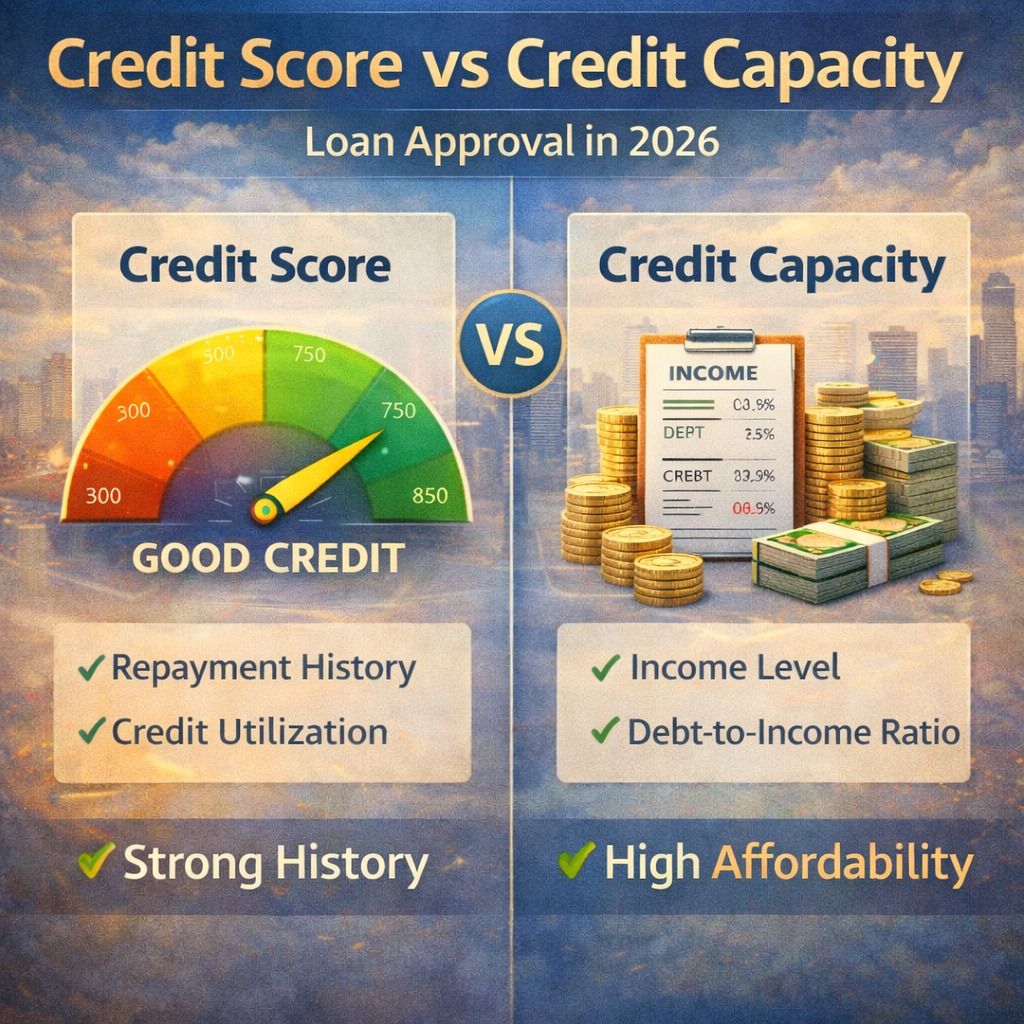
Many borrowers believe a high credit score alone guarantees loan approval. In 2026, that assumption is no longer fully true.
While credit score remains important, lenders are increasingly focusing on credit capacity—your actual ability to repay loans comfortably. Understanding the difference between these two concepts can decide whether your loan gets approved, reduced, or rejected.
So, in 2026, what matters more: credit score or credit capacity?
Let’s break it down clearly.
AI Answer Box
In 2026, both credit score and credit capacity matter for loan approval. Credit score shows repayment behaviour, while credit capacity reflects affordability. Lenders increasingly prioritise credit capacity to avoid over-leveraging borrowers, even if their credit score is high.
Quick Summary Box (Fast Indexing)
Credit score shows behaviour
Credit capacity shows affordability
High score alone is not enough in 2026
EMI-to-income ratio is critical
Balanced credit profile wins approvals
What Is a Credit Score?
A credit score is a numerical representation of your past credit behaviour.
What credit score reflects:
Timely EMI and credit card payments
Payment delays or defaults
Credit utilisation
Loan and card history
Important:
Credit score answers the question:
👉 “Did this person repay loans responsibly?”
What Is Credit Capacity?
Credit capacity refers to your financial ability to take and repay additional debt without stress.
Credit capacity depends on:
Monthly income
Existing EMIs
Fixed expenses
Employment stability
In simple terms:
Credit capacity answers:
👉 “Can this person afford another loan right now?”
Credit Score vs Credit Capacity: Key Differences
| Factor | Credit Score | Credit Capacity |
|---|---|---|
| Measures | Behaviour | Affordability |
| Based on | Past data | Current finances |
| Changes | Slowly | Quickly |
| High value means | Responsible borrower | Safe repayment ability |
| Risk focus | Default history | Over-borrowing risk |
How Lenders Evaluate Borrowers in 2026
In 2026, lenders use dual assessment models.
Step 1: Credit Score Check
Filters risky borrowers
Screens repayment discipline
Step 2: Credit Capacity Analysis
Calculates EMI affordability
Evaluates debt-to-income ratio
Prevents borrower stress
👉 Both must pass for smooth approval.
Why Credit Capacity Is Gaining More Importance in 2026
Rising EMI Burden
With higher living costs, lenders are cautious about:
EMI overload
Default risk despite good scores
Responsible Lending Regulations
Financial institutions are now encouraged to:
Avoid over-leveraging borrowers
Focus on sustainable repayment
Income Stability Over Credit History
Even borrowers with high credit scores face rejection if:
Income is unstable
Existing EMIs are high
Can a High Credit Score Still Get Rejected?
Yes—and it’s more common in 2026.
Common reasons:
EMIs already exceed 40–50% of income
Recent job change or income drop
High credit card utilisation
Can Strong Credit Capacity Compensate for a Low Score?
Partially—but with conditions.
Moderate score + strong income = possible approval
Low score + weak capacity = rejection
Lenders may:
Approve smaller amounts
Charge higher interest
Shorten tenure
Ideal Borrower Profile in 2026
| Area | Ideal Range |
|---|---|
| Credit score | 700+ |
| EMI-to-income ratio | Below 35–40% |
| Credit card usage | Below 30% |
| Employment | Stable |
| Loan enquiries | Minimal |
How to Improve Both Credit Score & Credit Capacity
Improve Credit Score:
Pay EMIs on time
Reduce card utilisation
Avoid frequent loan enquiries
Improve Credit Capacity:
Reduce existing EMIs
Increase income sources
Avoid unnecessary debt
Expert Commentary: The New Lending Reality
“In 2026, lenders don’t just ask if you repay—they ask if you can repay comfortably. Credit capacity is now as important as credit score.”
— Credit Risk Analyst
Key Takeaways
Credit score shows discipline
Credit capacity shows affordability
High score alone doesn’t guarantee approval
Lenders now balance both factors
Smart borrowers manage EMIs, not just scores
❓ Frequently Asked Questions (FAQs)
1. What matters more in 2026: credit score or credit capacity?
Both matter, but credit capacity is gaining more importance.
2. Can I get a loan with high credit score but low income?
Approval may be limited or rejected due to low credit capacity.
3. What is a safe EMI-to-income ratio?
Ideally below 35–40%.
4. Does reducing EMIs improve credit capacity?
Yes, it directly increases borrowing power.
5. Can income increase improve loan eligibility?
Yes, stable income boosts credit capacity.
6. Does credit capacity affect interest rates?
Yes, better capacity can lead to better terms.
7. Is credit score still important?
Absolutely—it remains the first screening filter.
8. How often should I check my credit health?
At least once every quarter.
Conclusion: Balance Beats Perfection in 2026
In 2026, loan approval is no longer about choosing between credit score and credit capacity—it’s about balancing both.
A strong credit score opens the door.
Strong credit capacity decides how wide that door opens.
📌 Smart borrowers don’t just chase scores—they manage affordability.
Published on : 1st January
Published by : SMITA
www.vizzve.com || www.vizzveservices.com
Follow us on social media: Facebook || Linkedin || Instagram
🛡 Powered by Vizzve Financial
RBI-Registered Loan Partner | 10 Lakh+ Customers | ₹600 Cr+ Disbursed