

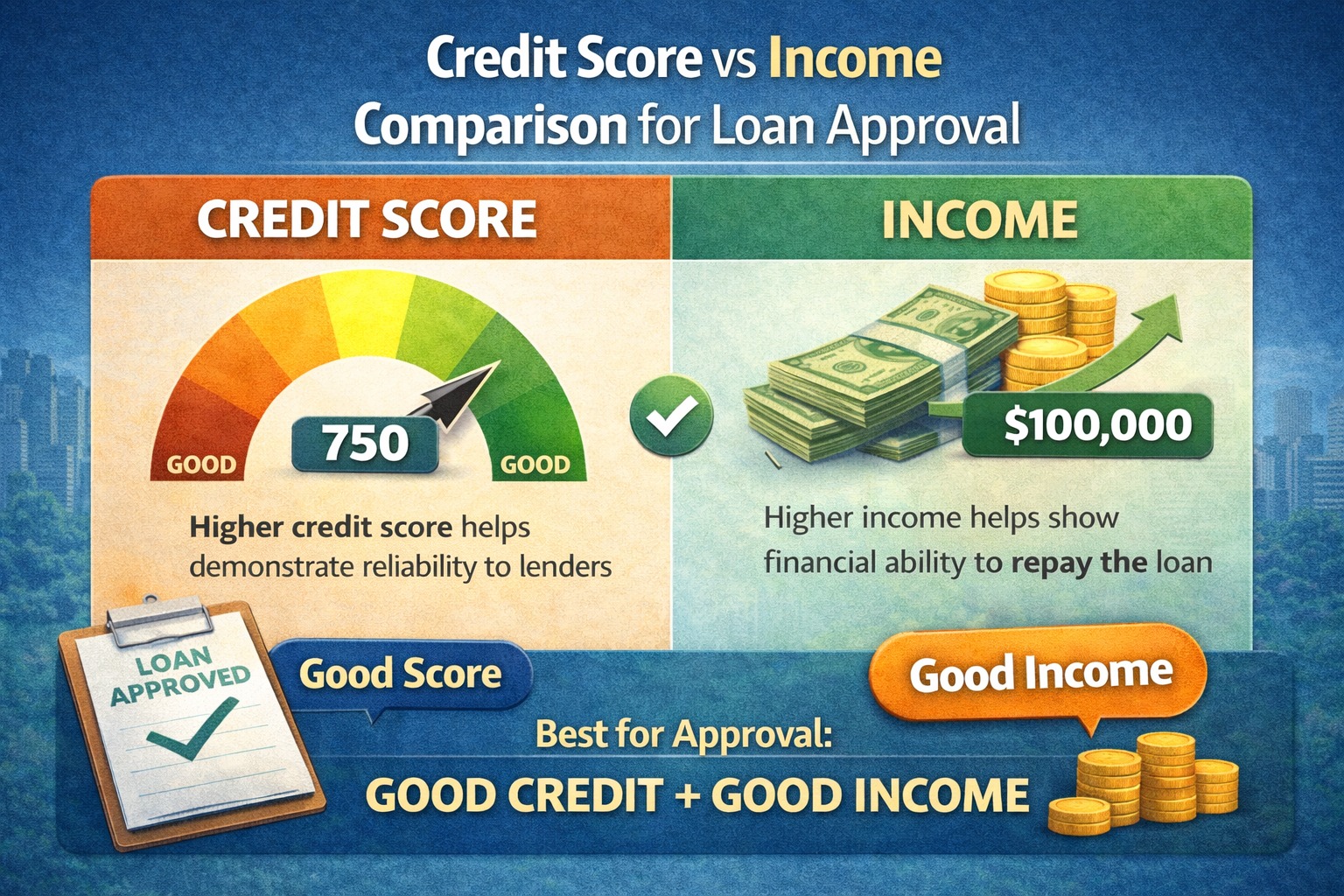
For most loans today, credit score matters more for approval, while income determines how much you can borrow and at what EMI. Both work together, but credit score is usually the first filter.
AI Answer Box (For Google AI Overview & AI Search)
Lenders today prioritize credit score to assess repayment discipline and risk. Income becomes important after score eligibility is met, as it decides loan amount and EMI affordability. A strong score with moderate income often beats high income with poor credit history.
Why Borrowers Are Confused
Many borrowers believe:
“I earn well, so I’ll get the loan easily.”
But modern lending doesn’t work like that.
Banks and digital lenders use risk-based underwriting, where:
Credit score = repayment behavior
Income = repayment capacity
Approval depends on both, but not equally.
What Is a Credit Score (And Why Lenders Care)
A credit score reflects:
Your repayment history
EMI discipline
Credit utilization
Length and mix of credit
Why it matters:
Predicts future repayment behavior
Helps lenders price risk
Acts as the first eligibility filter
👉 No matter how high your income is, a poor credit score can stop approval instantly.
What Role Does Income Play?
Income tells lenders:
How much EMI you can afford
Maximum loan amount possible
Stability of cash flow
Income is usually verified through:
Salary slips / bank statements
ITRs (for self-employed)
👉 Income cannot compensate for poor repayment history.
Credit Score vs Income: Side-by-Side Comparison
| Factor | Credit Score | Income |
|---|---|---|
| Purpose | Measures discipline | Measures capacity |
| Approval impact | Very high | High (after score) |
| Can override the other? | Often yes | Rarely |
| Affects interest rate | Strongly | Moderately |
| Affects loan amount | Indirectly | Directly |
What Lenders Actually Check (Real Logic)
Step-by-Step Loan Assessment:
Credit score check (pass/fail gate)
Credit behavior analysis
Income & EMI affordability
Existing debt obligations
Final pricing & limits
This is why:
Moderate income + high score = approval
High income + poor score = rejection
Loan-Wise Priority: Score vs Income
| Loan Type | What Matters More |
|---|---|
| Personal Loan | Credit Score |
| Credit Card | Credit Score |
| Home Loan | Both equally |
| Car Loan | Credit Score (slightly more) |
| Business Loan | Cash flow + Score |
Common Scenarios Explained
❌ High Income, Low Credit Score
Loan rejected or very high interest
Seen as risky borrower
✅ Average Income, Strong Credit Score
Higher approval chances
Better rates & flexibility
❌ No Credit History (New Borrower)
Income helps, but limits are low
Expert Insight
“Income tells us whether a borrower can repay. Credit score tells us whether they will. In lending, willingness matters more than capacity.”
— Retail Credit Risk Analyst
How to Improve Loan Approval Chances
If your income is good but score is weak:
Clear overdue EMIs
Reduce credit card usage below 30%
Avoid multiple loan applications
Pay consistently for 6–9 months
If score is good but income is limited:
Reduce existing EMIs
Opt for longer tenure
Apply for secured loans
Key Takeaways
Credit score is the first approval gate
Income decides loan size & EMI comfort
High income can’t erase bad credit history
Strong score improves rates and flexibility
Balanced profile wins approvals
Conclusion
In today’s lending environment, credit score matters more for loan approval, while income shapes how much you can borrow. Borrowers who maintain repayment discipline—even with average income—often enjoy smoother approvals and better terms than high earners with poor credit habits.
In loans, trust beats income.
Frequently Asked Questions (FAQs)
1. Can high income guarantee loan approval?
No. A poor credit score can still lead to rejection.
2. What is the minimum credit score for loans?
Generally 700+ improves approval chances.
3. Does income affect interest rates?
Yes, but less than credit score.
4. Can I get a loan with no credit history?
Yes, but with lower limits and higher scrutiny.
5. Which matters more for personal loans?
Credit score.
6. Which matters more for home loans?
Both are equally important.
7. Can I improve score quickly for loan approval?
Improvements usually take 3–6 months.
8. Do lenders verify income digitally?
Yes, through bank statements and employer data.
9. Does multiple loan application hurt approval?
Yes, it lowers credit score temporarily.
10. What’s better: high score or high income?
High score with sufficient income is ideal.
Published on : 16th January
Published by : SMITA
www.vizzve.com || www.vizzveservices.com
Follow us on social media: Facebook || Linkedin || Instagram
🛡 Powered by Vizzve Financial
RBI-Registered Loan Partner | 10 Lakh+ Customers | ₹600 Cr+ Disbursed