

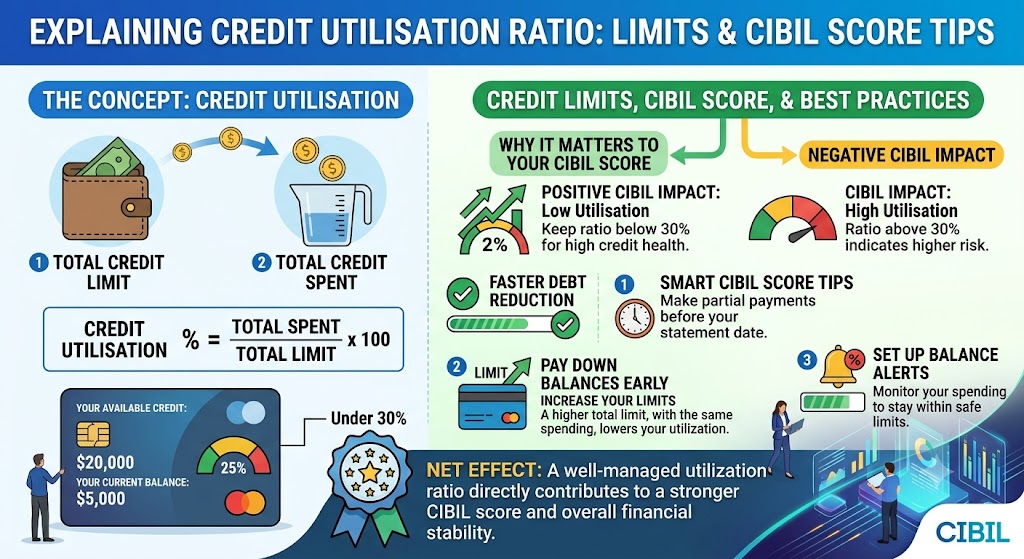
Credit utilisation is an important factor that can influence your CIBIL score. Whether you use a credit card for daily purchases, emergencies, or major expenses, the amount of credit you use compared with your available credit limit can affect how lenders view your financial behaviour.
Many borrowers focus on paying their credit card bills on time but overlook their credit utilisation ratio. Even when you make payments regularly, using a large portion of your available credit limit may negatively affect your credit profile.
Understanding the relationship between credit utilisation and your CIBIL score can help you manage credit responsibly, maintain a healthy financial profile, and improve your chances of getting approved for loans in the future.
What Is Credit Utilisation?
Credit utilisation refers to the percentage of your available revolving credit that you are currently using. It is most commonly associated with credit cards and other revolving credit facilities.
For example, if your credit card has a limit of ₹1,00,000 and your outstanding balance is ₹30,000, your credit utilisation ratio is 30%.
A lower credit utilisation ratio generally indicates that you are not heavily dependent on borrowed credit. In contrast, consistently using most of your available credit limit may signal greater credit risk to lenders.
How to Calculate Your Credit Utilisation Ratio
You can calculate your credit utilisation ratio using a simple formula:
Credit Utilisation Ratio = (Outstanding Credit Card Balance ÷ Total Credit Limit) × 100
Let's understand this with an example.
Suppose you have a credit card with a limit of ₹80,000 and an outstanding balance of ₹20,000.
Credit utilisation = (₹20,000 ÷ ₹80,000) × 100 = 25%
This means you are using 25% of your available credit limit.
If you have multiple credit cards, your overall utilisation can be calculated by adding their outstanding balances and dividing the total by their combined credit limits.
For example:
| Credit Card | Credit Limit | Outstanding Balance |
|---|---|---|
| Card A | ₹50,000 | ₹10,000 |
| Card B | ₹1,00,000 | ₹20,000 |
| Total | ₹1,50,000 | ₹30,000 |
Your overall credit utilisation ratio is 20%.
How Does Credit Utilisation Affect Your CIBIL Score?
Credit utilisation helps demonstrate how you manage your available credit. A high ratio may indicate that you rely heavily on credit, while a lower ratio can suggest more controlled borrowing.
Here are the main ways credit utilisation may affect your CIBIL score.
1. High Credit Utilisation May Lower Your Score
Using a large percentage of your credit limit can negatively affect your credit profile, even if you pay your bills on time.
For example, if your credit limit is ₹50,000 and your outstanding balance reaches ₹45,000, your utilisation ratio is 90%. Such high utilisation may make lenders view your credit behaviour as riskier.
Keeping your outstanding balance lower can help you maintain a healthier credit profile.
2. Low Credit Utilisation Can Support Credit Health
Using a smaller portion of your available credit generally demonstrates that you can manage credit without relying heavily on borrowing.
Many financial experts recommend keeping credit utilisation below 30% as a practical guideline. However, this is not a guaranteed CIBIL scoring threshold, and a lower ratio does not guarantee a particular score.
For example, if your total credit limit is ₹1,00,000, keeping your reported balance below ₹30,000 would mean utilisation is below 30%.
3. Maxing Out Your Credit Card Can Create Problems
A maxed-out credit card means you have used nearly all your available credit limit. This can increase your utilisation ratio substantially and may negatively influence your credit score.
High utilisation can also reduce your available borrowing capacity and make it harder to manage unexpected expenses.
Avoid treating your full credit limit as money available to spend. Instead, use your card according to your income and repayment capacity.
4. Credit Utilisation Can Change Your Score Over Time
Credit utilisation is not necessarily fixed. It can change whenever your balances or credit limits change.
For example, paying down your credit card balance may reduce your utilisation ratio. Once your lender reports the updated information to the credit bureau, your score may respond positively.
However, the timing and size of any score change depend on your complete credit profile and the information reported.
What Is the Ideal Credit Utilisation Ratio for a Good CIBIL Score?
There is no single utilisation percentage that guarantees a good CIBIL score. Nevertheless, maintaining a low ratio is generally a sensible credit management practice.
| Credit Utilisation | General Interpretation |
|---|---|
| 0% | No reported revolving balance; not necessary to maintain at all times |
| 1%–10% | Low utilisation |
| 11%–30% | Generally considered a reasonable range |
| 31%–50% | Higher utilisation; consider reducing the balance |
| Above 50% | Relatively high utilisation |
| Near 100% | Very high utilisation; may negatively affect your credit profile |
These ranges are general guidelines, not official CIBIL scoring bands. Your credit score also depends on repayment history, account age, credit mix, enquiries, and other information in your credit report.
You do not need to carry a balance or pay interest to build a positive credit history. Paying your credit card bill in full by the due date is generally a sound financial practice.
Practical Ways to Reduce Credit Utilisation
If your credit utilisation ratio is high, you can take several practical steps to bring it down.
1. Pay Your Credit Card Balance Regularly
Avoid waiting until your payment due date to review your outstanding balance. Making payments earlier can help reduce the balance reported by your lender, depending on the reporting date and payment processing.
Always ensure that at least the required payment is made by the due date, and preferably pay the full statement balance to avoid interest charges.
2. Avoid Unnecessary Credit Card Spending
Use your credit card for purchases you can afford to repay. Avoid spending simply because you have a high credit limit.
Planning expenses and tracking transactions can help you prevent your outstanding balance from increasing unexpectedly.
3. Consider Requesting a Credit Limit Increase
A higher credit limit can reduce your utilisation ratio if your spending and outstanding balance remain unchanged.
For example, a balance of ₹20,000 on a ₹50,000 limit represents 40% utilisation. If the limit increases to ₹1,00,000, the same balance represents 20%.
However, a limit increase is not guaranteed. Check whether the issuer will conduct a credit enquiry and avoid increasing your spending just because the limit is higher.
4. Manage Multiple Credit Cards Carefully
If you have several credit cards, monitor both individual card utilisation and overall utilisation. A high balance on one card may still be worth addressing even when your combined utilisation is relatively low.
Keep track of payment dates, balances, and credit limits to prevent unnecessary borrowing and missed payments.
5. Avoid Closing Cards Without Considering the Impact
Closing a credit card may reduce your total available credit limit. If your outstanding balances remain unchanged, your overall utilisation ratio could increase.
Before closing an unused card, consider any fees, security concerns, spending habits, and the possible effect on your overall credit profile.
Credit Utilisation vs Payment History
Credit utilisation and payment history are different aspects of credit management.
| Factor | Credit Utilisation | Payment History |
|---|---|---|
| What it measures | Credit used compared with the available limit | Whether payments are made on time |
| Main concern | High outstanding balances | Missed or delayed payments |
| How to manage it | Reduce balances and control spending | Pay EMIs and bills by their due dates |
| Effect of improvement | May help your score as updated balances are reported | Consistent timely payments support credit health |
Both factors matter. A low utilisation ratio does not compensate for repeated missed payments, and a perfect payment history does not guarantee that high utilisation will have no effect on your score.
How Often Should You Check Your Credit Utilisation?
Checking your credit card balances at least once a month is a useful habit. You can also review your credit report periodically to understand how your accounts are being reported.
Remember that your credit report may not reflect your current balance immediately because lenders report information according to their reporting schedules.
If your credit utilisation appears unusually high despite making payments, verify the reported balance and reporting date. Contact your card issuer if the information seems incorrect.
Common Credit Utilisation Mistakes to Avoid
Avoid these common mistakes when managing your credit cards:
-
Assuming that paying the minimum amount always keeps your credit profile healthy.
-
Using the entire credit limit because repayment is not immediately due.
-
Believing that a 0% utilisation ratio is always necessary for a good score.
-
Applying for several new credit cards just to increase available limits.
-
Taking on additional debt solely to reduce the utilisation percentage.
-
Ignoring errors in your credit report.
The goal is to use credit responsibly, not to maximise the amount of credit available to you.
Conclusion
Credit utilisation is an important part of maintaining a healthy CIBIL score. Using a large portion of your available credit limit may negatively affect your credit profile, while maintaining lower balances can support responsible credit management.
To manage credit utilisation effectively, monitor your balances, avoid unnecessary spending, pay your credit card bills in full whenever possible, and review your credit report regularly.
Published on : 18th October 2026
Published by : yogendra
www.vizzve.com || www.vizzveservices.com
Follow us on social media: Facebook || Linkedin || Instagram
🛡 Powered by Vizzve Financial
RBI-Registered Loan Partner | 10 Lakh+ Customers | ₹600 Cr+ Disbursed