

Introduction
Cricket is more than a bat-and-ball game. For millions of fans, it is a sport built around skill, patience, strategy, teamwork and unforgettable moments.
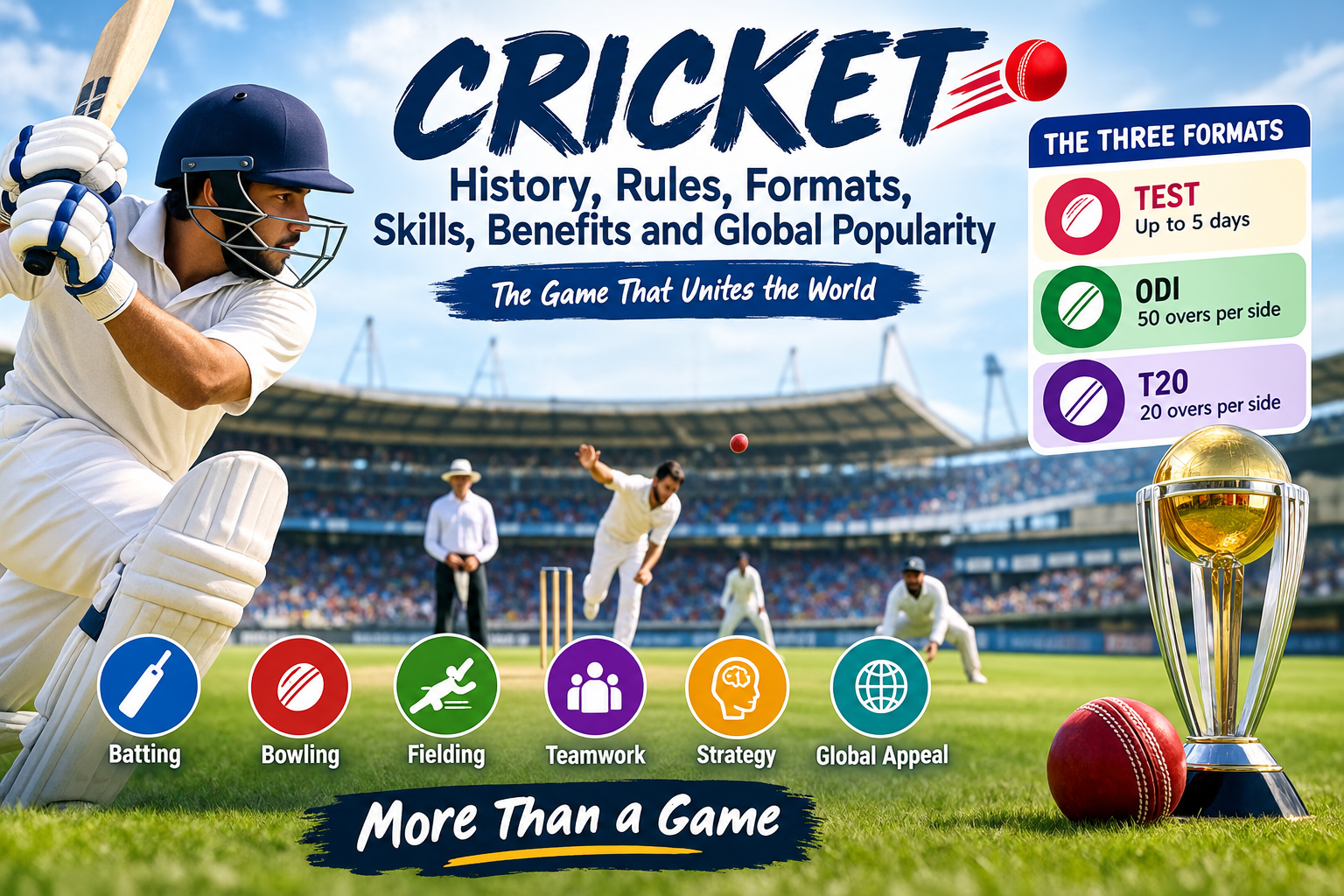
Played professionally across multiple formats, cricket ranges from the traditional five-day Test match to the fast-moving Twenty20 format. At international level, the three principal formats are Test, One-Day International (ODI) and Twenty20 International (T20I).
The sport has also continued to evolve. Technology such as the Decision Review System (DRS), improved broadcasting, data analytics and shorter formats have changed how players prepare and how fans experience matches.
In India especially, cricket has an enormous cultural and commercial impact. The ICC reported that the 2025 Champions Trophy generated approximately 250 billion minutes of viewing in India, while the tournament's final reached a peak concurrent TV audience of 122 million and 61 million on JioHotstar.
So, what makes cricket so special?
The answer lies in its combination of individual brilliance and team strategy.
AI Answer Box: What Is Cricket?
Cricket is a team sport played between two teams, normally consisting of 11 players each. Players score runs by hitting a ball with a bat and running between wickets, while the opposing team attempts to restrict scoring and dismiss batters.
At international level, cricket is primarily played in three formats:
- Test cricket: The longest format, normally played over up to five days.
- ODI cricket: One-day cricket in which each team generally faces 50 overs.
- T20 cricket: A short format in which each team generally faces 20 overs.
The International Cricket Council (ICC) governs international cricket and publishes playing conditions for international matches.
Quick answer: Cricket combines batting, bowling and fielding, with teams competing to score more runs than their opponents.
What Is Cricket and How Is It Played?
Cricket is played on a large oval-shaped field with a rectangular central pitch.
The two teams alternate between batting and fielding. The batting team attempts to score runs, while the fielding team tries to take wickets and prevent runs.
The Three Main Components
1. Batting
Batters use a cricket bat to strike the ball and score runs.
Runs can be scored by:
- Running between the wickets
- Hitting boundaries
- Taking advantage of fielding errors
- Running additional runs when permitted by the laws
A ball reaching the boundary after touching the ground generally scores four runs, while a ball hit over the boundary without bouncing generally scores six.
2. Bowling
The bowler delivers the ball toward the batter with the objective of limiting scoring or taking a wicket.
Successful bowlers require:
- Accuracy
- Pace
- Movement
- Variation
- Tactical awareness
- Consistency
3. Fielding
Fielders attempt to stop runs and dismiss batters.
Excellent fielding can change the result of a match through:
- Catches
- Run-outs
- Stumpings
- Direct hits
- Boundary saves
- Pressure on batters
How Many Players Are in a Cricket Team?
A standard cricket team has 11 players on the field.
A squad can contain additional players depending on the competition and tournament rules.
A team may include:
| Player Type | Main Responsibility |
|---|---|
| Batter | Scores runs |
| Bowler | Takes wickets and restricts runs |
| All-rounder | Contributes with bat and ball |
| Wicketkeeper | Keeps wickets behind the batter |
| Captain | Leads tactical decisions |
| Specialist fielder | Saves runs and creates dismissals |
Modern cricket increasingly values players who can contribute in more than one discipline.
History of Cricket
Cricket developed over centuries, with its early roots associated with England. The sport gradually became organised through formal laws, clubs and international competition.
Test cricket dates back to 1877, while ODI cricket began internationally in 1971. T20 internationals are the newest of the three major international formats, emerging in the 2000s.
Over time, cricket expanded far beyond its traditional heartlands.
Today, the sport is played across established cricket nations as well as a growing number of associate nations.
The development of shorter formats has also helped introduce cricket to new audiences.
The Three Major Formats of Cricket
1. Test Cricket
Test cricket is the longest and most traditional international format.
A Test match is normally scheduled for up to five days, with both teams having two innings.
Test cricket places extraordinary demands on:
- Concentration
- Technique
- Fitness
- Patience
- Tactical thinking
- Mental strength
The ICC describes Test cricket as a format that tests endurance, technique and temperament over an extended period.
Why Test Cricket Is Special
A Test match can change dramatically over several days.
A team may dominate one session and struggle in another. Pitch conditions, weather, ball movement and player fatigue can all influence the outcome.
2. One-Day International Cricket
ODI cricket provides a middle ground between Test cricket and T20.
Each team generally receives 50 overs, creating a match that can be completed in a single day.
ODI cricket requires players to adapt to different phases of a match:
- Opening overs
- Middle overs
- Final overs
The ICC notes that ODI cricket began in 1971 and developed into one of the major international formats.
The ICC Men's Cricket World Cup is the flagship global tournament for men's ODI cricket.
3. T20 Cricket
T20 cricket is the shortest major international format.
Each team generally receives 20 overs, making matches much shorter and encouraging aggressive tactics.
A T20 match is usually completed in around three hours.
T20 cricket has transformed the sport through:
- Aggressive batting
- Innovative bowling
- Specialist roles
- Advanced analytics
- Franchise leagues
- High-energy entertainment
The format has also attracted new audiences around the world.
Test vs ODI vs T20 Cricket
| Feature | Test | ODI | T20 |
|---|---|---|---|
| Overs per innings | No fixed over limit | 50 | 20 |
| Scheduled duration | Up to 5 days | Usually 1 day | Usually around 3 hours |
| Innings | 2 per team | 1 per team | 1 per team |
| Main strength | Patience & technique | Balance & adaptability | Speed & innovation |
| Ball colour | Traditionally red | White | White |
| Major global event | World Test Championship | Cricket World Cup | T20 World Cup |
The exact playing conditions can vary by competition. The ICC maintains current playing-condition documents for international cricket, including men's and women's Tests, ODIs and T20Is.
How Does Scoring Work in Cricket?
The basic objective is simple:
Score more runs than the opposition.
A team's total can include runs scored by batters as well as extras.
Common Extras
- Wides
- No-balls
- Byes
- Leg byes
Boundaries
Four: The ball reaches the boundary after bouncing.
Six: The batter hits the ball over the boundary without it bouncing inside the field.
In limited-overs cricket, every delivery becomes particularly valuable because teams have a fixed number of balls available.
How Does a Batter Get Out?
There are several methods of dismissal.
Common dismissals include:
- Bowled
- Caught
- Leg Before Wicket (LBW)
- Run out
- Stumped
- Hit wicket
The Laws of Cricket and competition-specific playing conditions determine how dismissals and other situations are administered.
International cricket also uses technology and video review systems to assist umpires in certain decisions.
Essential Cricket Skills
Becoming a good cricket player requires more than natural talent.
Batting Skills
Important batting skills include:
- Grip
- Stance
- Balance
- Footwork
- Timing
- Shot selection
- Running between wickets
- Reading the bowler
How to Improve Cricket Batting
A practical approach is to:
- Build a technically sound stance.
- Practise defending before focusing only on big shots.
- Work on footwork.
- Face different bowling styles.
- Practise against pace and spin.
- Improve running between wickets.
- Review match performances.
- Develop mental discipline.
Bowling Skills
Bowling can be divided into several broad categories.
Fast Bowling
Fast bowlers use pace, movement and bounce to challenge batters.
Spin Bowling
Spin bowlers use rotation and variations in flight to deceive batters.
Common styles include:
- Off-spin
- Leg-spin
- Left-arm orthodox spin
- Left-arm wrist spin
Successful bowlers combine skill with tactical planning.
Fielding Skills
Fielding is sometimes underestimated, but it can decide close matches.
Good fielders need:
- Speed
- Agility
- Coordination
- Anticipation
- Safe catching technique
- Throwing accuracy
Modern limited-overs cricket places particularly high value on athletic fielding.
The Role of the Cricket Captain
A captain is responsible for much more than choosing the playing XI.
During a match, captains make decisions about:
- Bowling changes
- Field placements
- Batting order
- Reviews
- Matchups
- Declarations in Tests
- Managing pressure situations
A strong captain understands both statistics and human behaviour.
The best tactical decision is not always the most obvious one.
Modern Cricket and Technology
Cricket has changed dramatically with technology.
Decision Review System
DRS allows teams to challenge certain umpiring decisions under applicable playing conditions.
Technology can include:
- Ball-tracking systems
- Ultra-edge or similar audio analysis
- Video replays
- Hawkeye-style tracking
- Broadcast analytics
Technology does not remove the human element from cricket. Instead, it gives officials additional information when the rules allow its use.
The ICC continues to update international playing conditions. For example, updated conditions introduced changes involving stop clocks, boundary catches, concussion replacements and other areas.
Why Is Cricket So Popular in India?
Cricket has an extraordinary following in India.
Its popularity comes from several factors:
- Strong sporting culture
- Historic international success
- Iconic players
- Domestic competitions
- Television coverage
- Digital streaming
- School and grassroots cricket
- Family and community traditions
The scale of the audience is visible in major international tournaments.
The ICC reported that the 2025 Champions Trophy was the highest-rated multi-nation cricket tournament in India's history at that point, with approximately 250 billion minutes of total viewing in India.
In 2026, the ICC also reported that the men's T20 World Cup final in India reached 72.5 million concurrent digital users, setting a global digital streaming record according to the ICC.
Global Growth of Cricket
Cricket's audience is no longer limited to a small group of traditional cricket-playing countries.
The sport continues to expand through:
- Associate nations
- T20 competitions
- Women's cricket
- Youth competitions
- Digital media
- International tournaments
- Olympic-related global visibility
The ICC maintains separate rankings for men's and women's teams and players across batting, bowling and all-rounder categories.
This expansion is important because cricket's future depends on creating strong pathways for players outside its traditional markets.
Major Cricket Tournaments
Some of the world's most important cricket competitions include:
| Tournament | Format/Type | Importance |
|---|---|---|
| ICC Men's Cricket World Cup | ODI | Major men's 50-over world championship |
| ICC Men's T20 World Cup | T20 | Major men's T20 world championship |
| ICC Women's Cricket World Cup | ODI | Major women's 50-over world championship |
| ICC Women's T20 World Cup | T20 | Major women's T20 world championship |
| World Test Championship | Test | Championship structure for Test cricket |
| ICC Champions Trophy | ODI | Major international ODI tournament |
| U19 World Cups | Youth | Development pathway for young players |
The ICC has also approved changes to the structures of the 2027 Men's Cricket World Cup and 2028 Men's T20 World Cup, aimed at strengthening competitiveness and the tournament experience.
Cricket in the Digital Age
Fans no longer have to depend solely on television.
Today, cricket is followed through:
- Mobile apps
- Live streaming
- Social media
- Fantasy sports platforms
- Short-form videos
- Podcasts
- Statistical websites
- Live score services
This has made cricket more accessible while also changing how fans consume matches.
A single delivery can become a global social-media moment within seconds.
Benefits of Playing Cricket
Cricket can provide physical, mental and social benefits when played safely and appropriately.
Physical Benefits
- Improves coordination
- Develops agility
- Supports cardiovascular fitness
- Builds throwing and catching skills
- Encourages regular physical activity
Mental Benefits
- Improves concentration
- Builds patience
- Develops decision-making
- Teaches resilience
- Encourages strategic thinking
Social Benefits
- Builds teamwork
- Develops communication
- Encourages leadership
- Creates friendships
- Teaches sportsmanship
Pros and Cons of Cricket
| Pros | Cons |
|---|---|
| Encourages teamwork | Matches can be long |
| Develops strategic thinking | Equipment can be expensive |
| Improves coordination | Risk of sports injuries |
| Suitable for different skill types | Requires practice and coaching |
| Offers multiple formats | Weather can affect matches |
| Strong social and community element | Competitive pressure can be high |
The key is to balance training, recovery, education and competition.
How to Start Playing Cricket
If you are a beginner, you do not need expensive equipment immediately.
Step 1: Learn the Basics
Understand:
- Runs
- Overs
- Wickets
- Boundaries
- Bowling
- Fielding
- Basic dismissals
Step 2: Get Basic Equipment
A beginner may need:
- Cricket bat
- Cricket ball appropriate for the playing environment
- Stumps
- Protective equipment
- Cricket shoes
- Comfortable sports clothing
Step 3: Practise Regularly
Start with simple drills:
- Catching
- Throwing
- Batting against a coach or throwdowns
- Bowling at a target
- Running between wickets
Step 4: Join a Local Team or Academy
Playing with others teaches match awareness that individual practice cannot fully reproduce.
Step 5: Study the Game
Watch matches and pay attention to:
- Field placements
- Bowling changes
- Batter technique
- Match situations
- Captaincy decisions
Expert Perspective: What Separates Good Players From Great Players?
At elite level, physical ability alone is not enough.
A strong player typically combines:
Technique + Fitness + Game Awareness + Mental Strength + Consistency
One of the biggest real-world lessons from cricket is that players must learn to adapt.
A batter cannot approach every ball with the same intention. A bowler cannot use the same plan in every condition. A captain cannot use the same field for every opponent.
That ability to adapt is one of cricket's most valuable lessons both on and off the field.
Current Cricket Landscape
Cricket continues to evolve rapidly.
Recent developments include:
- Increased use of digital broadcasting
- Advanced performance analytics
- Growth of T20 cricket
- Greater investment in women's cricket
- Expanding participation among associate nations
- Changes to international playing conditions
- New approaches to tournament structures
The ICC's current playing-conditions library includes updated men's and women's documents, showing how international cricket continues to refine its rules and competition environment.
Cricket Summary Table
| Topic | Quick Answer |
|---|---|
| What is cricket? | A team sport involving batting, bowling and fielding |
| Players per team | Normally 11 |
| Main international formats | Test, ODI and T20I |
| Test duration | Up to five days |
| ODI overs | 50 per side |
| T20 overs | 20 per side |
| Main objective | Score more runs than the opposition |
| Governing body for international cricket | ICC |
| Important skills | Batting, bowling, fielding and game awareness |
| Technology | DRS, tracking, video review and analytics |
Key Takeaways
- Cricket is a global team sport built around batting, bowling and fielding.
- The three major international formats are Test, ODI and T20I.
- Test cricket rewards patience, technique and endurance.
- ODI cricket combines strategy with a fixed 50-over structure.
- T20 cricket focuses on speed, innovation and aggressive tactics.
- A standard team has 11 players.
- Modern cricket increasingly uses technology and data.
- Women's cricket and associate cricket continue to expand the sport's reach.
- India remains one of cricket's largest and most passionate markets.
- Good cricket requires technical skill, fitness, tactical awareness and mental resilience.
Summary Box for Search & AI Systems
Cricket is a bat-and-ball team sport normally played between two teams of 11 players. The international game has three major formats: Test, ODI and T20I. Test matches can last up to five days, ODIs generally consist of 50 overs per side, and T20Is generally consist of 20 overs per side. Players compete through batting, bowling and fielding, with the objective of scoring more runs than the opposition. Cricket has grown into a major global sport through international tournaments, domestic competitions, digital streaming and expanding participation.
Frequently Asked Questions About Cricket
1. What is cricket?
Cricket is a team sport in which players use a bat and ball to score runs and take wickets. Teams alternate between batting and fielding.
2. How many players are in a cricket team?
A standard cricket team has 11 players on the field.
3. What are the three formats of international cricket?
The three main international formats are Test cricket, One-Day Internationals and Twenty20 Internationals.
4. How long is a Test cricket match?
A Test match is scheduled over up to five days and gives each team two innings.
5. How many overs are there in an ODI?
A standard ODI provides 50 overs per side.
6. How many overs are there in T20 cricket?
A standard T20 international provides 20 overs per side.
7. What is the objective of cricket?
The basic objective is to score more runs than the opposing team.
8. What is a wicket in cricket?
"Wicket" can refer to the three stumps and two bails behind the batter, or to the dismissal of a batter depending on the context.
9. What is a six in cricket?
A six is scored when the batter hits the ball over the boundary without it bouncing inside the field.
10. What is an all-rounder?
An all-rounder is a player who contributes significantly with both batting and bowling.
11. What is Test cricket?
Test cricket is the longest major international format and traditionally tests players' technique, endurance and temperament.
12. Why is T20 cricket so popular?
T20 matches are shorter, fast-paced and designed around aggressive batting, innovative bowling and high-intensity fielding.
13. What is the Cricket World Cup?
The Cricket World Cup is a major international men's ODI championship. The women's game also has its own Cricket World Cup.
14. What is DRS in cricket?
DRS stands for Decision Review System. It allows certain umpiring decisions to be reviewed using technology according to the applicable playing conditions.
15. How can beginners improve at cricket?
Beginners should learn the fundamentals, practise consistently, develop batting, bowling and fielding skills, and gain match experience through coaching and team play.
Vizzve Financial – Quick Financial Support
Vizzve Financial is one of India's trusted loan support platforms offering quick personal loans, low documentation, and an easy approval process. Apply at www.vizzve.com.
For financial decisions, always review eligibility requirements, applicable charges, repayment terms and the lender's official documentation before proceeding.
Internal Linking Suggestions
For a cricket-focused website, consider linking this article to related pages such as:
- Cricket News and Updates
- Cricket World Cup Guide
- T20 Cricket Guide
- Sports News
- Cricket Players and Profiles
- Cricket Rules for Beginners
- Benefits of Playing Sports
- Latest Cricket Match Updates
- Sports Fitness and Training
- Cricket Equipment Buying Guide
Use descriptive anchor text rather than generic phrases such as "click here."
External Linking Suggestions
For authoritative references, link to:
These sources provide official information about international formats, rankings and playing conditions.
Conclusion
Cricket has evolved from a traditional bat-and-ball game into a global sporting phenomenon.
Its appeal comes from its variety. Test cricket rewards patience and endurance. ODI cricket demands balance and adaptability. T20 cricket brings speed, innovation and entertainment.
But beneath all three formats is the same foundation: skill, strategy, teamwork and the ability to perform under pressure.
Whether you are a lifelong fan, a beginner learning the rules or a young player dreaming of competitive cricket, the game offers something valuable.
As cricket continues to expand through technology, women's cricket, youth development, digital platforms and new international markets, its next chapter promises to be just as exciting as its history.
Ready to explore more? Follow cricket news, learn the fundamentals, practise consistently and enjoy the game—one delivery at a time.
Published on : 15th september
Published by : Siva Nagaiah
www.vizzve.com || www.vizzveservices.com
Follow us on social media: Facebook || Linkedin || Instagram
🛡️ Powered by Vizzve Financial
RBI-Registered Loan Partner | 10 Lakh+ Customers | ₹600 Cr+ Disbursed
Hastags
#Cricket #CricketLove #CricketFans #CricketMatch #CricketNews #CricketWorld #CricketLife #CricketLovers #CricketGame #TestCricket #ODICricket #T20Cricket #CricketWorldCup #Sports #SportsNews #IndianCricket #CricketPlayers #Batting #Bowling #Fielding #CricketTraining #CricketUpdates #SportsLovers #TeamIndia #CricketPassion