

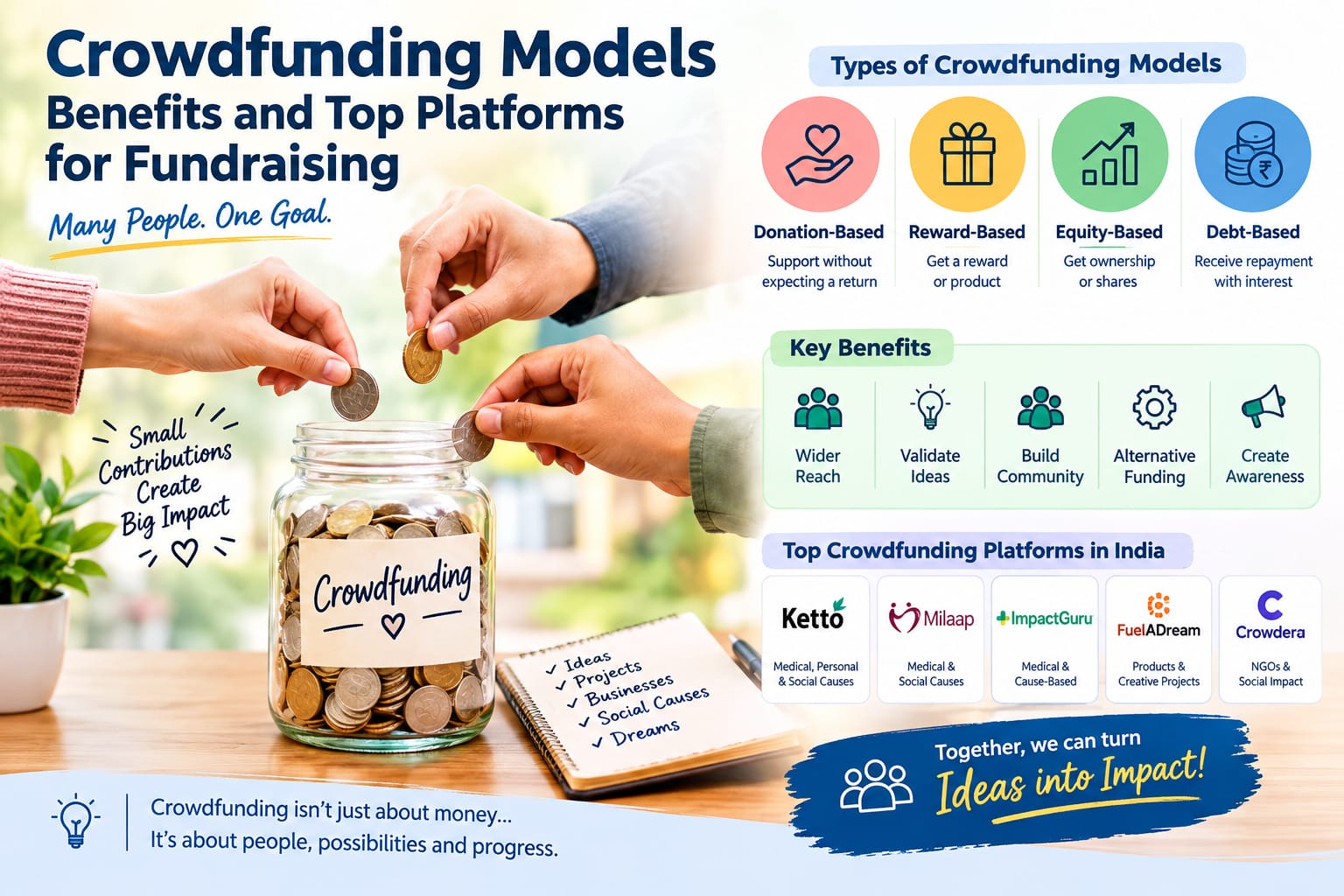
Raising money for a medical emergency, social cause, creative project, startup idea or community initiative can be difficult when personal savings and traditional financing are not enough.
Crowdfunding offers an alternative way to raise money by collecting relatively small contributions from a large number of people, usually through an online platform.
Depending on the model, supporters may simply donate money, receive a product or reward, provide financing that must be repaid, or receive an investment interest. The legal and regulatory treatment can differ significantly between these models.
In India, donation-based fundraising platforms such as Milaap, Ketto and ImpactGuru are prominent examples of online fundraising services. Their websites currently describe fundraising for areas including medical needs, education, NGOs, personal causes and social initiatives.
This guide explains the major crowdfunding models, how crowdfunding works, its advantages and disadvantages, how to create a campaign, and what to check before choosing a platform.
Crowdfunding is a method of raising money from a large group of people, usually through an online platform. Instead of depending on one lender, investor or donor, a campaign can receive many smaller contributions.
The four commonly discussed models are donation-based, reward-based, equity-based and debt/lending-based crowdfunding. The model determines what contributors receive and what regulatory requirements may apply.
For individuals and charitable causes in India, donation-based crowdfunding is commonly used for medical expenses, education, emergencies, NGOs and social causes. Platforms such as Milaap, Ketto and ImpactGuru provide online fundraising services in these areas.
What Is Crowdfunding?
Crowdfunding is an online fundraising method where a campaign creator seeks financial support from a large number of contributors.
A campaign may be created for:
- Medical treatment
- Education
- Emergency expenses
- Social causes
- NGO projects
- Community initiatives
- Creative projects
- Product development
- Business ideas
- Sports and artistic activities
The basic concept is simple:
Campaign → Online platform → Public visibility → Contributions → Fund distribution
However, not every crowdfunding campaign works in the same way.
The contributor's relationship with the campaign depends on the crowdfunding model.
How Does Crowdfunding Work?
A typical crowdfunding campaign follows several stages.
Step 1: Define the fundraising objective
The campaign creator identifies:
- Why money is required
- How much is needed
- Who will benefit
- How the money will be used
- When the funds are required
A specific objective generally makes a campaign easier for potential supporters to understand.
Step 2: Choose the appropriate crowdfunding model
The creator decides whether the campaign is based on:
- Donations
- Rewards
- Investment
- Lending
The choice is important because each model has different financial, legal and operational implications.
Step 3: Select a platform
The creator chooses a crowdfunding website that supports the required campaign category.
Important considerations include:
- Platform reputation
- Supported causes
- Verification process
- Payment methods
- Platform charges
- Withdrawal rules
- Documentation
- Privacy policies
- Donor support
- Campaign management tools
Step 4: Create the campaign
A strong campaign usually contains:
- Clear title
- Fundraising target
- Detailed explanation
- Beneficiary information
- Supporting documents
- Photos or videos
- Expected use of funds
- Contact information
For example, Milaap says its fundraiser setup involves providing information about the fundraiser and beneficiary, followed by review and withdrawal of funds.
Step 5: Share the campaign
A campaign's success often depends heavily on visibility.
Creators may share it through:
- Personal networks
- Community groups
Step 6: Receive contributions
Supporters contribute through the payment methods provided by the platform.
Step 7: Provide updates
Regular updates can help maintain transparency and keep supporters informed about progress.
Step 8: Withdraw or distribute funds
Depending on the platform and campaign type, funds may be transferred to the beneficiary, hospital, bank account or another permitted recipient.
Major Crowdfunding Models
There are four widely discussed crowdfunding models.
| Model | What Supporters Provide | What They Receive | Common Uses |
|---|---|---|---|
| Donation-based | Money as a donation | Usually no financial return | Medical, charity, emergencies |
| Reward-based | Money | Product, experience or reward | Creative projects, products |
| Equity-based | Investment capital | Potential ownership/equity | Startups and businesses |
| Debt/Lending-based | Loan capital | Repayment and potentially interest | Business or personal financing |
The regulatory framework can differ substantially between these categories. SEBI's consultation material has historically distinguished donation/reward crowdfunding from peer-to-peer lending and equity crowdfunding, noting that lending and securities-based models can fall under financial-sector regulation.
1. Donation-Based Crowdfunding
Donation crowdfunding is one of the most familiar models.
People contribute money because they want to support a person, family, NGO, social cause or project.
Generally, the contributor does not expect a financial return.
Common examples
- Cancer treatment
- Organ transplant
- Accident treatment
- Education expenses
- Disaster relief
- Animal welfare
- Community development
- NGO programs
- Emergency assistance
Platforms such as ImpactGuru describe their service as connecting donors and beneficiaries without providing financial returns to contributors.
Milaap currently lists categories including medical, education, NGO, memorial, sports, animals, environment and other causes.
Benefits of donation crowdfunding
- No conventional loan repayment for donated funds
- Access to a large donor network
- Can reach people outside the campaigner's immediate circle
- Online payment collection
- Potentially fast campaign creation
- Useful during emergencies
Limitations
- Donations are not guaranteed
- Campaign visibility matters
- Supporting documents may be required
- Platform and payment charges may apply
- Fundraising targets may not be achieved
2. Reward-Based Crowdfunding
Reward crowdfunding is commonly associated with creative projects, new products and community-supported ideas.
Instead of receiving equity, contributors may receive something connected with the project.
For example:
₹1,000 contribution → Early access or merchandise
₹5,000 contribution → Product + additional benefits
₹10,000 contribution → Premium version or special experience
The exact structure depends on the campaign.
Common uses
- New products
- Films
- Games
- Books
- Music
- Art projects
- Technology products
- Creative campaigns
The key distinction is that the contributor expects a reward rather than ownership of the company.
3. Equity Crowdfunding
Equity crowdfunding involves raising capital from investors in exchange for an ownership interest or securities.
For example, a startup might seek funding from multiple investors instead of relying entirely on one venture capital investor.
However, equity crowdfunding should not be treated like ordinary donation crowdfunding.
It can involve:
- Securities
- Investor rights
- Disclosure requirements
- Company-law considerations
- Securities-market regulations
- Investor risk
SEBI's crowdfunding consultation material specifically discusses crowd-sourced equity funding separately from donation and reward crowdfunding.
Important: Anyone considering an equity-based crowdfunding structure in India should obtain appropriate legal and regulatory advice rather than assuming that a model permitted elsewhere is automatically permitted in India.
4. Debt or Lending-Based Crowdfunding
Debt crowdfunding involves contributors providing money that is expected to be repaid according to agreed terms.
Peer-to-peer lending is a related regulated financial activity in India.
The RBI's framework provides for NBFC-P2P platforms, which operate as intermediaries between participants in peer-to-peer lending. RBI directions require eligible platforms to obtain registration and set out restrictions on their activities.
RBI also clarified in 2024 that NBFC-P2P platforms cannot assume the credit risk arising from transactions on their platforms; losses of principal or interest are borne by lenders according to the applicable framework.
This makes it important to distinguish ordinary donation crowdfunding from regulated lending platforms.
Crowdfunding vs Traditional Loans
Crowdfunding and borrowing solve different financial problems.
| Feature | Crowdfunding | Traditional Loan |
|---|---|---|
| Main source of money | Multiple contributors | Lender |
| Repayment | Depends on model | Usually required |
| Interest | Usually absent in donations | Usually charged |
| Credit assessment | Depends on platform/model | Usually important |
| Purpose | Causes, projects, products, investment | Personal/business/other financing |
| Public campaign | Usually required for public crowdfunding | Generally not |
| Success certainty | Not guaranteed | Depends on eligibility and approval |
| Documentation | Depends on campaign | Lender-specific |
| Ownership impact | Depends on model | Usually no ownership transfer |
A donation campaign is therefore not simply another type of personal loan.
Benefits of Crowdfunding
1. Access to a Larger Audience
An online campaign can reach people beyond the campaigner's immediate community.
Social media makes it possible to share a fundraiser across multiple networks.
2. Useful During Emergencies
Medical emergencies can create large expenses within a short period.
Crowdfunding allows families to communicate their financial need and request contributions from a broader community.
3. Lower Dependence on One Funding Source
Instead of relying entirely on one person or institution, crowdfunding can bring together contributions from many supporters.
4. Easy Digital Payments
Modern platforms can provide online payment options that make contributing more convenient.
Milaap, for example, currently lists UPI, cards, net banking, wallets and other payment options for donations.
5. Storytelling Can Build Awareness
A well-explained campaign can help people understand the problem and the intended impact.
6. Community Support
Crowdfunding can bring together family members, friends, colleagues, communities and strangers around a common cause.
Disadvantages and Risks of Crowdfunding
Crowdfunding is not free money and does not guarantee success.
1. No Guaranteed Funding
Creating a fundraiser does not mean the target will automatically be reached.
2. Privacy Concerns
Campaign creators may have to share personal, financial or medical information.
Before publishing sensitive information, check the platform's privacy policy.
3. Platform Fees
The headline platform fee is not necessarily the only cost.
Possible charges may include:
- Payment gateway fees
- Processing charges
- Applicable taxes
- Optional promotional services
- Other platform-specific charges
Always check the platform's current pricing page.
4. Fraud Risk
Fake campaigns can damage donor trust.
Both campaigners and donors should verify information before making or requesting contributions.
5. Emotional Pressure
Medical and emergency campaigns can involve sensitive personal stories. Campaign creators should provide truthful information without exaggerating claims.
6. Regulatory Risk
Equity and lending models can involve securities and financial regulation.
A crowdfunding model should therefore be assessed according to its actual structure, not merely its marketing description.
Pros and Cons of Crowdfunding
| Pros | Cons |
|---|---|
| Wider reach | Funding is not guaranteed |
| Easy online sharing | Requires campaign promotion |
| Useful for emergencies | Privacy concerns |
| Can mobilize communities | Platform/payment costs may apply |
| Multiple contributors | Fraud can occur |
| Digital payment options | Regulatory issues for some models |
| Can build awareness | Campaign management takes time |
Top Crowdfunding Platforms for Fundraising in India
Instead of treating one platform as universally "best," it is more useful to compare platforms based on campaign purpose, supported categories, fees, verification, payment options and withdrawal rules.
1. Milaap
Milaap is an Indian online fundraising platform that supports categories including medical needs, education, NGOs, social causes, sports, animals and environmental campaigns.
Its current fundraiser pages describe campaign setup, verification, sharing tools and withdrawals.
Useful for: Medical, education, NGO and social fundraising.
2. Ketto
Ketto provides crowdfunding services for medical, social and charitable causes.
Its website describes fundraising for medical treatment, NGOs, education and other causes, as well as campaign creation, sharing and fund withdrawal.
Useful for: Medical and social fundraising campaigns.
3. ImpactGuru
ImpactGuru supports fundraising across categories such as medical treatment, NGOs, education, personal causes, film, sports and travel.
ImpactGuru also states that it is an online technology platform connecting donors and beneficiaries and that it does not provide financial returns to contributors on its platform.
Useful for: Medical, NGO, personal and social causes.
Crowdfunding Platform Comparison
| Platform | Key Categories | Campaign Type | Notable Features |
|---|---|---|---|
| Milaap | Medical, education, NGO, social causes | Primarily donation-based | Campaign tools, social sharing, verification |
| Ketto | Medical, education, NGOs, social causes | Primarily donation-based | Fundraising dashboard, campaign sharing |
| ImpactGuru | Medical, NGO, education, personal, creative | Donation-based fundraising | Fundraiser assistance, multiple categories |
Note: Fees, payment methods, eligibility, verification requirements and withdrawal conditions can change. Check each platform's current terms before launching or contributing to a campaign.
How to Choose a Crowdfunding Platform
Choosing a platform should start with the purpose of the fundraiser.
Check these 10 factors
- Campaign category
- Platform charges
- Payment processing fees
- Verification requirements
- Withdrawal process
- Supported payment methods
- Donor reach
- Customer support
- Privacy and data policies
- Terms and conditions
Ask before starting
- Does the platform support my type of campaign?
- What documents are required?
- What fees will be deducted?
- Who can withdraw the money?
- Can I edit the campaign after publishing?
- How long does verification take?
- Are international donations supported?
- What happens if the campaign target is not reached?
How to Create a Successful Crowdfunding Campaign
Step 1: Set a Realistic Goal
Avoid choosing an arbitrary number.
Calculate:
Estimated requirement = Actual expenses + reasonable related costs
For medical fundraising, supporting documents such as estimates, bills and medical reports can help establish credibility.
Step 2: Write a Clear Story
A good campaign should quickly answer:
- Who needs help?
- What happened?
- How much money is required?
- What will the money pay for?
- Why is support needed now?
Step 3: Add Supporting Evidence
Depending on the campaign, this can include:
- Bills
- Estimates
- Reports
- Registration documents
- Project details
- Photographs
- Relevant certificates
ImpactGuru, for example, lists supporting documentation such as medical reports, doctor letters and medical bills among the information that may be required for medical fundraisers.
Step 4: Use a Specific Headline
Instead of:
"Please Help Us"
Use something more informative:
"Help Fund Rahul's Emergency Heart Surgery"
A clear headline tells visitors immediately what the campaign is about.
Step 5: Explain the Fund Usage
A simple breakdown can improve transparency.
For example:
| Expense | Estimated Amount |
|---|---|
| Hospital treatment | ₹2,00,000 |
| Medicines | ₹50,000 |
| Diagnostic tests | ₹25,000 |
| Follow-up care | ₹25,000 |
| Total | ₹3,00,000 |
Step 6: Share Consistently
Start with people who already know you.
Then expand through:
- Social media
- Community groups
- Local organizations
- Professional networks
Step 7: Publish Updates
Share genuine updates about:
- Progress
- Amount raised
- Expenses
- Remaining requirement
- Important milestones
Transparency can help maintain donor confidence.
Real-World Experience: What Often Makes a Campaign Work?
In practical fundraising, launching the page is only the beginning.
Campaigners commonly need to spend time on:
Communication
People need to understand the problem quickly.
Trust
Donors may want evidence before contributing.
Consistency
A campaign shared once may not reach everyone who could help.
Updates
Regular, factual updates can keep the campaign visible.
Documentation
Supporting evidence can answer questions before donors need to ask them.
The important lesson is simple:
A crowdfunding platform provides infrastructure; the campaign creator still has to communicate, build trust and actively reach potential supporters.
Crowdfunding Safety Tips for Donors
Before donating:
Verify the campaign
Check:
- Beneficiary details
- Supporting documents
- Hospital information where relevant
- Campaign updates
- Organizer identity
- Platform verification information
Do not share sensitive banking information
Never give:
- OTPs
- UPI PINs
- Internet banking passwords
- Card PINs
A legitimate donation does not require you to disclose your banking credentials.
Check the URL
Use the official platform website or app rather than an unfamiliar link received through a random message.
Understand tax claims
Do not automatically assume every donation qualifies for a tax deduction.
Tax treatment depends on the recipient, applicable provisions and documentation.
Crowdfunding Safety Tips for Campaign Creators
Campaign creators should:
- Provide truthful information
- Keep supporting documents ready
- Avoid exaggerated claims
- Explain how money will be used
- Protect beneficiary privacy
- Keep donors updated
- Follow platform rules
- Maintain records of funds received and spent
- Understand applicable tax requirements
For organizations, additional legal and reporting requirements may apply depending on the nature of the organization and donations.
Is Crowdfunding Legal in India?
The answer depends on the type and structure of crowdfunding.
Donation-based fundraising for legitimate causes operates through online platforms in India.
However, crowdfunding should not be treated as one single regulated financial product.
SEBI's consultation material distinguishes donation/reward crowdfunding from peer-to-peer lending and equity crowdfunding.
For peer-to-peer lending, RBI regulates NBFC-P2P platforms under its applicable framework. RBI's directions state that an NBFC-P2P platform must obtain a Certificate of Registration and operate within specified restrictions.
Therefore:
Donation crowdfunding ≠ Equity crowdfunding ≠ P2P lending
Anyone planning a business, investment or lending-based crowdfunding structure should obtain professional legal and regulatory advice.
Crowdfunding vs Personal Loan
Crowdfunding and personal loans can both provide access to money, but they work differently.
Crowdfunding
Money comes from multiple supporters.
There may be no repayment obligation in donation-based campaigns.
Personal Loan
Money comes from a lender and must generally be repaid according to the loan agreement, usually with interest.
The right financial route depends on the purpose, eligibility, urgency, cost and ability to repay.
When Is Crowdfunding Useful?
Crowdfunding may be useful when:
- You have a genuine community-supported cause
- You need emergency assistance
- You are raising money for an NGO
- You have a creative project
- You need public support for a social initiative
- Friends and family can help amplify your campaign
- You can provide transparent documentation
It may be less suitable when:
- The campaign has no clear purpose
- You cannot provide evidence
- You require guaranteed financing
- You need a predictable repayment-based funding arrangement
- Your campaign involves securities without appropriate regulatory advice
Crowdfunding and Financial Planning
Crowdfunding should not automatically replace financial planning.
For individuals, a broader financial strategy may include:
- Emergency savings
- Health insurance
- Life insurance where appropriate
- Responsible borrowing
- Regular savings
- Income diversification
- Expense management
For businesses and startups, crowdfunding can be considered alongside other funding sources such as:
- Bootstrapping
- Bank finance
- Venture capital
- Angel investment
- Grants
- Strategic partnerships
The suitability of each source depends on the specific situation.
Key Takeaways
- Crowdfunding raises money from a large number of contributors, generally through an online platform.
- The major models include donation, reward, equity and debt/lending crowdfunding.
- Donation crowdfunding is commonly used for medical, personal, educational and social causes.
- Milaap, Ketto and ImpactGuru are examples of platforms operating online fundraising services in India.
- A successful campaign needs more than a fundraising page—it needs clear communication, documentation and active sharing.
- Platform fees, payment charges and withdrawal conditions should be checked before starting a campaign.
- Donors should verify campaigns and never share OTPs, PINs or passwords.
- Equity and lending-based crowdfunding can involve financial-sector regulations and should not be confused with donation crowdfunding.
- RBI regulates NBFC-P2P lending platforms under its applicable framework.
- Always check the latest platform terms and applicable laws before fundraising or investing.
Frequently Asked Questions
1. What is crowdfunding?
Crowdfunding is a fundraising method in which many people contribute money toward a particular person, cause, project, product or business through an online platform.
2. What are the four main crowdfunding models?
The commonly discussed models are donation-based, reward-based, equity-based and debt/lending-based crowdfunding.
3. How does donation crowdfunding work?
A campaign creator explains a genuine financial need and asks supporters to contribute. Donors generally do not receive a financial return.
4. What are the benefits of crowdfunding?
Major benefits include wider reach, online payments, community support, faster communication and the ability to receive many smaller contributions.
5. What are the disadvantages of crowdfunding?
There is no guarantee that the target will be achieved. Campaigners may also face privacy concerns, platform charges, fraud risks and significant promotional work.
6. Which crowdfunding platforms are available in India?
Examples include Milaap, Ketto and ImpactGuru, particularly for donation-based campaigns and social or medical causes.
7. Is crowdfunding legal in India?
Legality depends on the type and structure of the crowdfunding activity. Donation crowdfunding and regulated lending or securities-based crowdfunding should not be treated as the same activity.
8. Can crowdfunding be used for medical expenses?
Yes. Medical crowdfunding is a major use case for online fundraising platforms in India. Milaap, Ketto and ImpactGuru all currently feature medical fundraising services.
9. Do crowdfunding campaigns always reach their target?
No. Fundraising depends on the campaign's credibility, purpose, network, communication, donor interest and other factors.
10. Do crowdfunding platforms charge fees?
Fees vary by platform and campaign. Some platforms advertise low or zero platform fees for certain campaigns, while payment-processing or other charges may still apply. Always check the current pricing terms.
11. Can startups use crowdfunding?
Startups can use certain forms of crowdfunding internationally, including reward and investment-based models. In India, however, the legal and regulatory structure for securities-based fundraising requires careful consideration.
12. What documents are needed for crowdfunding?
Requirements vary. Medical campaigns may require hospital documents, bills or medical reports, while NGO and business campaigns may require organizational or project documentation.
13. How can I make my crowdfunding campaign successful?
Set a realistic target, explain the situation clearly, provide supporting evidence, use strong visuals, share the campaign consistently and publish genuine updates.
14. Is crowdfunding better than a personal loan?
They serve different purposes. Donation crowdfunding generally does not create the same repayment obligation as a loan, while a personal loan provides financing that must normally be repaid with interest.
15. What should donors check before contributing?
Check the campaign details, beneficiary information, supporting documents, platform verification, updates and payment page. Never disclose OTPs, PINs or banking passwords.
Published on : 26th September
Published by : Shanlee JV
www.vizzve.com || www.vizzveservices.com
Follow us on social media: Facebook || Linkedin || Instagram
🛡 Powered by Vizzve Financial
RBI-Registered Loan Partner | 10 Lakh+ Customers | ₹600 Cr+ Disbursed