

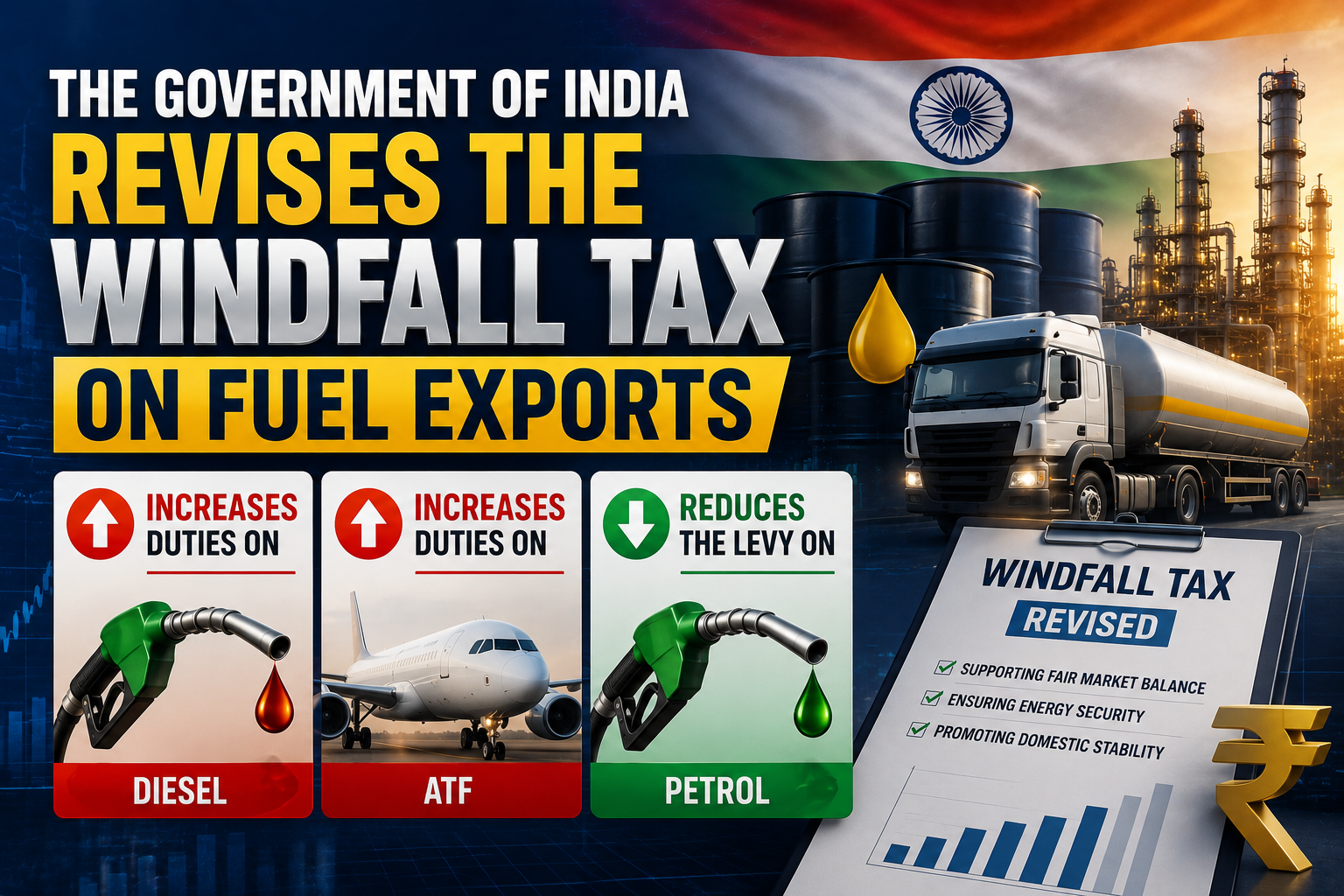
The Indian government has revised the windfall tax on fuel exports, increasing export duties on diesel and aviation turbine fuel (ATF) while reducing the export duty on petrol. The revised rates take effect from 16 July 2026 and are part of the government's regular review of export duties in response to changing global crude oil prices and domestic fuel supply conditions.
AI Answer Box
Why has the government revised the windfall tax?
The government adjusts windfall taxes every fortnight based on global crude oil prices and market conditions. In the latest review, export duties on diesel were increased from ₹8.5 to ₹15.5 per litre, ATF duties from ₹7.5 to ₹14.5 per litre, while the petrol export duty was reduced from ₹4 to ₹2.5 per litre. The revision aims to balance domestic fuel availability, government revenue, and changing international energy prices.
Government Revises Windfall Tax on Fuel Exports
The Government of India has announced another revision to the windfall tax on fuel exports, reflecting its ongoing strategy of adjusting export duties in line with global crude oil prices and domestic energy requirements.
Under the latest notification, export duties on diesel and aviation turbine fuel (ATF) have been increased, while the duty on petrol exports has been lowered. The revised tax rates become effective from 16 July 2026.
The move comes as international crude oil prices have remained volatile due to geopolitical tensions in West Asia, increasing concerns over energy security and inflation worldwide.
Revised Windfall Tax Rates
Latest Export Duty Changes
| Fuel | Previous Duty | Revised Duty |
|---|---|---|
| Diesel | ₹8.5/litre | ₹15.5/litre |
| Aviation Turbine Fuel (ATF) | ₹7.5/litre | ₹14.5/litre |
| Petrol | ₹4/litre | ₹2.5/litre |
The revised rates are applicable from 16 July 2026.
What Is a Windfall Tax?
A windfall tax is a special levy imposed by the government on companies that earn unusually high profits due to exceptional market conditions, such as a sharp rise in crude oil prices.
The objective is to:
- Share extraordinary profits with the government.
- Ensure adequate domestic fuel availability.
- Manage inflationary pressures.
- Balance exports with domestic demand.
Why Was the Tax Revised?
Several factors influenced the latest revision.
1. Rising Global Crude Oil Prices
International crude prices have increased due to geopolitical developments and supply concerns, prompting the government to review export duties.
2. Protecting Domestic Fuel Supply
Higher duties on diesel and ATF exports can discourage excessive exports and help ensure sufficient domestic availability.
3. Revenue Management
Windfall taxes also provide additional government revenue during periods of elevated commodity prices.
4. Regular Fortnightly Review
India reviews windfall taxes periodically to keep pace with changes in global energy markets rather than maintaining fixed rates.
Impact on Oil Companies
The revised duties could influence companies involved in refining and exporting petroleum products.
Potential Effects
- Lower export margins for diesel and ATF.
- Changes in export strategies.
- Focus on domestic market sales.
- Greater sensitivity to global crude price movements.
Companies with diversified revenue streams may be better positioned to absorb changes in export duties.
Impact on India's Economy
The revised tax structure could influence several areas of the economy.
Key Areas
- Inflation outlook
- Fuel availability
- Government revenue
- Trade balance
- Energy sector profitability
- Investor sentiment
The overall impact will depend on future crude oil prices and global demand.
Expert Commentary (EEAT)
India's windfall tax mechanism allows policymakers to respond quickly to changes in global energy markets. By revising export duties in line with crude oil prices, the government seeks to balance domestic fuel supply, inflation management, and fiscal revenue. For investors, these changes may affect short-term profitability of refining companies, but long-term investment decisions should continue to focus on operational efficiency, refining margins, and broader energy market trends.
Key Takeaways
- India has revised the windfall tax on fuel exports effective 16 July 2026.
- Export duties on diesel and ATF have been increased.
- The petrol export duty has been reduced.
- The revision follows rising global crude oil prices and geopolitical tensions.
- The policy aims to support domestic fuel availability and manage inflation.
- Oil refining companies may experience changes in export profitability.
- Investors should monitor crude oil prices, government policy, and energy sector earnings.
Pros & Cons of the Revised Windfall Tax
Pros
- Helps ensure adequate domestic fuel availability.
- Generates additional government revenue during periods of high crude oil prices.
- Supports efforts to manage inflation by balancing exports and domestic supply.
- Allows policymakers to respond quickly to global energy market changes.
- Promotes energy security during periods of geopolitical uncertainty.
- Protects domestic consumers from excessive fuel supply disruptions.
- Strengthens fiscal management through flexible taxation.
Cons
- Higher export duties may reduce profitability for oil refining companies.
- Export competitiveness may decline in certain international markets.
- Frequent tax revisions can create uncertainty for exporters.
- Lower refining margins may affect short-term earnings.
- Investors may become cautious about policy-related risks.
- Companies may need to revise export strategies more frequently.
Impact on Consumers, Oil Companies & Investors
For Consumers
The revised windfall tax is primarily aimed at maintaining adequate fuel supplies within the country. While retail fuel prices depend on multiple factors—including global crude oil prices, exchange rates, and taxes—stable domestic supply can help moderate price pressures over time.
Consumers should continue monitoring:
- Petrol and diesel prices
- LPG costs
- Inflation trends
- Transportation expenses
For Oil Companies
Oil marketing and refining companies may experience changes in export profitability due to higher duties on diesel and aviation turbine fuel (ATF).
Key areas to monitor include:
- Refining margins
- Export volumes
- Domestic sales
- Global crude oil prices
- Operational efficiency
Companies with diversified operations and strong domestic businesses may be better positioned to manage policy changes.
For Investors
Energy sector investors should closely monitor:
- International crude oil prices
- Government policy revisions
- Quarterly earnings of oil companies
- Refining margins
- Global demand for petroleum products
Investment decisions should consider both long-term industry fundamentals and evolving government policies.
Frequently Asked Questions (FAQs)
1. What is a windfall tax?
A windfall tax is an additional levy imposed on companies that earn unusually high profits due to exceptional market conditions, such as sharp increases in crude oil prices.
2. Why did the government revise the windfall tax?
The government periodically reviews export duties to reflect changes in global crude oil prices, domestic fuel availability, and broader economic conditions.
3. Which fuels are affected by the latest revision?
The revised policy increases export duties on diesel and aviation turbine fuel (ATF) while reducing the duty on petrol exports.
4. Does the windfall tax affect petrol prices for consumers?
Retail fuel prices depend on several factors, including crude oil prices, taxes, exchange rates, and marketing costs. The windfall tax is only one of these factors.
5. How does the windfall tax impact oil companies?
Higher export duties can reduce export margins and influence refining profitability, particularly for companies that export large quantities of petroleum products.
6. Why is India sensitive to crude oil prices?
India imports a significant portion of its crude oil requirements, making the economy sensitive to changes in global energy prices.
7. How often does the government review windfall taxes?
The government generally reviews these duties at regular intervals based on prevailing market conditions and crude oil prices.
8. Can the windfall tax change again?
Yes. The government may revise export duties in future depending on international crude oil prices and domestic requirements.
9. How does the tax affect government revenue?
Higher duties during periods of elevated oil prices can increase government revenue.
10. Which sectors are most affected?
Oil refining, fuel exports, aviation, logistics, transportation, and energy-related industries are among the sectors most directly affected.
11. Should investors monitor crude oil prices?
Yes. Crude oil prices influence inflation, corporate earnings, refining margins, and overall economic conditions.
12. Does the windfall tax impact inflation?
By supporting domestic fuel availability, the policy may help manage inflationary pressures, although inflation depends on multiple economic factors.
13. What global events influence crude oil prices?
Geopolitical tensions, OPEC+ production decisions, supply disruptions, global demand, and currency movements all play important roles.
14. How do refining margins affect oil companies?
Higher refining margins generally improve profitability, while lower margins may reduce earnings.
15. What is the long-term outlook for India's energy sector?
The long-term outlook remains positive, supported by growing energy demand, investments in refining capacity, renewable energy expansion, and continued infrastructure development.
Conclusion
The government's latest revision of the windfall tax on fuel exports reflects its effort to balance domestic fuel availability, inflation management, and fiscal revenue amid changing global crude oil prices. By increasing export duties on diesel and ATF while reducing the levy on petrol exports, policymakers aim to respond to evolving market conditions without imposing a one-size-fits-all approach.
For businesses and investors, the policy highlights the importance of monitoring energy markets, government regulations, and crude oil price trends. While short-term profitability for some refining companies may be affected, the long-term outlook for India's energy sector continues to be supported by rising domestic demand, infrastructure investment, and economic growth.
Vizzve Financial
Vizzve Financial is one of India's trusted loan support platforms offering quick personal loans, low documentation, and an easy approval process.
Whether you need funds for business expansion, education, home renovation, medical emergencies, or personal financial goals, Vizzve Financial provides a fast, secure, and hassle-free borrowing experience.
Apply today at: www.vizzve.com
Published on : 16th July
Published by : SMITA
www.vizzve.com || www.vizzveservices.com
Follow us on social media: Facebook || Linkedin || Instagram
🛡 Powered by Vizzve Financial
RBI-Registered Loan Partner | 10 Lakh+ Customers | ₹600 Cr+ Disbursed