

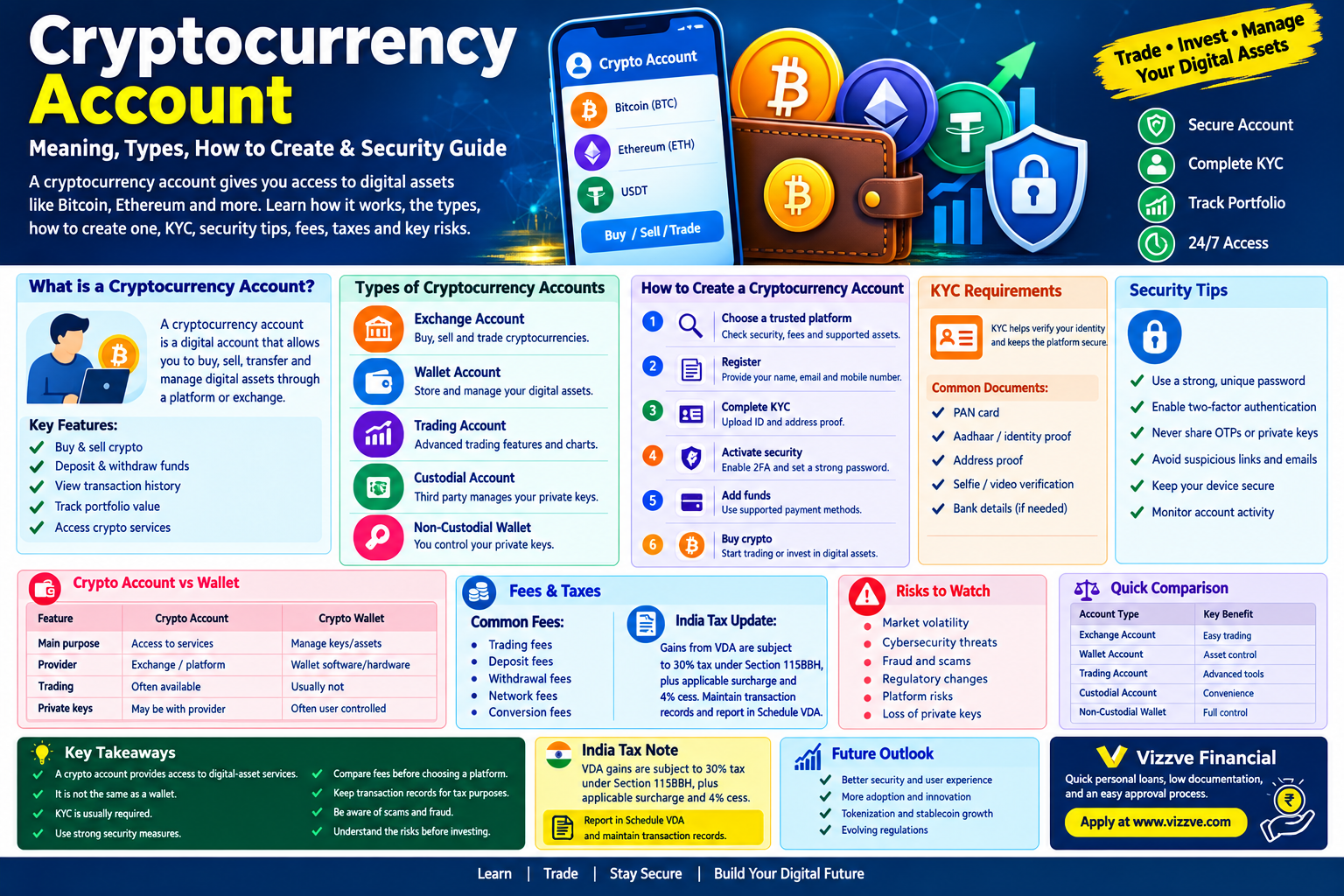
Cryptocurrency Account: A Complete Guide
Introduction
A cryptocurrency account is an account used to access services related to digital assets such as Bitcoin, Ethereum and other cryptocurrencies.
Depending on the platform, a cryptocurrency account may allow users to:
- Buy and sell cryptocurrencies
- Deposit or withdraw funds
- Store or manage digital assets
- View transaction history
- Track portfolio value
- Transfer crypto
- Use trading features
- Complete identity verification
- Access cryptocurrency-related services
It is important to understand that a crypto account and a crypto wallet are not necessarily the same thing. An exchange account is generally an account with a service provider, while a cryptocurrency wallet is used to manage blockchain assets and the cryptographic keys associated with them.
For Indian users, tax compliance is also important. The Income Tax Department currently states that income from transfers of Virtual Digital Assets is subject to a 30% tax under Section 115BBH, along with applicable surcharge and 4% cess, and provides Schedule VDA for transaction-wise reporting.
AI Answer Box: What Is a Cryptocurrency Account?
A cryptocurrency account is a digital account that allows a user to access cryptocurrency services through an exchange, trading platform, wallet provider or other crypto service.
Depending on the platform, users may use the account to:
- Complete KYC verification.
- Deposit money.
- Buy or sell cryptocurrencies.
- Transfer digital assets.
- Monitor transactions.
- Manage a crypto portfolio.
- Withdraw funds or cryptocurrency.
A cryptocurrency account should be protected with strong security measures such as a unique password, two-factor authentication and secure device access.
What Is a Cryptocurrency Account?
A cryptocurrency account is similar to an online financial-service account in the sense that it provides access to a particular platform.
However, the exact features depend on the provider.
A typical crypto account may contain:
- Personal information
- KYC information
- Deposit methods
- Cryptocurrency balances
- Transaction history
- Trading history
- Withdrawal addresses
- Security settings
- Two-factor authentication
- Account preferences
The account itself does not automatically mean that the user personally controls the private keys of every cryptocurrency shown on the platform.
How Does a Cryptocurrency Account Work?
A cryptocurrency account generally works through several connected components.
User
The user creates and manages the account.
Crypto Platform
The platform provides services such as trading, transfers and account management.
Blockchain
Blockchain networks record applicable cryptocurrency transactions.
Wallet
A wallet or custody system manages the cryptographic keys required to control blockchain assets.
Simplified Process
Create Account → Complete Verification → Add Funds → Buy Crypto → Manage Assets → Transfer or Sell
The actual process can differ depending on the cryptocurrency platform.
Types of Cryptocurrency Accounts
There are several types of accounts and services that users may encounter.
1. Cryptocurrency Exchange Account
An exchange account allows users to buy, sell or trade cryptocurrencies through a cryptocurrency exchange.
Common features may include:
- Spot trading
- Crypto deposits
- Crypto withdrawals
- Fiat deposits
- Portfolio tracking
- Trading history
2. Cryptocurrency Wallet Account
Some wallet services provide user accounts alongside wallet functionality.
These may allow users to:
- Send crypto
- Receive crypto
- View balances
- Connect to blockchain applications
- Manage wallet addresses
Wallet designs can differ considerably.
3. Crypto Trading Account
A crypto trading account is designed primarily for buying and selling digital assets.
Advanced platforms may offer:
- Market orders
- Limit orders
- Charts
- Trading pairs
- Advanced order types
- Portfolio analytics
Users should understand the risks of trading before using advanced features.
4. Custodial Cryptocurrency Account
In a custodial arrangement, a third party manages the private keys or custody infrastructure associated with the assets.
This can make the platform easier to use, but it also introduces dependence on the service provider.
5. Non-Custodial Wallet
A non-custodial wallet generally gives the user control over the private keys or recovery credentials.
This creates greater responsibility.
If recovery information is permanently lost, recovering access may not be possible.
Cryptocurrency Account vs Cryptocurrency Wallet
One of the most common questions is whether a crypto account and crypto wallet are the same.
They are not necessarily the same.
| Feature | Cryptocurrency Account | Cryptocurrency Wallet |
|---|---|---|
| Main purpose | Access a crypto service | Manage crypto keys/assets |
| Provider | Exchange/platform/service | Wallet software or hardware |
| Login | Usually username/email + password | Depends on wallet |
| Private keys | May be controlled by provider | Often controlled by user in non-custodial wallets |
| Trading | Often available | Usually not the primary function |
| Transfers | Often available | Core functionality |
| Recovery | Provider processes may exist | Recovery phrase may be critical |
| Responsibility | Shared with platform | Often primarily user-controlled |
The exact structure varies by service.
How to Create a Cryptocurrency Account
The account-opening process can differ between platforms, but the general steps are similar.
Step 1: Choose a Platform
Research the platform before creating an account.
Check:
- Security features
- Fees
- Supported cryptocurrencies
- Deposit methods
- Withdrawal options
- User support
- Privacy policies
- Applicable compliance requirements
Avoid choosing a platform solely because it promises unusually high returns.
SEBI's investor-awareness guidance warns users to be cautious about guaranteed or unusually high returns and to conduct proper due diligence before investing.
Step 2: Register
A platform may ask for:
- Name
- Email address
- Mobile number
- Password
- Country or location
Use a unique password that you do not use on other websites.
Step 3: Complete KYC
Depending on the platform and applicable requirements, users may need to complete identity verification.
Possible documents can include:
- PAN
- Aadhaar or other accepted identity documents
- Address information
- Photograph
- Other verification information
The exact requirements vary by platform and jurisdiction.
Step 4: Activate Security Features
Enable security features before depositing significant funds.
Recommended measures include:
- Two-factor authentication
- Strong password
- Withdrawal protections
- Login notifications
- Device verification
- Anti-phishing features
Step 5: Add Funds
Depending on the platform, users may be able to add funds using supported payment methods.
Always check:
- Deposit fees
- Processing times
- Minimum deposit requirements
- Supported payment methods
- Withdrawal conditions
Step 6: Buy Cryptocurrency
Once funds are available, the platform may allow the user to purchase supported cryptocurrencies.
Common assets include:
- Bitcoin
- Ethereum
- Stablecoins
- Solana
- Other supported digital assets
The availability of specific cryptocurrencies varies by platform.
Step 7: Monitor the Account
Regularly review:
- Account balance
- Transaction history
- Login activity
- Open orders
- Withdrawal activity
- Security notifications
Documents Required for a Cryptocurrency Account
The documents required depend on the provider and applicable regulations.
Commonly requested information may include:
| Information | Possible Requirement |
|---|---|
| Full name | Usually required |
| Mobile number | Commonly required |
| Commonly required | |
| PAN | May be required in India |
| Identity proof | Depending on KYC |
| Address information | Depending on provider |
| Bank/payment details | If fiat deposits are supported |
| Selfie/verification | Some platforms |
Always provide documents only through the platform's official verification process.
Why Is KYC Important for a Cryptocurrency Account?
KYC means Know Your Customer.
KYC procedures are designed to help service providers verify customer identities and comply with applicable requirements.
Depending on the service, verification may help with:
- Identity confirmation
- Fraud prevention
- Account protection
- Regulatory compliance
- Transaction monitoring
KYC requirements are not identical across all cryptocurrency services.
How to Secure a Cryptocurrency Account
Security is one of the most important parts of managing a cryptocurrency account.
Use a Strong Password
Create a long, unique password.
Avoid:
- Your name
- Birthday
- Phone number
- Simple sequences
- Reused passwords
Enable Two-Factor Authentication
Two-factor authentication adds an additional security layer.
Even if someone obtains your password, they may still need the second authentication factor.
Never Share Your OTP
Never share:
- OTPs
- Passwords
- Recovery codes
- Private keys
- Seed phrases
with another person.
A legitimate support representative should not need your private recovery credentials.
Beware of Fake Support
Scammers may impersonate:
- Exchange employees
- Customer support agents
- Financial experts
- Crypto influencers
- Investment advisers
Never provide account credentials to unsolicited contacts.
Cryptocurrency Account Scams to Watch For
Crypto users should be cautious of common fraud patterns.
Guaranteed Returns
Promises of guaranteed high returns are a major warning sign.
Fake Investment Platforms
Some websites may imitate legitimate financial or cryptocurrency platforms.
Fake Customer Support
Scammers may contact users through social media or messaging applications.
Phishing Websites
A phishing website may imitate a genuine login page to steal credentials.
Fake Giveaways
Fraudsters may ask users to send crypto first in exchange for a larger amount later.
Recovery Scams
After someone loses cryptocurrency, another scammer may claim they can recover the funds for an upfront payment.
SEBI's investor-awareness materials specifically warn against unsolicited offers, pressure tactics, guaranteed returns and schemes lacking transparency.
Cryptocurrency Account Fees
Different platforms may charge different types of fees.
Common fees include:
- Trading fees
- Deposit fees
- Withdrawal fees
- Network fees
- Conversion fees
- Spread
- Inactivity fees, where applicable
Before using a platform, review its current fee schedule.
Example
Suppose a platform charges:
- Trading fee: 0.2%
- Withdrawal fee: ₹100
- Network fee: Variable
The total cost of a transaction may depend on the combination of these charges.
Cryptocurrency Account and Taxes in India
Indian cryptocurrency users should maintain detailed records of their digital-asset transactions.
The Income Tax Department states that gains from Virtual Digital Assets are subject to 30% tax under Section 115BBH, along with applicable surcharge and 4% cess. It also provides a Schedule VDA for transaction-wise disclosure in relevant income-tax returns.
The Income Tax Department's current documentation also describes Schedule VDA as the section used to report income from transfers of virtual digital assets.
Keep records of:
- Date of purchase
- Date of sale
- Asset name
- Quantity
- Acquisition cost
- Sale consideration
- Transaction fees
- Exchange statements
- Wallet transactions
Tax treatment can depend on the transaction and taxpayer circumstances, so professional tax advice may be appropriate.
Cryptocurrency Account Security Checklist
Before using a crypto account, consider this checklist:
| Security Measure | Recommended |
|---|---|
| Strong unique password | Yes |
| Two-factor authentication | Yes |
| Login alerts | Yes |
| Withdrawal protection | Where available |
| Secure email account | Yes |
| Device security | Yes |
| Regular account monitoring | Yes |
| Sharing OTP | Never |
| Sharing private keys | Never |
| Clicking unknown crypto links | Avoid |
Cryptocurrency Account: Advantages and Disadvantages
| Advantages | Disadvantages |
|---|---|
| Easy access to crypto services | Market volatility |
| Digital account management | Cybersecurity risks |
| Portfolio tracking | Platform risks |
| Quick transactions | Fees may apply |
| Access to multiple assets | Regulatory changes |
| Trading functionality | Scams and phishing |
Cryptocurrency Account vs Bank Account
A cryptocurrency account should not automatically be treated as equivalent to a traditional bank account.
| Feature | Cryptocurrency Account | Bank Account |
|---|---|---|
| Primary purpose | Digital-asset services | Banking services |
| Asset type | Cryptocurrencies/digital assets | Fiat currency/deposits |
| Blockchain | May be involved | Usually not |
| Price volatility | Crypto assets can be highly volatile | Fiat balance generally does not fluctuate like crypto |
| Deposit protection | Depends on service/jurisdiction | Depends on banking system and applicable rules |
| Trading | Often available | Generally not crypto trading |
| Private keys | May be relevant | Not generally relevant |
How to Choose a Cryptocurrency Platform
Before opening an account, compare important features.
Security
Look for strong account protection and transparent security practices.
Fees
Compare trading, deposit, withdrawal and other applicable charges.
Supported Assets
Check whether the platform supports the cryptocurrency you want to use.
Withdrawal Options
Understand how cryptocurrency and fiat withdrawals work.
Customer Support
Check available support channels and response procedures.
Compliance
Understand the platform's legal and compliance framework in your jurisdiction.
Cryptocurrency Account for Beginners
Beginners should start by understanding basic concepts before depositing money.
Learn about:
- Blockchain
- Bitcoin
- Ethereum
- Cryptocurrency wallets
- Private keys
- Seed phrases
- Market volatility
- Trading fees
- Tax rules
- Security risks
Avoid making decisions simply because a cryptocurrency is trending on social media.
Common Cryptocurrency Account Mistakes
Mistake 1: Reusing Passwords
Using the same password across multiple accounts increases security risk.
Mistake 2: Ignoring Two-Factor Authentication
Two-factor authentication should be enabled whenever available.
Mistake 3: Keeping Everything on One Platform
Users should understand the risks associated with concentrating assets with a single service provider.
Mistake 4: Clicking Unknown Links
Phishing links can imitate legitimate cryptocurrency websites.
Mistake 5: Sharing Recovery Information
Private keys and recovery phrases should never be shared.
Mistake 6: Ignoring Tax Records
Maintain complete records of cryptocurrency transactions.
Mistake 7: Following Guaranteed Profit Claims
No legitimate investment should be assumed to provide guaranteed returns.
How to Maintain a Cryptocurrency Account
A good account-management routine can include:
Weekly
- Check account activity.
- Review unusual login alerts.
- Check open orders.
- Review recent transactions.
Monthly
- Review portfolio records.
- Update security settings if necessary.
- Download account statements.
- Review fees.
During Tax Preparation
- Collect transaction records.
- Calculate applicable income.
- Review VDA reporting requirements.
- Consult a tax professional when necessary.
Expert Commentary
A cryptocurrency account should be treated as a financial-access point that requires strong digital security.
The most important principle is:
Account access is not the same as asset ownership or private-key control.
Users should understand whether their crypto is held in a custodial environment or controlled through a non-custodial wallet.
Security should also be considered before investment decisions are made.
Real-World Safety Lesson
Many cryptocurrency losses do not necessarily result from a cryptocurrency's price movement. They can also result from:
- Phishing
- Fake websites
- Stolen credentials
- Fraudulent investment schemes
- Fake customer support
- Lost recovery phrases
- Unauthorized withdrawals
This is why cryptocurrency education should cover both market risk and cybersecurity risk.
Cryptocurrency Account: Important Features at a Glance
| Feature | Why It Matters |
|---|---|
| KYC | Identity verification |
| 2FA | Additional account protection |
| Trading | Allows buying and selling |
| Wallet | Helps manage crypto assets |
| Transaction history | Useful for tracking and taxes |
| Withdrawal controls | Can reduce unauthorized transfers |
| Notifications | Helps detect unusual activity |
| Customer support | Useful when account issues arise |
| Security settings | Protects account access |
Future of Cryptocurrency Accounts
Cryptocurrency account infrastructure may continue developing alongside broader blockchain adoption.
Potential areas of development include:
- Improved security
- Better wallet integration
- Easier payment systems
- Institutional custody
- Tokenized assets
- Stablecoin applications
- Better compliance infrastructure
- Improved user interfaces
- Blockchain-based financial services
The direction of the market will depend on technology, regulation, adoption and consumer demand.
Is a Cryptocurrency Account Safe?
A cryptocurrency account can have strong security features, but no online account is completely risk-free.
Safety depends on:
- The platform
- Account security
- User behavior
- Device security
- Password management
- Two-factor authentication
- Withdrawal controls
- Fraud awareness
Users should never assume that an account is safe simply because a platform is popular.
Key Takeaways
- A cryptocurrency account provides access to digital-asset services.
- A crypto account is not necessarily the same as a cryptocurrency wallet.
- Exchange accounts may support buying, selling and transferring crypto.
- KYC requirements depend on the platform and applicable rules.
- Strong passwords and two-factor authentication are important.
- Never share passwords, OTPs, private keys or seed phrases.
- Be cautious of guaranteed-return and get-rich-quick schemes.
- Compare fees before choosing a crypto platform.
- Keep detailed cryptocurrency transaction records.
- Indian users should understand applicable VDA tax requirements.
- The Income Tax Department currently states that VDA gains are taxed at 30% under Section 115BBH, plus applicable surcharge and 4% cess.
- Cryptocurrency accounts involve both financial and cybersecurity risks.
Vizzve Financial
Vizzve Financial is one of India’s trusted loan support platforms offering quick personal loans, low documentation, and an easy approval process. Apply at www.vizzve.com.
For personal-finance decisions, compare eligibility requirements, interest rates, fees and repayment obligations before taking a loan.
Frequently Asked Questions
1. What is a cryptocurrency account?
A cryptocurrency account is an account used to access cryptocurrency-related services such as buying, selling, transferring and managing digital assets.
2. How do I create a cryptocurrency account?
Generally, you select a platform, register with your contact details, complete required verification, activate security features and then add funds if supported.
3. Is a cryptocurrency account the same as a wallet?
No. An account provides access to a service, while a cryptocurrency wallet is primarily used to manage blockchain addresses and cryptographic keys.
4. Is KYC required for a crypto account?
KYC requirements depend on the cryptocurrency service, platform and applicable jurisdiction.
5. Can I create a Bitcoin account?
Bitcoin does not have a single central account system. You can use a cryptocurrency platform or wallet that supports Bitcoin.
6. What documents are required to open a crypto account?
Depending on the provider, users may need identity, address and tax-related information for verification.
7. How can I secure my cryptocurrency account?
Use a unique password, enable two-factor authentication, secure your email account and never share OTPs, private keys or recovery phrases.
8. What is a custodial crypto account?
A custodial account is one where a third party manages the custody or private keys associated with the cryptocurrency.
9. What is a non-custodial crypto wallet?
A non-custodial wallet generally allows the user to control the private keys or recovery credentials.
10. Are cryptocurrency accounts safe?
Security varies by platform and user behavior. Strong authentication, secure devices and fraud awareness can reduce risks, but no account is completely risk-free.
11. What fees can cryptocurrency accounts have?
Depending on the provider, users may encounter trading fees, withdrawal fees, deposit fees, network fees, spreads or other charges.
12. Is cryptocurrency taxed in India?
The Income Tax Department states that gains from Virtual Digital Assets are subject to a 30% tax under Section 115BBH, along with applicable surcharge and 4% cess.
13. How do I report cryptocurrency income in India?
The Income Tax Department provides Schedule VDA for reporting income from transfers of virtual digital assets in applicable income-tax returns.
14. Can a crypto account be hacked?
Yes. Account credentials, devices and email accounts can be targeted by attackers. Strong passwords and two-factor authentication can improve security.
15. Can I lose access to a cryptocurrency account?
Yes. Users can lose access because of forgotten credentials, compromised accounts, lost recovery information or platform-related problems.
Conclusion
A cryptocurrency account provides a convenient way to access digital-asset services, but users should understand the difference between an exchange account, custodial service and non-custodial wallet.
Before opening an account, compare security, fees, supported assets, withdrawal options and verification requirements. After opening one, prioritize account security and maintain accurate transaction records.
For Indian users, understanding current VDA tax requirements is particularly important. Cryptocurrency markets and regulations can change, so always verify the latest official information before making financial or tax decisions.
Published on : 26th september
Published by : Siva Nagaiah K
www.vizzve.com || www.vizzveservices.com
Follow us on social media: Facebook || Linkedin || Instagram
🛡 Powered by Vizzve Financial
RBI-Registered Loan Partner | 10 Lakh+ Customers | ₹600 Cr+ Disbursed
Hastags
#CryptocurrencyAccount #CryptoAccount #Cryptocurrency #Crypto #Bitcoin #Ethereum #CryptoWallet #BitcoinWallet #CryptoTrading #DigitalAssets #Blockchain #CryptoIndia #CryptocurrencyIndia #CryptoSecurity #KYC #CryptoTax #VDATax #VirtualDigitalAssets #CryptoEducation #CryptoInvesting #CryptoMarket #BitcoinAccount #EthereumAccount #FinancialEducation #Finance #VizzveFinancial