

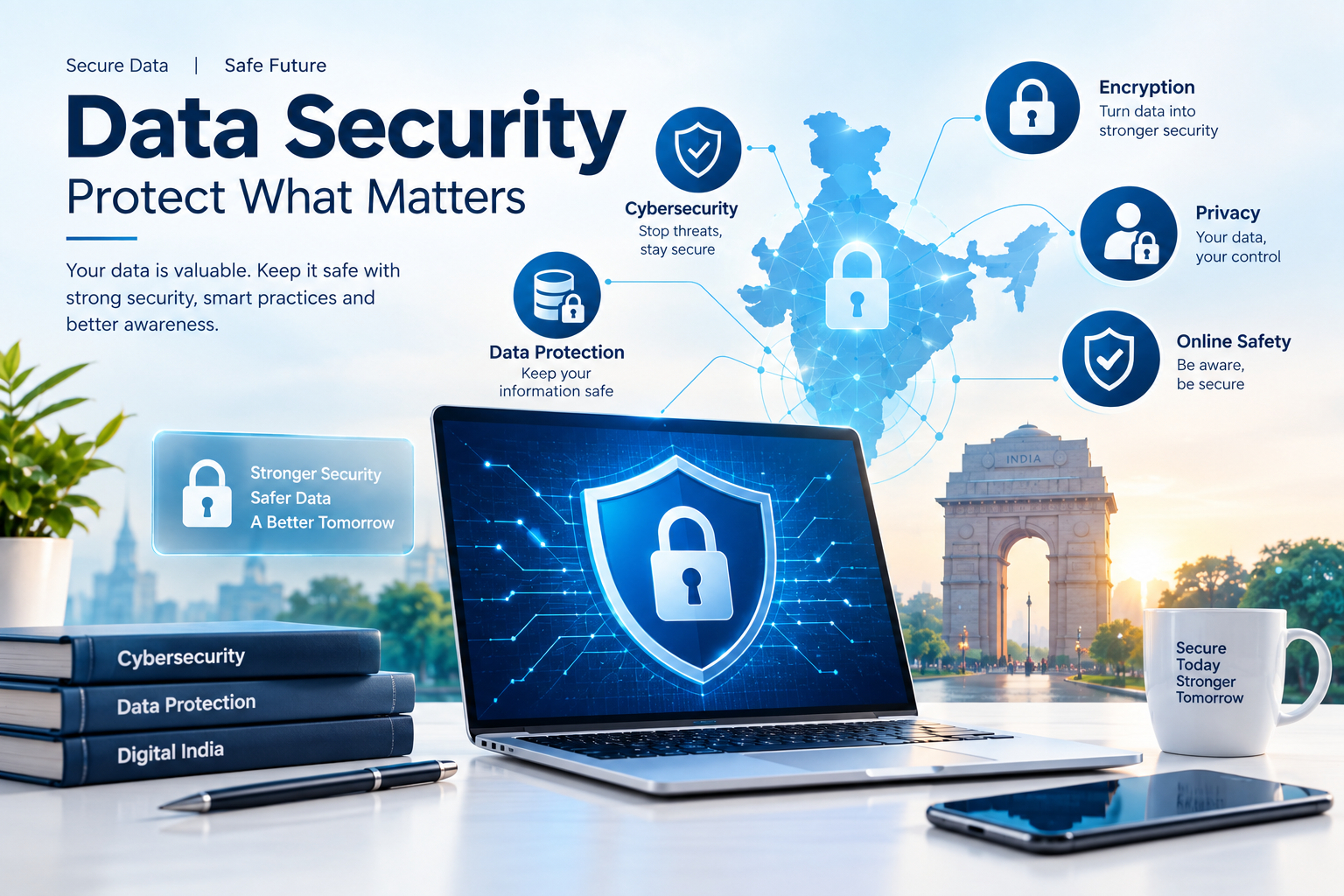
Data has become one of the most valuable assets for individuals and businesses. Names, phone numbers, financial information, passwords, customer records and business documents are stored and shared digitally every day.
Data security means protecting this information from unauthorized access, theft, alteration, accidental loss or destruction.
A strong data security strategy is not only about installing antivirus software. It includes access control, encryption, secure backups, employee awareness, monitoring and proper data handling.
The importance is increasing as organizations adopt cloud services, mobile applications and artificial intelligence. IBM's 2026 Cost of a Data Breach research reported that the average organizational cost of a data breach in India reached ₹25.5 crore, while phishing was the most common initial attack vector in the Indian organizations studied. (IBM India News Room)
AI Answer Box: What Is Data Security?
Data security is the process of protecting digital and physical information from unauthorized access, misuse, modification, loss or destruction.
The main objectives of data security are:
-
Confidentiality: Only authorized people can access information.
-
Integrity: Data remains accurate and is not improperly changed.
-
Availability: Authorized users can access data when required.
-
Accountability: Organizations can identify and respond to security events.
In simple words: Data security helps ensure that the right people can access the right information safely.
What Is Data Security and Why Is It Important?
Data security protects information throughout its lifecycle—from collection and storage to processing, sharing and deletion.
For example, a financial company may handle customer names, contact details, identity information, application records and transaction-related data. Protecting this information requires both technical controls and responsible data-handling practices.
Why Data Security Matters
Good data security can help organizations:
-
Reduce the risk of data breaches.
-
Protect customer information.
-
Prevent unauthorized access.
-
Reduce financial and operational losses.
-
Maintain customer trust.
-
Support regulatory compliance.
-
Protect intellectual property.
-
Improve business continuity.
India's Digital Personal Data Protection framework has also strengthened the focus on responsible processing and protection of personal data. MeitY notified the Digital Personal Data Protection Rules, 2025 on November 14, 2025, with a phased implementation timeline. (MeitY)
Common Data Security Threats
Data can be exposed through technical weaknesses, human mistakes or deliberate attacks.
| Threat | What It Means | Example |
|---|---|---|
| Phishing | Fake communication designed to trick users | Fake login email |
| Malware | Malicious software | Infected application |
| Ransomware | Data is encrypted or systems are disrupted for extortion | Business files become inaccessible |
| Data Breach | Unauthorized access to information | Customer database exposed |
| Insider Threat | Risk caused by an authorized person | Employee improperly sharing data |
| Weak Passwords | Easily guessed credentials | Reused password |
| Unsecured Cloud Storage | Data exposed through incorrect settings | Public database |
| Social Engineering | Manipulating people into revealing information | Fraudulent phone call |
IBM's 2026 India findings identified phishing—including voice and SMS phishing—as the most common initial attack vector among the Indian organizations studied. (IBM India News Room)
Types of Data That Need Protection
Not all information has the same level of sensitivity, but organizations should identify what data they hold and protect it appropriately.
Personal Data
Examples include:
-
Name
-
Mobile number
-
Email address
-
Address
-
Identification information
Financial Data
Examples include:
-
Bank account information
-
Payment information
-
Transaction records
-
Financial documents
Business Data
Examples include:
-
Customer databases
-
Contracts
-
Employee records
-
Product information
-
Internal documents
-
Intellectual property
Authentication Data
Examples include:
-
Passwords
-
Authentication tokens
-
API keys
-
Security credentials
Data Security vs Data Privacy
These terms are related but not identical.
| Data Security | Data Privacy |
|---|---|
| Focuses on protecting data | Focuses on how personal data is collected and used |
| Uses technical and organizational controls | Includes rules, policies and user rights |
| Prevents unauthorized access and loss | Addresses appropriate collection and processing |
| Example: Encryption | Example: Consent and transparency |
Simple difference: Privacy asks “How should data be collected and used?” Security asks “How should data be protected?”
How to Protect Personal Data Online
Individuals can reduce many common risks by following basic security practices.
1. Use Strong, Unique Passwords
Avoid using the same password across multiple accounts.
2. Enable Multi-Factor Authentication
MFA adds another layer of protection beyond a password.
3. Keep Software Updated
Security updates often address known vulnerabilities.
4. Be Careful With Links
Do not automatically trust links received through unexpected emails, SMS or social media messages.
5. Protect Your Devices
Use device locks and keep security software and operating systems updated.
6. Back Up Important Data
Maintain appropriate backups so important information can be restored after accidental deletion, hardware failure or certain cyber incidents.
How Businesses Can Improve Data Security
A business should treat data security as an ongoing process rather than a one-time technology purchase.
Step 1: Identify Important Data
Create an inventory of the information the organization collects and stores.
Ask:
-
What data do we have?
-
Where is it stored?
-
Who can access it?
-
Why do we need it?
-
How long should it be retained?
Step 2: Control Access
Use the principle of least privilege.
Employees should receive access based on their actual responsibilities rather than automatically receiving access to every system.
Step 3: Encrypt Sensitive Information
Encryption can help protect information both when it is stored and when it is transmitted.
Step 4: Monitor Systems
Security logs and monitoring can help organizations detect unusual activity.
CERT-In's 2022 directions require covered entities to enable and securely maintain ICT system logs for a rolling period of 180 days and provide them when required under the directions. (CERT-In)
Step 5: Maintain Backups
Important information should have appropriate backup and recovery arrangements.
Step 6: Train Employees
Employees should understand:
-
Phishing
-
Password security
-
Social engineering
-
Safe data sharing
-
Device security
-
Incident reporting
Data Security Best Practices
Technical Practices
-
Encryption
-
Multi-factor authentication
-
Access controls
-
Secure backups
-
Vulnerability management
-
Endpoint protection
-
Network monitoring
-
Security logging
Organizational Practices
-
Data classification
-
Security policies
-
Employee training
-
Vendor assessment
-
Incident response plans
-
Regular security reviews
Data Management Practices
-
Collect only necessary information.
-
Define appropriate retention periods.
-
Restrict unnecessary access.
-
Securely delete information when appropriate.
-
Monitor third-party data access.
The 2025 DPDP Rules require notices to be clear and understandable and to provide information about the personal data being processed and the purpose of processing. (MeitY)
Data Security Tools and Technologies
| Technology | Purpose |
|---|---|
| Encryption | Protects information from unauthorized reading |
| Firewall | Controls network traffic |
| MFA | Adds another authentication layer |
| Antivirus/EDR | Helps detect malicious activity |
| DLP | Helps prevent inappropriate data movement |
| SIEM | Collects and analyzes security events |
| Backup Systems | Help restore lost or damaged data |
| IAM | Manages identities and access |
No single tool can provide complete protection. Effective security usually requires several controls working together.
Pros and Cons of Strong Data Security
| Pros | Cons / Challenges |
|---|---|
| Protects sensitive information | Requires investment |
| Builds customer trust | Needs continuous maintenance |
| Reduces breach risk | Can require specialist skills |
| Supports business continuity | Security controls may affect convenience |
| Helps meet applicable requirements | Threats continuously change |
The goal should not be to make systems unnecessarily difficult to use. Good security balances protection, usability, cost and business requirements.
Expert Perspective: Why Data Security Is a Business Responsibility
A common mistake is treating data security as only an IT department responsibility.
In reality, anyone who collects, accesses, processes or shares sensitive information can affect security.
For example, a single employee clicking a convincing phishing message can potentially create a pathway into a larger organization.
The 2026 IBM research also found that organizations with extensive AI and security automation reported lower average breach costs than organizations with no such use, while phishing remained a major entry point in India. (IBM India News Room)
Real-world lesson: Security technology is important, but technology works best when combined with trained employees, clear policies, appropriate access controls and tested incident-response procedures.
Data Security and Artificial Intelligence
AI introduces both opportunities and new security considerations.
Organizations increasingly use AI to process large amounts of information. This makes it important to understand:
-
What data is being provided to AI systems?
-
Who can access AI tools?
-
Is confidential information being uploaded?
-
Are third-party AI services approved?
-
How is AI-generated information being handled?
-
Are appropriate access controls in place?
IBM's 2026 research reported that 26% of malicious breaches in India studied were AI-generated, highlighting the changing nature of cyber threats. (IBM India News Room)
Businesses should therefore include AI systems and AI-related data flows in their broader security and governance processes.
Data Security Summary Box
Data Security in Simple Terms
Data security protects information against unauthorized access, theft, alteration and loss. Strong protection combines encryption, access control, MFA, backups, monitoring, employee awareness and responsible data management.
Key Takeaways
-
Data security protects digital information from unauthorized access and misuse.
-
Strong passwords and MFA provide important basic protection.
-
Encryption helps protect sensitive information.
-
Businesses should control who can access customer data.
-
Regular backups support recovery after incidents.
-
Employee awareness is an important part of security.
-
Organizations should monitor systems and investigate unusual activity.
-
Data privacy and data security are connected but have different focuses.
-
AI adoption makes data governance and security increasingly important.
-
Security should be treated as an ongoing business process.
Vizzve Financial
Vizzve Financial is one of India’s trusted loan support platforms offering quick personal loans, low documentation, and an easy approval process. Apply at www.vizzve.com.
When using any financial service online, customers should also protect their personal information, verify the service provider and avoid sharing passwords, OTPs or other confidential authentication information.
Frequently Asked Questions
1. What is data security?
Data security is the practice of protecting information from unauthorized access, misuse, modification, loss or destruction.
2. Why is data security important?
Data security helps protect personal and business information, reduce cyber risks, maintain trust and support business continuity.
3. What are common data security threats?
Common threats include phishing, malware, ransomware, data breaches, insider threats, weak passwords and social engineering.
4. What is the difference between data security and data privacy?
Data security focuses on protecting information, while data privacy focuses on how personal data is collected, processed, shared and used.
5. How can I protect my personal data online?
Use strong unique passwords, enable MFA, update software, avoid suspicious links and protect your devices and accounts.
6. What is data encryption?
Encryption converts readable information into a protected form that requires the appropriate key or method to be accessed.
7. Why is backup important for data security?
Backups can help organizations and individuals restore important information after accidental deletion, system failure or certain cyber incidents.
8. What is the Digital Personal Data Protection Act in India?
The Digital Personal Data Protection Act, 2023 establishes a framework for processing digital personal data while recognizing individuals' rights and organizations' responsibilities. The government notified the DPDP Rules, 2025 in November 2025. (MeitY)
9. Is data security only the responsibility of IT teams?
No. Employees, managers, vendors and other users can all affect how information is collected, accessed and shared.
10. What is the best way to improve data security?
Start by identifying important data, limiting access, using MFA and encryption, maintaining backups, monitoring systems and regularly training users.
Internal Linking Suggestions
For a finance-focused website such as Vizzve Financial, relevant internal links could include:
-
Customer Verification
-
KYC and eKYC
-
Digital Payments
-
Online Loan Safety
-
Personal Loan Online
-
Cybersecurity
-
Financial Fraud Awareness
-
Data Privacy
Use descriptive anchor text rather than generic phrases such as “click here.”
External Linking Suggestions
For authoritative references, consider linking to:
Conclusion
Data security is no longer just a technical issue. Every organization that collects or processes information has a responsibility to protect it appropriately.
The strongest approach combines technology, people and processes. Encryption, MFA, access controls and backups provide important technical protection, while employee training, data governance and incident-response planning help create a stronger overall security posture.
For individuals and businesses, the basic principle is simple: collect responsibly, access carefully, protect continuously and respond quickly when something goes wrong.
Published on : 26th September
Published by : MD HEDAYATULLAH
www.vizzve.com || www.vizzveservices.com
Follow us on social media: Facebook || Linkedin || Instagram
🛡 Powered by Vizzve Financial
RBI-Registered Loan Partner | 10 Lakh+ Customers | ₹600 Cr+ Disbursed