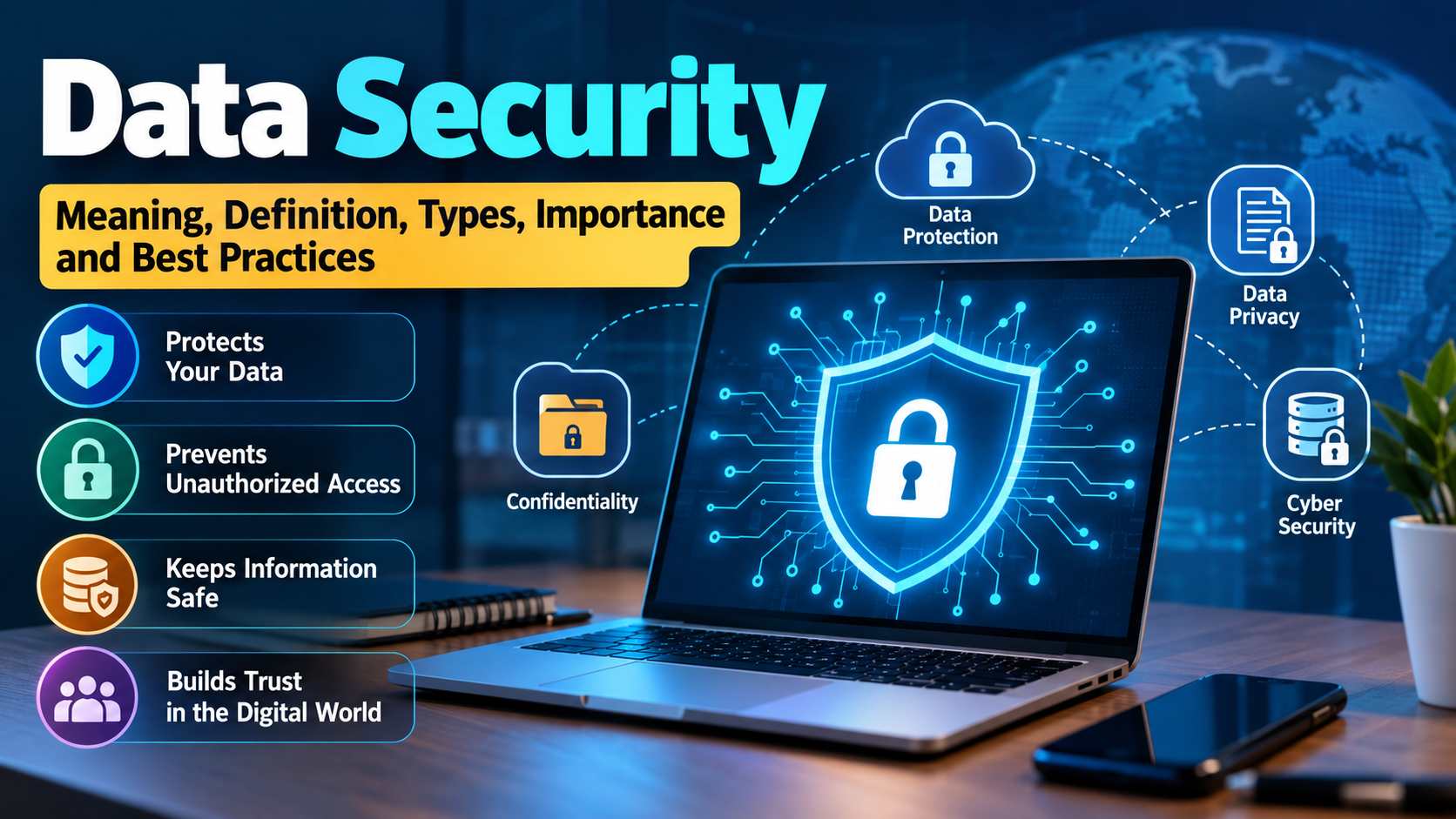
Data Security Meaning: Definition, Types, Importance & Best Practices
Vizzve Admin
Data has become one of the most valuable assets in the digital economy. From bank account details and passwords to customer records, financial transactions and business information, enormous amounts of data are created and stored every day.
This makes data security increasingly important.
What is data security?
Data security is the process of protecting digital and physical data from unauthorized access, misuse, alteration, disclosure, loss or destruction.
It involves technologies, policies, procedures and security practices designed to keep information confidential, accurate and available to authorized users.
For individuals, data security helps protect personal information and financial accounts. For businesses, it helps protect customer information, intellectual property, financial records and operational data.
Data security is the protection of information from unauthorized access, theft, modification, disclosure, loss or destruction. It uses measures such as encryption, access controls, authentication, backups, monitoring and security policies to protect data.
The three fundamental goals of data security are commonly described through the CIA triad:
- Confidentiality: Only authorized people can access information.
- Integrity: Data remains accurate and is not improperly changed.
- Availability: Authorized users can access data when they need it.
Data Security Meaning and Definition
The meaning of data security is broader than simply protecting files with a password.
It covers the complete lifecycle of information—from collection and storage to processing, transmission, sharing, archiving and deletion.
Simple definition of data security
Data security means keeping information safe from unauthorized access, accidental loss, cyberattacks, misuse and unauthorized changes.
For example, when a banking application encrypts sensitive information and requires strong authentication before allowing access, those measures form part of data security.
Why Is Data Security Important?
Data security is important because a security incident can affect individuals, businesses, financial institutions and public organizations.
A compromised database may expose information such as:
- Names and addresses
- Phone numbers
- Email addresses
- Passwords
- Bank account information
- Payment information
- Identification documents
- Customer records
- Business contracts
- Intellectual property
- Employee information
A serious incident can result in financial losses, operational disruption, regulatory consequences and loss of customer trust.
Key reasons data security matters
1. Protects personal information
People share significant amounts of personal information online. Security controls help reduce the risk of unauthorized access.
2. Prevents financial fraud
Financial information can be targeted by criminals for fraud, identity theft and unauthorized transactions.
3. Protects businesses
Companies need to protect customer databases, financial information, employee records and proprietary information.
4. Supports regulatory compliance
Organizations may have legal and regulatory obligations concerning personal and sensitive information.
5. Builds customer trust
Customers expect organizations to handle their information responsibly.
The CIA Triad of Data Security
The CIA triad provides a simple framework for understanding the core objectives of information security.
| Principle |
Meaning |
Example |
| Confidentiality |
Prevent unauthorized access |
Encryption and access controls |
| Integrity |
Prevent unauthorized modification |
File integrity monitoring |
| Availability |
Ensure authorized access |
Backups and disaster recovery |
A strong security program needs to consider all three.
Protecting confidentiality while allowing no legitimate access, for example, would not create a practical information system.
Types of Data Security
Data security involves multiple layers of protection rather than a single technology.
1. Data Encryption
Encryption converts readable information into an encoded form that requires an appropriate key or mechanism to recover the original information.
Encryption can protect information:
- At rest
- During transmission
- In certain processing environments
For example, encrypted communications can help protect information while it travels between a user's device and an online service.
2. Access Control
Access control determines who can access particular information and what they are allowed to do with it.
Organizations can use:
- User permissions
- Role-based access
- Least-privilege principles
- Administrative controls
- Device restrictions
A finance employee, for example, may need access to accounting systems but not necessarily to every customer database.
3. Authentication
Authentication verifies the identity of a person or system.
Common methods include:
- Passwords
- PINs
- Biometrics
- Security keys
- Multi-factor authentication (MFA)
- One-time passwords
Why is MFA useful?
MFA adds another verification factor beyond a password. This can reduce the impact of a compromised password because an attacker may still need another authentication factor.
4. Data Backup
Backups create additional copies of important information so it can potentially be restored after accidental deletion, hardware failure, ransomware or other incidents.
A good backup strategy should consider:
- Backup frequency
- Storage location
- Access controls
- Encryption
- Recovery testing
- Retention periods
A backup that has never been tested may not provide the expected protection during an emergency.
5. Data Masking
Data masking hides or replaces sensitive information while preserving enough information for legitimate testing or operational purposes.
For example, an application development environment might use masked customer information instead of exposing production customer records.
6. Data Loss Prevention
Data Loss Prevention (DLP) technologies and processes can help organizations identify and control the movement of sensitive information.
Depending on the implementation, DLP can monitor information moving through:
- Email
- Cloud services
- Endpoints
- External storage
- Business applications
7. Network Security
Network security protects systems and information moving across networks.
Common controls include:
- Firewalls
- Network segmentation
- Intrusion detection
- Intrusion prevention
- Secure network configurations
- Monitoring
8. Physical Security
Digital security also has a physical component.
Organizations may need to protect:
- Servers
- Data centers
- Networking equipment
- Backup media
- Employee devices
- Office systems
Physical access to a server or storage device can create security risks even when digital controls are strong.
Common Data Security Threats
Understanding threats is an important part of protecting information.
| Threat |
What it means |
Possible impact |
| Phishing |
Fraudulent messages designed to deceive users |
Credential theft |
| Malware |
Malicious software |
Data theft or disruption |
| Ransomware |
Malware that can restrict access to data |
Operational disruption |
| Insider threats |
Risk involving authorized users |
Unauthorized disclosure |
| Weak passwords |
Easily compromised credentials |
Account takeover |
| Data breaches |
Unauthorized access to information |
Information exposure |
| Social engineering |
Manipulating people to reveal information |
Fraud or unauthorized access |
| Lost devices |
Devices containing sensitive data are lost |
Data exposure |
| Misconfiguration |
Incorrect security settings |
Unintended data access |
Data Security vs Data Privacy
Data security and data privacy are related but they are not exactly the same.
| Data Security |
Data Privacy |
| Focuses on protecting data |
Focuses on appropriate collection and use of data |
| Uses technical and organizational controls |
Includes policies, rights and governance |
| Prevents unauthorized access and alteration |
Addresses how information should be handled |
| Includes encryption and access controls |
Includes transparency and data-use practices |
Simple example
Suppose an organization collects a customer's phone number.
Privacy concerns why the organization collects it, how it uses it and whether the collection is appropriate.
Security concerns how the organization protects that phone number from unauthorized access or disclosure.
Both are important.
Data Security in Banking and Financial Services
Financial institutions process highly sensitive information, making data security a critical part of digital banking.
Security measures may include:
- Multi-factor authentication
- Transaction monitoring
- Encryption
- Access controls
- Fraud detection
- Secure APIs
- Device security
- Audit logging
- Incident response procedures
Customers also have an important role.
They should avoid sharing:
- OTPs
- PINs
- Passwords
- Card security information
- Banking credentials
A bank or legitimate financial service should not require customers to disclose confidential authentication credentials through unsolicited calls or messages.
Data Security in Digital Lending
Digital lending platforms may handle information relating to borrowers, applications, transactions and identity verification.
Important security practices can include:
- Secure authentication
- Encryption
- Access control
- Data minimization
- Secure application development
- Monitoring and logging
- Vendor risk management
- Appropriate retention and deletion practices
Borrowers should also check whether they are dealing with a legitimate financial service provider before sharing sensitive information.
How Does Data Security Work?
Data security normally works through multiple layers.
Step 1: Identify sensitive information
Organizations first identify what information requires protection.
Step 2: Classify the information
Data can be categorized according to sensitivity and business importance.
Step 3: Restrict access
Access should be provided according to legitimate business requirements.
Step 4: Encrypt sensitive information
Encryption can reduce the consequences of unauthorized access to protected information.
Step 5: Monitor systems
Security monitoring can help identify suspicious activities.
Step 6: Maintain backups
Important information should have appropriate backup and recovery arrangements.
Step 7: Test security controls
Organizations should regularly test their systems, processes and recovery procedures.
Step 8: Respond to incidents
A documented incident-response process can help an organization contain and recover from security events.
Data Security Best Practices for Individuals
You don't need to be a cybersecurity expert to improve your personal data security.
Follow these practical steps:
- Use strong and unique passwords.
- Enable multi-factor authentication where available.
- Keep your operating system and applications updated.
- Avoid clicking suspicious links.
- Download applications from trusted sources.
- Review account activity regularly.
- Avoid sharing OTPs and passwords.
- Use secure networks for sensitive transactions.
- Back up important personal files.
- Lock your phone and computer.
- Be careful when sharing personal information online.
A simple rule
If someone unexpectedly asks for your password, OTP or banking credentials, stop and verify the request through an official channel.
Data Security Best Practices for Businesses
Businesses should approach data security as an ongoing process rather than a one-time project.
Recommended practices
Employee awareness
Employees should understand phishing, social engineering, password security and information-handling requirements.
Least privilege
Users should receive only the access necessary for their responsibilities.
Regular updates
Operating systems, applications and security tools should be maintained and updated.
Security monitoring
Organizations should monitor systems for suspicious activities and unusual access patterns.
Backup and recovery
Critical data should have tested recovery procedures.
Vendor management
Third-party service providers can introduce additional security risks and should be assessed appropriately.
Pros and Cons of Data Security
Benefits
- Protects sensitive information
- Reduces unauthorized access
- Helps prevent data loss
- Supports business continuity
- Builds customer confidence
- Helps organizations meet applicable requirements
- Reduces the potential impact of security incidents
Challenges
- Requires ongoing investment
- Security systems can be complex
- Employees can make mistakes
- Threats continually evolve
- Poorly configured controls can create vulnerabilities
- Security can never eliminate every possible risk
The goal is therefore risk reduction and resilience, not the unrealistic promise of absolute security.
Real-World Data Security Example
Imagine an online financial service storing customer information.
A basic security architecture might include:
Customer → Secure Connection → Authentication → Application → Access Control → Encrypted Database → Backup & Monitoring
Each layer provides a different type of protection.
If an attacker obtains a password, multi-factor authentication may provide another barrier.
If a database is accessed improperly, encryption can reduce exposure depending on how encryption and key management are implemented.
If information is accidentally deleted, properly maintained backups may support recovery.
This illustrates why modern data security uses defense in depth.
Expert Commentary: Why Data Security Is a Continuous Process
Cybersecurity professionals generally emphasize that security should be treated as a continuous risk-management process.
Technology alone is not enough.
An organization can purchase advanced security software but still face significant risk if:
- Employees are not trained.
- Access permissions are excessive.
- Software remains unpatched.
- Backups are not tested.
- Security alerts are ignored.
- Third-party access is poorly managed.
Effective security therefore combines people, processes and technology.
Data Security Checklist
Use this quick checklist to review basic security practices:
☐ Strong passwords are being used
☐ MFA is enabled for important accounts
☐ Software is regularly updated
☐ Sensitive information is encrypted where appropriate
☐ Access permissions are reviewed
☐ Important data is backed up
☐ Backups are tested
☐ Employees receive security awareness training
☐ Suspicious activity is monitored
☐ Incident-response procedures exist
☐ Third-party access is reviewed
☐ Sensitive information is securely deleted when no longer required
Key Takeaways
Data security means protecting information against unauthorized access, use, modification, disclosure, loss and destruction.
The most important points are:
- Data security protects personal, financial and business information.
- Confidentiality, integrity and availability are its core objectives.
- Encryption is one important security control, but it is not the only one.
- Strong authentication can reduce account compromise risks.
- Backups are essential for recovery from certain failures and attacks.
- Data privacy and data security are related but distinct concepts.
- Employees and users are an important part of the security environment.
- Organizations should continuously review and improve security controls.
- No security system can guarantee zero risk.
Frequently Asked Questions
1. What is data security in simple words?
Data security means protecting information from unauthorized access, theft, misuse, alteration, loss or destruction.
2. What is the definition of data security?
Data security is the combination of technologies, processes and controls used to protect data throughout its lifecycle.
3. Why is data security important?
It helps protect sensitive information, reduce cyber risks, support business operations and maintain customer trust.
4. What are the three principles of data security?
The three core principles are confidentiality, integrity and availability, commonly known as the CIA triad.
5. What are common types of data security?
Common types include encryption, access control, authentication, backups, data masking, data loss prevention, network security and physical security.
6. What is data encryption?
Encryption transforms readable information into an encoded form so that it cannot be readily understood without the appropriate key or mechanism.
7. What is the difference between data security and data privacy?
Data security focuses on protecting information, while data privacy focuses on how personal information is collected, used, shared and managed.
8. How can individuals protect their data?
Individuals can use strong passwords, MFA, software updates, secure devices, careful online behavior and reliable backups.
9. What is a data breach?
A data breach is an incident involving unauthorized access to, disclosure of or acquisition of protected information.
10. Is a password enough to protect data?
A password alone may not provide sufficient protection for important accounts. Multi-factor authentication can add another layer of security.
11. What is data security in banking?
It refers to the controls financial institutions use to protect customer, transaction and financial information from unauthorized access and other security risks.
12. What is data loss prevention?
Data Loss Prevention refers to technologies and processes designed to identify and help prevent inappropriate movement, sharing or disclosure of sensitive information.
13. Can data security prevent all cyberattacks?
No. Security controls can reduce risk and limit the impact of incidents, but no system can guarantee complete protection against every threat.
14. Why are data backups important?
Backups provide additional copies of information that may help organizations or individuals recover after accidental deletion, system failures or certain cyber incidents.
15. What is the best way to improve data security?
A layered approach is generally appropriate: strong authentication, access controls, encryption, software updates, backups, monitoring, employee awareness and an effective incident-response process.
Published on : 25th September
Published by : Shanlee JV
www.vizzve.com || www.vizzveservices.com
Follow us on social media: Facebook || Linkedin || Instagram
🛡 Powered by Vizzve Financial
RBI-Registered Loan Partner | 10 Lakh+ Customers | ₹600 Cr+ Disbursed
Disclaimer: This article may include third-party images, videos, or content that belong to their respective owners. Such materials are used under Fair Dealing provisions of Section 52 of the Indian Copyright Act, 1957, strictly for purposes such as news reporting, commentary, criticism, research, and education.
Vizzve and India Dhan do not claim ownership of any third-party content, and no copyright infringement is intended. All proprietary rights remain with the original owners.
Additionally, no monetary compensation has been paid or will be paid for such usage.
If you are a copyright holder and believe your work has been used without appropriate credit or authorization, please contact us at grievance@vizzve.com. We will review your concern and take prompt corrective action in good faith... Read more

