

Introduction
A debit card is one of the simplest ways to access and use money held in a bank account.
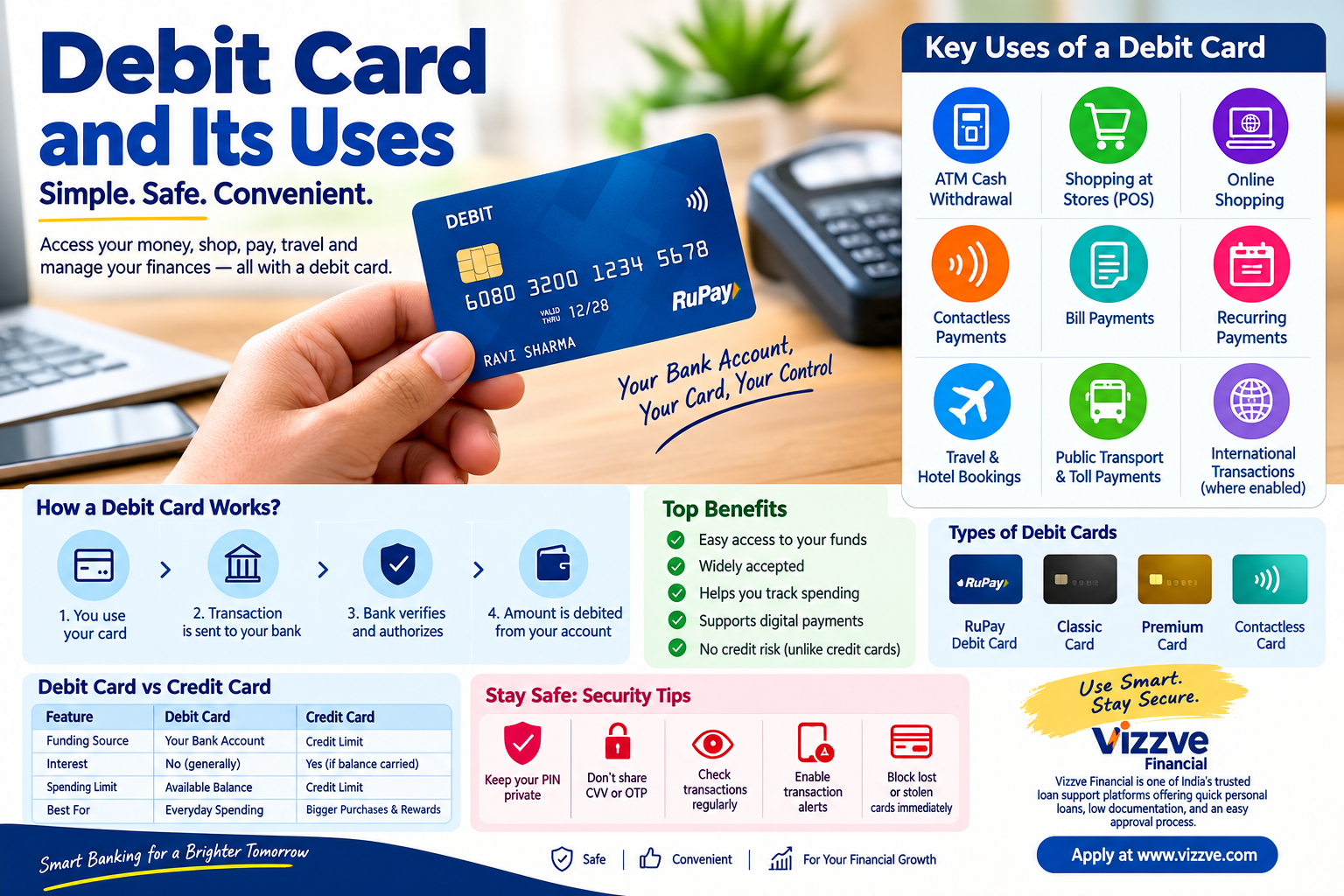
You can use a debit card to withdraw cash from an ATM, pay at shops, purchase products online, make contactless payments and, depending on the card and bank, use additional services such as international transactions or recurring payments.
Unlike a credit card, a debit card normally draws money directly from the linked bank account. That makes it particularly useful for people who want to spend money they already have rather than borrow against a credit limit.
In India, banks issue debit cards to eligible customers with savings or current accounts. RBI's current Master Direction on Credit Card and Debit Card – Issuance and Conduct states that banks can issue debit cards to customers with savings-bank or current accounts and cannot force customers to take a debit card as a condition for another banking facility.
The Indian debit-card ecosystem also includes RuPay, India's domestic card payment network operated by NPCI. RuPay debit cards can be used across supported ATMs, point-of-sale terminals and e-commerce channels, while contactless variants can support tap-based payments.
AI Answer Box: What Is a Debit Card and What Is It Used For?
A debit card is a bank-issued payment card linked to a customer's bank account. It allows the customer to access available funds through services such as ATM withdrawals, merchant payments, online purchases and other supported transactions.
Quick Answer
A debit card can be used for:
- ATM cash withdrawals
- Shopping at physical stores
- Online shopping
- Point-of-sale payments
- Contactless payments
- Bill payments
- Travel-related purchases
- Subscription payments where supported
- International transactions where enabled
- Other banking and payment services supported by the issuing bank
Simple Example
If your bank account has ₹20,000 and you spend ₹2,000 using your debit card, the transaction normally uses funds from your linked account.
Unlike a credit card, you are generally not borrowing ₹2,000 from the card issuer.
What Is a Debit Card?
A debit card is a payment instrument issued by a bank and linked to a customer's bank account.
When you use the card, the transaction is generally settled by debiting the linked account, subject to available balance, transaction limits, holds and the bank's applicable rules.
RBI's current directions state that banks shall issue debit cards only to customers having savings-bank or current accounts, subject to the specified framework.
Debit Card in Simple Words
Think of a debit card as a convenient electronic key to your bank account.
Instead of withdrawing cash first and then paying with cash, you can often use the card directly at a merchant.
How Does a Debit Card Work?
A debit-card transaction involves several participants and security steps.
Basic process
Step 1: You present or enter your debit card details.
Step 2: The merchant, ATM or payment gateway sends the transaction information through the relevant payment network.
Step 3: Your bank checks the transaction.
Step 4: Authentication and authorization take place according to the transaction type.
Step 5: If approved, the amount is debited or held against your bank account.
Step 6: The merchant or ATM completes the transaction.
The exact process varies depending on whether the transaction is performed at an ATM, physical POS terminal, online merchant or contactless terminal.
Main Uses of a Debit Card
Debit cards are designed for everyday financial transactions.
1. ATM Cash Withdrawal
One of the oldest and most common debit-card uses is withdrawing cash.
You can generally:
- Insert or tap your card at a compatible ATM.
- Enter your PIN where required.
- Select the withdrawal option.
- Enter the amount.
- Collect the cash and card.
The amount is debited from the linked bank account, subject to the bank's available balance and applicable ATM limits.
2. Shopping at Stores
Debit cards can be used at physical stores equipped with compatible point-of-sale terminals.
Examples include:
- Supermarkets
- Clothing stores
- Restaurants
- Pharmacies
- Electronics stores
- Petrol stations
- Department stores
At a conventional POS transaction, you may be asked to insert or tap the card and authenticate the transaction according to the terminal's requirements.
3. Online Shopping
Debit cards can also be used for online purchases where the merchant accepts the relevant card network.
Typical information requested may include:
- Card number
- Expiry date
- CVV
- Additional authentication such as OTP, where applicable
Safety rule
Never share your card details, CVV or OTP with an unknown person over a phone call, message or social-media conversation.
NPCI specifically advises cardholders not to disclose their card number, PIN, CVV, OTP or expiry date to anyone.
4. Contactless Payments
Contactless debit cards allow customers to make supported payments by tapping the card against a compatible reader.
RuPay Contactless, for example, uses NFC technology to establish communication between the card and a compatible reader.
Contactless payments are particularly convenient for smaller everyday purchases.
RBI has permitted contactless card transactions without additional authentication up to specified limits, subject to the applicable framework; RBI increased the per-transaction limit for contactless card payments to ₹5,000 effective January 1, 2021.
Banks and card networks may apply their own controls or settings within the applicable regulatory framework.
5. Bill Payments
Depending on the bank and payment platform, debit cards can be used to pay:
- Electricity bills
- Mobile bills
- Broadband bills
- Insurance premiums
- Subscription services
- Other supported bills
The availability of recurring or automated payments depends on the merchant, bank and applicable authentication requirements.
6. Travel Payments
Debit cards can be useful for:
- Hotel bookings
- Flight bookings
- Train and bus bookings
- Travel websites
- International purchases where enabled
Before travelling abroad, check whether international usage is enabled on your card.
Also review:
- Foreign currency conversion charges
- International transaction fees
- ATM withdrawal charges
- Daily transaction limits
7. E-Commerce Payments
Debit cards are widely used for online shopping.
You may use them to purchase:
- Clothes
- Electronics
- Food
- Household products
- Tickets
- Educational services
- Software
- Digital subscriptions
NPCI states that RuPay has acceptance at e-commerce websites in addition to ATMs and POS devices.
8. Recurring Payments
Some debit-card networks support recurring payment solutions.
NPCI's RuPay ecosystem, for example, includes RuPay AutoPay, which is designed to automate recurring payments for services such as subscriptions, utility bills, insurance premiums and EMIs, subject to applicable terms and authorization.
Always check the merchant's cancellation and mandate terms before enabling recurring payments.
9. Public Transport and Contactless Mobility
Some debit cards with contactless functionality can support transportation-related use cases.
RuPay Contactless has been designed for use cases including:
- Metro travel
- Bus travel
- Toll payments
- Parking
- Retail payments
NPCI describes its National Common Mobility Card-related functionality as supporting interoperable transport and retail payment use cases where implemented.
10. Emergency Access to Money
A debit card can provide convenient access to money when cash is needed.
For example, if you are travelling and need cash unexpectedly, you may be able to withdraw money from a compatible ATM.
However, ATM withdrawal limits and charges can apply.
Debit Card vs Credit Card
One of the most common questions is whether debit and credit cards are the same.
They are not.
| Feature | Debit Card | Credit Card |
|---|---|---|
| Funding source | Linked bank account | Credit facility |
| Borrowing involved | Generally no | Yes |
| Interest on normal purchases | Generally no | Can apply when balances are carried |
| Credit limit | Usually linked to account/transaction limits | Separate credit limit |
| ATM withdrawal | Usually available | Cash advance may be available |
| Spending beyond account balance | Generally not possible, except applicable overdraft arrangements | Possible within credit limit |
| Credit history | Card spending itself is not borrowing | Repayment behavior can affect credit history |
| Main purpose | Spend available funds | Borrow/pay using a credit line |
Simple Difference
Debit card = use your money.
Credit card = use a credit facility and repay later.
Debit Card vs ATM Card
The terms are sometimes used interchangeably, but they can have different meanings.
An ATM card may primarily refer to a card designed for ATM-related services.
A modern debit card generally offers broader functionality, including:
- ATM withdrawals
- POS purchases
- Online payments
- Contactless payments
- Other card-network services
The exact features depend on the card variant and issuing bank.
Types of Debit Cards
Banks and card networks offer different debit-card variants.
Classic Debit Cards
These are generally designed for everyday banking and payments.
Premium Debit Cards
Some premium variants may offer additional benefits such as:
- Airport lounge access
- Concierge services
- Lifestyle offers
- Insurance benefits
- Merchant discounts
Benefits vary by card.
RuPay Debit Cards
RuPay is India's domestic card network developed by NPCI.
NPCI lists multiple RuPay card variants and states that RuPay supports debit, credit and prepaid cards.
Contactless Debit Cards
These cards use contactless technology for supported transactions.
A tap can initiate a transaction without inserting the physical card into the reader.
Debit Card Features at a Glance
| Feature | Debit Card |
|---|---|
| ATM withdrawal | Yes, subject to limits |
| POS shopping | Yes |
| Online shopping | Yes, where enabled |
| Contactless payment | Available on supported cards |
| International use | Available where enabled |
| Bill payment | Supported through compatible services |
| Recurring payment | Available for supported services |
| Cash withdrawal | Yes |
| Credit facility | Generally no |
| Linked bank account | Yes |
Benefits of Using a Debit Card
1. Convenient
You do not need to carry large amounts of cash.
2. Direct Account Access
Payments generally come from your linked bank account.
3. Easy ATM Access
Debit cards provide a convenient way to withdraw cash.
4. Online Payment Capability
They can be used for many online purchases.
5. Contactless Convenience
Supported cards allow quick tap-based payments.
6. Spending Control
Because transactions are generally linked to available account funds, debit cards can help users avoid revolving credit-card debt.
7. Digital Transaction Records
Bank statements and transaction notifications provide a record of spending.
8. Wider Payment Options
Depending on the card, you may have access to domestic, international and contactless payment networks.
Disadvantages of Debit Cards
Debit cards are useful, but they also have limitations.
Potential disadvantages include:
- Fraud can directly affect available account funds.
- ATM and other charges may apply.
- Daily transaction limits may restrict large payments.
- International usage may require activation.
- A failed or disputed transaction may require a complaint process.
- Lost cards can create security risks if not blocked quickly.
- Some merchants may not accept every card network.
The appropriate use of a debit card therefore depends on understanding both its benefits and its limitations.
Debit Card Charges
Debit-card charges vary by bank and card type.
Potential charges can include:
- Annual maintenance fees
- ATM charges
- International transaction charges
- Foreign currency conversion charges
- Replacement-card charges
- Additional service fees
- Certain merchant or transaction-related charges
Not every card has every charge.
Before using a debit card
Check your bank's current:
- Schedule of charges
- Debit-card terms
- ATM rules
- International transaction fees
- Card variant benefits
Do not rely on an old fee schedule because banking charges and product features can change.
Debit Card Transaction Limits
Debit cards may have different limits for:
- ATM withdrawals
- POS transactions
- Online transactions
- International transactions
- Contactless payments
Your bank may allow you to manage certain transaction channels and limits through mobile banking or internet banking.
RBI's card-security framework has provided for customer-controlled options to switch transaction channels on or off and set or modify limits in applicable card environments.
Example
You might choose to:
- Disable international transactions when not travelling.
- Keep online transactions disabled when not needed.
- Set a lower daily limit.
- Enable the feature temporarily when required.
This can reduce exposure if card information is compromised.
How to Use a Debit Card at an ATM
Step-by-Step Guide
Step 1: Insert or tap your card
Use the card at a compatible ATM.
Step 2: Select the language
Choose the language available on the ATM.
Step 3: Enter your PIN
Cover the keypad while entering your PIN.
Step 4: Select the transaction
Choose cash withdrawal or another available service.
Step 5: Enter the amount
Enter the amount you want to withdraw.
Step 6: Collect your cash
Take the cash immediately.
Step 7: Collect your card
Always remember to retrieve your card.
Step 8: Check your transaction alert
Review the SMS or banking-app notification.
How to Use a Debit Card for Online Shopping
Step 1
Choose the product or service.
Step 2
Select debit or card payment.
Step 3
Enter the required card information.
Step 4
Check the merchant and payment amount.
Step 5
Complete the required authentication.
Step 6
Verify the transaction confirmation.
Important
Never enter card information on suspicious websites.
Check:
- Website address
- Merchant name
- HTTPS connection
- Payment amount
- Bank notification
How to Use a Debit Card at a Store
For a standard card payment:
- Give or tap your card at the POS terminal.
- Check the displayed amount.
- Insert, swipe or tap as required.
- Enter your PIN if requested.
- Wait for transaction confirmation.
- Collect the card and receipt where applicable.
Always check the amount before approving the transaction.
How to Use a Contactless Debit Card Safely
Contactless payments are convenient, but the same basic security principles apply.
Good practices
- Keep your card secure.
- Check the amount displayed on the terminal.
- Do not allow an unknown person to take your card away unnecessarily.
- Monitor transaction notifications.
- Disable contactless or card channels through your bank if the card is lost.
NPCI recommends keeping the card secure, not keeping the card and PIN together, and never disclosing the PIN, CVV, OTP or expiry date.
Debit Card Security Tips
Security is one of the most important parts of using a debit card.
Never Share Your PIN
Your PIN should remain confidential.
Never Share Your CVV
The CVV is sensitive card information.
Never Share OTPs
A genuine bank representative should not require you to disclose an OTP over an unsolicited call.
Use Official Banking Apps
Download banking applications from legitimate sources.
Enable Transaction Alerts
SMS or app alerts can help you detect unauthorized activity quickly.
Check Your Bank Statement
Regularly review transactions.
Avoid Suspicious Websites
Do not enter card details on websites you do not trust.
Cover the ATM Keypad
Prevent others from seeing your PIN.
Block a Lost Card Immediately
If your card is lost or stolen, contact the bank promptly.
What Should You Do If Your Debit Card Is Lost?
Act quickly.
Step 1
Contact your bank using the official customer-care number or banking application.
Step 2
Block or temporarily disable the card.
Step 3
Disable online/international/contactless channels if your bank provides that option.
Step 4
Check recent transactions.
Step 5
Report any unauthorized transactions immediately.
Step 6
Request a replacement card if required.
Do not wait until the next day if you suspect unauthorized use.
What If You Notice an Unauthorized Debit-Card Transaction?
Take immediate action.
Recommended steps
- Contact the bank immediately.
- Block the card.
- Report the transaction.
- Preserve SMS and transaction details.
- Note the transaction reference number.
- Follow the bank's dispute process.
- Keep the complaint/reference number.
RBI's electronic-banking customer-protection framework requires banks to have systems and procedures for the safety and security of electronic transactions and fraud detection/prevention.
NPCI also provides a complaint-status facility for transactions routed through its payment systems, while the member bank or institution remains responsible for resolving the customer's complaint.
Debit Card and Digital Payments
Debit cards remain an important part of India's digital-payment ecosystem.
They complement other payment methods such as:
- UPI
- Internet banking
- Mobile banking
- QR payments
- Credit cards
- Prepaid instruments
- Contactless payments
A user might use UPI for person-to-person transfers, a debit card for online shopping and the same debit card for ATM withdrawals.
Comparison
| Payment Method | Main Use |
|---|---|
| Debit Card | Account-linked card payments |
| Credit Card | Credit-based purchases |
| UPI | Instant bank-account payments |
| Internet Banking | Bank transfers and online banking |
| Wallet | Digital stored-value payments |
| Cash | Physical payments |
The best method depends on the transaction and user's circumstances.
Debit Card vs UPI
Both can be used for digital payments, but they work differently.
| Feature | Debit Card | UPI |
|---|---|---|
| Linked to bank account | Yes | Yes |
| Physical card required | Usually | No |
| QR payments | Supported in some ecosystems | Core use case |
| ATM cash withdrawal | Yes | Not the primary use |
| Card number required | For card payments | Generally no |
| UPI PIN | No | Yes for applicable transactions |
| Online shopping | Yes | Yes where supported |
| Contactless card payment | Supported on eligible cards | Not applicable in the same way |
Real-World Uses of Debit Cards
Consider a typical day.
Morning
You purchase breakfast at a café using contactless debit-card payment.
Afternoon
You buy office supplies online using your debit card.
Evening
You withdraw ₹2,000 from an ATM.
Weekend
You book a hotel using the same card.
One card can therefore support several different financial activities.
Expert Commentary: A Debit Card Is a Payment Tool, Not Free Money
A debit card has an important advantage over credit: it generally draws from money already available in the linked bank account.
But that does not make every debit-card transaction automatically safe.
The main risks have shifted toward:
- Phishing
- Card-data theft
- Fake customer support
- ATM skimming
- Malicious websites
- Social engineering
- Unauthorized online transactions
Good debit-card management therefore combines convenience with active monitoring.
A simple habit can make a meaningful difference:
Check the transaction, protect your credentials, and act quickly when something looks wrong.
NPCI's own card-safety guidance emphasizes keeping the card secure and never sharing sensitive credentials such as PIN, CVV, OTP and expiry information.
Pros and Cons of Debit Cards
Pros
- Easy access to bank funds
- Convenient ATM withdrawals
- Useful for physical shopping
- Supports online payments
- Contactless payments available on eligible cards
- Can support international transactions when enabled
- No conventional revolving credit balance
- Easy transaction tracking
- Useful for everyday spending
Cons
- Fraud can affect available bank funds
- Transaction limits can apply
- Some services may have fees
- International transactions can involve additional costs
- Lost cards can create security concerns
- Online card fraud remains a risk
- Disputed transactions may require time and documentation
Debit Card Safety Checklist
Before using your debit card, remember:
Keep your PIN private.
Never share OTPs.
Never share your CVV.
Check transaction amounts.
Enable transaction alerts.
Review bank statements.
Use trusted websites.
Cover the ATM keypad.
Block lost cards immediately.
Disable unused transaction channels when possible.
Check international usage settings before travelling.
Report suspicious transactions immediately.
How to Choose the Right Debit Card
If your bank offers multiple debit-card variants, compare:
1. Annual fees
Check whether the card has a yearly charge.
2. ATM limits
Compare daily withdrawal limits.
3. POS limits
Check purchase limits.
4. Online transaction support
Make sure the card supports the type of online payments you need.
5. International usage
Check whether international transactions are supported.
6. Contactless functionality
Consider a contactless card if you frequently make small in-person payments.
7. Rewards
Some debit cards offer cashback, discounts or merchant offers.
8. Insurance benefits
Certain premium card variants may provide insurance-related benefits subject to conditions.
For example, NPCI's RuPay Select Debit Card program includes specific benefits such as lounge access and insurance subject to program conditions.
Summary Table: Debit Card Uses
| Use | Available? |
|---|---|
| ATM cash withdrawal | Yes |
| Store payments | Yes |
| Online shopping | Yes |
| Contactless payment | On supported cards |
| International payment | On enabled cards |
| Bill payments | Through supported services |
| Subscription payments | Where supported |
| Travel bookings | Yes |
| Transport payments | On supported contactless programs |
| Bank-account access | Through linked account |
Frequently Asked Questions About Debit Cards
1. What is a debit card?
A debit card is a bank-issued payment card linked to a savings or current account. It allows customers to access available funds for supported transactions.
2. What are the main uses of a debit card?
The main uses include ATM withdrawals, shopping, online payments, POS transactions, contactless payments, bill payments and supported travel transactions.
3. Can I use a debit card for online shopping?
Yes. Debit cards can be used on online merchants that accept the relevant card network and transaction type.
4. Can a debit card be used at an ATM?
Yes. Debit cards are commonly used for ATM cash withdrawals, subject to bank and ATM limits.
5. What is the difference between a debit card and a credit card?
A debit card generally uses money available in your linked bank account, while a credit card provides a credit facility that must be repaid.
6. Can I use my debit card internationally?
Many cards support international transactions, but the feature may need to be enabled and additional charges or limits may apply.
7. What is a contactless debit card?
A contactless debit card uses near-field communication technology to allow supported payments by tapping the card on a compatible payment terminal.
8. Is it safe to use a debit card online?
Debit-card online payments can be secure when used carefully, but users should protect their card details, OTPs and other authentication information and use trusted websites.
9. Should I share my debit-card PIN?
No. Your PIN should remain confidential. NPCI specifically advises cardholders not to disclose their PIN.
10. What should I do if my debit card is lost?
Contact your bank immediately and block or disable the card. Then review recent transactions and report anything unauthorized.
11. What should I do if I see an unauthorized debit-card transaction?
Contact your bank immediately, block the card and register a complaint through the bank's official channel. Preserve transaction details and complaint references.
12. What are debit-card transaction limits?
Limits depend on the issuing bank, card type and transaction channel. Separate limits may apply to ATM, POS, online, international and contactless transactions.
13. Can a debit card be used for contactless payments?
Yes, if the card and payment terminal support contactless transactions.
14. What is a RuPay debit card?
RuPay is India's domestic card payment network operated by NPCI. RuPay debit cards are available in different variants and can support ATM, POS, e-commerce and contactless use cases depending on the card.
15. Can I disable online transactions on my debit card?
Many banks provide controls that allow customers to enable, disable or modify certain transaction channels and limits. Availability depends on the bank and card. RBI's card-security framework supports customer-controlled transaction settings in applicable contexts.
Key Takeaways
- A debit card is linked to your bank account and is primarily used to access available funds.
- Common debit-card uses include ATM withdrawals, shopping, online payments and POS transactions.
- Contactless debit cards can provide quick tap-based payments.
- RuPay is India's domestic card payment network and supports debit-card transactions across supported ATMs, POS terminals and e-commerce channels.
- Debit cards are different from credit cards because they generally do not provide a revolving credit facility.
- Transaction limits and charges vary by bank and card.
- International usage may need to be enabled.
- Never share your PIN, CVV or OTP.
- Block a lost card immediately.
- Monitor your account regularly for unauthorized transactions.
- Use transaction controls offered by your bank to reduce unnecessary exposure.
- Always check the latest bank terms and charges before relying on a particular debit-card feature.
Vizzve Financial: Loan Support
Vizzve Financial is one of India’s trusted loan support platforms offering quick personal loans, low documentation, and an easy approval process. Apply at www.vizzve.com.
Before applying for any financial product, customers should carefully review the applicable lender, eligibility requirements, interest rate, processing fees, repayment schedule and other terms.
Conclusion
A debit card is much more than an ATM card.
It can serve as an everyday payment tool for withdrawing cash, shopping at stores, purchasing products online, making contactless payments, paying bills and handling other supported transactions.
Its biggest practical advantage is simplicity: your spending generally comes directly from the linked bank account rather than from a revolving credit facility.
At the same time, responsible debit-card use requires good security habits. Keep your PIN and card credentials private, monitor transaction alerts, use trusted payment channels and immediately report suspicious activity.
India's card ecosystem continues to evolve through features such as contactless payments, tokenization and specialized card variants. NPCI's RuPay ecosystem, for example, supports contactless functionality and a range of debit-card variants designed for different customer needs.
The best way to use a debit card is simple:
Spend carefully, protect your card information, monitor your account and use the security controls provided by your bank.
Published on : 22nd september
Published by : Siva Nagaiah K
www.vizzve.com || www.vizzveservices.com
Follow us on social media: Facebook || Linkedin || Instagram
🛡 Powered by Vizzve Financial
RBI-Registered Loan Partner | 10 Lakh+ Customers | ₹600 Cr+ Disbursed
Hastags
#DebitCard #DebitCardUses #DebitCardIndia #BankingTips #PersonalFinance #DigitalPayments #ATMCard #OnlinePayments #ContactlessPayments #CashlessPayments #FinancialLiteracy #MoneyManagement #SmartBanking #BankingIndia #UPIPayments #CardSecurity #FinanceTips #DigitalBanking #VizzveFinancial #FinancialPlanning