

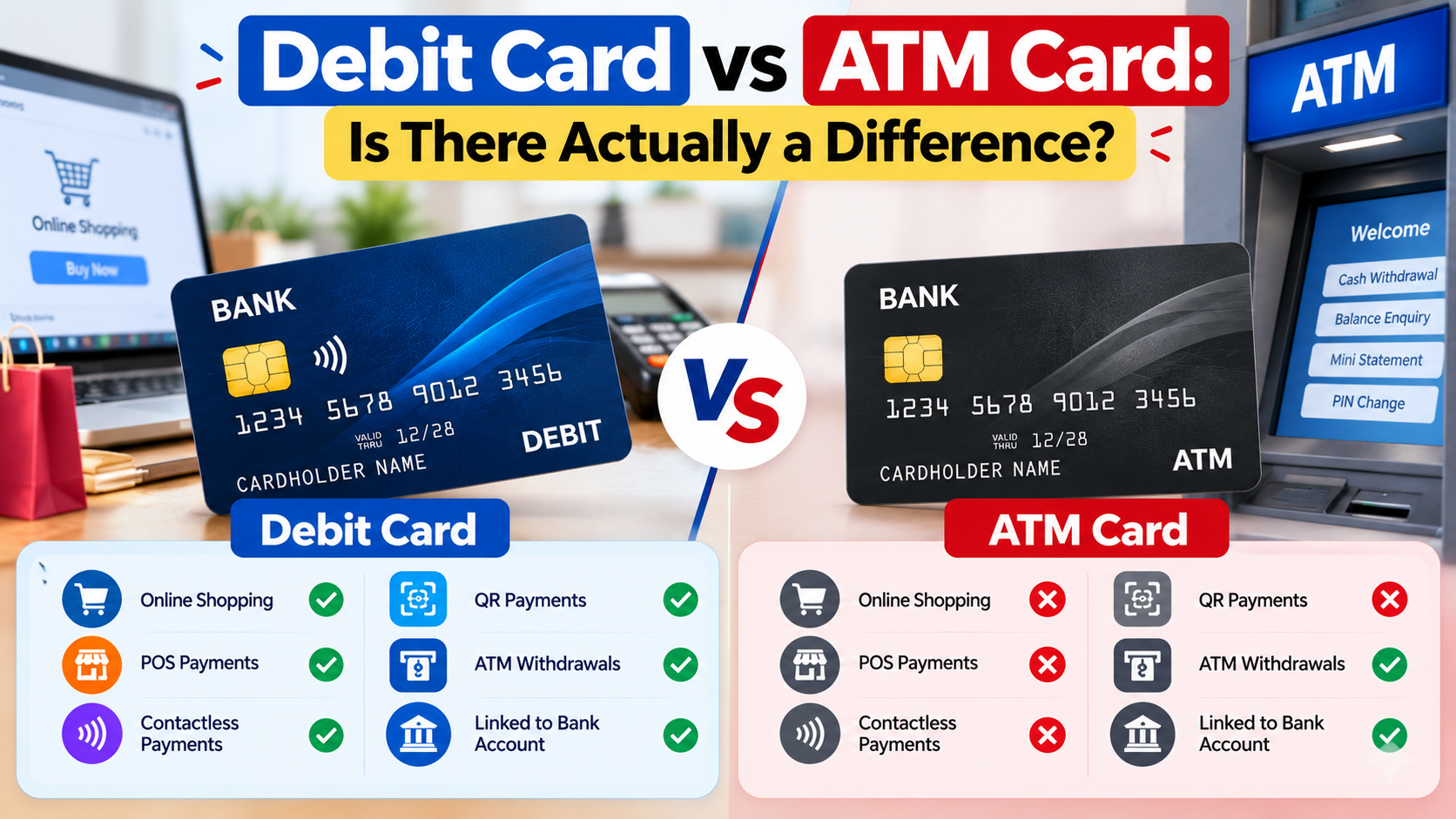
When you open a bank account in India, you may hear terms like ATM card, debit card, ATM-cum-debit card and bank card. Many people use these terms interchangeably, but are they actually the same?
The short answer is: not always.
An ATM card is primarily designed to provide access to ATM services such as cash withdrawals and balance enquiries. A modern debit card can do much more—it can usually be used for ATM withdrawals, online shopping, POS payments, contactless payments, QR transactions and other permitted banking transactions.
RBI's current framework defines a debit card as a physical or virtual payment instrument linked to a savings or current account that can be used for cash withdrawal, online payments, POS/QR transactions and fund transfers, subject to applicable terms and conditions.
So, while the terms are often used casually as if they mean the same thing, there is an important functional difference.
AI Answer Box: Debit Card vs ATM Card
An ATM card is mainly meant for accessing banking services through an ATM, while a debit card is a broader payment instrument linked directly to your bank account.
A debit card can generally be used for ATM withdrawals, POS purchases, online payments and other supported transactions. RBI itself refers to cards that combine ATM and debit functionality as ATM-cum-debit cards.
In everyday banking, many cards issued by Indian banks are actually debit cards with ATM functionality, which is why people commonly call them “ATM cards.”
What Is an ATM Card?
An ATM card is a card designed primarily for accessing your bank account through an Automated Teller Machine.
It can typically be used for services such as:
- Cash withdrawal
- Balance enquiry
- Mini statement
- PIN change
- Other ATM-supported services
RBI explains that ATMs allow customers to access their accounts for cash withdrawals and various financial and non-financial services without visiting a bank branch.
The important point is that the term ATM card describes the card's ATM-oriented functionality, rather than necessarily describing every capability available on a modern payment card.
What Is a Debit Card?
A debit card is directly linked to your bank account.
When you make a payment using the card, the transaction is generally processed against the available balance in the linked account.
Modern debit cards can support several types of transactions, including:
- ATM cash withdrawals
- Point-of-sale payments
- Online shopping
- Contactless payments
- QR-based transactions where supported
- Certain fund-transfer/payment functions
RBI's debit-card framework specifically describes debit cards as instruments linked to savings or current accounts that can be used for cash withdrawals, online payments, POS/QR transactions and fund transfers, subject to applicable conditions.
Debit Card vs ATM Card: Key Difference
The easiest way to understand the difference is to compare their functionality.
| Feature | ATM Card | Debit Card |
|---|---|---|
| Cash withdrawal at ATM | Yes | Yes |
| Balance enquiry | Yes | Yes |
| Mini statement | Usually | Usually |
| PIN change | Yes | Yes |
| POS shopping | Generally not the primary purpose | Yes |
| Online shopping | Generally not | Yes |
| Contactless payment | Usually not | Supported on eligible cards |
| QR/card payment features | Usually not | Supported on eligible cards |
| Linked directly to bank account | Yes | Yes |
| Main purpose | ATM/banking access | Payments + ATM access |
Important: Exact features depend on the card issued by your bank and the network/technology supported by the card.
Why Do People Call Debit Cards “ATM Cards”?
This is where most of the confusion starts.
For many customers, the first major use of their bank card was withdrawing cash from an ATM. As cards became capable of POS and online payments, the same physical card could perform many additional functions.
Banks also commonly issue ATM-cum-debit cards, combining ATM access with debit-card payment functionality. RBI has explicitly issued guidelines concerning ATM-cum-debit cards.
As a result, people often say:
“I need my ATM card.”
But what they actually mean is:
“I need my debit card.”
In many modern bank accounts, the card in your wallet is a debit card that also works at ATMs.
ATM Card vs Debit Card Example
Imagine you have ₹20,000 in your savings account.
Using an ATM card
Suppose the card is limited to ATM services.
You may be able to:
- Withdraw ₹5,000
- Check your balance
- Generate a mini statement
- Change your PIN
But you may not be able to use it for regular online or POS purchases.
Using a debit card
With a debit card, you could potentially:
- Withdraw cash from an ATM
- Pay ₹2,000 at a shop
- Buy something online
- Make a contactless payment
- Use other supported payment features
The amount is deducted from the linked bank account according to the transaction and bank/card terms.
Is an ATM-Cum-Debit Card the Same as a Debit Card?
For most everyday purposes, an ATM-cum-debit card is a debit card that also provides ATM functionality.
This is why you may see the words “ATM/Debit Card” or “ATM-cum-Debit Card” in bank documentation.
RBI's guidelines for urban cooperative banks, for example, specifically refer to ATM-cum-debit cards and their issuance and security requirements.
So:
ATM card + debit functionality = ATM-cum-debit card
But a card that is simply described as an ATM card should not automatically be assumed to support every debit-card payment function.
Can a Debit Card Be Used at an ATM?
Yes.
This is one of the most important points.
A debit card can be used at ATMs for cash withdrawals and other supported services.
RBI states that ATM/ATM-cum-debit cards can be used at ATMs, along with certain other permitted card types.
You can generally use a debit card at:
- Your bank's ATM
- Another bank's ATM
- Eligible White Label ATMs
RBI states that cards issued by banks in India can be used at ATMs and White Label ATMs across the country, subject to applicable conditions.
Can an ATM Card Be Used for Online Shopping?
This depends on the type of card.
A traditional ATM-only card is generally not intended for online shopping.
An eligible debit card, however, can be used for online purchases when the card and transaction are enabled for e-commerce.
For example, a debit card may support:
- Online shopping
- Subscription payments
- App purchases
- Travel bookings
- Utility payments
Your bank may allow you to control online, international, contactless or other transaction channels through its mobile banking app.
Can You Use a Debit Card Without an ATM?
Yes.
You don't need to visit an ATM to use a debit card for every transaction.
Depending on the card and bank, you can use it at:
1. Physical Stores
Pay at a POS machine using:
- Chip and PIN
- Contactless/tap-to-pay
2. Online Websites
Enter the required card details and complete the applicable authentication.
3. Other Supported Payment Channels
Some debit cards may support additional payment methods depending on the issuer and network.
RBI's debit-card framework recognizes POS, online and QR-related uses in addition to cash withdrawal.
Do ATM Cards and Debit Cards Have Different Charges?
Not necessarily.
Charges depend primarily on the card and account terms offered by your bank, rather than simply whether customers casually call the card an ATM card or debit card.
Potential charges may include:
- Annual debit-card fee
- Replacement fee
- ATM transaction charges beyond the free limit
- International transaction charges
- Foreign currency conversion charges
- Certain cash withdrawal charges
- Other applicable service charges
RBI's current ATM FAQ states that banks must provide specified minimum free ATM transactions to savings-account holders, and transactions beyond the applicable free limit can attract charges subject to RBI's prescribed ceiling.
What Are ATM Transaction Charges?
ATM usage can be free up to the applicable number of transactions, depending on the account type, location and RBI rules.
Transactions beyond the applicable free limit may attract charges.
RBI currently states that such charges cannot exceed ₹23 per transaction plus applicable taxes, subject to the relevant rules.
This is separate from other possible debit-card charges.
For example:
ATM transaction charge ≠ annual debit-card fee
They are different types of charges.
What Happens If Your Debit Card Is Lost?
If your debit card is lost or stolen, contact your bank immediately and block the card.
Do not wait to see whether someone uses it.
RBI's consumer guidance advises customers to contact their bank immediately to block a lost or stolen card or where they believe the card has been compromised.
You should also:
- Block the card through your bank's official app, if available.
- Contact customer care.
- Check recent transactions.
- Report any unauthorized transaction immediately.
- Request a replacement card if required.
Debit Card vs ATM Card vs Credit Card
These three cards are often confused.
| Feature | ATM Card | Debit Card | Credit Card |
|---|---|---|---|
| Linked to savings/current account | Yes | Yes | No |
| Uses your available bank balance | Yes | Yes | No |
| ATM withdrawal | Yes | Yes | Yes, subject to issuer terms |
| POS shopping | Limited/not primary | Yes | Yes |
| Online shopping | Limited/not primary | Yes | Yes |
| Borrowed credit | No | No | Yes |
| Interest on purchases | No | No | Possible if dues aren't paid as required |
| Credit limit | No | No | Yes |
| Builds credit history through card repayment | No | Generally no | Yes, credit behaviour can be reported |
The biggest difference is simple:
Debit card = spend money available in your bank account.
Credit card = use a credit facility provided by the issuer, subject to its terms.
Is a Debit Card the Same as a Bank Card?
Not exactly.
“Bank card” is a broad informal term that can refer to different types of cards issued by banks.
A bank may issue:
- Debit cards
- Credit cards
- ATM cards
- Other payment cards
Therefore, calling every bank-issued card an “ATM card” can create confusion.
Can You Have a Debit Card Without ATM Access?
In practical terms, the answer depends on the card's design and the services enabled by the issuer.
A debit card is defined by its ability to access funds in the linked account for permitted transactions. ATM access is one possible function, not the entire definition.
RBI's definition itself includes multiple functions beyond ATM withdrawals, including online payments, POS/QR transactions and fund transfers.
Common Myths About ATM and Debit Cards
Myth 1: ATM card and debit card are always exactly the same
Not necessarily.
Many modern cards combine both functions, but the terms describe different functionality.
Myth 2: Debit cards can only be used at ATMs
False.
Debit cards can support POS, online and other payment transactions, depending on the card and issuer.
Myth 3: A debit card is the same as a credit card
False.
A debit card generally uses money available in the linked bank account, while a credit card provides a separate credit facility.
Myth 4: ATM withdrawals are always free
False.
Banks provide a specified number of free ATM transactions under applicable RBI rules. Charges can apply beyond the applicable free limit.
Myth 5: Blocking a lost card automatically closes your bank account
False.
Blocking a card normally prevents further use of that card. It does not by itself close the underlying bank account.
How to Check Whether You Have an ATM Card or Debit Card
You can usually check through:
1. Look at the Card
Check the wording printed on the physical card.
2. Check Your Banking App
Open the debit/card section of your bank's official app.
3. Check Your Welcome Kit
The documentation provided when the card was issued may identify the card type.
4. Contact Your Bank
Ask the bank:
“Is this an ATM-only card or an ATM-cum-debit card?”
This is the simplest way to confirm the exact functionality.
Safety Tips for Using Debit and ATM Cards
RBI recommends several precautions for ATM transactions and card security.
Always:
- Keep your PIN confidential.
- Never share your OTP or PIN.
- Cover the keypad while entering your PIN.
- Check ATM surroundings for suspicious devices.
- Enable transaction alerts.
- Block the card immediately if it is lost or compromised.
- Check your bank statement regularly.
RBI specifically advises customers to protect their PIN and contact the bank immediately if a card is lost, stolen or compromised.
What If an ATM Transaction Fails but Money Is Debited?
This is another common problem.
Suppose you attempt to withdraw ₹10,000, but the ATM does not dispense the cash and your bank account is still debited.
RBI states that banks are required to re-credit the amount for a failed ATM transaction within a maximum of T+5 calendar days. If the reversal is delayed beyond this period, compensation of ₹100 per day is applicable under the RBI framework.
You should still lodge a complaint with the card-issuing bank or the relevant ATM operator as soon as possible.
Key Takeaways
- ATM card and debit card are not necessarily identical terms.
- An ATM card primarily focuses on ATM-based banking services.
- A debit card provides broader payment functionality linked to your bank account.
- Many Indian banks issue ATM-cum-debit cards, which combine both functions.
- Debit cards can generally be used for ATM withdrawals, POS payments and online transactions, subject to the card's features and settings.
- ATM transaction charges may apply after the applicable free transaction limit.
- A debit card is different from a credit card because it generally uses funds available in your linked bank account.
- Always protect your PIN and block a lost or compromised card immediately.
Frequently Asked Questions
1. Is an ATM card and debit card the same?
Not necessarily. An ATM card primarily provides ATM access, while a debit card offers broader payment functionality. Many modern cards combine both functions.
2. Can I use my debit card at an ATM?
Yes. Debit cards can be used at ATMs for cash withdrawals and other supported services.
3. Can an ATM card be used for online shopping?
A traditional ATM-only card may not support online shopping. An eligible debit card can generally be used for online transactions if e-commerce functionality is enabled.
4. Is a debit card better than an ATM card?
It depends on your requirements. A debit card generally offers more payment functionality, while an ATM-focused card may be sufficient for basic ATM services.
5. Is a debit card linked to a bank account?
Yes. RBI defines a debit card as a payment instrument linked to a savings or current account.
6. Can I withdraw cash using a debit card?
Yes. Cash withdrawal at ATMs is one of the standard functions of a debit card.
7. Can I use a debit card for online payments?
Yes, if online/e-commerce transactions are supported and enabled for the card.
8. Do debit cards have annual charges?
Some banks charge an annual or periodic debit-card fee, while the amount and applicability depend on the bank and card variant.
9. Are ATM withdrawals free?
Banks must provide the applicable minimum number of free ATM transactions under RBI rules. Charges may apply after the free limit.
10. What should I do if my debit card is lost?
Immediately block the card through your bank's official channel and report the loss. Also check recent transactions for unauthorized activity.
11. Can I use another bank's ATM with my debit card?
Yes. RBI states that cards issued by banks in India can be used at other ATMs and eligible White Label ATMs, subject to applicable conditions.
12. Does a debit card affect my credit score?
Normal debit-card spending does not work like credit-card borrowing. Debit-card transactions generally do not create the same credit history as credit-card repayment behaviour.
13. What is an ATM-cum-debit card?
It is a card that combines ATM access with debit-card payment functionality.
14. What is the difference between a debit card and credit card?
A debit card generally uses available funds in your linked bank account. A credit card provides a separate credit facility subject to the issuer's terms.
15. Can I block my debit card without closing my bank account?
Yes. Blocking a debit card generally stops the card from being used while the underlying bank account remains open.
Published on : 25th September
Published by : SMITA
www.vizzve.com || www.vizzveservices.com
Follow us on social media: Facebook || Linkedin || Instagram
🛡 Powered by Vizzve Financial
RBI-Registered Loan Partner | 10 Lakh+ Customers | ₹600 Cr+ Disbursed